Atomic Structure
Everything around us — air, water, your phone, your body — is made of matter. And matter is made of extremely tiny particles called atoms.
Understanding atomic structure is essential because it explains chemical reactions, electricity, radiation, bonding between atoms, and the properties of materials. Without atomic theory, modern chemistry, physics, and medicine would not exist.
Hydrogen Atom
1What Is an Atom and Why Does It Matter?
An atom is the smallest unit of an element that retains its chemical properties. Atoms are the building blocks of all matter in the universe.
Imagine a solar system in miniature: the Sun is the nucleus at the centre, and the planets orbiting it are electrons. Gravity holds the solar system together — in an atom, electrical attraction does the same job.
What Does Atomic Structure Explain?
- What atoms are made of
- How subatomic particles behave
- Why elements react differently
- How the periodic table is organised
- Chemical reactions and bonding between atoms
- Electricity and the properties of materials
Atomic structure forms the foundation for chemistry, physics, and biology. Many technologies — from medicine to electronics — depend on our understanding of how atoms work.
2Key Definitions
Atom
The smallest unit of an element that retains its chemical properties
Subatomic Particles
Particles smaller than atoms: protons, neutrons, and electrons
Nucleus
Dense central core of the atom containing protons and neutrons
Proton (p⁺)
Positively charged particle found in the nucleus
Neutron (n⁰)
Neutral (no charge) particle found in the nucleus
Electron (e⁻)
Negatively charged particle that moves around the nucleus
Atomic Number (Z)
Number of protons in an atom — determines the element
Mass Number (A)
Total number of protons + neutrons in the nucleus
Isotopes
Atoms of the same element with different numbers of neutrons
Ion
An atom that has gained or lost electrons, giving it a charge
3Structure of the Atom
Let's break down the atom step by step, from its basic structure to the Bohr model used in high school chemistry.
Step 1: Basic Structure
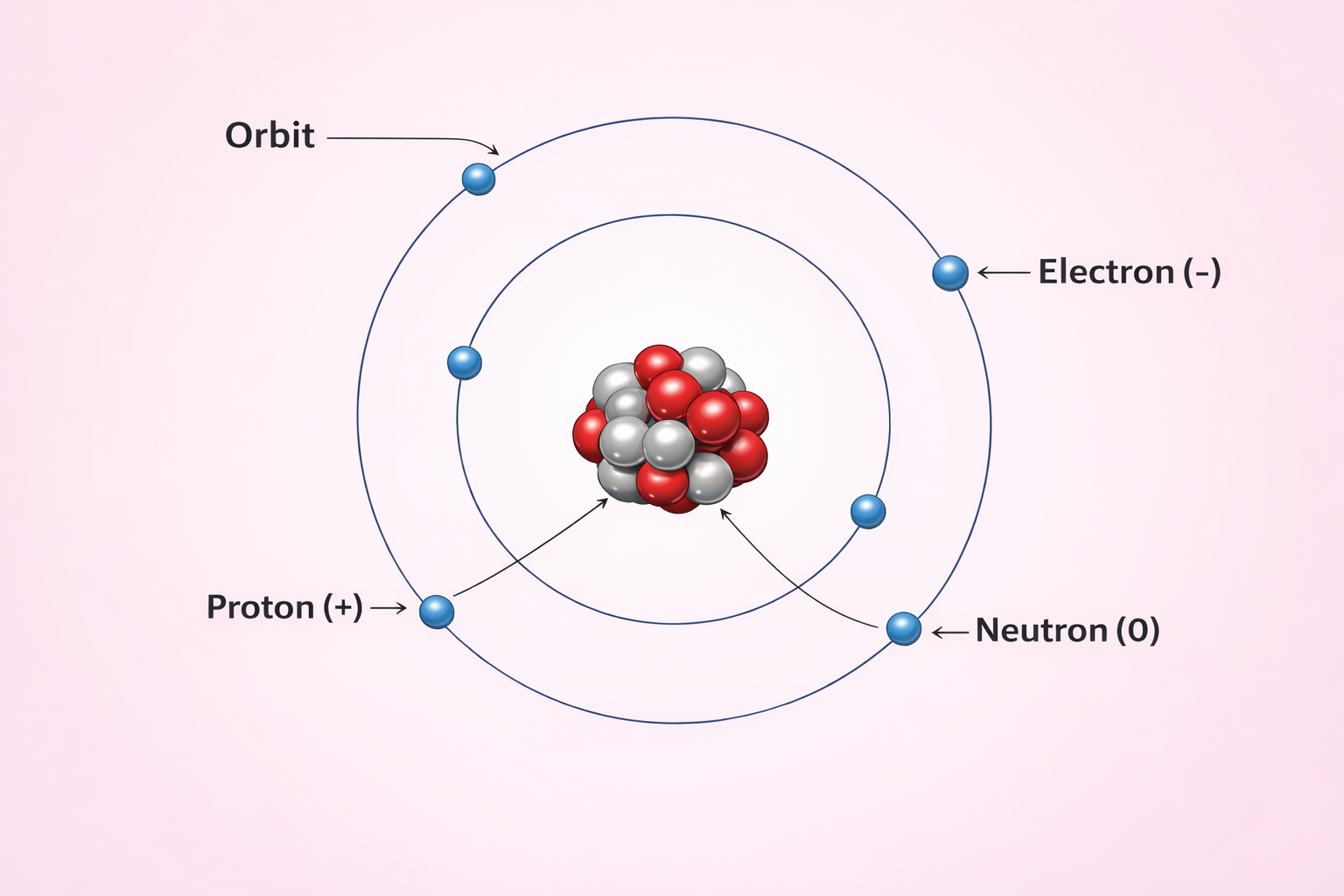
An atom has a tiny, heavy centre called the nucleus, which contains protons (positive) and neutrons (neutral). Electrons (negative) move around the nucleus in energy levels. Electrons are much lighter than protons and neutrons.
Step 2: Charges and Attraction
Opposite charges attract — this electrical attraction between positive protons and negative electrons keeps electrons around the nucleus. Neutrons help stabilise the nucleus.
Proton (p⁺)
- Charge: Positive (+1)
- Location: Inside nucleus
- Relative mass: 1
Electron (e⁻)
- Charge: Negative (−1)
- Location: Around nucleus in shells
- Relative mass: ~1/1836
Step 3: Atomic Number — Identity of an Element
The number of protons determines the element. Even if neutrons change, the element remains the same as long as the proton count stays the same.
1
proton
Hydrogen (H)
6
protons
Carbon (C)
8
protons
Oxygen (O)
Change the number of protons and you change the element. This is a fundamental rule — the atomic number is the identity card of every element.
Step 4: Mass Number
The mass number is the total number of protons and neutrons. Electrons are not included because they have very small mass compared to the particles in the nucleus.
Mass Number (A) = Protons + Neutrons
Step 5: Isotopes
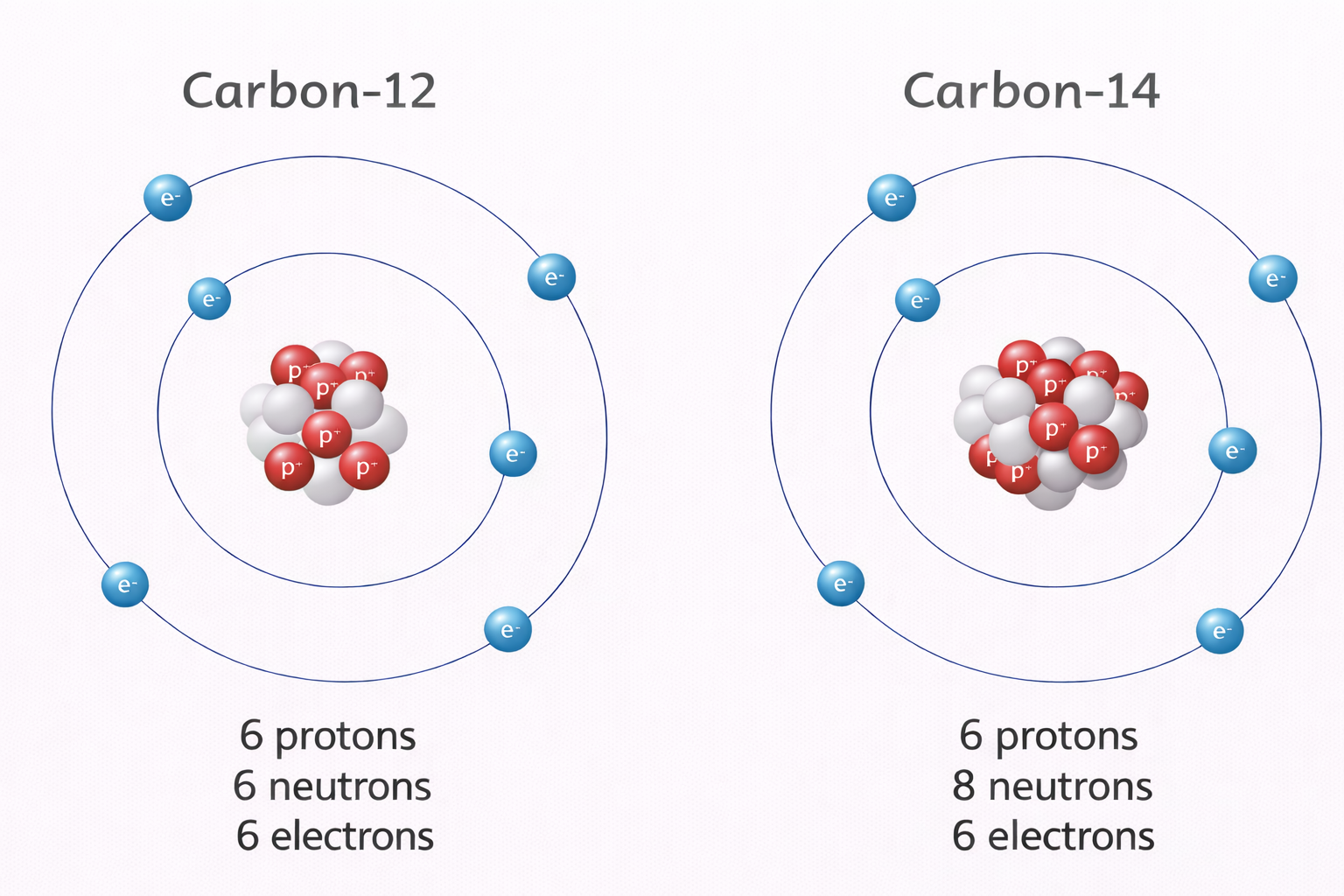
Isotopes are atoms of the same element with different numbers of neutrons. They have the same atomic number but different mass numbers.
Carbon-12
- Protons: 6
- Neutrons: 6
- Mass number: 12
Carbon-14
- Protons: 6
- Neutrons: 8
- Mass number: 14
Both are carbon because they have 6 protons. The difference is in the number of neutrons.
Step 6: Bohr Model and Energy Levels
Electrons do not move randomly — they occupy specific energy levels (shells) around the nucleus. Each shell can hold a maximum number of electrons:
2
electrons max
First shell (n=1)
8
electrons max
Second shell (n=2)
8
electrons max
Third shell (n=3)*
*Simplified for high school level. The third shell can actually hold up to 18 electrons in advanced chemistry.
Electrons in the outermost shell are called valence electrons. They are the most important electrons because they determine how an atom bonds and reacts chemically.
"Protons define. Neutrons stabilise. Electrons decide reactions."
4Important Formulae
A = p + n
Mass Number = Number of Protons + Number of Neutrons
Counts the heavy particles in the nucleus
Z = p
Atomic Number = Number of Protons
Defines the element — the identity card of every atom
n = A − Z
Number of Neutrons = Mass Number − Atomic Number
Subtract protons from total mass to find neutrons
Worked Examples
Example 1: Finding Neutrons
An atom has atomic number = 11 and mass number = 23. Find the number of neutrons.
n = A − Z
n = 23 − 11
n = 12 neutrons
Example 2: Conceptual
If an atom loses one electron, what happens?
It becomes a positive ion because protons now outnumber electrons. The atom has a net positive charge (+1).
5Memory Aids
"P is Positive, N is Neutral, E is Electric (negative)"
Remembers the charge of each subatomic particle.
"PMN = Protons Make Number"
Protons determine the Atomic Number (identity of the element).
"Mass is heavy in the core,
Protons plus neutrons — nothing more!"
Remembers the mass number formula: A = p + n.
Imagine a solar system: the Sun is the nucleus, planets are electrons, and gravity is the electrical attraction. This helps you remember the structure and why electrons stay in orbit.
6Common Mistakes
Confusing atomic number with mass number. The atomic number counts protons only, while the mass number counts protons plus neutrons. Always check which one the question is asking for.
Thinking electrons are inside the nucleus. Electrons orbit around the nucleus in energy levels. Only protons and neutrons are found inside the nucleus.
Including electrons in the mass number. Mass number = protons + neutrons only. Electrons have negligible mass and are never counted.
Thinking isotopes are different elements. Isotopes have the same number of protons (same element) but different numbers of neutrons. Carbon-12 and Carbon-14 are both carbon.
Believing neutrons affect chemical reactivity. Neutrons affect the stability and mass of an atom, not its chemical behaviour. Chemical reactions are determined by electrons, specifically valence electrons.
Frequently Asked Questions
- What is the difference between atomic number and mass number?
- The atomic number (Z) is the number of protons in an atom and determines which element it is. The mass number (A) is the total number of protons plus neutrons. Electrons are not counted in the mass number because their mass is negligibly small compared to protons and neutrons.
- What are isotopes?
- Isotopes are atoms of the same element that have the same number of protons but different numbers of neutrons. For example, Carbon-12 has 6 protons and 6 neutrons, while Carbon-14 has 6 protons and 8 neutrons. Both are carbon because they have 6 protons.
- Why don't electrons fall into the nucleus?
- Electrons occupy specific energy levels (shells) around the nucleus. According to quantum mechanics, electrons exist in stable orbitals at fixed energy levels. They can only move between these levels by absorbing or releasing specific amounts of energy, which prevents them from simply spiraling into the nucleus.
- Do neutrons affect chemical reactions?
- Neutrons generally do not affect chemical reactivity — they primarily affect the stability and mass of the atom. Chemical reactions are determined by electrons, specifically the valence electrons in the outermost shell. However, neutrons do matter for nuclear reactions and radioactive decay.
- What are valence electrons and why do they matter?
- Valence electrons are the electrons in the outermost energy level (shell) of an atom. They determine how an atom bonds with other atoms and its chemical reactivity. Atoms tend to react in ways that give them a full outer shell, which is the driving force behind chemical bonding.
Practice Quiz
Test your understanding — select the correct answer for each question.
1.What determines the identity of an element?
2.If the atomic number is 8, how many protons are present?
3.An atom has mass number 40 and atomic number 18. How many neutrons does it have?
4.Isotopes differ in:
5.Why do atoms react chemically?
Final Study Advice
- 1. Draw and label an atom from memory using the Bohr model — if you can draw it, you know it.
- 2. Remember the key phrase: "Protons define. Neutrons stabilise. Electrons decide reactions."
- 3. Practice calculating neutrons using n = A − Z with different elements.
- 4. Don't confuse atomic number with mass number — one counts protons, the other counts protons and neutrons.