Differentiation Rules
Differentiation rules are the foundational shortcuts that allow you to calculate derivatives of various functions without using the tedious limit definition every single time. They transform a lengthy algebraic process into a streamlined calculation.
This guide covers the Power Rule, Product Rule, Quotient Rule, Chain Rule, trigonometric derivatives, memory aids, common mistakes, and a practice quiz to test your understanding.
1Introduction
Imagine you're trying to figure out how fast a rocket is accelerating at a precise moment, or how quickly a company's profits are changing with each additional product sold. In mathematics, the tool we use to measure these instantaneous rates of change is the derivative.
Differentiation rules are the "recipes" or shortcuts that allow us to calculate derivatives without having to use the tedious and often complex limit definition every single time. While the definition is fundamental to understanding what a derivative is, these rules are indispensable for practical application.
Imagine you're a mission control specialist, tracking a rocket's ascent. The rocket's height h(t) = 500t - 4.9t² + (1/3)sin(t). To know its velocity and acceleration at every second, you'd need to differentiate — manually using limits would be impossible in real-time. Differentiation rules are your superpower!
Why Differentiation Rules Matter
Efficiency
Save time and effort compared to using the limit definition for every derivative.
Problem Solving
Enable you to tackle complex functions and real-world applications like optimization and related rates.
Foundation
Building blocks for higher-level calculus concepts including integration and differential equations.
2Key Definitions
Derivative
The instantaneous rate of change of a function. Geometrically, the slope of the tangent line at a point. Notation: f'(x), dy/dx, d/dx[f(x)].
Differentiation
The process of finding the derivative of a function.
Power Rule
A rule for finding the derivative of functions in the form xⁿ: d/dx[xⁿ] = nxⁿ⁻¹.
Constant Rule
The derivative of any constant is zero: d/dx[c] = 0.
Product Rule
A rule for differentiating the product of two functions: (fg)' = f'g + fg'.
Quotient Rule
A rule for differentiating the quotient of two functions: (f/g)' = (f'g - fg')/g².
Chain Rule
A rule for differentiating composite functions: d/dx[f(g(x))] = f'(g(x)) * g'(x).
Constant Multiple Rule
d/dx[cf(x)] = cf'(x). Pull out the constant, differentiate the function.
Sum/Difference Rule
d/dx[f(x) ± g(x)] = f'(x) ± g'(x). Differentiate term by term.
Trigonometric Derivatives
Specific rules for derivatives of sin, cos, tan, cot, sec, and csc.
3Basic Differentiation Rules
These are the fundamental building blocks for differentiating most functions.
The Constant Rule
The derivative of any constant is always zero. Think of a horizontal line: its slope is always 0.
d/dx[c] = 0
where c is any constant
Examples
d/dx[7] = 0
d/dx[π] = 0
d/dx[-42] = 0
The Power Rule
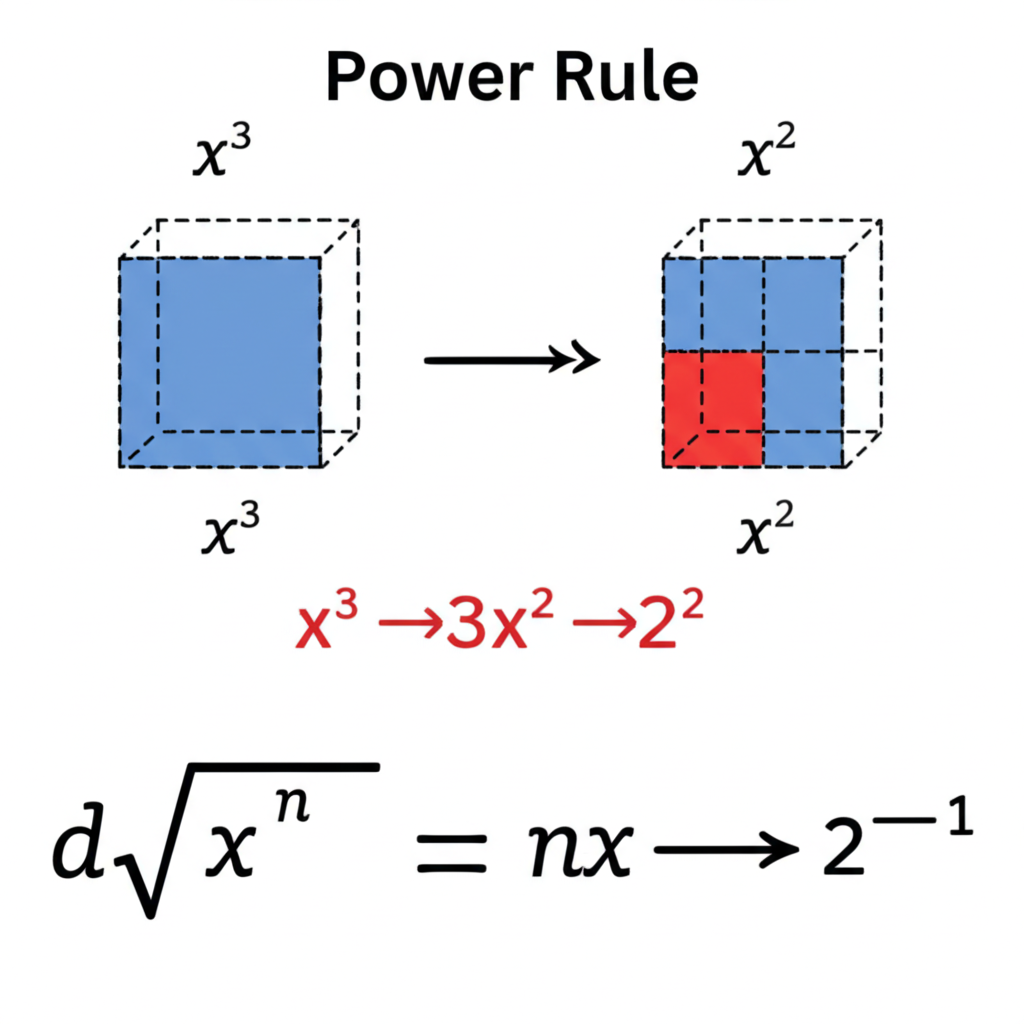
This is arguably the most frequently used rule. Bring the exponent down as a coefficient, then subtract 1 from the original exponent.
d/dx[xⁿ] = nxⁿ⁻¹
where n is any real number
Examples
d/dx[x⁴] = 4x³
d/dx[x] = d/dx[x¹] = 1x⁰ = 1
d/dx[√x] = d/dx[x1/2] = (1/2)x-1/2 = 1/(2√x)
The Constant Multiple Rule
If a function is multiplied by a constant, you can "pull out" the constant, differentiate the function, and then multiply the result by the constant.
d/dx[cf(x)] = cf'(x)
where c is a constant
Example
d/dx[5x³]
= 5 · d/dx[x³]
= 5 · (3x²)
= 15x²
The Sum and Difference Rules
The derivative of a sum or difference of functions is simply the sum or difference of their individual derivatives.
d/dx[f(x) + g(x)]
= f'(x) + g'(x)
d/dx[f(x) - g(x)]
= f'(x) - g'(x)
Worked Example
Find d/dx[4x² + 7x - 2]
= d/dx[4x²] + d/dx[7x] - d/dx[2] (Sum/Difference Rules)
= 4(2x) + 7(1) - 0 (Power, Constant Multiple, Constant Rules)
= 8x + 7
Worked Example: Polynomial
Find f'(x) for f(x) = 3x⁵ - 7x² + 9x - 11
f'(x) = 3(5x⁴) - 7(2x) + 9(1) - 0
f'(x) = 15x⁴ - 14x + 9
4Product Rule
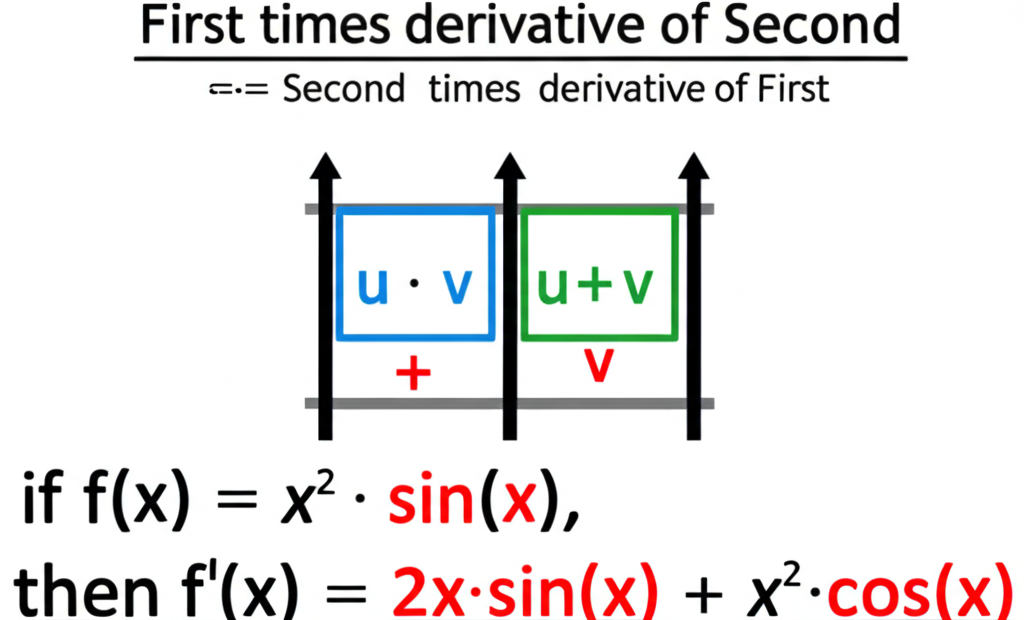
The Product Rule is used when you have two functions, f(x) and g(x), multiplied together. You cannot simply differentiate each factor separately.
d/dx[f(x)g(x)] = f'(x)g(x) + f(x)g'(x)
"f prime g plus f g prime"
Worked Example
Find dy/dx for y = (x³)(sin x)
Let f(x) = x³ and g(x) = sin x
f'(x) = 3x², g'(x) = cos x
dy/dx = f'(x)g(x) + f(x)g'(x)
dy/dx = (3x²)(sin x) + (x³)(cos x)
dy/dx = 3x² sin x + x³ cos x
Worked Example: With Exponentials
Find dy/dx for y = (x³ + 2x)(eˣ)
Let f(x) = x³ + 2x, g(x) = eˣ
f'(x) = 3x² + 2, g'(x) = eˣ
dy/dx = (3x² + 2)(eˣ) + (x³ + 2x)(eˣ)
dy/dx = eˣ(x³ + 3x² + 2x + 2)
5Quotient Rule
The Quotient Rule is used when one function f(x) is divided by another function g(x). Pay close attention to the order of subtraction in the numerator.
d/dx[f(x)/g(x)] = (f'(x)g(x) - f(x)g'(x)) / [g(x)]²
"Low d-high minus high d-low, over low squared"
Worked Example
Find dy/dx for y = (4x - 1) / (x² + 3)
Let f(x) = 4x - 1 (high), g(x) = x² + 3 (low)
f'(x) = 4, g'(x) = 2x
dy/dx = (f'g - fg') / g²
= (4(x² + 3) - (4x - 1)(2x)) / (x² + 3)²
= (4x² + 12 - 8x² + 2x) / (x² + 3)²
= (-4x² + 2x + 12) / (x² + 3)²
Worked Example: With Trig
Find h'(x) for h(x) = (cos x) / (x² + 1)
f(x) = cos x, g(x) = x² + 1
f'(x) = -sin x, g'(x) = 2x
h'(x) = ((-sin x)(x² + 1) - (cos x)(2x)) / (x² + 1)²
h'(x) = (-x²sin x - sin x - 2x cos x) / (x² + 1)²
6Chain Rule
The Chain Rule is used to differentiate composite functions — functions within functions. Think of it like peeling an onion, working from the outside in.
d/dx[f(g(x))] = f'(g(x)) · g'(x)
Derivative of the outer function (keeping the inner the same) times the derivative of the inner function.
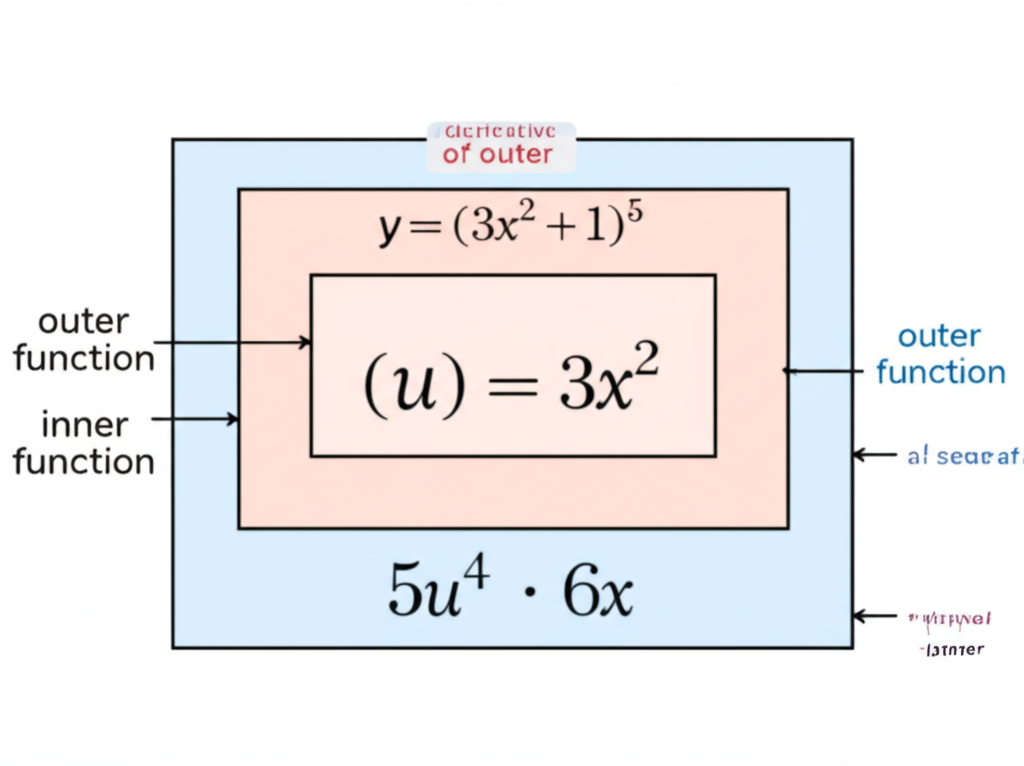
- Identify the "outer" function f and the "inner" function g(x).
- Differentiate the outer function f, treating the inner function g(x) as a single variable.
- Multiply the result by the derivative of the inner function g'(x).
Worked Example: Power + Chain
Find dy/dx for y = (3x² + 5)⁴
Outer: f(u) = u⁴, Inner: u = 3x² + 5
f'(u) = 4u³
g'(x) = 6x
dy/dx = 4(3x² + 5)³ · 6x
dy/dx = 24x(3x² + 5)³
Worked Example: Trig + Chain
Find dy/dx for y = sin(4x - 5)
Outer: f(u) = sin(u), Inner: u = 4x - 5
f'(u) = cos(u)
g'(x) = 4
dy/dx = cos(4x - 5) · 4
dy/dx = 4 cos(4x - 5)
Worked Example: Multi-layer
Find f'(x) for f(x) = (x³ - 2x + 1)⁵
Outer: u⁵, Inner: u = x³ - 2x + 1
f'(u) = 5u⁴
g'(x) = 3x² - 2
f'(x) = 5(x³ - 2x + 1)⁴(3x² - 2)
7Trigonometric Derivatives
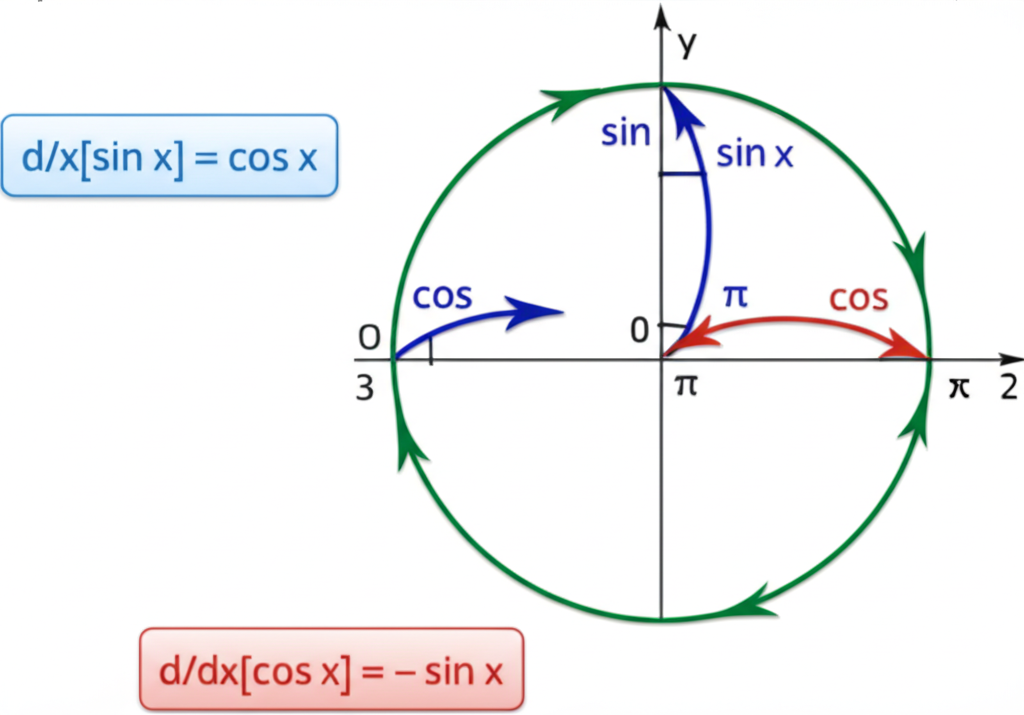
These are fundamental derivatives you must memorize for AP Calculus. Notice the pattern: the derivatives of the "co-" functions (cos, cot, csc) always have a negative sign.
| Function | Derivative |
|---|---|
| sin x | cos x |
| cos x | -sin x |
| tan x | sec² x |
| cot x | -csc² x |
| sec x | sec x tan x |
| csc x | -csc x cot x |
The derivatives of the "co-" functions (cos, cot, csc) are all negative. If the function starts with "co-", its derivative will be negative.
8Memory Aids
"f prime g plus f g prime"
Say it out loud multiple times! (fg)' = f'g + fg'. The derivative of a product is the first function's derivative times the second, plus the first times the second's derivative.
"Low d-high minus high d-low, over low squared."
Low = denominator g(x), high = numerator f(x), d-high = derivative of numerator, d-low = derivative of denominator. This classic mnemonic is extremely effective.
"Derivative of the OUTSIDE, keep the INSIDE the same, then multiply by the derivative of the INSIDE."
Think of peeling layers — always work from the outermost function inward.
sin x → cos x → -sin x → -cos x → sin x
Think of a circle: going clockwise is differentiation, counter-clockwise is integration.
"Flat line, no change, zero slope!"
A constant function is a horizontal line. Horizontal lines have a slope of zero. Therefore, the derivative of a constant is always zero.
"Co- means negative."
The derivatives of cos x, cot x, and csc x all have a negative sign. If the trig function starts with "co-", its derivative is negative.
9Common Mistakes
Forgetting to apply the Chain Rule
This is the most frequent error. If you have a function inside another function (e.g. sin(2x), (x²+1)³), you must multiply by the derivative of the inner function.
Sign errors in the Quotient Rule
The numerator is f'g - fg'. Forgetting the minus sign or reversing the order (fg' - f'g) is a common mistake. Remember "low d-high minus high d-low".
Incorrectly applying the Power Rule to constants
d/dx[5] = 0, not 5x⁰ or 5. The Power Rule d/dx[xⁿ] = nxⁿ⁻¹ only applies to xⁿ, not to standalone constants.
Distributing the derivative operator improperly
d/dx[f(x)g(x)] is NOT f'(x)g'(x). You must use the Product Rule. Similarly, d/dx[f(x)/g(x)] is NOT f'(x)/g'(x). You must use the Quotient Rule.
Trigonometric derivative sign errors
Especially d/dx[cos x] = -sin x. It's easy to forget the negative sign. Remember: all "co-" function derivatives are negative.
Confusing Product and Quotient Rules
Ensure you know which rule to apply based on whether the functions are multiplied or divided. Product uses addition (f'g + fg'), Quotient uses subtraction (f'g - fg').
Not rewriting functions before differentiating
For d/dx[1/x²], rewrite as d/dx[x⁻²] before applying the Power Rule. For d/dx[³√x], rewrite as d/dx[x1/3]. Always convert roots and fractions to power form first.
Algebraic simplification errors after differentiation
After applying differentiation rules, ensure you correctly simplify the resulting expression. Watch for errors when combining terms, factoring, or distributing negatives.
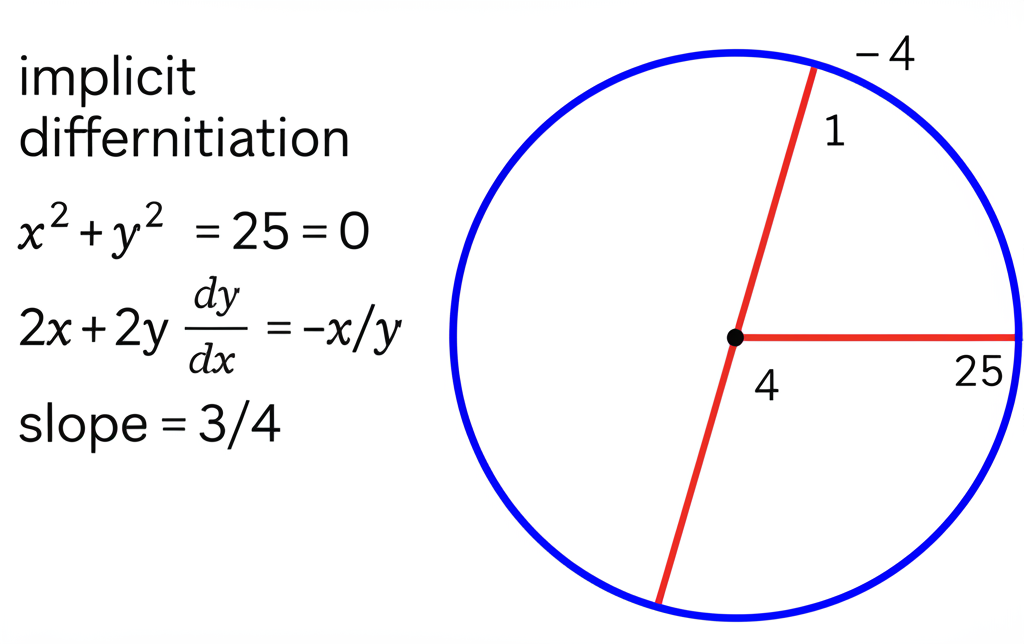
Implicit differentiation allows finding dy/dx even when y is not explicitly solved in terms of x.
Quick Revision Summary
- ✓Differentiation rules are essential shortcuts for finding derivatives, which represent instantaneous rates of change.
- ✓Constant Rule: d/dx[c] = 0. The derivative of any constant is zero.
- ✓Power Rule: d/dx[xⁿ] = nxⁿ⁻¹. Bring the exponent down, subtract 1.
- ✓Constant Multiple Rule: d/dx[cf(x)] = cf'(x). Pull out the constant.
- ✓Sum/Difference Rules: Derivatives can be applied term by term.
- ✓Product Rule: (fg)' = f'g + fg'. Used for functions multiplied together.
- ✓Quotient Rule: (f/g)' = (f'g - fg')/g². Used for functions divided by each other.
- ✓Chain Rule: d/dx[f(g(x))] = f'(g(x)) · g'(x). Vital for composite functions.
- ✓Trig Derivatives: sin x → cos x, cos x → -sin x, tan x → sec² x. Memorize all six.
- ✓Always watch for common mistakes — especially forgetting the Chain Rule or sign errors in the Quotient Rule.
- ✓Rewrite roots and fractions as power expressions before differentiating.
- ✓Always simplify your final derivative expressions when possible.
Frequently Asked Questions
- What is the derivative, in simple terms?
- The derivative tells you the instantaneous rate of change of a function at any given point. Imagine a graph: the derivative at a point is the slope of the tangent line to the curve at that exact point. It answers "how fast is this changing right now?"
- Why do we need differentiation rules if we have the limit definition?
- While the limit definition (f'(x) = lim (h->0) [f(x+h) - f(x)]/h) defines what a derivative is, it's often very algebraically intensive and time-consuming to use for complex functions. Differentiation rules provide efficient, algebraic shortcuts to find derivatives quickly and accurately.
- When do I know to use the Chain Rule?
- You use the Chain Rule whenever you have a composite function -- one function "nested" inside another. Look for expressions like (something)ⁿ, sin(something), e raised to something, ln(something), where "something" is itself a function of x (not just x alone).
- Are there derivatives for other trigonometric functions like sec x or csc x?
- Yes! For AP Calculus you should also know: d/dx[cot x] = -csc² x, d/dx[sec x] = sec x tan x, and d/dx[csc x] = -csc x cot x. These can often be derived using the Quotient Rule from their definitions (e.g. sec x = 1/cos x).
- How do I know which rule to use when a function has multiple operations?
- Always work from the "outside in." Identify the last operation that would be performed if you were evaluating the function. If the overall structure is f(x) * g(x), start with the Product Rule. If it's f(x)/g(x), use the Quotient Rule. If it's (expression)ⁿ or trig(expression), start with the Chain Rule. Then apply other rules to differentiate the inner pieces.
Practice Quiz
Test your understanding — select the correct answer for each question.
1.What is the derivative of x⁴?
2.What is d/dx[5x³]?
3.Product rule states: (fg)' = ?
4.What is the derivative of sin(x)?
5.Chain rule is used for:
6.What is d/dx[x⁻²]?
7.Quotient rule formula is:
8.What is the derivative of cos(x)?
9.d/dx[3] = ?
10.Chain rule: if y = f(g(x)), then dy/dx = ?
Final Study Advice
- 1.Always identify the structure of the function first — is it a product, quotient, or composite? This tells you which rule to apply.
- 2.When functions involve multiple operations, work from the outside in — start with the outermost operation.
- 3.Rewrite roots and fractions as power expressions before differentiating (e.g. √x = x1/2, 1/x = x⁻¹).
- 4.Practice the Chain Rule extensively — it is the most commonly tested rule on the AP exam.
- 5.Always simplify your answers and double-check for sign errors, especially in Quotient Rule and trig derivatives.