Limits & Continuity
Limits and continuity are the foundational concepts of calculus. A limit describes the behavior of a function as its input approaches a certain value, while continuity ensures a function has no breaks, holes, or jumps at a point.
This guide covers key definitions, limit evaluation techniques, one-sided limits, continuity conditions, types of discontinuities, limits at infinity, memory aids, common mistakes, and a practice quiz.
1Introduction
Calculus is the study of change, and at its heart lies the concept of a limit. A limit describes the behavior of a function as its input approaches a certain value. It is about what a function tends towards, rather than necessarily what it is at a specific point.
Limits are the bedrock upon which all of calculus is built. Derivatives (the instantaneous rate of change) and integrals (the area under a curve) are both defined using limits. Understanding limits also helps us analyze what happens to a function at "problematic" points (like division by zero) or at the extreme ends of its domain.
Imagine you are on a roller coaster. As the coaster approaches the peak of a huge drop, you can anticipate how high it will be and how fast it will be going just before it starts its descent. Even if there is a tiny gap in the track right at the very peak, you can still tell what the height and speed should be at that exact moment by observing its path leading up to and away from that point. This anticipation, this prediction of value based on nearby behavior, is the essence of a limit.
Why Limits Matter
Derivatives
The instantaneous rate of change (slope of a tangent line) is defined as a limit of the difference quotient.
Integrals
The area under a curve is found by summing infinitely many infinitesimally small rectangles, a process defined by a limit.
Function Behavior
Limits help us analyze what happens at points where a function is undefined, such as holes or asymptotes.
End Behavior
Limits at infinity (x → ∞) reveal horizontal asymptotes and long-run trends of a function.
2Key Definitions
Limit
The value a function approaches as the input approaches some value. Denoted lim x→a f(x) = L.
Continuous Function
A function is continuous if its graph can be drawn without lifting your pencil. Formally: lim x→a f(x) = f(a).
One-Sided Limit
The limit as x approaches a from one direction only. Left-hand: lim x→a⁻ f(x). Right-hand: lim x→a⁺ f(x).
Discontinuity
A point where a function is not continuous. Can be removable (hole), jump, or infinite (vertical asymptote).
Horizontal Asymptote
A line y = L that the graph approaches as x → ∞ or x → −∞. Found via limits at infinity.
Vertical Asymptote
A line x = a where the function approaches ±∞. Found when the denominator equals zero and the factor does not cancel.
Indeterminate Form
An expression like 0/0 that requires further work to evaluate. Does not mean the limit is zero or undefined.
Removable Discontinuity (Hole)
A single point where a function is undefined but the limit exists. Can be "fixed" by redefining the function at that point.
Intermediate Value Theorem (IVT)
If f is continuous on [a, b] and k is between f(a) and f(b), then there exists c in (a, b) such that f(c) = k.
3Evaluating Limits
There are several techniques for evaluating limits. Always start with direct substitution and move to algebraic methods only when you get an indeterminate form like 0/0.
a) Direct Substitution
Always try this first. If f(x) is a polynomial, rational, radical, or trigonometric function and a is in the domain, simply substitute.
Evaluate: lim x→2 (x² + 3x − 1)
Substitute x = 2:
(2)² + 3(2) − 1 = 4 + 6 − 1
= 9
b) Factoring and Canceling
If direct substitution gives 0/0, try factoring the numerator and denominator and canceling the common factor.
Evaluate: lim x→4 (x² − 16) / (x − 4)
Direct sub: (16 − 16) / (4 − 4) = 0/0 (indeterminate)
Factor: (x − 4)(x + 4) / (x − 4)
Cancel (x − 4): lim x→4 (x + 4)
= 4 + 4 = 8
c) Rationalizing
When radicals produce 0/0, multiply the numerator and denominator by the conjugate of the expression containing the radical.
Evaluate: lim x→0 (√(x + 1) − 1) / x
Direct sub: (√1 − 1) / 0 = 0/0 (indeterminate)
Multiply by conjugate (√(x+1) + 1) / (√(x+1) + 1):
= (x + 1 − 1) / [x(√(x+1) + 1)]
= x / [x(√(x+1) + 1)]
Cancel x: 1 / (√(x+1) + 1)
= 1 / (√1 + 1) = 1/2
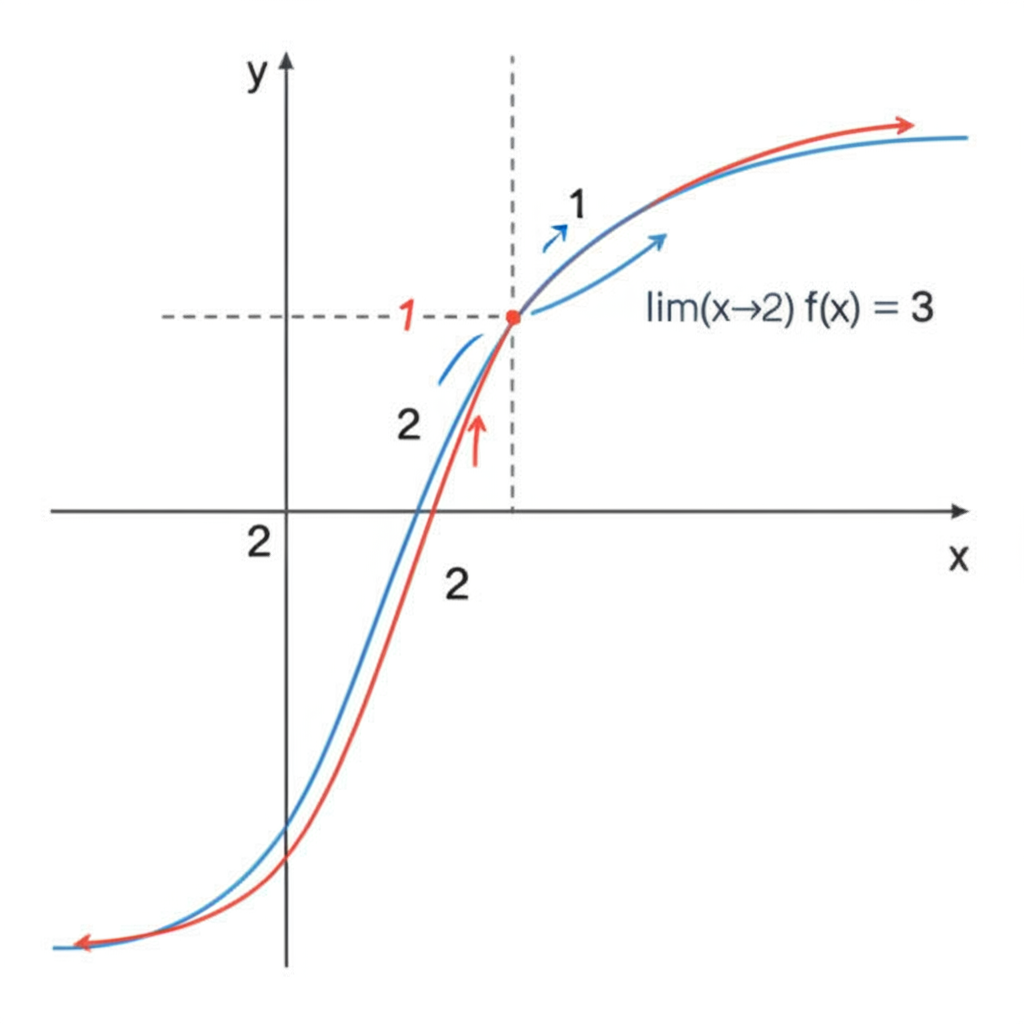
d) Piecewise Functions
For piecewise functions, evaluate the one-sided limits at the boundary points using the appropriate piece for each side.
f(x) = { x + 1 if x < 2, x² − 1 if x ≥ 2 }. Find lim x→2 f(x).
Left-hand: lim x→2⁻ (x + 1) = 2 + 1 = 3
Right-hand: lim x→2⁺ (x² − 1) = 4 − 1 = 3
Both equal 3, so lim x→2 f(x) = 3
e) Special Limits to Memorize
lim x→0 (sin x) / x = 1
lim x→0 (1 − cos x) / x = 0
These special trigonometric limits appear frequently on the AP exam. Memorize them.
4One-Sided Limits
Sometimes a function behaves differently depending on whether you approach a point from the left or the right. One-sided limits let us examine each direction independently.
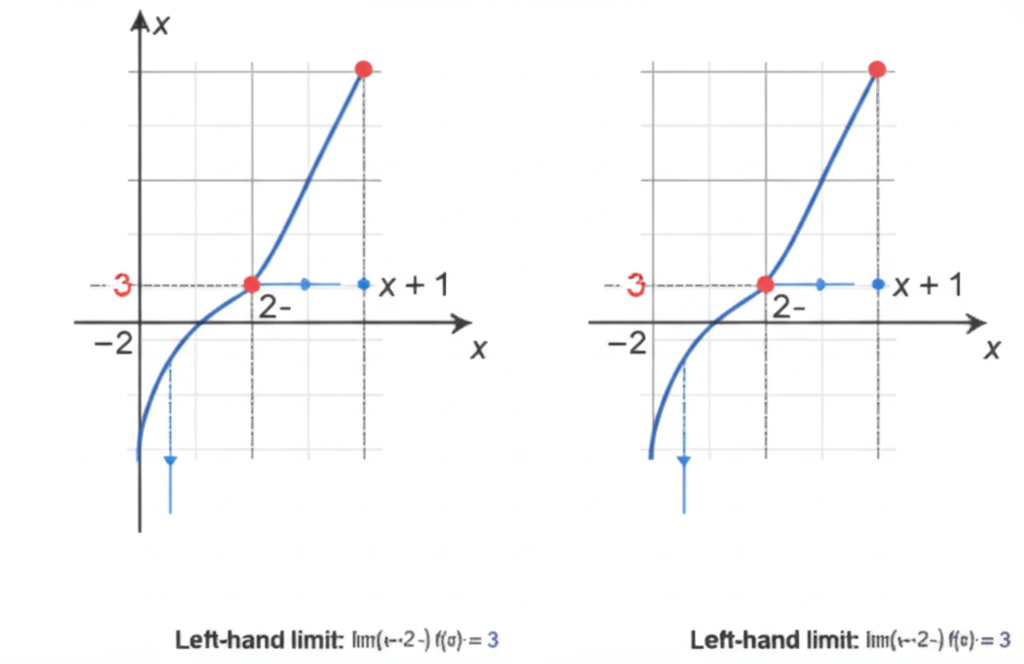
Left-Hand Limit
lim x→a⁻ f(x)
Approaching 'a' from values less than a (from the left side of the graph).
Right-Hand Limit
lim x→a⁺ f(x)
Approaching 'a' from values greater than a (from the right side of the graph).
The Two-Sided Limit Exists If and Only If
lim x→a⁻ f(x) = lim x→a⁺ f(x) = L
If the one-sided limits are not equal, the two-sided limit does not exist (DNE).
Worked Example: When the Limit DNE
f(x) = { 2x + 1 if x < 1, x² + 3 if x ≥ 1 }. Evaluate limits at x = 1.
Left: lim x→1⁻ (2x + 1) = 2(1) + 1 = 3
Right: lim x→1⁺ (x² + 3) = 1 + 3 = 4
Since 3 ≠ 4:
lim x→1 f(x) = DNE (jump discontinuity)
5Continuity
Informally, a function is continuous if you can draw its graph without lifting your pencil. Formally, continuity at a point requires three conditions to be satisfied simultaneously.
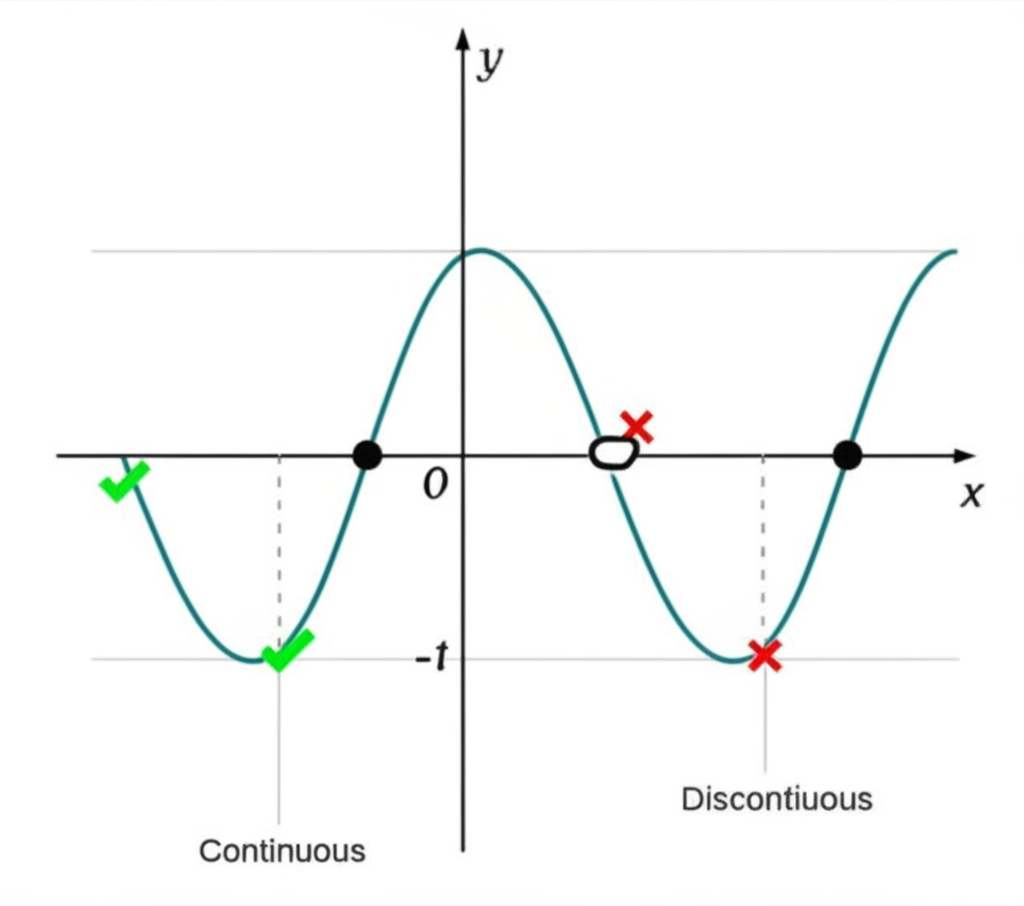
Three Conditions for Continuity at x = a
Condition 1
f(a) is defined
The function must have an actual value at the point. No holes allowed.
Condition 2
lim x→a f(x) exists
The left-hand and right-hand limits must both exist and be equal.
Condition 3
lim x→a f(x) = f(a)
The limit value must equal the actual function value at the point.
If any one of the three conditions fails, the function is discontinuous at that point. Each type of discontinuity corresponds to a different condition failing.
Continuity on an Interval
Open Interval (a, b)
A function is continuous on (a, b) if it is continuous at every single point within that interval.
Closed Interval [a, b]
Continuous on (a, b), plus: lim x→a⁺ f(x) = f(a) and lim x→b⁻ f(x) = f(b).
6Types of Discontinuities
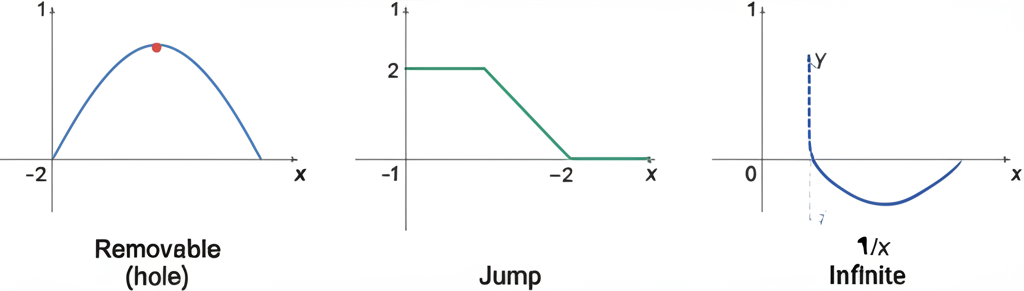
When a function fails one or more of the continuity conditions, we classify the type of discontinuity based on what went wrong.
Interactive: Discontinuity Explorer
Choose a discontinuity type and slide x toward the problem point to see how the function behaves differently in each case.
Why it fails: Limit exists = 4, but f(2) is undefined
f(x) = (x²−4)/(x−2)
Removable (Hole)
The limit exists, but f(a) is either undefined or does not equal the limit. Looks like a "hole" in the graph.
Occurs when a factor cancels in a rational function.
Jump
The left-hand and right-hand limits exist but are not equal. The graph "jumps" from one value to another.
Common in piecewise functions where pieces do not connect.
Infinite (Asymptote)
The function approaches ±∞ from one or both sides. Indicates a vertical asymptote.
Occurs when the denominator is zero and the factor does not cancel.
Which Continuity Condition Fails?
The limit exists (condition 2 passes), but condition 1 or condition 3 fails. The hole can be "filled" by redefining f(a).
Condition 2 fails because the left and right limits are different. The two-sided limit does not exist.
Condition 2 fails because the function values grow without bound (±∞). This is a vertical asymptote, not a finite limit.
7Limits at Infinity
Limits at infinity describe the end behavior of a function as x grows without bound. They reveal horizontal asymptotes.
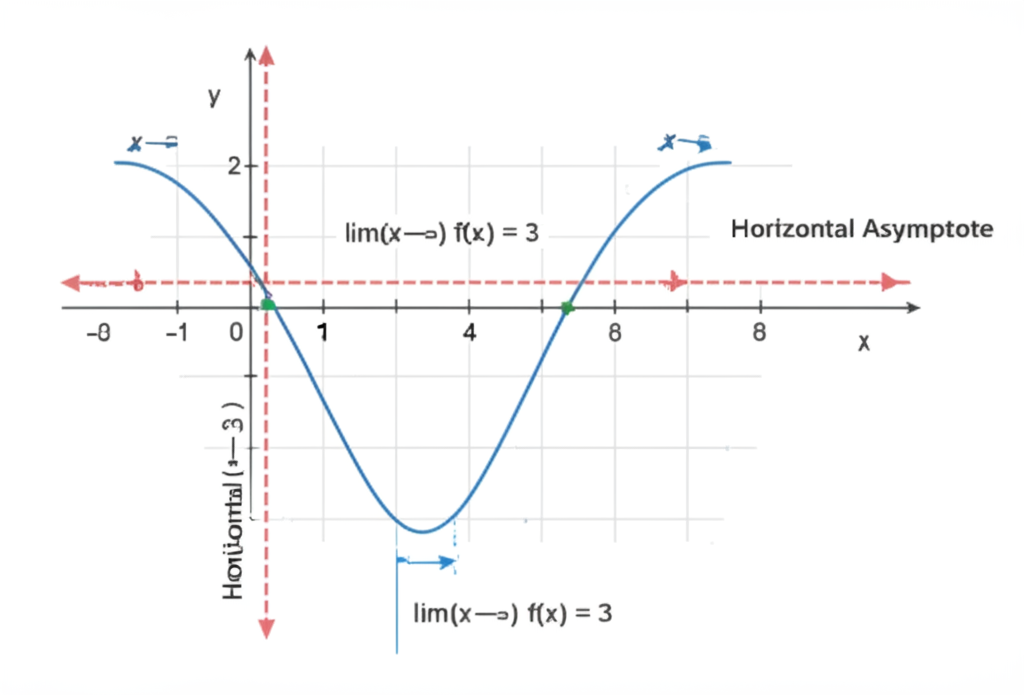
Rational Functions: Compare Degrees
For rational functions P(x) / Q(x), compare the degree of the numerator to the degree of the denominator:
Degree N < Degree D
lim = 0
Horizontal asymptote at y = 0.
e.g. lim x→∞ (2x + 1) / (x² − 3) = 0
Degree N = Degree D
lim = LCₙ / LC₄
Ratio of leading coefficients.
e.g. lim x→∞ (3x² − 5x) / (2x² + 7) = 3/2
Degree N > Degree D
lim = ±∞
No horizontal asymptote.
e.g. lim x→∞ (x³ + 2) / (x² − 1) = ∞
Division Method (Worked Example)
Evaluate: lim x→∞ (3x² − 5x) / (2x² + 7)
Divide every term by x² (highest power in denominator):
= lim x→∞ (3 − 5/x) / (2 + 7/x²)
As x → ∞: 5/x → 0 and 7/x² → 0
= (3 − 0) / (2 + 0) = 3/2
General Strategy
Divide every term by the highest power of x in the denominator. Then use the fact that c/xn approaches 0 as x approaches infinity for any constant c and positive n.
8Memory Aids
"BOBO BOTN EATS DC"
For limits at infinity of rational functions: Bigger On Bottom = 0, Bigger On Top = No horizontal asymptote, Exponents Are The Same = Divide Coefficients.
"DEL" for Continuity
Defined: f(a) must be defined. Exists: the limit must exist. Limits equal: the limit equals f(a). All three conditions spell out DEL.
"Sub it, Factor it, Rationalize it"
The order for evaluating limits: (1) try direct substitution, (2) if 0/0, try factoring, (3) if radicals, try rationalizing.
"HJI" for Discontinuities
Hole (removable), Jump, Infinite. The three types of discontinuities, from "friendliest" (can be fixed) to "most severe" (vertical asymptote).
"Limits are about the journey, not the destination."
A limit describes the value a function is approaching (the journey toward a point), not the actual function value at that point (the destination).
9Common Mistakes
Confusing the limit with the function value
The limit describes what a function approaches, not what it equals at that point. A function can have a limit of 5 at x = 2 even if f(2) is undefined or equals something else entirely.
Assuming 0/0 means the limit is 0 or undefined
The form 0/0 is indeterminate, meaning the limit could be any number. You must use algebraic techniques (factoring, rationalizing) to simplify before evaluating.
Forgetting to check both one-sided limits
For piecewise functions and potential discontinuities, you must verify that both the left-hand and right-hand limits exist and are equal before concluding the two-sided limit exists.
Mixing up removable and non-removable discontinuities
A removable discontinuity (hole) has an existing limit but f(a) is missing or wrong. A jump or infinite discontinuity cannot be fixed because the limit itself does not exist.
Incorrect degree comparison for limits at infinity
When comparing degrees of numerator and denominator, make sure to identify the leading term of each. Do not be misled by terms in the middle of the expression — only the highest-power terms matter for end behavior.
Forgetting IVT requires continuity
The Intermediate Value Theorem only applies to continuous functions on closed intervals. If the function has a discontinuity on the interval, IVT cannot be applied.
Not simplifying before substituting
After factoring or rationalizing, students sometimes forget to substitute the value back in. The algebraic manipulation removes the 0/0 form, but you still need to evaluate the simplified expression.
Quick Revision Summary
- ✓A limit describes the value a function approaches as the input approaches a certain point — it is about the journey, not the destination.
- ✓Always try direct substitution first. If you get 0/0, use factoring or rationalizing.
- ✓A two-sided limit exists only when both one-sided limits exist and are equal.
- ✓Three conditions for continuity at x = a: f(a) is defined, the limit exists, and the limit equals f(a).
- ✓Three types of discontinuities: removable (hole), jump, and infinite (vertical asymptote).
- ✓For limits at infinity, compare degrees: smaller numerator degree = 0, equal degrees = ratio of leading coefficients, larger numerator degree = no horizontal asymptote.
- ✓Special limits: lim (sin x / x) = 1 and lim (1 - cos x) / x = 0 as x approaches 0.
- ✓The Intermediate Value Theorem guarantees that a continuous function on [a, b] takes on every value between f(a) and f(b).
Frequently Asked Questions
- What is the difference between a limit and a function value?
- A limit describes the value a function approaches as the input gets closer to a certain point, while the function value is the actual output at that point. A limit can exist even if the function is undefined at that point (e.g., a hole in the graph). The limit is about the trend or behavior near the point, not the value at the point itself.
- When does a two-sided limit not exist?
- A two-sided limit does not exist (DNE) when: (1) the left-hand and right-hand limits are not equal (jump discontinuity), (2) the function oscillates infinitely near the point, or (3) the function approaches positive or negative infinity (infinite discontinuity / vertical asymptote). For the two-sided limit to exist, both one-sided limits must exist and be equal.
- What are the three conditions for continuity at a point?
- A function f(x) is continuous at x = a if and only if all three conditions are met: (1) f(a) is defined (the point exists), (2) the limit as x approaches a exists (left-hand and right-hand limits are equal), and (3) the limit equals the function value, i.e., lim x->a f(x) = f(a). If any condition fails, the function is discontinuous at that point.
- How do you evaluate a limit that gives 0/0 after direct substitution?
- The form 0/0 is an indeterminate form, meaning more work is needed. Common techniques include: (1) factoring the numerator and denominator, then canceling common factors, (2) rationalizing by multiplying by the conjugate when radicals are involved, and (3) using special limit identities such as lim(sin x / x) = 1 as x approaches 0. After simplification, try direct substitution again.
- How do you find horizontal asymptotes using limits at infinity?
- For rational functions, compare the degrees of the numerator and denominator: (1) if the numerator degree is less, the horizontal asymptote is y = 0; (2) if degrees are equal, the asymptote is y = (leading coefficient of numerator) / (leading coefficient of denominator); (3) if the numerator degree is greater, there is no horizontal asymptote (the function grows without bound). You can also divide every term by the highest power of x in the denominator.
Practice Quiz
Test your understanding — select the correct answer for each question.
1.What is a limit?
2.If lim(x→a⁻) f(x) = 5 and lim(x→a⁺) f(x) = 5, then lim(x→a) f(x) = ?
3.What type of discontinuity does f(x) = (x² - 4)/(x - 2) have at x = 2?
4.What is a horizontal asymptote?
5.For a function to be continuous at x = a, which condition is NOT required?
6.What is lim(x→0) sin(x)/x?
7.The Intermediate Value Theorem applies to:
8.What does lim(x→∞) f(x) = 3 mean?
9.A jump discontinuity occurs when:
10.What is lim(x→2) (x² - 4)/(x - 2)?
Final Study Advice
- 1.Always start with direct substitution — it is the fastest method and works for most straightforward limits.
- 2.When you get 0/0, recognize it as an indeterminate form and apply factoring, rationalizing, or special limits.
- 3.For continuity questions, check all three conditions systematically — do not skip any.
- 4.Practice identifying which type of discontinuity a function has — the AP exam tests this directly.
- 5.Use "BOBO BOTN EATS DC" for quick recall of horizontal asymptote rules on exam day.