Why AI-Generated Flashcards Are Better When They Come From Your Own Materials
Tutoremy Team
Editorial · April 9, 2026
You can generate flashcards from any AI tool in seconds. Type "make flashcards about mitosis" into ChatGPT and you'll get a set instantly. The problem is: whose version of mitosis did it use?
If your biology teacher defined mitosis as "cell division that produces two genetically identical daughter cells," but the AI flashcard says "a type of cell division where the nucleus divides," your student just studied the wrong definition. They'll recognize the AI's version on a Quizlet deck and think they know it. Then the exam asks for the definition the teacher used, and they get it wrong.
This isn't a hypothetical. It happens constantly — and it's the core reason why source-faithful flashcard generation (from your uploaded materials) is fundamentally better than generic AI generation (from a topic keyword).
The Two Types of AI Flashcard Generation
Type 1: Topic-based (generic)
You give the AI a topic — "photosynthesis," "World War I causes," "quadratic formula." It generates flashcards from its training data (essentially, a blend of textbooks, Wikipedia, and academic papers it was trained on).
The problem: The AI doesn't know what YOUR class covered. It doesn't know which definition your teacher used, which examples were emphasized, or which subtopics were deliberately skipped. You get a generic set that may include material you haven't learned yet and exclude material you're responsible for.
Type 2: Source-faithful (from uploaded materials)
You upload your actual class materials — lecture slides, notes, a textbook chapter — and the AI generates flashcards specifically from that content.
The advantage: Every flashcard maps to something in your source material. If your slides defined "osmosis" a specific way, that's the definition on the flashcard. If your slides didn't mention "reverse osmosis," it won't appear in the set. The flashcards test what you were taught, not what the internet says about the topic.
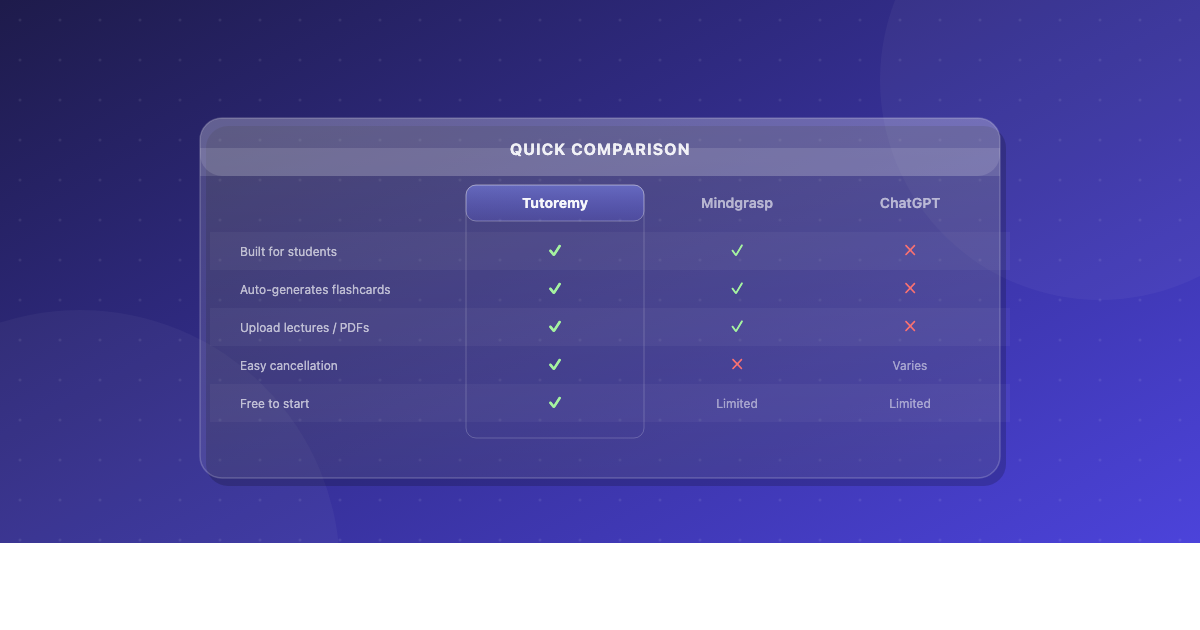
Tutoremy uses this second approach. Upload your materials for free and get flashcards pulled directly from your content.
Why This Matters More Than You'd Think
1. Terminology varies across curricula
Different textbooks, different teachers, and different grade levels use different terminology for the same concepts. "Rate of change" vs "slope." "Cellular respiration" vs "aerobic respiration." "The Reformation" vs "the Protestant Reformation." Generic AI doesn't know which version your class uses. Source-faithful AI uses the exact terms from your materials.
2. Scope varies across classes
An AP Biology class covers the Calvin cycle in depth. A general biology class might mention it once. Generic AI doesn't know the depth your class requires. Source-faithful AI generates cards proportional to how much your materials covered each concept.
3. Examples matter
When your teacher used a specific example to explain a concept (e.g., "the insulin-glucose feedback loop to illustrate negative feedback"), that example is likely to appear on the exam. Generic AI will generate a different example. Source-faithful AI captures the one your teacher used.
For Teachers: Why This Approach Saves You Time
If you're a teacher creating flashcards for your class, the source-faithful approach is even more compelling. You don't have to type out every card — just upload the materials you already have.
Upload your lecture slides to Tutoremy → get a flashcard set in under two minutes → review and edit → share with your class. The flashcards match your curriculum because they were generated from your curriculum.
Compare this to Quizlet, where you'd either type each card manually (30-60 minutes for a 25-card set) or search for a pre-made set someone else created (which probably doesn't match your class exactly).
For Parents: Creating Flashcards Without Being an Expert
One of the hardest parts of helping your child study is not knowing the material well enough to create good flashcards. If you're not a chemistry teacher, how do you know which concepts are flashcard-worthy and which are background context?
Source-faithful generation solves this. Upload whatever materials the teacher provided — a chapter PDF, class notes, a study packet — and the AI identifies the flashcard-worthy content. You don't need to know the subject. The materials know the subject.
Try it free at tutoremy.ai. Upload a PDF, get flashcards, and use them to quiz your child.
The Trust Question
"Can I trust AI-generated flashcards?"
If they're generated from a generic topic: verify carefully. The AI might use different definitions, include content you haven't covered, or miss content you have.
If they're generated from your source material: trust is higher, but still review. The AI might over-simplify a definition, miss a nuance, or generate a card that's too trivial ("What chapter is this from?"). A 3-minute review pass catches these issues.
The baseline quality is high enough that you spend 3 minutes reviewing instead of 30 minutes creating. That's the real value proposition.
The Short Version
Generic AI flashcards test what the internet knows about a topic. Source-faithful AI flashcards test what your class actually covered. The difference is the difference between studying the right material and studying adjacent material that feels right but isn't.
Upload your materials. Get flashcards that match your curriculum. Review them. Study them. That's it.