How to Actually Use AI for Studying (Without Getting Yourself in Trouble)
Tutoremy Team
Editorial · April 1, 2026
There's a useful version and a harmful version
AI tools are everywhere in education right now, and most students are figuring out the rules as they go. That's a problem — not because AI is inherently bad for learning, but because the line between "using AI to study" and "using AI to cheat" is real, and getting it wrong has consequences.
A 2024 survey by Wiley of 850 college instructors and 2,067 students found that 96% of instructors believe at least some of their students cheated with AI in the past year — up from 72% three years earlier. At the same time, those same instructors and students both acknowledged that AI can genuinely improve learning when used appropriately.
This guide is about the appropriate version.
The core distinction: AI as input vs. AI as output
The cleanest way to think about this:
- Using AI to help you understand and prepare material = study tool.
- Using AI to produce the work you're supposed to submit = academic dishonesty.
This distinction matters because the purpose of assignments isn't just to create a document — it's to develop understanding. Penn Foster's academic integrity guidelines put it clearly: "Writing your own assignments isn't just a requirement, it's how you demonstrate your understanding, critical thinking, and ability to communicate what you've learned. Letting AI do that for you short-circuits the learning process."
The same logic applies whether it's an essay, a problem set, or a take-home exam. If you didn't do the thinking, you didn't learn it — and you'll face that gap on the next exam, in the oral defence, or in your career.
What AI is genuinely good for in studying
Explaining concepts you don't understand
This is one of the most legitimate uses of AI. You're sitting with a confusing paragraph in your textbook, or a concept from lecture that didn't land. You ask an AI to explain it differently — to use an analogy, simplify the language, or walk through it step by step.
This is the same thing as asking a tutor, a classmate, or office hours. The input is your confusion; the output is clarity you then apply to your own work.
Generating practice questions
AI tools can generate practice questions from your notes, lecture slides, or textbook content. This feeds directly into retrieval practice — one of only two study techniques rated "high utility" across 10 methods reviewed by Dunlosky et al. (2013). You're not outsourcing the learning; you're creating more opportunities to practice it.
Building flashcard sets from your own content
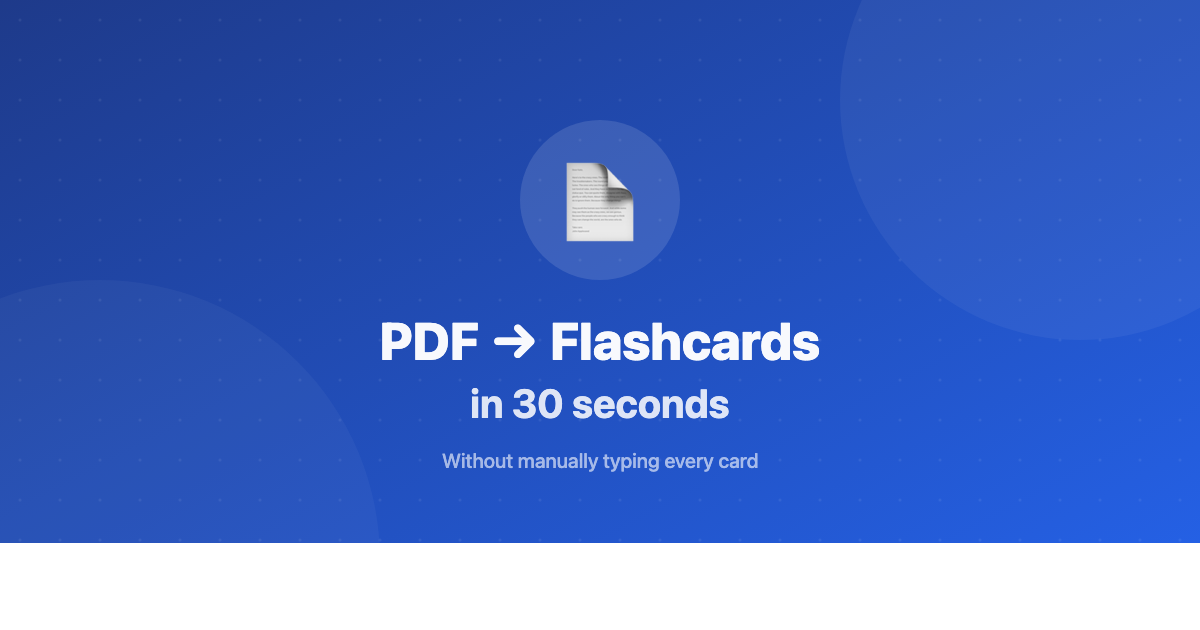
Manually creating flashcards for an entire course is time-consuming. AI can do that prep work quickly, especially when you feed it your own lecture recordings or notes. The output becomes raw material for active study — you still have to do the retrieval practice.
Summarising material you've already read
If you've read a chapter and want a condensed version to review, AI summarisation is a reasonable time-saver. The key word is "already read" — if you're using the summary as a substitute for engaging with the source material, you're skipping the comprehension work the reading was designed to produce.
Stress-testing your understanding
Explain a concept to an AI as if you're teaching it, then ask the AI to identify any gaps or errors in your explanation. This is the Feynman Technique with an AI as your listener — and it's one of the more effective ways to surface what you don't actually understand yet.
What AI is not good for in studying
Writing your assignments
Covered above. The downstream effects go beyond academic misconduct: you don't build the skill, you don't understand the material, and you don't develop the ability to think and write independently. These costs compound.
Summarising readings you haven't read
AI summaries of a book chapter or paper are inevitably thinner than the source. More importantly, the point of assigned readings is often the process of engaging with complexity, forming your own interpretation, and developing critical thinking. An AI can tell you what a paper says; it can't do the intellectual work of grappling with it.
"Checking" answers on graded work
If your assignment is graded and you're using AI to verify or fix your answers before submitting, that's the same as submitting work that isn't yours. Most institutions' policies are explicit on this.
Know your institution's actual rules
AI policy varies significantly between institutions and even between courses within the same school. Carnegie Mellon's guidance on AI tools in coursework shows that students sometimes get flagged for AI use they didn't realize was prohibited — including using AI translation tools for coursework in a second language.
The safest approach: check your syllabus. If it doesn't address AI, ask your instructor directly. Document that you asked. Don't assume permissiveness where it's not stated.
The short version
AI is a legitimate study tool when it helps you understand, prepare, and practice material you're responsible for learning. It becomes a problem when it substitutes for the cognitive work the assignment or exam is designed to assess.
Use it to generate practice questions, explain confusing concepts, create flashcards from your own content, and stress-test your understanding. Don't use it to produce work you'll submit as your own.
---
AI that works with your course material. Tutoremy lets you upload your own lectures and notes, then generates summaries, flashcards, and practice questions grounded in your actual course content — study support that's both effective and academically sound.