AI Study App vs ChatGPT vs NotebookLM: Which One Should You Actually Use?
Tutoremy Team
Editorial · April 8, 2026
The honest version of the question
If you're a student looking for an AI study app, you've probably already noticed something inconvenient: ChatGPT is free, NotebookLM is free, Gemini is free. Most "AI study apps" charge
So why would you pay for one?
The honest answer is: sometimes you shouldn't. There are real scenarios where ChatGPT or NotebookLM is genuinely the better choice, and we'll cover those. But there are also scenarios where a purpose-built study app does things the general tools structurally can't — and using the wrong tool for the wrong job is one of the most common reasons students give up on AI for studying after two weeks.
This guide is the comparison nobody selling you a study app wants to write. We make Tutoremy, so we have an obvious bias here — but the goal of this post is to tell you when Tutoremy isn't the answer just as much as when it is.
What each tool actually is
Before getting into when to use which, it's worth being precise about what these tools actually do.
ChatGPT
A general-purpose conversational AI. You give it a prompt, it gives you an answer. It can read PDFs you upload (up to a point), summarize text, explain concepts, and generate practice questions if you ask. It has no built-in concept of a "course," a "study session," or a "flashcard deck" — every conversation starts from scratch unless you organize it yourself.
NotebookLM
Google's source-grounded research tool. You upload sources (PDFs, slides, YouTube videos, web pages, audio) into a "notebook," and NotebookLM answers questions using only those sources, with citations. It can generate study guides, FAQ documents, briefing docs, mind maps, and the now-famous AI-generated podcast summaries. It's free, surprisingly powerful, and increasingly the default for students who want an AI that won't hallucinate beyond their materials.
A purpose-built AI study app
Tools like Tutoremy, Mindgrasp, StudyFetch, Turbo, and Studley take uploaded course material and turn it into a structured study system: flashcards, quizzes, practice tests, summaries, and progress tracking — usually with spaced-repetition scheduling baked in. They're narrower than ChatGPT and more opinionated than NotebookLM. Tutoremy specifically is built around the lectures, slides, and notes from your actual course, so the flashcards and quizzes you get back are grounded in what your professor will actually test. One thing worth noting up front: Tutoremy always has a free tier — you can use it without ever paying. Most other study apps in this category are paid-only or trial-then-paywall, which is part of why we're upfront about it.
That's the real difference. ChatGPT is a thinking partner. NotebookLM is a research tool. A study app is a study system.
Side by side: what each one actually does
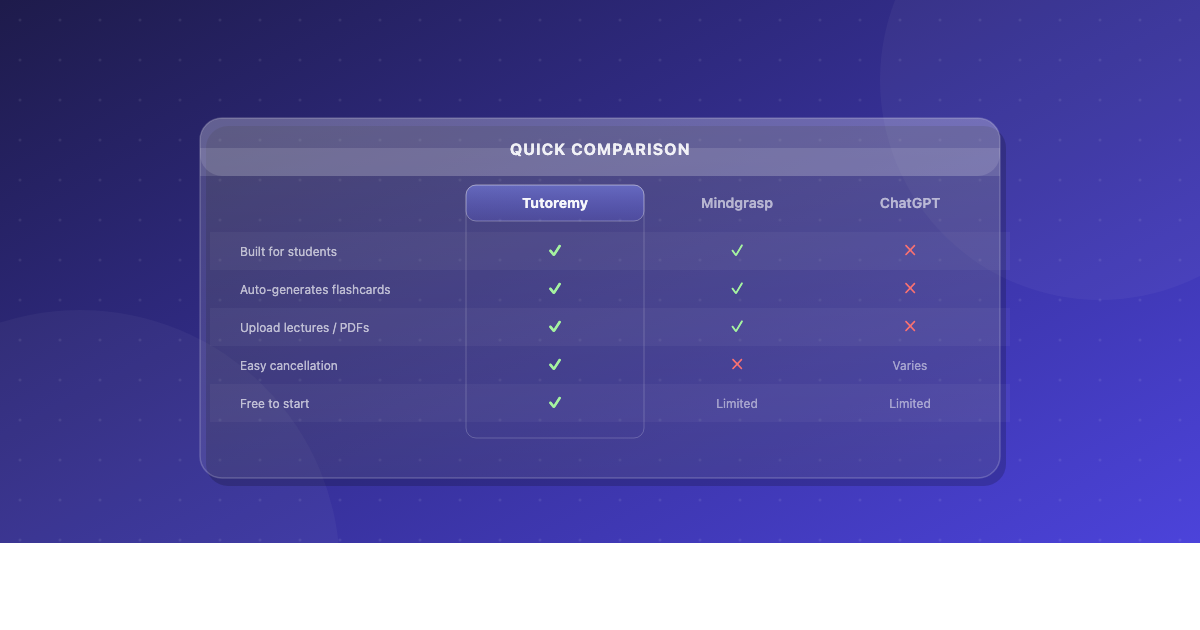
| Feature | ChatGPT (free) | NotebookLM (free) | AI study app |
|---|---|---|---|
| Upload PDFs / lecture notes | Limited on free tier | Up to 50+ sources per notebook | Yes |
| Upload YouTube / lecture videos | Indirectly | Yes, native | Yes |
| Source citations | No | Yes, inline | Usually yes |
| Generate summaries | Yes | Yes, with citations | Yes |
| Generate flashcards | Only if you ask, manually | Not native | Yes, structured decks |
| Spaced-repetition scheduling | No | No | Yes |
| Quiz / practice test grading | No | No | Yes |
| Progress tracking across a course | No | No | Yes |
| AI tutor / Q&A on your material | Yes | Yes | Yes |
| Cost | Free tier is real | Free | Tutoremy: free tier always. Others: often paid only |
The pattern is clear: ChatGPT and NotebookLM are excellent at the input side of studying (understanding, summarizing, asking questions). Study apps like Tutoremy are built for the output side — the part where you actually have to memorize, practice, and prepare for an exam.
Three student scenarios
The best way to pick a tool isn't to compare features in the abstract. It's to figure out which scenario you're actually in.
Scenario 1 — "I just need to understand this PDF"
You have a confusing chapter, a research paper you need to skim, or a problem set explanation you didn't follow in lecture. You're not building a study system. You just want clarity, fast.
Use ChatGPT. Drop the PDF in, ask it to explain the part you're stuck on, ask follow-up questions until it clicks. This is what general LLMs are best at — fast, conversational comprehension. Paying for a study app to do this is overkill, and honestly, it's not what Tutoremy is for either.
NotebookLM also works here, especially if you want citations back to the source. But the friction of creating a notebook for a one-off question makes ChatGPT the lighter choice.
Scenario 2 — "I have a semester of lectures and I need to organize them into something I can actually study from"
You have 14 weeks of lecture recordings, slide decks, and reading assignments. You need to extract what matters, see how it connects, and have something searchable you can return to before the midterm.
This is NotebookLM's strongest scenario. Upload everything into one notebook. Ask it to generate a study guide, a glossary, a timeline. Ask questions across all your sources at once and get cited answers. The free tier is generous enough for most undergraduate courses.
A study app can do this too — Tutoremy, for example, will turn the same uploaded lectures into structured study guides automatically and is usually more polished out of the box. But if you're cost-sensitive and disciplined, NotebookLM is genuinely a strong free option for this scenario. The honest trade-off: NotebookLM gives you great organized notes; it doesn't give you flashcards, quizzes, or a system that actually drills you on the material. That's where a tool like Tutoremy starts to pull ahead.
Scenario 3 — "I need to memorize 400 terms for a final, and I need to actually retain them"
This is where general tools fall apart and purpose-built study apps earn their price.
The reason is cognitive science, not marketing. The two highest-rated study techniques in the Dunlosky et al. (2013) review of 10 common methods are practice testing and distributed practice — what most people call retrieval practice and spaced repetition. Both require structure: a system that tracks what you've seen, when you saw it last, what you got wrong, and what to show you next.
ChatGPT can generate flashcards if you ask, but it has no memory of which ones you've seen or struggled with. NotebookLM can give you a study guide, but it won't drill you on it tomorrow morning and again in four days. Neither tool schedules. Neither tool grades. Neither tool tracks.
A study app does all three. That's the part you're actually paying for — not the AI, the system. Tutoremy, for instance, takes the lectures and notes you upload and builds a spaced-repetition schedule around them automatically, so the cards you got wrong on Monday come back on Wednesday and again the following week. That scheduling layer is the part general LLMs structurally can't replicate.
Use a purpose-built AI study app when you have a high-stakes exam, a large body of content to memorize, or you've already tried "I'll just use ChatGPT" and bounced off it after a week.
What NotebookLM still can't do
NotebookLM is the closest free alternative to a study app, so it deserves a fair callout on what it doesn't do — not as a takedown, but because most students don't realize what's missing until exam week.
- No native flashcards. You can ask it to generate Q&A pairs, but they live in a document. You can't drill them, mark "easy/hard," or have the tool re-show the cards you got wrong.
- No spaced-repetition scheduling. Forgetting curves don't care how good your notes are. NotebookLM has no concept of what to show you tomorrow.
- No quiz grading. It can write a practice test for you. It can't score it, identify your weak areas, or adjust what you study next.
- No progress tracking across a course. Every study session is independent.
If those four things matter for how you study, NotebookLM is a brilliant input tool but not a complete study tool — and the gap between those two is exactly what Tutoremy was built to close. If they don't matter for how you study, save your money and use NotebookLM.
Why students abandon "I'll just use ChatGPT" workflows
There's a quiet pattern that almost every student who tries to study with ChatGPT alone goes through. Week 1: it's amazing. You can ask anything, it explains everything, you feel productive. Week 2: you realize you've been chatting, not studying. The information went into your head and right back out. You can't remember what you covered last Monday.
The friction isn't the AI. It's the absence of structure. Every conversation starts from zero. There's no record of what you've practiced. There's no system pushing you to retrieve. You have to be your own scheduler, your own quiz generator, your own progress tracker — and almost nobody is, especially during finals week when willpower is the scarcest resource you have.
This is the same reason Anki and Quizlet existed long before AI. The hard part of studying was never finding the information. It was building a system that made you actually engage with it on the schedule your brain needs.
AI study apps are essentially Anki and Quizlet with the manual setup work removed. Tutoremy, for example, takes a lecture recording or a stack of notes and produces the flashcards, quizzes, and review schedule that you'd otherwise have to spend hours building yourself. Whether that's worth
Picking the right tool for you
A short decision guide:
- Use ChatGPT if you mostly need on-demand explanations, one-off help, and a smart conversational partner. Don't pay for a study app if this is 90% of your usage.
- Use NotebookLM if you have a lot of source material to organize, you want cited answers, and you're disciplined enough to study from documents without a system pushing you. The price is right.
- Use an AI study app like Tutoremy if you have high-stakes exams, large volumes to memorize, or you've already tried the free tools and noticed you're not retaining anything. You're paying for the system, not the AI — and with Tutoremy, "paying" is optional, since the free tier is always available. Most competing study apps don't offer that.
Honest closing note: most students benefit from using more than one of these. ChatGPT for quick comprehension, NotebookLM for organizing source material, and a study app like Tutoremy for the actual drill-and-retain loop. Pick based on the job, not on the brand.
---
Tutoremy is built for Scenario 3. Upload your lectures, notes, and slides, and Tutoremy turns them into structured flashcards, practice quizzes, and a study system that actually schedules itself — grounded in your real course material. If you've tried ChatGPT or NotebookLM and bounced off them, that's the gap we built Tutoremy to fill.