Blog/The Best Quizlet Alternatives in 2026 (Honestly Ranked by What You Actually Need)
Tutoremy Blog·AI & Technology·10 min read

The Best Quizlet Alternatives in 2026 (Honestly Ranked by What You Actually Need)

TT

Tutoremy Team

Editorial · April 9, 2026

Why this post exists

If you're reading this, something pushed you to look for a Quizlet alternative. For most students, that something is the same: somewhere between 2022 and 2024, the features that made Quizlet useful — Learn mode, Test mode, unlimited practice rounds — started disappearing behind a paywall. The free version still exists, but it now caps you at five Learn rounds and one practice test before nudging you to subscribe to Quizlet Plus (currently around $35.99/year).

That's not the end of the world. $35.99 a year is less than a single textbook. But the friction is real, and so is the question: if I'm going to switch tools, what should I actually switch to?

There are at least 30 "Quizlet alternative" listicles on the first page of Google right now, and most of them are written by the apps they're recommending. We make Tutoremy, so we have the same bias. The difference is that this post is going to tell you when Tutoremy isn't the right answer just as much as when it is — because for some of these use cases, Knowt or Anki genuinely beats us, and it would be silly to pretend otherwise.

The honest framing: there's no single best Quizlet alternative

Listicles like to rank things 1 through 10 because rankings drive clicks. The truth is messier. The best Quizlet alternative depends on which part of Quizlet you actually used.

Most students used Quizlet for one of three things:

1. Making and reviewing flashcards manually for vocab, dates, and definitions — the original use case. 2. Searching public study sets that someone in their class already made. 3. Cramming with Learn mode and Test mode the night before an exam.

Each of those maps to a different alternative. There's no app that does all three perfectly — including Quizlet.

So instead of a 1-through-10 ranking, we'll split the field into four categories:

  • Free Quizlet drop-in replacements — same UX, no paywall
  • Serious spaced-repetition tools — for memorizing huge volumes long-term
  • AI study apps that build cards FROM your course material — where Tutoremy lives
  • Notes + flashcards hybrids — for students who want one tool, not two

Category 1 — Free Quizlet drop-in replacements

Use this category if you mostly want what Quizlet used to be: a clean flashcard app with Learn and Test modes that doesn't paywall you mid-session.

Knowt — the most direct replacement

Knowt is the app most aggressively positioned as "the free Quizlet." Same general layout, same Learn-style mode, same flashcard creation flow. Critically, it imports Quizlet sets directly — paste a Quizlet URL and your old decks come over. If you have years of Quizlet history you don't want to abandon, Knowt is the path of least resistance.

What you get for free: unlimited cards, Learn mode, practice tests, basic AI features for generating cards from notes, and spaced repetition. What you don't get: the depth of Anki's algorithm or the polish of paid tools. But for most high schoolers replacing Quizlet 1-for-1, Knowt is the obvious answer.

When it's the right choice: you used Quizlet for traditional flashcards and you just want the paywall gone.

Brainscape — confidence-based repetition

Brainscape takes a different angle. After each card, you rate your confidence 1–5, and the app uses that rating to decide when to show you the card again. It's based on real cognitive science research and works well for vocab-heavy subjects like languages, anatomy, and law terminology.

The free tier is meaningful but limited compared to Knowt — Brainscape pushes harder on its paid tier. Worth it if confidence-based scheduling clicks for you.

Category 2 — Serious spaced repetition

Use this category if you're memorizing hundreds or thousands of cards over months: med school, law school, language learning, MCAT, USMLE, bar prep.

Anki — still the gold standard

We have to be honest about Anki. For pure spaced-repetition power, nothing else comes close. Anki has been the default tool for medical students for over a decade for a reason: the FSRS algorithm is the most-studied scheduling system in the field, the desktop and Android versions are completely free, and the community-built decks (AnKing for med, MCAT decks, language decks) are some of the best study resources ever assembled — also free.

Anki's downsides are real, though:

  • The interface looks like it was designed in 2008 (because it was)
  • Making your own cards is slow and finicky
  • The iOS app costs
5 (one-time, but still)
  • The learning curve is steep — most students bounce off in the first week
  • If you can push through the first week, Anki rewards you for years. If you can't, you'll quit and go back to Quizlet.

    When it's the right choice: you're a medical, law, or language student and you're in it for the long haul. This is genuinely better than Tutoremy for that specific use case, especially if a strong community deck already exists for your exam.

    Category 3 — AI study apps that build cards from your material

    This is the newest category, and it's where most of the "AI Quizlet alternative" hype lives. The pitch is the same across all of them: upload your lecture notes, slides, or textbook chapter, and the AI turns it into flashcards automatically.

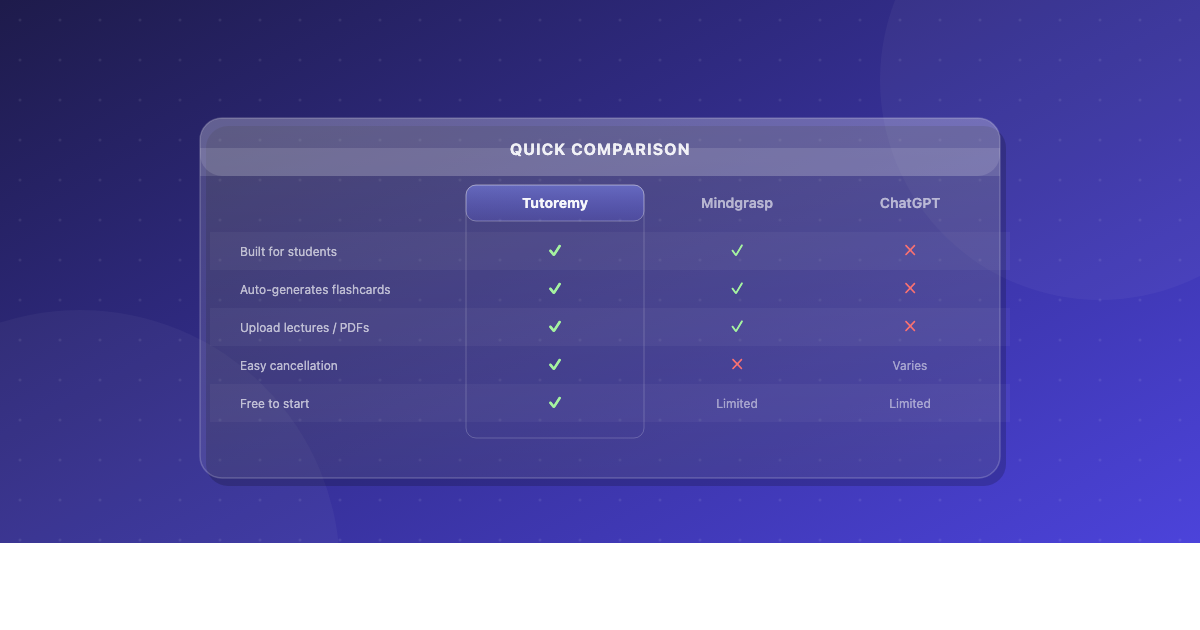
    Some of the names you'll see: Tutoremy, Okti, StudyGlen, StudyFetch, Mindgrasp, Studley, Knowt (which also has AI features), and a long tail of newer entrants.

    What this category is actually good at

    Manual flashcard creation is the part of Quizlet most students hated. It's tedious. It feels like work that isn't really studying. For a 200-slide lecture deck, it can take 90 minutes just to get the cards into a tool — before you've memorized a single thing.

    AI study apps collapse that to about 30 seconds. You upload the file, the AI extracts the testable concepts, and you're reviewing within a minute. That alone is the reason most students who switch don't go back.

    Where Tutoremy fits

    Tutoremy is built specifically around the lectures, slides, and notes from your actual course. The flashcards and quizzes you get back are grounded in what your professor will actually test, with spaced-repetition scheduling baked in so you're not the one deciding which card to drill next.

    Two things worth being upfront about, since you came here looking for Quizlet alternatives:

    1. Tutoremy has a real free tier — not a 7-day trial, not a "first 10 cards free" limit. You can use it without ever paying. Most other AI study apps in this category are trial-then-paywall, which is part of why we mention it. 2. It is not the right tool if you just want to import your old Quizlet sets and keep going. That's Knowt's job. Tutoremy is built for the workflow where you're starting from your professor's materials, not from existing decks.

    Where Tutoremy isn't the answer

    If your study workflow is "I have 1,200 community-built MCAT cards and I'm drilling them for 8 months," use Anki. If your workflow is "I just need to migrate my high school Quizlet sets and not pay," use Knowt. AI generation isn't magic, and a well-crafted deck made by experts beats any auto-generated set for high-stakes standardized exams.

    Category 4 — Notes + flashcards hybrids

    Use this category if you've been bouncing between Notion (or Obsidian) for notes and Quizlet for flashcards, and you want one tool instead of two.

    RemNote

    RemNote is a Notion-style document editor where you create flashcards inline as you write notes. Type a term, add an arrow, type the definition, and the line silently becomes a flashcard that lives in your spaced-repetition queue. It sounds gimmicky, and it is genuinely transformative if you're the kind of student who already takes detailed digital notes.

    The downside: it's a steeper conceptual jump than any other tool on this list. RemNote isn't a flashcard app with notes attached — it's a notes app with flashcards baked in. If you don't already have a digital note-taking habit, RemNote is overkill.

    Side by side: which one for which job

    You want to...Best alternativeWhy
    Replace Quizlet 1-for-1, same UX, freeKnowtImports Quizlet sets, same layout, no paywall
    Memorize 1,000+ cards over many monthsAnkiMost powerful scheduling, best community decks
    Turn your professor's slides into cards in 30 secondsTutoremyBuilt for course materials, real free tier
    Make flashcards while you take notesRemNoteNotes and cards in the same document
    Confidence-based vocab drillingBrainscapeCognitive-science-backed rating system
    Med school / USMLEAnki + AnKing deckProven workflow, community decks are gold
    Language learningAnki (or Tutoremy for course-based languages)Anki has the best language deck library

    A note on the "free" question

    Every app on this list has a free tier. The honest answer to "which is the most generous":

    • Knowt — most generous for traditional flashcard use
    • Anki — completely free on desktop and Android,
    5 one-time on iOS
  • Tutoremy — real free tier for AI-generated cards from your own materials, no trial timer
  • Brainscape — limited free tier; paid is the real product
  • RemNote — generous free tier for notes; flashcard count limits on free
  • If you're choosing primarily on price, Knowt and Anki are your two safest bets. If you're choosing on "what makes me actually study more," that's a different question — and the answer is usually "whichever one removes the most friction from your specific workflow."

    How to actually pick one in five minutes

    Don't read this whole post a second time. Use this:

    1. Did you mostly use Quizlet to import community sets and drill them? → Knowt 2. Are you prepping for a standardized exam (MCAT, USMLE, bar, LSAT)? → Anki 3. Do you want to upload your professor's slides and skip the manual card-making? → Tutoremy 4. Do you want one app for both notes and flashcards? → RemNote 5. None of the above and you just want the simplest free thing? → Knowt

    The bigger picture

    Quizlet didn't get worse on purpose. It got more expensive because it scaled, and the free version became a funnel for the paid version. That's how almost every consumer tool eventually evolves. The good news for students is that the paywall created enough demand for alternatives that there are now five or six legitimately good ones, each better than Quizlet at a specific job.

    The version of advice we'd give to a friend: try Knowt first if you're a high schooler with existing Quizlet sets. Try Tutoremy first if you're a college student dealing with PDFs and lecture slides. Try Anki first if you're studying for a standardized exam. Don't waste the first week of the semester picking the perfect tool — pick one in 10 minutes and start using it.

    ---

    Tutoremy is the AI study app for students starting from their professor's actual materials — not pre-made decks. Upload your lectures, slides, and notes, and Tutoremy turns them into flashcards, practice quizzes, and a spaced-repetition study system grounded in your course. Free tier available, no trial timer.

    Try Tutoremy free →

    Want a faster starting point?

    Upload your next lecture recording to Tutoremy.

    Get organized notes, flashcards, and a practice quiz automatically — in under two minutes. Free to try, no credit card required.

    Related Posts