The Best Study Apps for Business and MBA Students in 2026
Tutoremy Team
Editorial · April 9, 2026
Why business school is its own category
Undergraduate business and MBA programs are different from almost every other major in two specific ways:
1. The volume of reading is enormous — many MBA programs assign 150–250 pages of case studies per week 2. The studying isn't really about memorization — it's about frameworks (Porter's Five Forces, the BCG matrix, NPV, marketing mix) that you have to apply on demand
Generic "best study apps for college students" lists are written for STEM majors and don't address either of these. This list is specifically for business undergrads, full-time MBAs, executive MBA students, and the part-time crowd trying to manage 4 courses on top of a 50-hour week.
We make Tutoremy, an AI study app, and we'll mention it where it actually fits. Tutoremy is genuinely useful for one slice of business school (framework drilling and definitional content), and not the right tool for case prep itself. Honest framing throughout.
What business school students actually need
Before the apps, the framework. A business or MBA student's actual work breaks into five buckets:
1. Case study reading and prep — the central activity for case-method programs 2. Framework memorization — applying Porter's Five Forces, NPV, the 4 Ps, etc. on demand 3. Quantitative coursework — finance, accounting, statistics, operations 4. Recruiting prep — resumes, networking, interview prep, behavioral questions 5. Group project coordination — every MBA course has at least one group project
Different jobs, different tools.
1. For case study reading — GoodNotes or PDF Expert
If your program is case-method (HBS, Darden, Tuck, IESE, INSEAD, and many others), this is the tool that matters most. You're going to read between 100 and 250 pages of cases per week, and you need a way to annotate them efficiently.
GoodNotes (iPad + Apple Pencil) — handwritten margin notes, highlights, sticky notes, and the ability to flag patterns across a long case. The handwriting recognition makes your annotations searchable later. For most case-method programs, this is the standard.
PDF Expert (or Adobe Acrobat Pro) — laptop-based PDF annotation. Faster than GoodNotes if you type everything, slower for diagrams.
The case prep workflow most successful MBAs use:
1. First read: skim the case in 15 minutes to get the situation and the question 2. Identify the protagonist and the decision they have to make 3. Re-read the financial exhibits carefully — most cases hide the answer in the numbers 4. Outline your recommendation in 3–5 bullets 5. Predict 2–3 counterarguments your section will make in class
GoodNotes is the default tool because step 1–4 of this loop is much faster with marginalia.
2. For framework memorization — Tutoremy
This is where we honestly fit. Business school throws an enormous number of named frameworks at you — Porter's Five Forces, the BCG matrix, the McKinsey 7-S model, the value chain, SWOT, the marketing mix (4 Ps), the 5 Cs, perceptual maps, the GE-McKinsey nine-box, weighted average cost of capital, NPV, IRR, the Black-Scholes intuition, the four payoff diagrams. Pure recall, perfect flashcard territory.
Tutoremy turns your textbook chapters, lecture slides, or class notes into flashcards and a practice quiz automatically. Upload your strategy textbook chapter or your finance notes, get back a study set in 30 seconds. Spaced repetition is built in so you don't have to track when to review what.
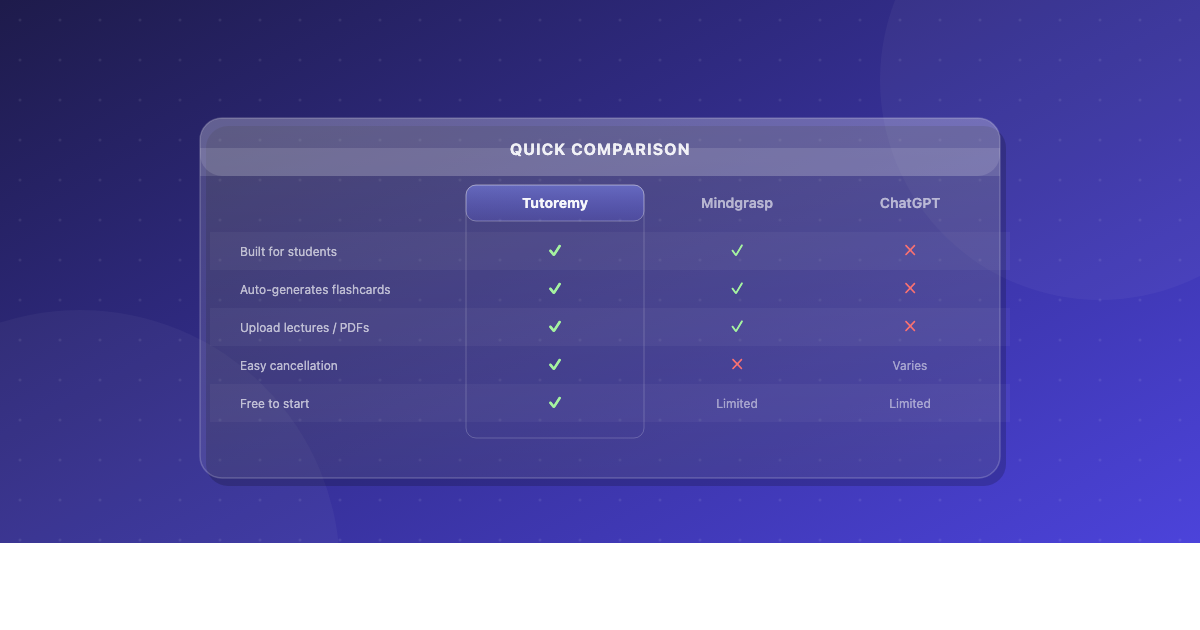
Tutoremy has a real free tier — no trial timer, no credit card.
When Tutoremy isn't the right answer for an MBA: when you're prepping for case discussion, where the actual work is reading the case and forming an argument, not memorizing a framework. Tutoremy doesn't replace case prep — it complements it.
3. For quantitative coursework — Excel + Wall Street Prep / Breaking Into Wall Street
For accounting, corporate finance, valuation, and most quant-heavy MBA courses, the central tool is Excel. Not a study app — Excel itself. The skills that matter are formula writing, pivot tables, and modeling discipline. There is no shortcut.
For financial modeling specifically, Wall Street Prep and Breaking Into Wall Street are the two industry-standard online courses. They're not free, but they're the gold standard for learning DCF, LBO, and M&A modeling — and most banking and finance recruits buy one before recruiting season.
For accounting basics, Khan Academy's accounting section is genuinely good and free. Use it as a content-review backup if your professor's lectures aren't clicking.
4. For recruiting prep — Management Consulted, RocketBlocks, Wall Street Oasis
Recruiting is the hidden second curriculum at most MBA programs, and the tools you need are recruiting-specific, not study apps.
Management Consulted and RocketBlocks — the two main case interview prep platforms for consulting recruiting. RocketBlocks is the best of the modern crop: short drills, structured feedback, math drills, and a clean mobile experience. Management Consulted is the more comprehensive option.
Wall Street Oasis — the long-running forum for finance recruiting. Free archives are huge; the paid courses (Investment Banking Interview Course, etc.) are the standard for finance prep.
Big Interview — for behavioral interview prep across any industry. Records your answers and gives feedback.
If you're recruiting for tech PM or operations roles, the tool stack changes — but the principle is the same: industry-specific prep platforms beat generic interview apps.
5. For group project coordination — Notion or Asana
Every MBA course has a group project, and group project coordination is one of the highest-friction parts of the program. The two tools that work best:
Notion — most popular, free with school email, flexible enough to handle a project tracker, shared document repository, and meeting notes in one place. The risk is the same as everywhere: spending more time on the dashboard than the project.
Asana — task-focused, less flexible, but better for groups that just want a clear "who's doing what by when" view. Free tier is enough for most small projects.
Pick one. Don't try to coordinate a 5-person project on Slack DMs and shared Google Docs.
6. For citation management — Zotero (free)
For the writing-heavy MBA courses (strategy, leadership, ethics) and any thesis or major paper, Zotero is the right citation manager. Free, open-source, integrates with Word and Google Docs, generates citations in any format, stores PDFs of every paper you cite. Mendeley does the same thing for money. Zotero is just better.
7. For cohort-wide study and shared notes — Notion or Google Drive
Most MBA cohorts have shared note repositories — collected outlines, past exam questions, recommended readings, brief sheets for accounting and finance. These usually live in Notion or Google Drive, maintained by a few generous students who care about the public good.
If your cohort doesn't have one, start one. The marginal effort is small and the karma is high.
What to ignore
A few things business school students get told to install that don't earn the install:
- "AI essay generators" for application essays. Adcoms can spot them, and the value of an application essay is the genuine self-reflection.
- Generic productivity apps with no business focus. Sunsama, Akiflow, etc. are nice but they're solving for individual contributors, not for MBA students whose calendars are mostly externally imposed.
- Expensive "MBA prep" apps that are mostly repackaged free content.
- Quizlet for framework memorization. The paywall on Learn mode and Test mode makes Tutoremy or Knowt a better free choice in 2026.
A realistic study week for a first-year MBA
Imagine a week in the first semester of a full-time MBA. Here's what the tool stack looks like in action:
- Sunday evening: Read the week's cases in GoodNotes. Write a 3-bullet outline of your view for each one in the margin.
- Monday morning before class: Quick re-skim of your annotations. Pull up the financial exhibits one more time.
- Monday/Wednesday/Friday classes: Take laptop notes during class discussion. Capture the things your section said that you didn't think of.
- Tuesday/Thursday afternoons: Use Tutoremy on your finance and accounting lecture slides — drill the frameworks and formulas across the week.
- Wednesday evening: Group project coordination in Notion. 30 minutes max.
- Friday afternoon: Recruiting prep — RocketBlocks for consulting drills, or finance modeling on Wall Street Prep.
- Saturday: Half-day off, half-day on the next week's case prep.
- Sunday: Cycle repeats.
This is the rhythm most successful first-year MBAs converge on. The tools are just the supporting infrastructure — the rhythm is the point.
Already studying for a business course?
Tutoremy has free reference guides on dozens of business and management topics — corporate finance, business strategy, marketing fundamentals, business ethics, organizational behavior, and more. Browse the full library at tutoremy.ai/resources/business.
TL;DR
| Job | Tool |
|---|---|
| Case reading and annotation | GoodNotes (iPad) or PDF Expert (laptop) |
| Framework memorization | Tutoremy or Anki |
| Quantitative courses | Excel + Wall Street Prep + Khan Academy |
| Consulting recruiting | RocketBlocks + Management Consulted |
| Finance recruiting | Wall Street Oasis + Wall Street Prep |
| Group projects | Notion or Asana |
| Citations | Zotero |
The unranked truth: case-method MBA studying is mostly reading and arguing, not memorizing. Use Tutoremy for the framework piece, GoodNotes for the case piece, and don't confuse them.
---
Tutoremy turns business school textbook chapters, lecture slides, and class notes into flashcards and quizzes — built for the framework and definitional side of business studying. Real free tier, no trial timer, no credit card.