Blog/The Best Study Apps for Psychology Students in 2026
Tutoremy Blog·Study Tips·10 min read
The Best Study Apps for Psychology Students in 2026
TT
Tutoremy Team
Editorial · April 9, 2026
Why psychology is one of the highest-leverage majors for the right tools
Psychology is one of the largest undergraduate majors in the US, and it has a specific structural advantage when it comes to studying: most of what you're tested on is named concepts, theorists, experiments, terms, and frameworks — exactly the kind of content that flashcards and active recall are best at. Cognitive psychology, developmental psych, abnormal psych, social psych, biological bases of behavior — all of them are vocabulary-heavy and definition-heavy.
The funny thing is that psychology students, despite studying the science of memory, are some of the worst offenders at using ineffective study techniques. Most psych students still reread their notes (which doesn't work) instead of using active recall (which their own field's literature says is twice as effective). The whole "testing effect" research is in your textbook. You should be using it.
This post is the honest tool stack for a psych student. We make Tutoremy, an AI study app, and we'll mention it where it actually fits — which is a lot of places, because psych studying is mostly the kind of work Tutoremy is built for.
What psychology students actually need to study
Before the apps, the framing. A psych student's actual work breaks into four buckets:
1. Vocabulary and definitions — terms, named effects, biases, disorders, brain regions
2. Theorists and theories — Freud, Skinner, Bandura, Piaget, Erikson, Maslow, the cognitive revolution
3. Famous experiments and findings — Milgram, Asch, Bobo doll, Stanford prison, the marshmallow test
4. Statistics and research methods — chi-square, ANOVA, t-tests, experimental design
Three of those four are pure recall — the most flashcard-friendly content in any undergrad major. The fourth (stats) needs different tools.
1. For vocabulary, definitions, theories, and experiments — Tutoremy
This is where we honestly fit, and the fit is strong. Tutoremy takes your textbook chapters, lecture slides, or class notes and generates flashcards and a practice quiz from them automatically. For psychology specifically:
Upload an Intro Psych textbook chapter and get back ~30 flashcards covering the testable concepts
Upload your Abnormal Psych slides for the unit on mood disorders
Upload a study guide of famous experiments with names, designs, and findings
Drill the defense mechanisms, the cognitive biases, the major theorists and their key claims
Memorize the brain regions and what they do for biological bases of behavior
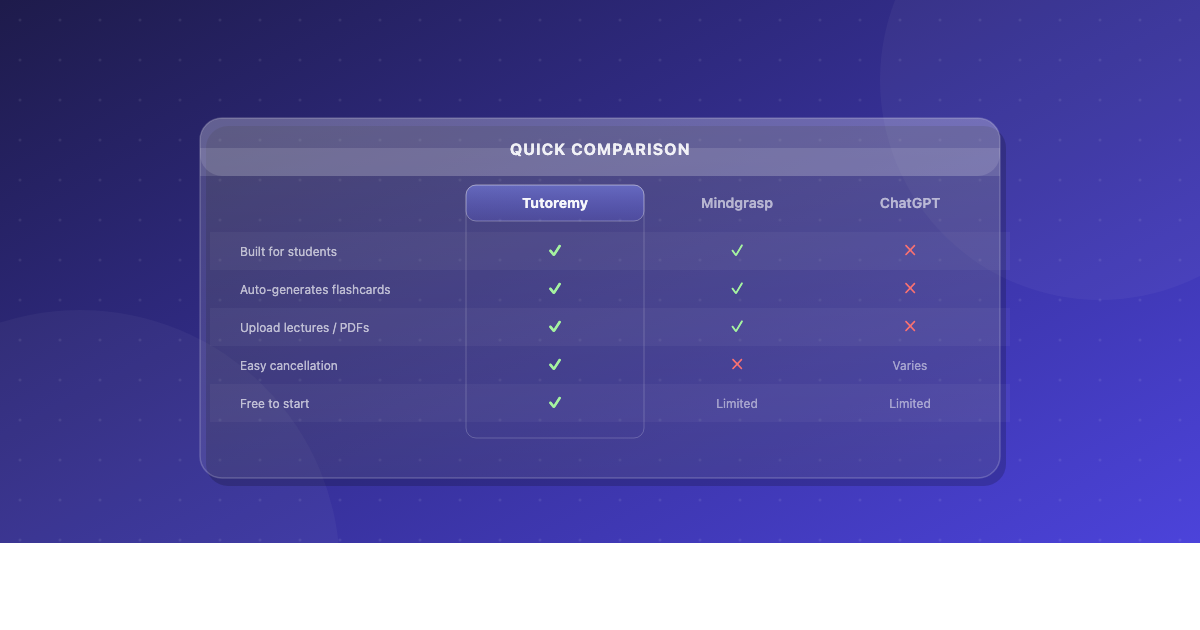
Tutoremy has a real free tier — no trial timer, no credit card. Spaced repetition is built in, so the scheduling decisions get made for you.
When Tutoremy isn't the right answer for a psych student: when you're studying for a research methods exam where you need to actually run a t-test or interpret a regression. Different bucket — see the stats section below.
2. For long-term retention across multiple psych courses — Anki
If you're a psych major (not just taking one psych course), the case for Anki is strong. The community decks for the GRE Psych Subject Test, AP Psychology, and undergraduate intro courses are some of the best in the entire community deck ecosystem.
Anki + a community psych deck means you build a single growing knowledge base across cognitive, developmental, social, abnormal, and biological psych — and the spaced repetition keeps everything fresh, even content from courses you took two semesters ago.
The downside: the Anki interface is rough, the iOS app is
5, and the first week is painful. If you can push through, Anki is unmatched for the long-haul case. If you can't, Tutoremy is the more accessible alternative.
3. For statistics and research methods — JASP, jamovi, or R
For the stats half of psychology (psych majors take more stats than people realize), the right tools are stats software, not study apps.
JASP — free, open-source, designed specifically for psych research. The most beginner-friendly stats software that exists. If your class uses SPSS, JASP can do almost everything SPSS does and is free.
jamovi — similar to JASP, also free, slightly different interface. Either one works.
R (with RStudio) — the standard tool in modern psych research. Free, open-source, much harder to learn than JASP, and worth learning if you're going to grad school. If you're not, JASP is enough.
For the conceptual stats stuff (what's a p-value, what's a Type I vs Type II error, what's effect size), Tutoremy or Anki flashcards are useful. For the procedural stuff (actually running an analysis), use the software.
4. For research papers and citations — Zotero (free)
Psych courses involve a lot of paper reading — primary sources from journals like Psychological Science, JPSP, Cognition, JEP. By upper division you'll be writing literature reviews and original research papers.
Zotero is the right citation manager. Free, open-source, integrates with Word and Google Docs, generates citations in APA format (the standard for psych). EndNote and Mendeley do the same thing for money. Zotero is just better.
For finding the papers themselves: Google Scholar + your university library's database access + PsycINFO (the APA's psych database).
5. For organization — Notion or Apple Notes
You need somewhere to keep your lecture notes, your reading list, your assignment tracker, and the random PDFs your professors send.
Notion — most popular workspace for college students. Free with school email. Build a simple class dashboard and stop tweaking it.
Apple Notes — boring answer that's enough for many students. Free, fast, syncs everywhere.
Pick one. Don't try to organize psych in three places.
6. For the more visual stuff — anatomy and brain regions
Biological psychology and behavioral neuroscience involve a lot of brain anatomy. Flashcards can carry some of this load, but for the spatial anatomy specifically, you'll do better with a tool built for it:
3D Brain (free app) — a 3D model of the brain you can rotate and explore. Each region has a description of its function, related disorders, and damage effects.
Sketchy Psych (paid) — illustrated mnemonic videos for psych concepts. Less famous than Sketchy Med, but useful for the visual learners.
Khan Academy MCAT prep — free, covers a lot of behavioral neuroscience that overlaps with psych courses.
7. For the writing-heavy assignments — Google Docs + Grammarly free
For the essays, research papers, and case studies that psych courses generate:
Google Docs for the actual writing. Free, syncs everywhere, handles comments and suggestions for peer review.
Grammarly's free tier for the polish pass. Catches typos and basic grammar issues. The free tier is enough for undergrad work.
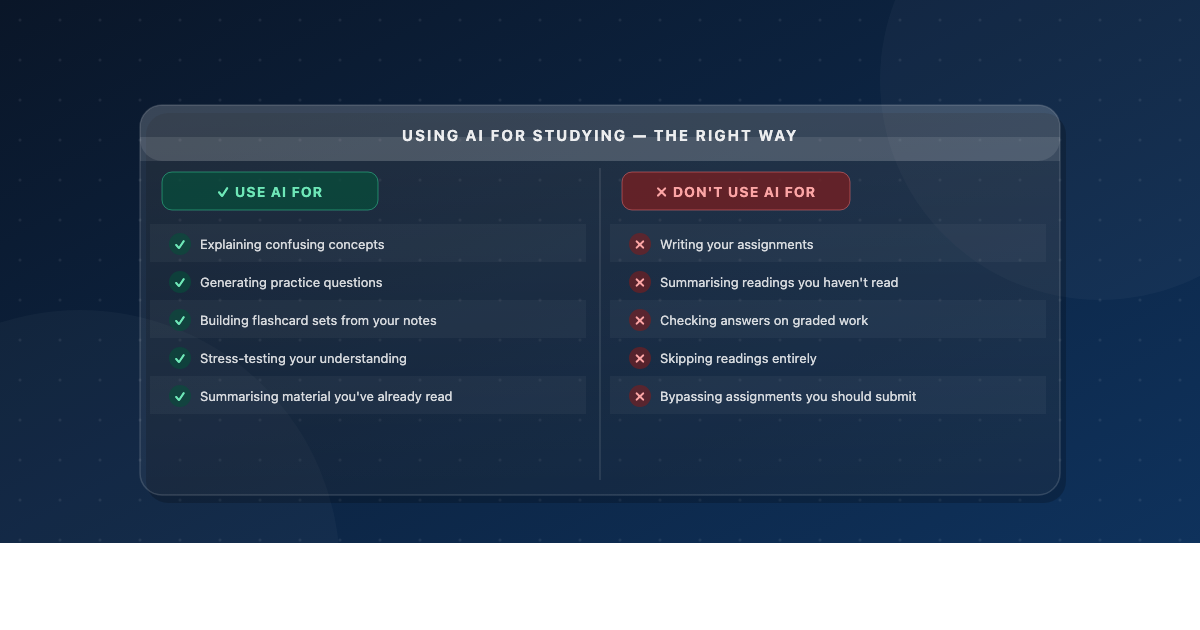
Skip the AI essay generators. They produce mediocre essays that are easy for graders to spot, and using them past a draft is academic dishonesty at most schools.
A worked example: studying for an Abnormal Psych midterm
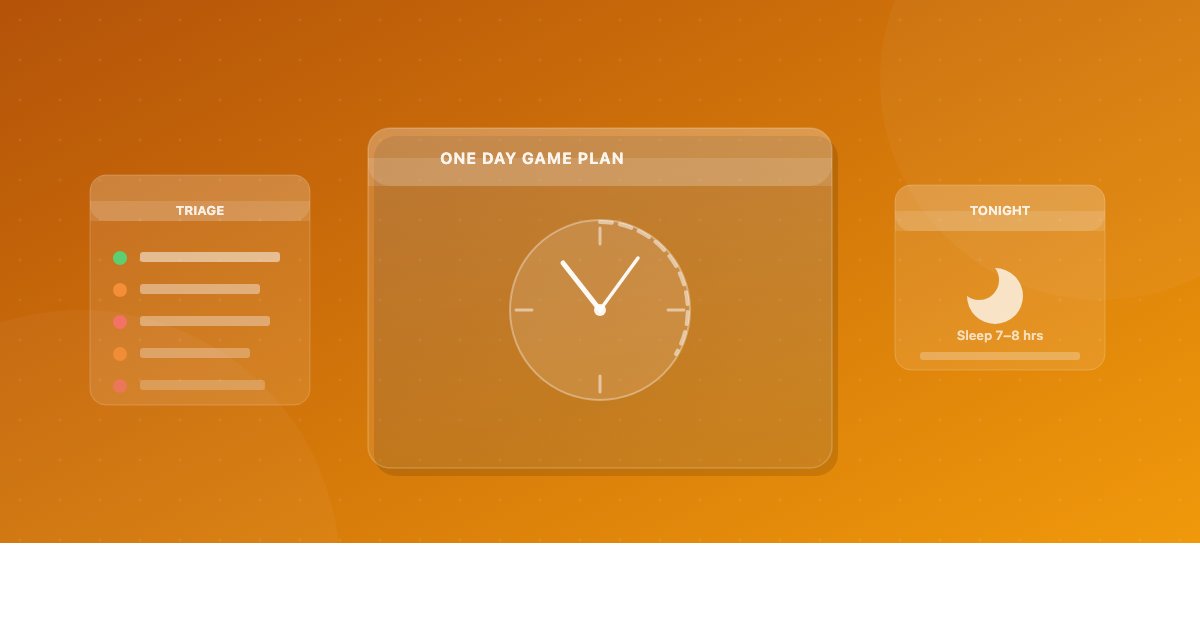
Imagine you have an Abnormal Psych midterm in a week covering anxiety disorders, mood disorders, and personality disorders. The actual workflow:
1. Day 1 (60 minutes): Read the relevant textbook chapters once, actively. Take notes in your own words.
2. Day 2 (45 minutes): Upload your textbook chapters and lecture slides to Tutoremy. Get back ~35 flashcards covering disorders, criteria, theorists, and treatments. Drill them once.
3. Day 3 (30 minutes): Drill the same flashcards again, no notes. Anything you get wrong, go back to the textbook and reread that section.
4. Day 4 (45 minutes): Add a flashcard set for the famous studies (Bandura, Beck, the early lithium trials). Drill the combined set.
5. Day 5 (30 minutes): Take the practice quiz Tutoremy generated. Identify the 5 things you keep getting wrong.
6. Day 6 (30 minutes): Targeted drill on the 5 things. Then a final pass through everything.
7. Day 7 (the day before): Light review only. Walk away. Sleep 8 hours.
Total active study time: ~4 hours over a week. Result: substantially better than the 6-hour cram session most students do the night before, which produces about half the retention.
What to ignore
A few things psych students get told to install that don't help:
"AI essay writers" for psych research papers. The grading rubric for psych papers checks for understanding of the literature, not for polish, and AI-generated essays consistently fail on the literature engagement part.
Quizlet still works for psych content but the paywall on Learn mode in 2026 makes Knowt or Tutoremy better free choices.
Generic "AI tutoring" apps. ChatGPT free tier handles one-off questions, and Khan Academy + your textbook handle the structured learning. Random AI tutor subscriptions aren't worth it.
SPSS if your school doesn't require it. JASP is free and does almost everything SPSS does.
Already studying for a psych course?
Tutoremy has free reference guides on dozens of psychology topics — cognitive psychology, biological bases of behavior, abnormal psychology, social psychology, developmental psychology, and more. Browse the full library at tutoremy.ai/resources/psychology.
TL;DR
Job
Tool
Vocab, theorists, experiments
Tutoremy or Anki
Long-haul retention
Anki + community psych deck
Statistics and research methods
JASP or jamovi (free); R for grad school
Research papers and citations
Zotero + PsycINFO
Brain anatomy
3D Brain app
Organization
Notion or Apple Notes
Writing
Google Docs + Grammarly free
The unranked truth: psych is one of the most flashcard-friendly majors in college. The students who do well are the ones who use active recall consistently, not the ones who reread their notes more times.
---
Tutoremy turns psychology textbook chapters, lecture slides, and study guides into flashcards and quizzes automatically — built around the active recall and spaced repetition science that psych students study but rarely apply to their own studying. Real free tier, no trial timer, no credit card.