How to Memorize Fast for a Test (And the Honest Truth About What "Fast" Actually Means)
Tutoremy Team
Editorial · April 9, 2026
The honest version of "fast"
Search "how to memorize fast for a test" and you get 30 results promising you can learn 10x faster, memorize a chapter in an hour, or master a subject overnight. Most of them are wrong in the same way: they confuse feeling like you know it with actually being able to recall it under pressure.
Here's the part nobody selling a study course wants to say: memorization is not actually fast. The mechanism that moves information into long-term memory is repetition spaced over time, and time is the one ingredient you can't shortcut. The good news is that "fast" still has a real meaning — it's about getting the most retention per hour of studying, not about bypassing how memory works. With the right technique, you can memorize 2–3x more in the same amount of time than someone using the wrong technique. That's the real win.
This post does two things. First, it tells you what the actual science says about memorization (briefly, because you came here to study, not read a textbook). Second, it gives you three concrete protocols depending on how much time you have left: 6 days, 24 hours, and 2 hours. If you only have one of those, jump to your scenario.
What the science actually says (in 90 seconds)
There are decades of research on memorization, and most of it points to the same two findings:
1. Active recall beats rereading by a wide margin. The landmark study here is Karpicke and Roediger (2008): students who tested themselves on material remembered 80% of it a week later. Students who just reread the same material remembered 36%. Same time invested, more than double the retention. Every legitimate study technique on the planet — flashcards, practice tests, the Feynman technique — is some variation of active recall.
2. Spaced repetition beats cramming for anything you need to remember more than 24 hours. Reviewing material 5 times across 5 days will outperform reviewing it 5 times in one sitting, even though the total time is identical. The "forgetting curve" is real, and reviews timed to fight it produce wildly disproportionate results.
That's basically the whole game. Everything else — memory palaces, mnemonics, color-coded notes, the Pomodoro technique — is supporting infrastructure. Active recall + spaced repetition is the engine.
This matters for your "fast" question because it tells you which 80% of common study advice is wasted effort. If you spent the last hour rereading your notes and highlighting things, you got close to nothing for that hour. If you spent the same hour quizzing yourself with the notes hidden, you got real retention. The technique is the variable, not the duration.
What NOT to do (the four anti-techniques)
These four are what most students do by default. They feel productive and they're almost completely useless for memorization:
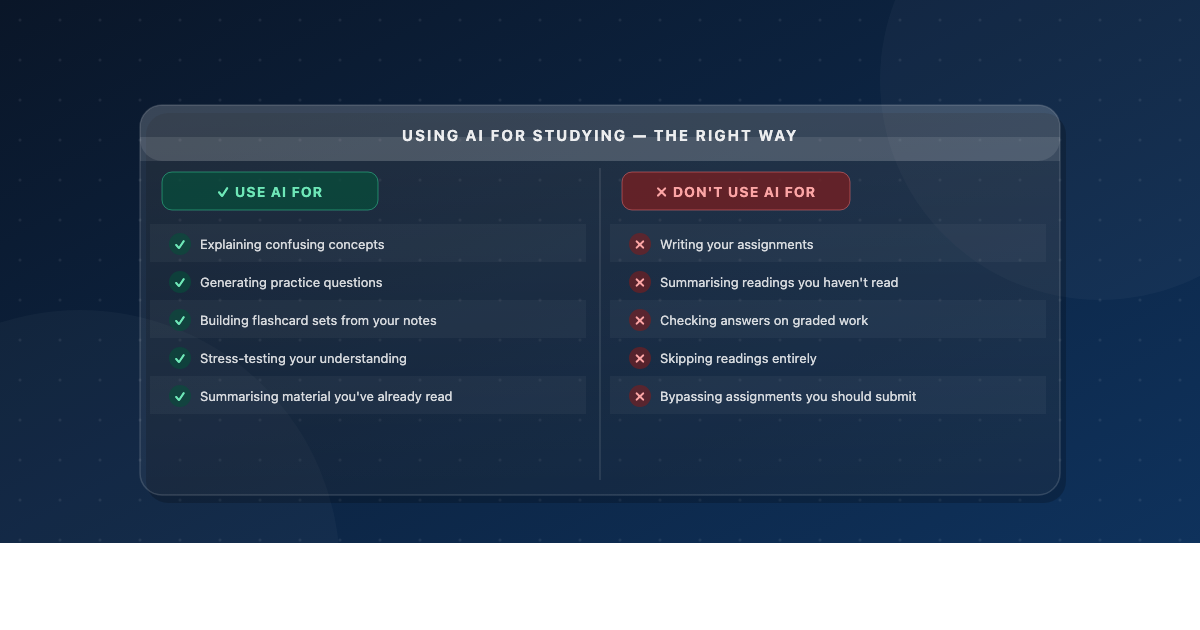
1. Rereading notes or the textbook. Creates the illusion of familiarity. You'll think you know it. You won't. 2. Highlighting or color-coding. Highlighting feels like studying. It is not studying. The act of highlighting does not move information into your memory — only the act of retrieving it does. 3. Watching the lecture again at 1.5x speed. Same problem as rereading, plus the false confidence boost of "I just spent an hour on this." 4. Marathon cramming the night before with no breaks. Past about 90 minutes without a break, retention collapses. You're memorizing less per hour than someone studying half as long with sleep.
If you cut these four habits and replace them with anything resembling active recall, you'll memorize meaningfully faster — even before you adopt any specific technique below.
The one technique that does most of the work
Before the time-budgeted protocols, the one technique you have to internalize is retrieval practice. Here's the entire workflow:
1. Read a chunk of material once (a section, a slide, a paragraph). 2. Close it. Hide it. Look away. 3. From memory, write down or say out loud everything you can remember about it. 4. Open it back up. Check what you missed. 5. Reread only the parts you missed. 6. Try again from memory. Repeat until you can recall the chunk completely. 7. Move to the next chunk.
That's it. Every flashcard app, every study tool, every "method" with a fancy name is some variation of these seven steps. The reason it works is that the act of straining to recall something is what builds the memory trace — not the act of seeing it.
The reason students don't do this naturally is that it's uncomfortable. Rereading feels easy. Trying to remember and failing feels bad. The discomfort is the whole point — it's the muscle being built. If your studying feels effortless, it isn't working.
Protocol 1 — You have 6 days
Six days is the sweet spot. It's enough time for spaced repetition to do its job, and enough time to actually learn material, not just hold it in your head until the test.
Day 1 (60–90 min) - Skim the entire scope of what's on the test. Write down the major topics on a single sheet of paper. Don't try to memorize anything yet — you're building a mental map. - Pick the topic you understand the worst. Read it once. Then close it and write down what you remember. Reread the gaps. Repeat until you can summarize the topic without looking. - This is the hardest day because you're encountering the most unfamiliar material. It's supposed to feel slow.
Day 2 (60 min) - Spend the first 15 minutes recalling what you learned yesterday without looking at the material. Then check. - Move on to a new topic. Same retrieval-practice loop.
Day 3 (60 min) - 15 minutes recalling Days 1 and 2 from memory. Check. - New topic for the rest of the session.
Day 4 (75 min) - Do a "mock test" — generate practice questions covering everything from Days 1–3. This is where a tool like Tutoremy helps if you'd rather not spend 20 minutes writing your own questions: upload the source material and Tutoremy generates a quiz from it. (If you'd rather do it manually, that works too — the technique matters more than the tool.) - Spend the rest of the session on the next topic.
Day 5 (60–90 min) - Full retrieval pass: every topic, no notes, written from memory. This will feel terrible. That's the signal it's working. - Reread anything you can't recall. Re-test 30 minutes later.
Day 6 — the day before the test (45–60 min) - Do not learn new material. Reinforce only. - One full mock test covering everything. - Targeted retrieval on the 3–5 things you keep getting wrong. - Sleep at least 7 hours. Sleep is when consolidated memories become permanent. This is not optional.
This protocol gets you to roughly 80% retention of an entire test's material, with about 6 hours of total work. Compare that to the 8 hours of cramming most students do the night before, which produces something closer to 30%.
Protocol 2 — You have 24 hours
This is where most students live. The honest answer is: you cannot learn an entire semester in 24 hours, but you can maximize what you retain. Here's how:
Hour 0–1: Prioritize ruthlessly. Look at the test scope. Identify the 30% of topics that will produce 70% of the points. (Hint: it's the topics your teacher repeated, the topics on practice problems, and the topics in any review sheet.) Ignore everything else. Trying to cover all of it will leave you with 30% retention of everything instead of 80% retention of the important parts.
Hour 1–4: First retrieval pass. For each priority topic: read it once, close it, recall from memory, check, repeat. Do not move on until you can recall the topic without looking. This is the most important block of the day.
Hour 4–5: Break. Eat. Walk outside. Don't look at your phone (your brain is consolidating). 60 minutes is the minimum useful break.
Hour 5–8: Quiz yourself on everything from Hour 1–4. If you have a tool that auto-generates practice questions from your material, this is the moment to use it — it's much faster than writing your own. Tutoremy has a free tier that can do this from your uploaded notes or slides, which is why we built it for exactly this scenario. If you don't want to use a tool, write your own questions.
Hour 8: Sleep. Yes, sleep. Sleep is the second half of memorization, not a waste of study time. Six hours of sleep beats two extra hours of cramming for retention. This is one of the most counterintuitive findings in the entire field, and it's backed by every study on the topic.
The morning of the test: 30 minutes of pure retrieval. No new material. Just recall everything, identify the 2–3 things that didn't stick, and reinforce them.
Protocol 3 — You have 2 hours
OK, you really procrastinated. The honest disclaimer: 2 hours is not enough time to learn material from scratch — it's only enough time to retrieve and organize material your brain has already partially encoded from class. If you didn't go to class or do any of the readings, this protocol won't save you.
Minute 0–10: Identify the 5–7 most likely test topics. Be ruthless. Do not try to cover everything.
Minute 10–60: For each topic, do one retrieval pass: read briefly, close, recall, check, repeat once. Move on. Don't perfect anything — get to good enough on as many topics as possible.
Minute 60–90: Quiz yourself on all 5–7 topics. Mix the order (interleaving — it forces your brain to discriminate between similar concepts). Identify the 2 worst.
Minute 90–110: Reinforce the 2 worst topics with another retrieval pass.
Minute 110–120: Walk away from your notes. Do something physical. Let your brain consolidate. Do not cram into the last 5 minutes — it adds anxiety, not retention.
This won't get you an A on a test you didn't prepare for. It will get you 5–10 percentage points more than walking in cold, which is sometimes the difference between passing and failing.
Memory tricks that legitimately help (and when to use them)
Most "memorization techniques" listed in study guides are mnemonic systems — clever ways to make a piece of information stick in your head. They have a specific niche: they're useful when you need to memorize arbitrary, unconnected facts (the 12 cranial nerves, the periodic table groups, the order of the U.S. presidents, vocabulary in a foreign language).
The two that actually deliver:
The memory palace (method of loci). Mentally walk through a place you know well — your house, your school — and place each item you need to remember at a specific spot. To recall the list, mentally walk the route. This works astonishingly well for ordered lists. It's not useful for understanding concepts.
Acronyms and acrostics. "ROY G BIV" for the visible spectrum. "Please Excuse My Dear Aunt Sally" for order of operations. Cheap, fast, and the brain loves them.
When mnemonics don't help: anything that requires understanding rather than recall (math problem-solving, essay material, historical analysis, applied science). For that material, the only thing that works is retrieval practice on the actual concepts.
The boring stuff that actually matters
These don't sound exciting, but the research on each is overwhelming:
- Sleep 7+ hours the night before. Sleep is when short-term memories get committed to long-term storage. Sleeping less than 6 hours measurably destroys exam performance. Every cramming session that costs you 2 hours of sleep is a net negative.
- Eat actual food. Your brain runs on glucose. Skipping meals before a test does measurable damage to your working memory.
- Take breaks every 45–90 minutes. Not phone breaks. Walking-outside breaks. Five minutes of doing nothing beats five more minutes of low-quality studying.
- Caffeine yes, energy drinks no. Moderate caffeine (1–2 cups) helps focus and recall. Energy drinks crash you mid-test.
Where Tutoremy fits (briefly)
Most of this post is technique, not tools — because the technique is what does the work. But the slowest part of any of these protocols is the manual labor of generating quiz questions from your material. That's the part where a tool legitimately saves you time.
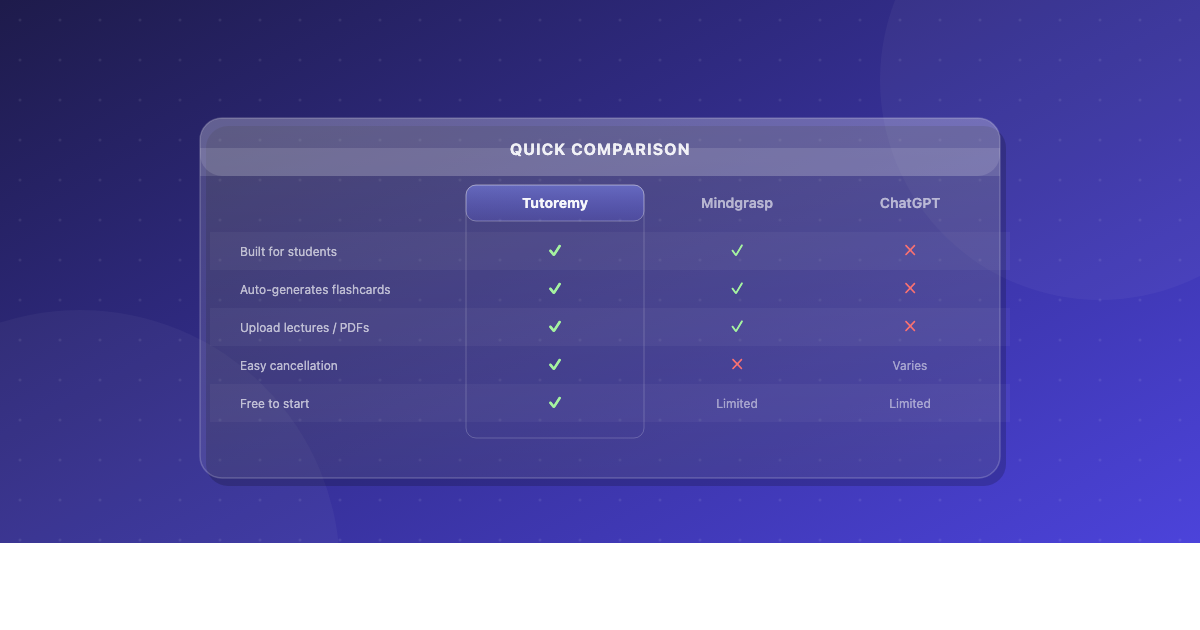
Tutoremy is built around this workflow: upload your lectures, slides, notes, or textbook chapters, and it generates flashcards and practice quizzes from them automatically. Spaced repetition is built in, so the scheduling decisions get made for you. It has a free tier — not a 7-day trial — because most students hitting this post are looking at a test in the next 24–48 hours and don't have time for a credit card flow.
If you'd rather do it manually, that works too. The protocols above are technique-first — pick the time bucket you have, follow the loop, and you'll memorize meaningfully more than you would by rereading.
TL;DR
- "Fast" is mostly a myth, but technique can 2–3x your retention per hour.
- Active recall beats rereading by a factor of 2.
- Stop highlighting. Stop rewatching lectures. Stop rereading.
- Use the protocol that matches your time: 6 days, 24 hours, or 2 hours.
- Sleep is part of memorizing, not the opposite of it.
- The discomfort of trying to recall and failing is the muscle being built. Don't run from it.
---
Tutoremy turns your lectures, notes, and slides into flashcards and practice quizzes automatically — built around the active recall and spaced repetition science this whole post is based on. Free tier always available, no trial timer.