How to Study for College Exams: A System That Actually Works
Tutoremy Team
Editorial · February 28, 2026
You probably already know that cramming the night before an exam isn't a great strategy. You've also probably done it anyway, gotten a decent grade, and told yourself it worked.
Here's the problem: it did work — for that exam. But the evidence on what actually produces lasting learning, and what just gets you through the next 48 hours, points in a very different direction.
This post is about building a study system that works past the exam. Not just for passing, but for actually retaining what you learned.
Why Most Students Study Wrong
A major review by Dunlosky and colleagues at Kent State University evaluated ten of the most common study techniques students rely on. Two techniques — distributed practice and practice testing — were rated high utility, meaning they produced meaningful gains across nearly every subject, age group, and type of learner.
The techniques most students actually use — highlighting, rereading, and summarizing — were rated low to moderate utility. They feel productive. They're not.
That gap between what works and what feels like it works is where most students lose exam points.
The Core Problem With Cramming
When you cram, you're loading information into working memory — not long-term memory. Research by Ebbinghaus established over a century ago that without reinforcement, people forget roughly 50% of new information within an hour and up to 70% within 24 hours. Cramming exploits a short window. It doesn't build anything durable.
The deeper problem: cramming feels effective because you can recall things right after studying them. That's working memory doing its job. It tells you nothing about what you'll remember in three days, or three weeks, when the next exam or cumulative final comes around.
If your exams are cumulative — and most college exams eventually are — cramming actively works against you.
A Study System That Actually Works
Here's a repeatable system built on what the research actually supports.
Step 1: Build your study schedule backwards from the exam date
Start with the exam date and work backwards. Most students do the opposite — they start studying when panic sets in and race toward the deadline. That's massed practice, and it's consistently outperformed by spaced practice even when the total hours studied are identical.
A simple rule: give yourself at least five study sessions spread across the time between now and the exam. Six or seven is better. Each session should cover the same material from a different angle — not just repeat the same pass.
Step 2: Know what you're actually being tested on
Before you study anything, spend 15 minutes mapping out the exam. What chapters or lectures does it cover? What format — multiple choice, short answer, essay? Has the professor signaled anything in class about what to focus on?
This sounds obvious, but most students skip it. They study everything equally, which means they study the low-yield material just as hard as the high-yield material. Time is the constraint. Know where to spend it.
Step 3: Generate your study materials, don't just consume them
The most common mistake in exam prep is passive consumption — rereading notes, rewatching lectures, reviewing slides. These feel like studying. The research is clear that they produce significantly less retention than active generation.
Active generation means: taking notes in your own words, writing flashcards from scratch, creating practice questions from the material, trying to explain a concept out loud before you look it up. The act of producing information is what strengthens the memory — not the act of receiving it again.
Step 4: Use practice testing as your primary study method
Once you have study materials, the most effective thing you can do is test yourself on them — repeatedly, and without looking. Roediger and Karpicke (2006) found that students who studied and then took practice tests retained substantially more after a week than students who spent the same time restudying. The act of retrieval — pulling information out of memory — is what makes it stick.
Practice tests don't have to be formal. Flashcards count. Closing your notes and trying to write down everything you remember counts. Explaining the material to someone (or to your wall) counts. The form matters less than the act of retrieval.
Step 5: Review what you got wrong, not what you got right
Most students review their correct answers after a practice test. This is comfortable and useless. The value is entirely in the mistakes — specifically in understanding why you got something wrong.
For every wrong answer: identify whether it was a knowledge gap (you didn't know the information), a comprehension gap (you knew it but didn't understand it well enough to apply it), or a careless error (you knew it and made a mistake). Each type of mistake has a different fix.
The Night Before: What to Actually Do
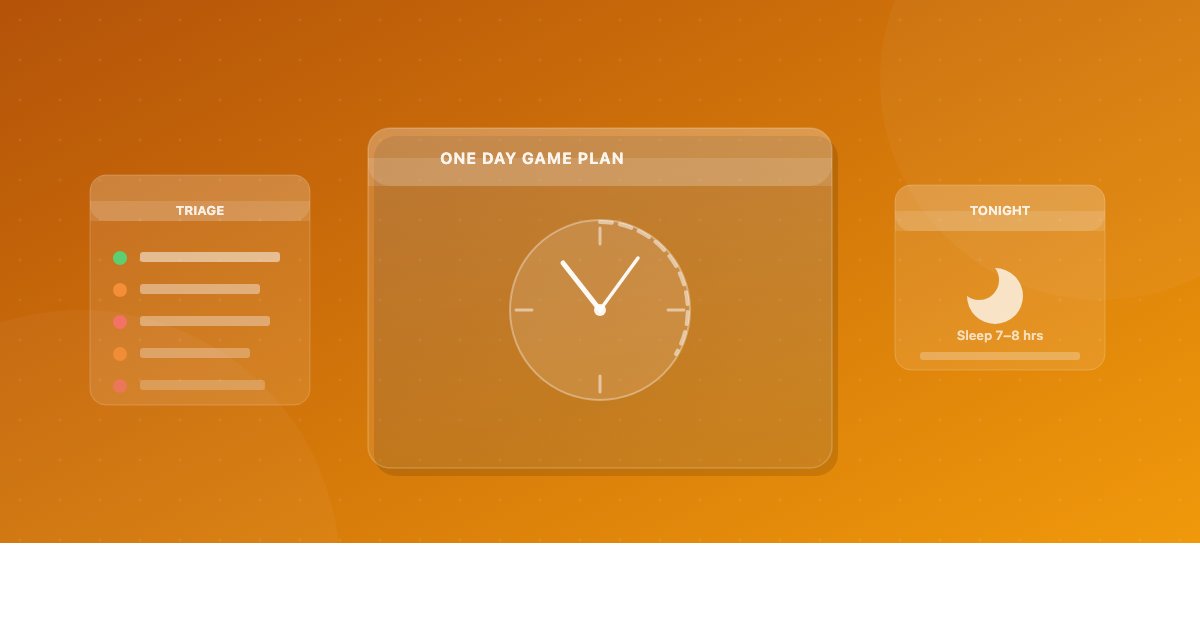
By the night before, you should have done the real studying already. The night before is not a study session — it's a light review.
Go through your flashcards once. Read through your summary notes. Make sure you have a clear mental map of the major topics and how they connect. Then stop.
Sleep matters more than one more hour of studying. Memory consolidation — the process by which short-term memory is converted into long-term memory — happens during sleep. Cutting it short to study undercuts everything you've done over the previous week.
Where AI Study Tools Fit Into This
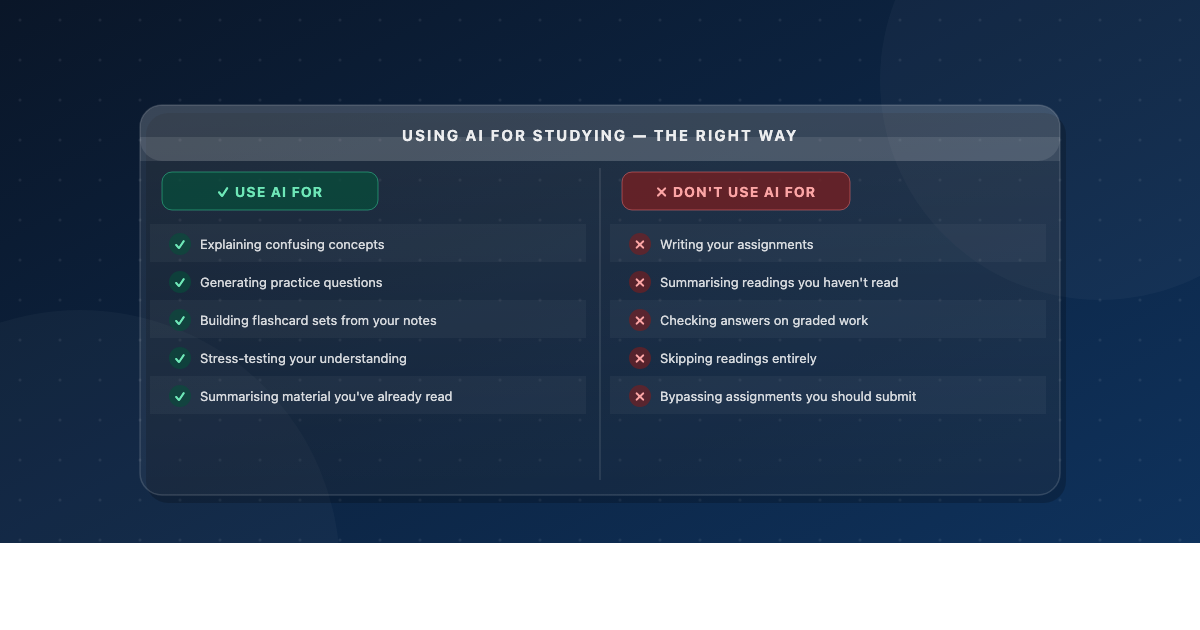
The system above works. It also takes time to set up — building flashcards from scratch, generating practice questions, summarizing material in your own words.
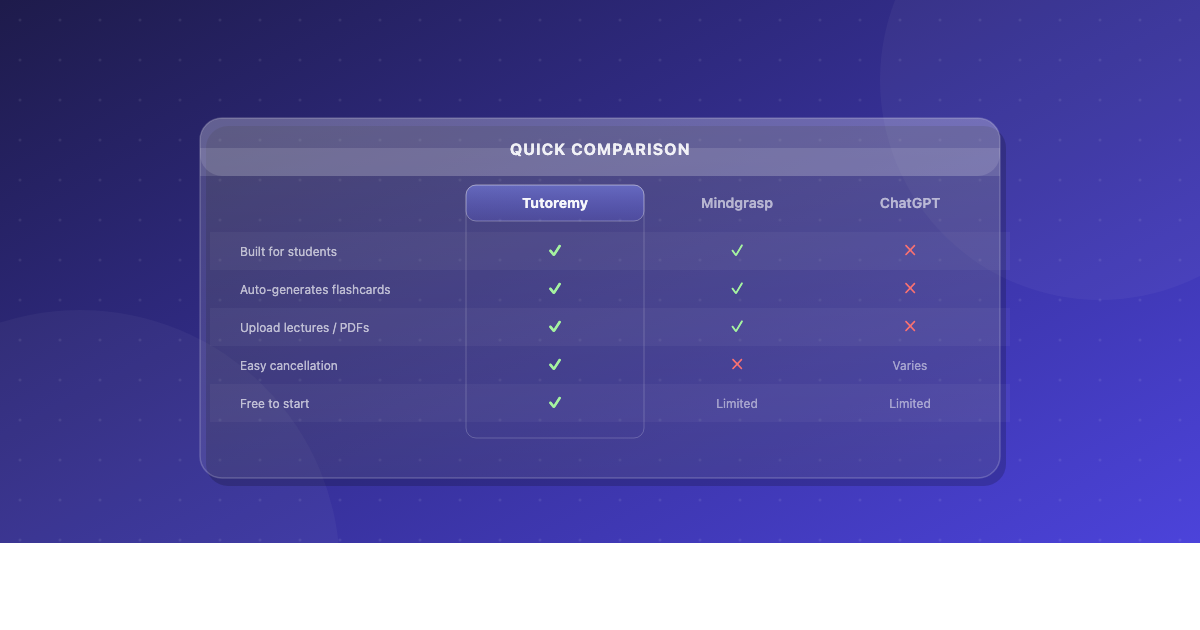
This is where a tool like Tutoremy can compress the setup phase. Upload your lecture recordings or course PDFs, and Tutoremy generates structured notes, flashcard sets, and practice quizzes automatically. The materials are built from your actual course content — not generic internet summaries.
That gets you to the part that matters — active retrieval and spaced practice — faster. The tool handles the generation. The learning is still on you.
The Short Version
Start earlier than you think you need to. Space your study sessions out. Test yourself on the material instead of rereading it. Review your mistakes. Sleep before the exam.
None of this is complicated. Most students just don't do it, because cramming feels like it works until suddenly it doesn't.