How to Study with ADHD (When Standard Study Advice Doesn't Work)
Tutoremy Team
Editorial · April 9, 2026
Why most ADHD study advice misses the point
If you've ever Googled "how to study with ADHD," you already know the standard list: take breaks, use the Pomodoro technique, find a quiet space, color-code your notes, get more sleep. It's not wrong. It's just the same advice given to every student on Earth, with the word "ADHD" added to the headline.
The reason that advice underperforms for ADHD students isn't that the techniques are bad. It's that they don't address the actual mechanism that makes studying hard for an ADHD brain. Telling someone with ADHD to "just take a 5-minute break every 25 minutes" assumes the problem is endurance. The real problem is usually one of three things: the task isn't stimulating enough to hold attention, the activation cost to start is too high, or the time-blindness makes it impossible to feel how much time is passing. None of those get fixed by a Pomodoro timer alone.
This post is for the version of you that has read 30 ADHD study guides, tried the techniques, and still can't get yourself to open the textbook. We make Tutoremy, an AI study app that ends up being a good fit for ADHD studying for reasons we'll get into — but most of the post is technique and reframing, not product. The technique matters more than the tool.
A quick disclaimer: this isn't medical advice. Medication, therapy, and accommodations from your school's disability office matter enormously and should be the foundation. This post is about the technique layer that sits on top of all that.
The three things that are actually different about an ADHD brain studying
Forget the listicles. Here's what's actually going on under the hood, in plain language:
1. The reward signal is delayed. Studying for a test next week pays off in a week. Neurotypical brains can hold "I'll be glad I did this" as motivation. ADHD brains don't get the dopamine signal until the reward is closer to immediate — sometimes as close as 30 seconds away. This is why a study session can feel impossible at 4pm and effortless at 10:30pm the night before the exam (because now the reward is finally close enough).
2. Activation cost is enormous. The hardest part of studying with ADHD is not the studying itself. It's the 90 seconds before the studying — the part where you have to put down your phone, close 11 tabs, decide which subject to start with, find your notes, sit down, and actually open the file. For most ADHD brains, that 90-second activation is harder than the next two hours of focus combined. Once you're in, you can hyperfocus for 3 hours straight. Getting in is the wall.
3. Time blindness. ADHD brains often perceive time as now and not now. Anything more than a day or two away feels equivalent to "doesn't exist yet." This is why ADHD students cram brilliantly the night before but cannot start a week early no matter how many planners they buy. The week-from-now version of the test isn't real to your brain yet.
Almost every ADHD-specific study strategy is really an attempt to engineer around one of these three. The Pomodoro technique addresses #1 (it makes the reward — the break — close enough to feel motivating). Body doubling addresses #2 (someone else being there lowers the activation cost). External deadlines and reminder systems address #3.
If you understand which of the three is actually getting you, you can pick a fix that targets it. Most generic study advice doesn't help because it's a fix for a problem you don't have.
The activation problem (and how to actually solve it)
For most ADHD students, this is the biggest one. You know what to study. You know how to study. You just cannot get yourself to start.
The standard advice is "just do five minutes." That works sometimes. Here's why it often doesn't, and what works better:
Make the first action smaller than "start studying." "Start studying" is too abstract for an ADHD brain to act on. "Open the PDF" is a concrete action. "Read the first sentence out loud" is even better. The trick isn't to commit to studying — it's to commit to a single physical action so small that the activation cost evaporates. Once you've read the first sentence, you're already studying.
Pre-position your materials. The night before, leave your laptop open to the file you'll start with. Leave the textbook open to the right page. Put a sticky note that says "first action: read the highlighted paragraph" on the keyboard. Removing the friction of finding what to study often does more than any focus technique.
Use environment switching as the on-ramp. Walking from your bed to a desk, or from your apartment to a library, gives your brain a physical state-change that helps activation. A lot of ADHD students discover that they cannot study at home at all, but can study fine in a coffee shop, library, or empty classroom. This isn't laziness — it's a real neurological pattern. If home doesn't work, stop trying to make it work.
Body doubling. Studying alongside someone else (literally, in the same room, both working on something) lowers activation cost dramatically for most ADHD brains. The other person doesn't have to be doing the same subject. They don't even have to be studying. They just need to be present and engaged in their own thing. This is why ADHD students often do best in libraries even when they could study anywhere.
Eat the worst-tasting frog first. If you can pick the most boring, low-stimulation subject as the very first thing you do when you sit down, you'll often find that the reward of "now I get to do the more interesting subject" is enough to pull you through. Saving the boring subject for last is a trap — by the time you get to it, your dopamine reserves are empty and you'll bail.
The dopamine problem (and how to fight it without becoming dependent on novelty)
Standard advice: "just push through, it'll get easier." It won't, not in the way it does for neurotypical brains. Your brain genuinely needs more stimulation to stay engaged with the same material. Here's how to give it that without resorting to studying with three browser tabs of TikTok open.
Add a second input channel. Reading the textbook alone is the lowest-stimulation version of studying. Reading the textbook while listening to a YouTube video that explains the same chapter, or while a tutor (or AI tutor) is asking you questions, is significantly higher stimulation. Two channels saturate the brain enough to hold focus.
Use active recall instead of rereading. Rereading is low-stimulation and feels like nothing is happening. Active recall — closing the book and trying to remember what you just read, or answering quiz questions — is a continuous low-grade challenge that ADHD brains find easier to stay engaged with. This is the single biggest swap you can make.
Quiz format is dramatically easier than note-taking format. If "open your notes and study" feels impossible but "answer 10 questions" feels manageable, that's because the quiz format provides constant micro-rewards (right answer = small dopamine hit). Most ADHD students who struggle with traditional studying find that flashcards and quizzes feel almost addictive in comparison. Tutoremy generates these from your uploaded course materials automatically — we're going to be honest: this is one of the use cases where an AI study tool genuinely changes the game for ADHD students, because it removes the activation cost of making the questions.
Fidget while studying. Fidget toys, walking on a treadmill, doodling, chewing gum — these are not childish workarounds. They are functional dopamine supplements. They free up the focus channel that would otherwise wander.
Stand up, move, switch posture. Sitting still for 90 minutes is harder for an ADHD brain than studying for 90 minutes. Standing desks, walking while reviewing flashcards, and pacing while practicing recall all work. You will feel less guilty for "not sitting properly" if you remember that the alternative is not studying at all.
The time-blindness problem (and how to make the future feel real)
ADHD time-blindness is the reason a test in 8 days might as well not exist, and the reason you suddenly find it possible to study at 11pm the night before.
Compress the time horizon. Don't tell yourself "I have a test in a week." Tell yourself "I have a quiz tomorrow morning that covers chapter 3." Then actually take that quiz tomorrow morning — even if it's a quiz you give yourself. Self-imposed quizzes turn an abstract future test into a concrete tomorrow event.
Externalize the deadlines. Telling yourself you'll study isn't enough. Tell a friend you'll text them what you scored on a self-quiz at 8pm. Schedule a study session with a classmate for a specific time. Anything that converts "I should study sometime" into "at 8pm, this person is expecting something from me" works.
Use a visible timer, not a clock. A clock tells you the time. A visible countdown timer shows you time passing. Time-blind brains often cannot perceive duration without seeing it shrink in real time. A 30-minute visual timer running on your desk does more than a watch ever could.
Build a streak. Once you've studied for 3 days in a row, the desire to keep the streak alive can do more than any motivation lecture. ADHD brains hate breaking streaks because the loss of progress is immediate and visceral — it activates a much closer dopamine signal than "you'll do well on the test."
What "Pomodoro" actually means for ADHD (it's not 25-on / 5-off)
The standard Pomodoro is 25 minutes of work followed by 5 minutes of break. For most ADHD students this is wrong in both directions. Here's a more useful framing:
- If you can't get started: Try 5 minutes on / 2 minutes off. The point is to lower the commitment so the activation cost disappears. You'll often find you blow past the 5-minute mark.
- If you have started and you're in flow: Don't stop at 25 minutes. ADHD hyperfocus is rare and precious. If you're locked in, ride it for as long as it lasts — sometimes 90 minutes, sometimes 3 hours. Stopping for an arbitrary "break" can break the spell entirely.
- If you're stuck and grinding (not flowing): Stop sooner. Push through is the wrong move. Take a real walking break. Come back with a different subject or different format.
The right Pomodoro length is the one that matches the state you're in, not the one a productivity app tells you to do.
A study session blueprint that actually works for ADHD
Here's a session structure built around the three problems above:
1. Pre-position (the night before): Decide what you'll study and leave it physically open and ready. No decisions in the morning. 2. Environment shift: Go somewhere that isn't your bed. Library, coffee shop, friend's place, empty classroom. Body doubling if available. 3. Smallest possible first action: Open the file. Read one sentence out loud. Don't try to commit to a session length — commit to the first 60 seconds. 4. Switch to active format within 5 minutes: As soon as you can, swap from passive (reading) to active (answering questions, flashcards, practice problems). The dopamine difference is huge. 5. Use a visible timer: Set a 25-minute count-down timer where you can see it shrinking. If you're in flow at 25, keep going. If you're not, take a real break — leave the desk. 6. Stack subjects by interest: Hardest/most boring subject FIRST while your dopamine is highest. The interesting subject is the reward. 7. End with a "tomorrow's first action" sticky note: Write the literal first action you'll take in tomorrow's session. Future-you will thank you.
This is not a magic formula. It's the lowest-friction structure I know of for an ADHD brain. Modify it freely.
Where Tutoremy fits (briefly and honestly)
Most of this post is technique, not product. But one of the consistent feedback patterns we hear from ADHD students using Tutoremy is that the workflow happens to remove a few of the biggest activation barriers:
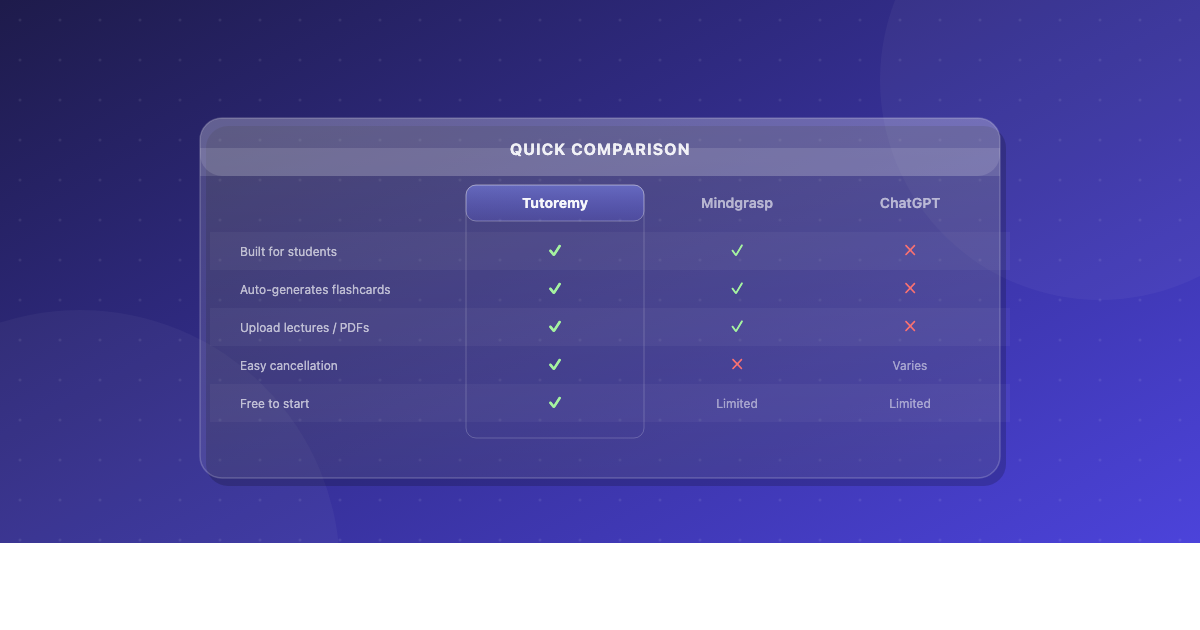
- You don't have to make flashcards. Upload the source material; you get questions instantly. The activation cost of "make a study set first" — which is where most ADHD students stall — is gone.
- The quiz format itself is more dopamine-friendly than rereading. Right answer → micro-reward. ADHD brains respond to this structure much better than to passive reading.
- The spaced-repetition scheduling is automatic. You don't have to remember when to review. The app surfaces the right material at the right time. Time-blindness is partially handled for you.
- It has a real free tier, which matters specifically for students who have already paid for accommodations, tutoring, and/or medication. We don't want price to be one more activation barrier.
Tutoremy is not a cure for ADHD. Nothing on the App Store is. It's a tool that happens to remove a few specific friction points that disproportionately affect ADHD studying. Use it if it helps. Use Anki, Knowt, or your own paper flashcards if those help more. The technique matters more than the brand.
What to do this week
If you remember nothing else from this post, do these three things this week:
1. Identify which of the three problems is your biggest one: activation, dopamine, or time-blindness. Stop using techniques aimed at the wrong problem. 2. Switch from rereading to active recall on at least one subject. Use any tool — Tutoremy, Quizlet, Anki, hand-drawn flashcards, or even just closing the book and trying to recall it. The format swap is more important than the tool. 3. Pre-position one study session before bed tomorrow. Pick the file. Open it. Set the sticky note. Reduce the morning decision count to zero.
That's it. Don't try to implement everything in this post in one week. Pick one technique aimed at your specific bottleneck and try it for five days. If it works, add another. If it doesn't, try a different one.
Studying with ADHD is harder than studying without it. Pretending otherwise — or shaming yourself for needing different strategies — burns energy you can't afford to lose. The goal isn't to study like a neurotypical student. It's to study in a way that works for the brain you actually have.
---
Tutoremy turns your lecture notes, slides, and PDFs into flashcards and practice quizzes automatically — removing the activation cost that's usually the hardest part of studying with ADHD. Free tier always available, no trial timer, no credit card.