How to Take Better Notes in College (And Actually Use Them Later)
Tutoremy Team
Editorial · March 8, 2026
Most note-taking advice skips the hard part: not how to take notes, but how to make notes that are actually worth reviewing later.
By the end of a typical semester, most students have notebooks and folders full of content they barely remember writing — and wouldn't know how to study from even if they tried. That's not a time problem. It's a system problem.
This post covers what the research says about effective note-taking, which methods work for which situations, and how to build a review habit that makes your notes count.
Why Most Notes Don't Work
Notes fail for two reasons that are almost always present at the same time: too much transcription and too little review.
On the transcription side, the default for most students is to try and capture as much of the lecture as possible — either by typing fast or scribbling everything down. Research by Mueller and Oppenheimer (2014) found that students who took notes on laptops tended to transcribe lectures verbatim, which produced shallower processing and worse performance on conceptual questions — even when they weren't distracted and used the laptop only for notes. Students who wrote by hand, forced to keep up with a slower medium, naturally had to summarize and paraphrase, which deepened encoding.
That said, a 2019 replication study found the handwriting advantage wasn't consistent across all conditions, so the laptop-versus-paper debate is still live. What both sides of the research agree on: the quality of processing matters more than the tool. Transcription — in any format — doesn't produce learning. Synthesis does.
On the review side, most students take notes once and look at them once — the night before the exam. By that point, notes are weeks old, the context is gone, and reviewing them is about as effective as reading someone else's notes. Your past self took those notes. Your current self has to reconstruct the meaning from scratch.
Three Note-Taking Methods Worth Knowing
No single method works for every course. Here are three that have the most evidence behind them and the clearest use cases.
The Cornell Method
Developed by Cornell education professor Walter Pauk in the 1950s, the Cornell method divides each page into three sections: a main notes area on the right (where you write during the lecture), a narrow cue column on the left (filled in after class with questions or keywords), and a summary box at the bottom. Research comparing note-taking strategies has found Cornell note-taking outperforms verbatim transcription in information retrieval — largely because the cue column forces active review and self-testing, and the summary section requires synthesis.
The format also naturally sets up spaced retrieval practice: cover the notes, read the cue, try to recall the content. That's a built-in quiz mechanism most students never use.
Best for: Lecture-heavy courses where the professor presents structured content with identifiable main points — introductory sciences, history, economics.
Outline Method
The outline method organizes information hierarchically as the lecture unfolds — main topics on the far left, subtopics indented beneath them, supporting details further in. It's fast, flexible, and works well when the lecture itself follows a clear structure.
The risk is false confidence: an outline can look comprehensive while missing the relationships between ideas. If you're just recording the hierarchy without understanding why concepts connect, the notes will look organized but won't support deep review.
Best for: Courses with well-organized lectures that follow a consistent structure — political theory, literature, formal lectures in any discipline.
Concept Mapping
Concept mapping builds a visual network of ideas on the page, drawing explicit connections between concepts rather than recording them sequentially. It's slower and harder to do in real time, which makes it better suited to review and consolidation than live note-taking.
The act of building a map forces you to ask: how does this idea relate to that one? That question is exactly what your brain needs to be answering during review — and rarely gets asked when you're just rereading linear notes.
Best for: Complex courses with dense interconnected content — organic chemistry, advanced theory, anything where exam questions test application rather than recall.
What Actually Makes Notes Useful
The method matters less than what happens in the 24 hours after the lecture. Most of the work that turns raw notes into durable memory happens during review, not during the lecture itself.
Review within 24 hours
Ebbinghaus's forgetting curve — documented as far back as 1885 and replicated consistently since — shows that memory drops steeply in the hours immediately after learning. Reviewing your notes the same evening or the following morning, while the lecture is still relatively fresh, takes far less time than relearning the same material a week later. It also gives you the opportunity to fill gaps, clarify confusing points, and write the cue column while context still exists.
Rewrite in your own words, not theirs
After a lecture, go through your notes and identify anything you wrote down but can't actually explain. Rewrite those sections in your own words. If you can't paraphrase it, you don't understand it — and you haven't learned it yet, regardless of how accurate your transcription was.
This is uncomfortable. That discomfort is the learning happening.
Turn notes into questions
The most useful transformation you can make to any set of notes is to convert the content into questions. For every concept, write: "What is this?" "Why does it matter?" "How does it connect to X?" These questions become your study material. Practice testing is one of the highest-utility study strategies identified in the research — and turning your own notes into questions is one of the most direct ways to build that kind of retrieval practice into your existing workflow.
Where AI Note-Taking Fits In
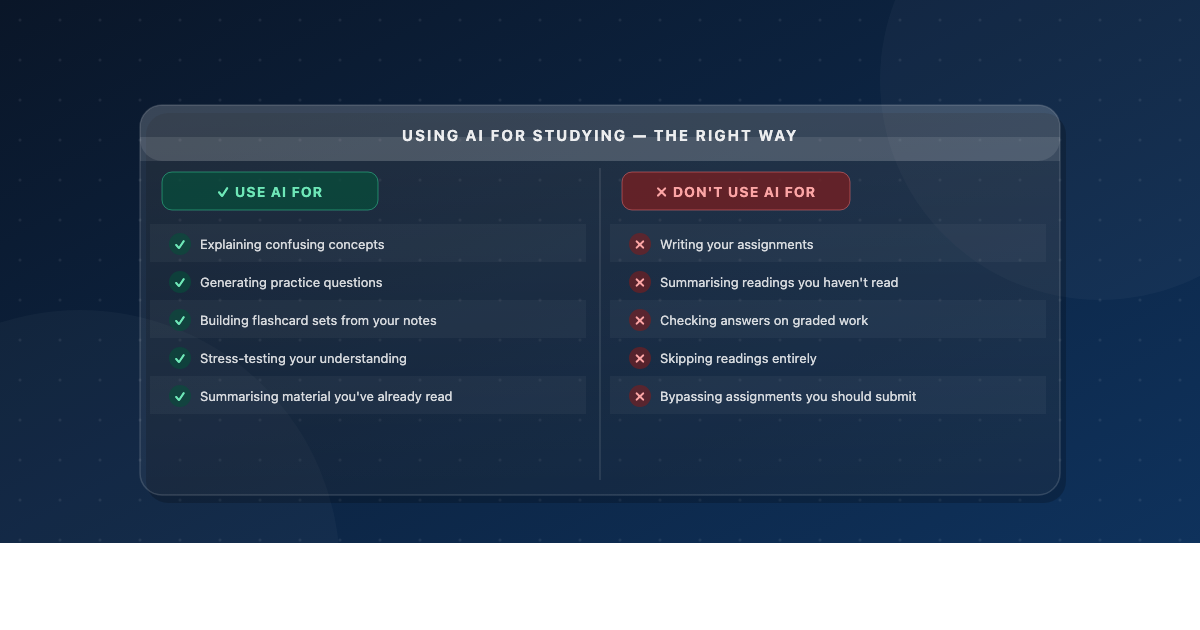
A growing number of students use AI tools to generate notes from lecture recordings — uploading audio or video and getting structured summaries in return.
This is genuinely useful for one specific problem: getting organized source material faster. If you've recorded a lecture and don't have time to process it by hand, AI-generated notes can give you a structured starting point — main concepts identified, vocabulary pulled out, key ideas organized — in a fraction of the time manual processing would take.
What AI can't do is build the understanding. Reading AI-generated notes is still passive consumption. The encoding happens when you engage with the material — when you paraphrase it, question it, and try to retrieve it from memory. AI notes are a better starting point than raw recordings; they're not a substitute for active review.
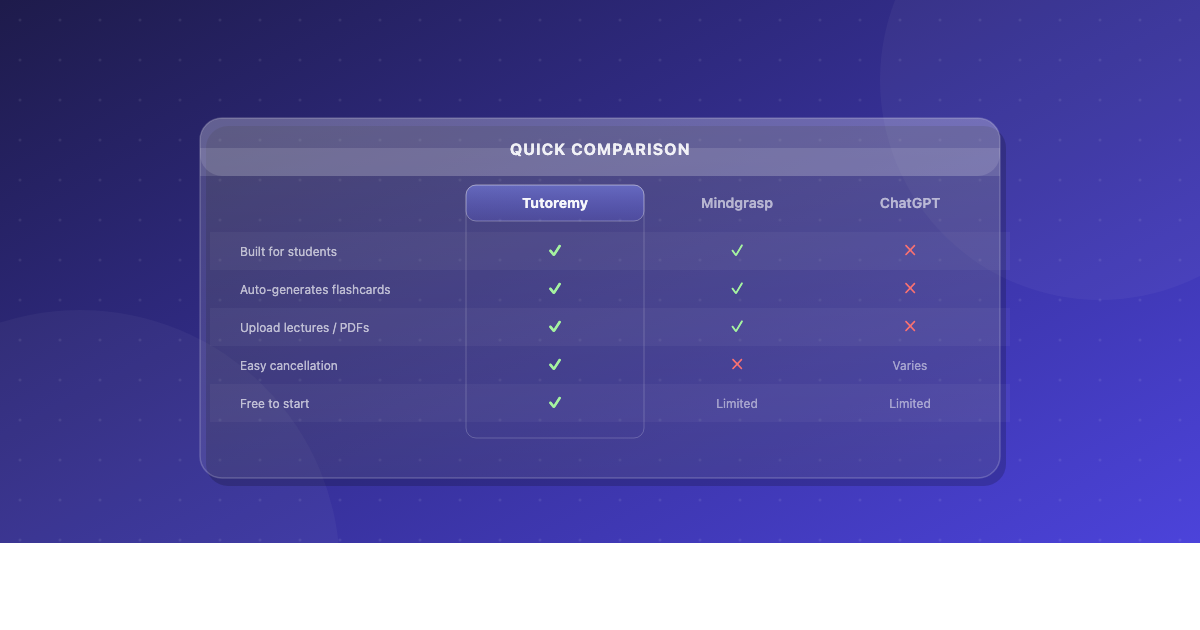
Tutoremy generates structured notes, flashcards, and practice questions directly from your uploaded lectures or PDFs. It handles the extraction so you can spend your review time on the part that actually builds memory.
The Short Version
Better notes come from processing, not transcribing. The method you use matters less than how quickly you review, how honestly you identify gaps, and whether you actively test yourself on the material.
Pick a format that fits the course. Review within 24 hours. Rewrite what you don't understand. Turn the rest into questions.
Everything else is details.
---
Want a faster starting point for review? Upload your lecture recordings or PDFs to Tutoremy and get structured notes, flashcards, and practice questions automatically — so you can spend your study time on what actually builds understanding. Free to try, no credit card required.