How to Turn Your Notes Into Flashcards That Actually Help You Study
Tutoremy Team
Editorial · April 2, 2026
Why most flashcards don't work
Students create flashcards. Students fail exams. The cards get blamed.
But the evidence for flashcards as a study tool is strong — the problem is usually how they're made and used, not the technique itself.
Researchers at Kent State found that students routinely "cheat" themselves by flipping cards too early — glancing at the question, recognising a vague sense of familiarity, and flipping without actually retrieving the answer. That recognition feels like knowing. It isn't.
A study by Senzaki et al. (2017) in Teaching of Psychology found that students using an enhanced flashcard strategy scored significantly higher on exams than those who didn't — but the strategy required active engagement with the material, not passive recognition.
This guide is about making cards that force you to actually retrieve, and using them in a way that produces durable memory.
What makes a good flashcard
One concept per card
The single most important rule. A card that asks "Explain the causes, major battles, and consequences of the Franco-Prussian War" is testing recall of an essay, not a retrievable fact or concept. Break it into multiple specific cards.
Ask for understanding, not just recognition
"What year did X happen?" tests memorisation. "Why did X happen, and what did it lead to?" tests understanding. The second type is harder to write and harder to answer — and significantly more useful for exams that ask you to apply knowledge rather than regurgitate it.
Write the cards yourself
There's meaningful evidence that creating your own flashcards improves learning beyond just reviewing pre-made ones. A study published in the Journal of Educational Psychology (2022) found that in five out of six experiments, user-generated flashcards produced better learning outcomes than pre-made ones — because the act of generating the card forces you to engage with and paraphrase the material.
This doesn't mean all pre-made cards are useless. It means if you have time, writing your own is worth it.
How to convert your notes into flashcards
Step 1: Identify the testable content
Go through your notes and ask: what is this lecturer likely to test? Key terms and definitions, important processes or sequences, cause-and-effect relationships, comparisons between concepts, formulas and their applications. These make good cards. Narrative context and background usually don't.
Step 2: Write the question side carefully
The question side should trigger retrieval, not recognition. Instead of:
"What is classical conditioning?"
Try:
"What's the difference between classical and operant conditioning, and give an example of each?"
The harder the question, the more cognitive effort required to answer it — and the stronger the memory formed.
Step 3: Write the answer side in your own words
Don't copy your textbook definition directly onto the card. Paraphrase it. If you can't explain it in your own words, that's the gap you need to address — not a reason to use someone else's language.
Step 4: Review with active recall
When reviewing: read the question, write down or say your answer before flipping, then check. If you got it, extend the interval before reviewing again. If you didn't, keep it in the current rotation. Research shows that writing down your answer before checking outperforms thinking "I think I know it" and flipping immediately.
Using AI to speed up card creation
The bottleneck for most students isn't reviewing flashcards — it's making them. For a lecture-heavy course, creating a comprehensive deck from scratch can take as long as studying itself.
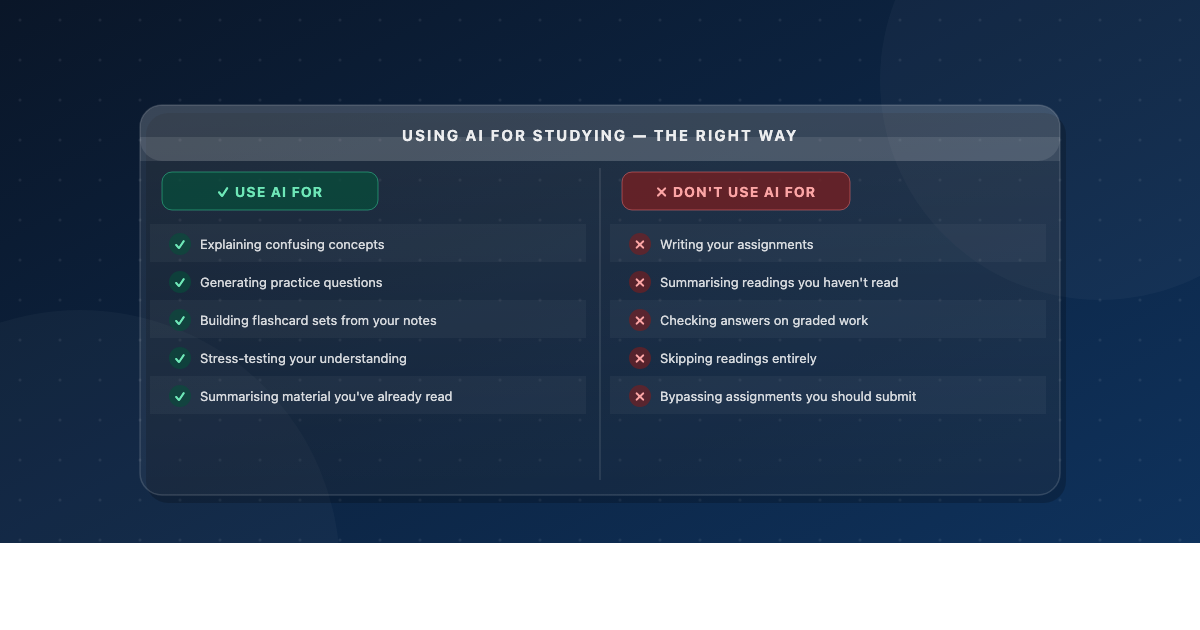
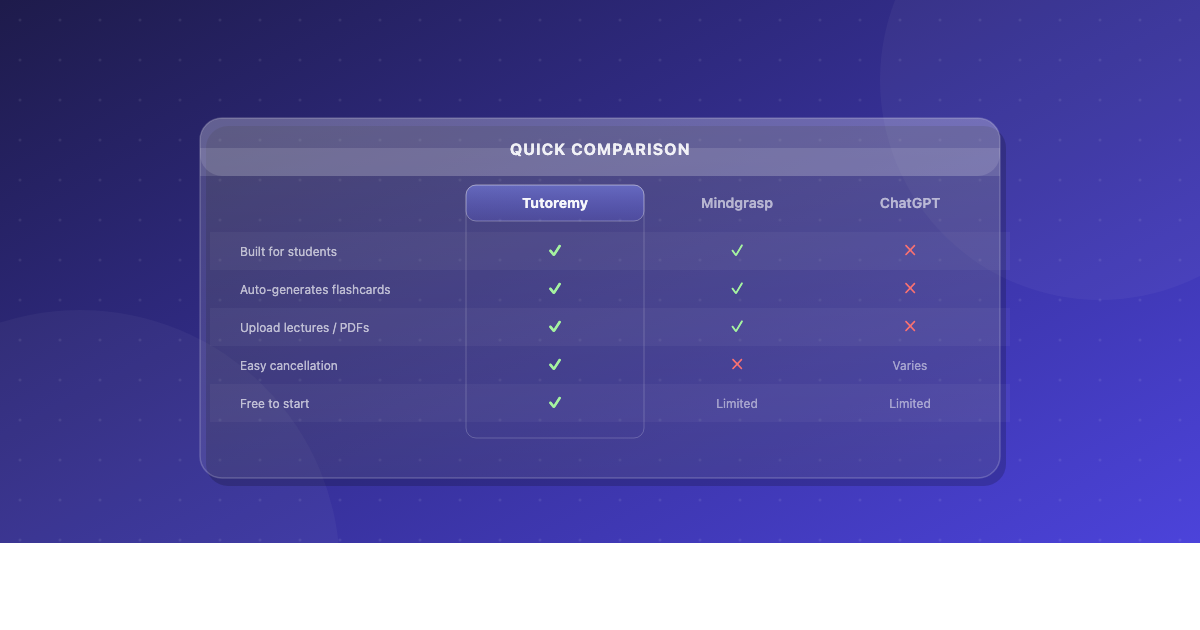
AI tools can do the initial card generation quickly, particularly when fed your own lecture recordings or notes. Tutoremy, for example, lets you upload course content and generates flashcard sets built from that material — including definitions, concept comparisons, and practice questions.
The tradeoff: AI-generated cards are faster but may miss nuance, misread emphasis, or occasionally get things wrong. The best approach is to use AI-generated cards as a starting point, review them for accuracy, and supplement with cards you write for concepts that need more precise treatment.
A note on quantity
More cards is not better. A deck of 200 mediocre cards will eat your study time and frustrate you. A deck of 60 high-quality cards covering the most likely exam content will serve you better.
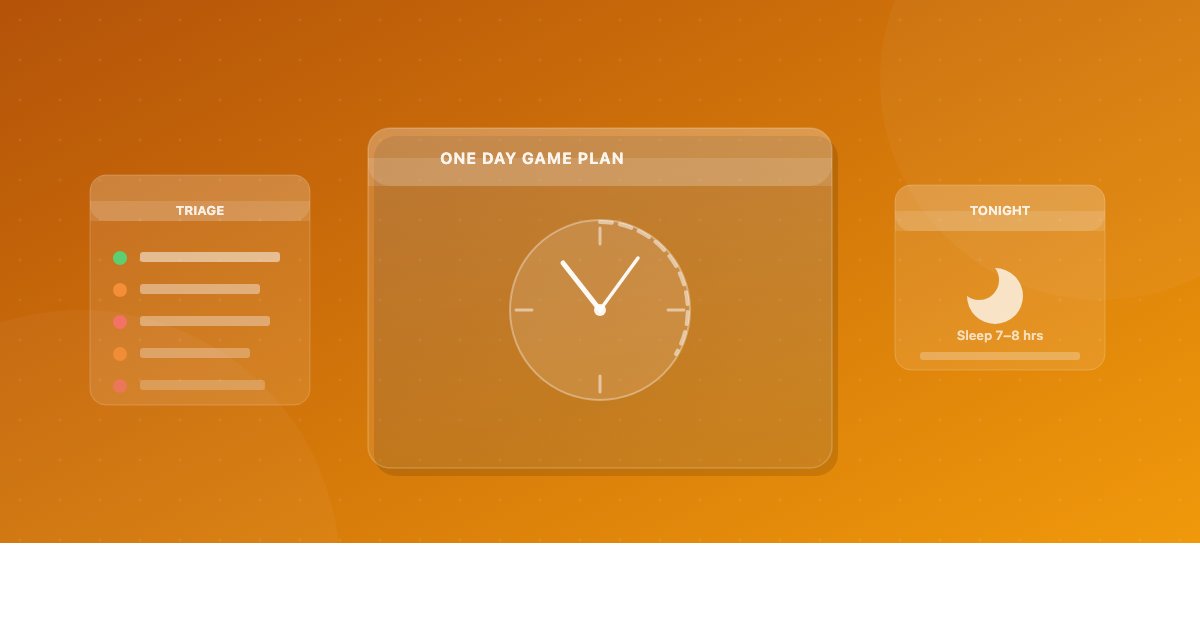
Be selective. Prioritise the concepts your lecturer returned to repeatedly, anything explicitly flagged as important, and the gaps you identified in your triage of weak topics. Everything else can wait.
The short version
Good flashcards test understanding, not just recognition. Write one concept per card, frame the question so it requires real retrieval, write the answer in your own words, and review by attempting the answer before checking. Use spaced repetition so the intervals extend as your confidence grows.
The tool doesn't matter much. The practice does.
---
Skip the card-creation bottleneck. Upload your lecture recordings or course PDFs to Tutoremy and get flashcard sets generated from your actual course content. Use them as your starting point, review for accuracy, and start studying faster.