Why You Procrastinate Studying (And What to Actually Do About It)
Tutoremy Team
Editorial · March 22, 2026
You already know procrastinating is bad. You've known that since the first time you stayed up until 2am finishing something you'd had three weeks to do. Knowing it's bad hasn't stopped it from happening.
That's because most procrastination advice treats the problem as a time management failure. It isn't. Understanding what procrastination actually is — and what drives it — is the only way to do something about it that lasts more than a week.
What Procrastination Actually Is
Procrastination isn't laziness. It's an emotion regulation problem. A major meta-analysis by Steel (2007), drawing on 691 correlations across decades of research, found that the strongest predictors of procrastination were task aversiveness and low self-efficacy — not poor time management skills or laziness. We avoid tasks that make us feel bad, not tasks we've misscheduled.
This reframe matters enormously. If procrastination is primarily about avoidance of negative emotion — the anxiety of starting something hard, the boredom of something dull, the dread of something confusing — then the fix is not a better calendar. The fix has to address the emotion.
It also explains something most students have noticed: procrastination is selective. You don't procrastinate everything equally. You procrastinate the things that feel threatening, confusing, or tedious. The tasks you find engaging or comfortable, you start without thinking about it.
The Task Aversion Loop
Here's what the procrastination cycle looks like in practice:
- You think about the task — studying for an exam, writing a paper, working through problem sets.
- The thought generates an unpleasant feeling: anxiety, overwhelm, boredom, frustration.
- You switch to something else — your phone, a show, anything — and the bad feeling immediately goes away.
- Your brain records: avoidance worked. The relief reinforces the avoidance.
- Next time the task comes up, avoidance feels even more automatic.
The research backs this up. Steel's meta-analysis found that task aversiveness had a relatively strong correlation with procrastination (r = 0.40). The more unpleasant a task feels, the more reliably people avoid it — and the more they avoid it, the more aversive the prospect of starting becomes. The cycle compounds.
Why Studying Specifically Gets Avoided
Studying triggers task aversion for a few specific reasons that are worth naming.
The task feels vague
'Study for the exam' is not a task. It's a category. Vague tasks are harder to start because your brain can't identify a clear entry point. The moment you sit down, you have to figure out what to do before you can do anything — and that ambiguity itself is aversive.
This is why 'I'll study tonight' almost never happens, but 'I'll do the first 20 flashcards from Chapter 4' usually does. Specificity reduces the friction of starting.
The task exposes what you don't know
Studying is one of the few academic activities where you immediately encounter your own ignorance. You open the material and realize you don't understand it as well as you thought. That moment of confronting a gap can feel threatening — especially if your identity is tied to being a good student.
Avoidance protects that self-image. If you never really study, you can always tell yourself you could have done better if you'd tried. Starting the work removes that buffer.
Rewards are distant
Studying now pays off at an exam that might be weeks away. The reward is real but delayed. The cost — the discomfort of sitting down and doing it — is immediate. Steel's model of procrastination identifies this directly: tasks with delayed rewards are systematically more likely to be avoided, because the brain weights immediate discomfort more heavily than future benefit.
What Actually Works
With the mechanism understood, here's what research and practice support.
Make the task smaller and more specific
The goal is to make the entry point obvious and low-stakes enough that starting doesn't require willpower. Instead of 'study biology,' try 'answer the 10 questions at the end of section 3.2.' Instead of 'work on the essay,' try 'write the first paragraph of the introduction.'
The specific task gives your brain a clear start and a defined end. Both reduce aversion. And starting — even on a small piece — usually produces momentum that carries you further than the small task itself.
Address the emotion directly
Notice when you're avoiding a task and name what you're feeling. 'I'm putting this off because it feels overwhelming' or 'I'm avoiding this because I don't know where to start.' Naming the emotion accurately — rather than acting it out — creates a small amount of psychological distance from it.
This isn't therapy-speak. It's a practical technique for interrupting the automatic avoidance loop before it gets a hold of you.
Make the start easier than the continuation
Don't tell yourself you'll study for three hours. Tell yourself you'll open your notes and read for five minutes. Then do it. The friction of starting is almost always worse than the experience of doing — once you're in the material, you're usually less averse to it than you were from the outside.
This is sometimes called an 'implementation intention' — a specific plan for when and how you'll start a task. Research by Gollwitzer (1999) consistently shows these dramatically improve follow-through compared to a general intention to 'study more.'
Remove the escape routes
Procrastination happens in the gap between starting and doing. Phone nearby? You'll pick it up. Browser open with tabs? You'll click one. The environment does a lot of the work your willpower is trying to do — and the environment wins more often.
Before a study session: phone in another room or on Do Not Disturb, browser extensions blocking social media if needed, a specific location you associate with work rather than leisure. The fewer attractive alternatives are immediately available, the lower the avoidance pull.
Make the task less aversive at the source
This is the one most advice skips. If you're procrastinating studying because the material is genuinely confusing and frustrating, the long-term fix is to make it less confusing — not to generate more willpower to sit with the confusion.
If a concept doesn't make sense, ask a question in office hours. Watch a different explanation of it. Use an AI tutor to work through it. Confusion that gets resolved becomes material you can engage with. Confusion that stays unresolved just deepens the aversion.
The Honest Truth About Motivation
Most students are waiting to feel motivated before they start. Motivation doesn't usually arrive before starting — it arrives after. Action produces motivation more reliably than motivation produces action.
That's not a comforting reframe. It means the answer is usually just to start, on something small and specific, before you feel ready to. The feeling of readiness is not a reliable signal and not worth waiting for.
The goal isn't to eliminate procrastination — everyone delays some things some of the time. The goal is to make studying specifically less aversive than it currently is, and to make starting it slightly easier than it currently is. That's enough.
Where Tutoremy Fits Into This
One of the reasons studying feels aversive is the gap between 'I have all this material' and 'I know what I'm supposed to do with it.' That gap creates the overwhelm that drives avoidance.
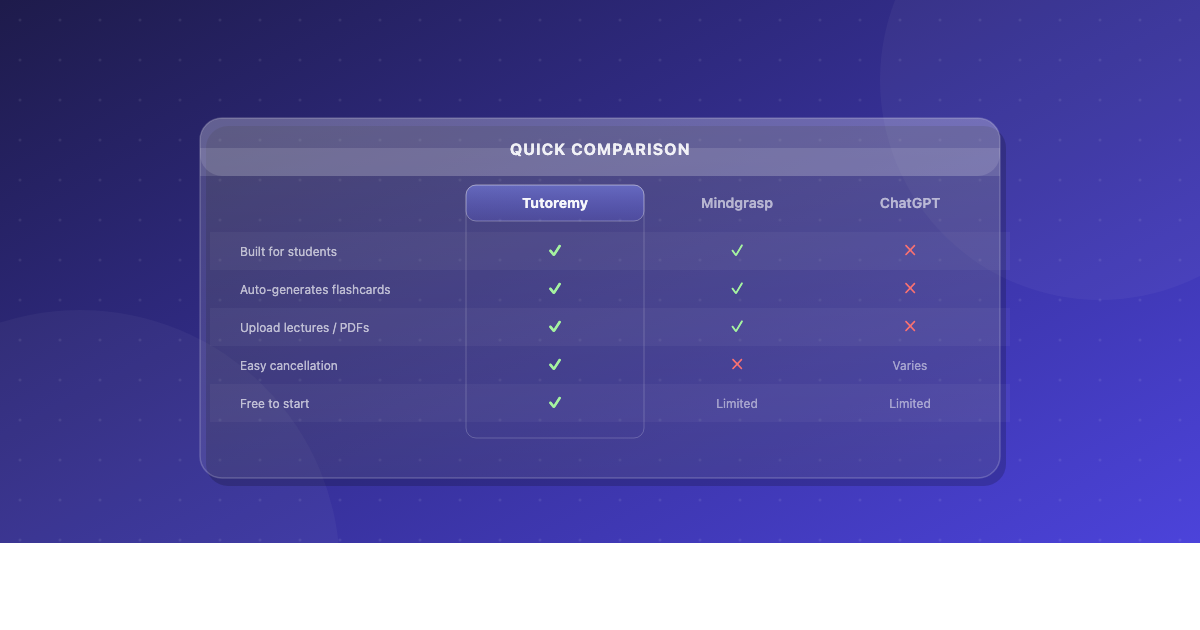
Tutoremy compresses that gap. Upload a lecture or PDF and within two minutes you have structured notes, a flashcard set, and a practice quiz built from your actual course content. The task of 'study this lecture' becomes 'do these 15 flashcards' — specific, bounded, and easier to start.
That won't fix the root causes of procrastination. But it removes one of the most reliable triggers: not knowing where to begin.
---
Make it easier to start. Upload your next lecture or PDF to Tutoremy and get notes, flashcards, and a practice quiz automatically — so you always have a specific, ready-to-use place to begin. Try Tutoremy free →