Cell Structure & Organelles
Cells are the basic building blocks of all living organisms. Understanding cell structure helps explain how living things grow, function, reproduce, and respond to their environment.
This guide covers cell types, every major organelle and its function, how organelles cooperate, and the key differences between plant and animal cells — with diagrams, memory aids, and a practice quiz.
Tap the pulsing dots to explore each organelle
1What Is a Cell and Why Does It Matter?
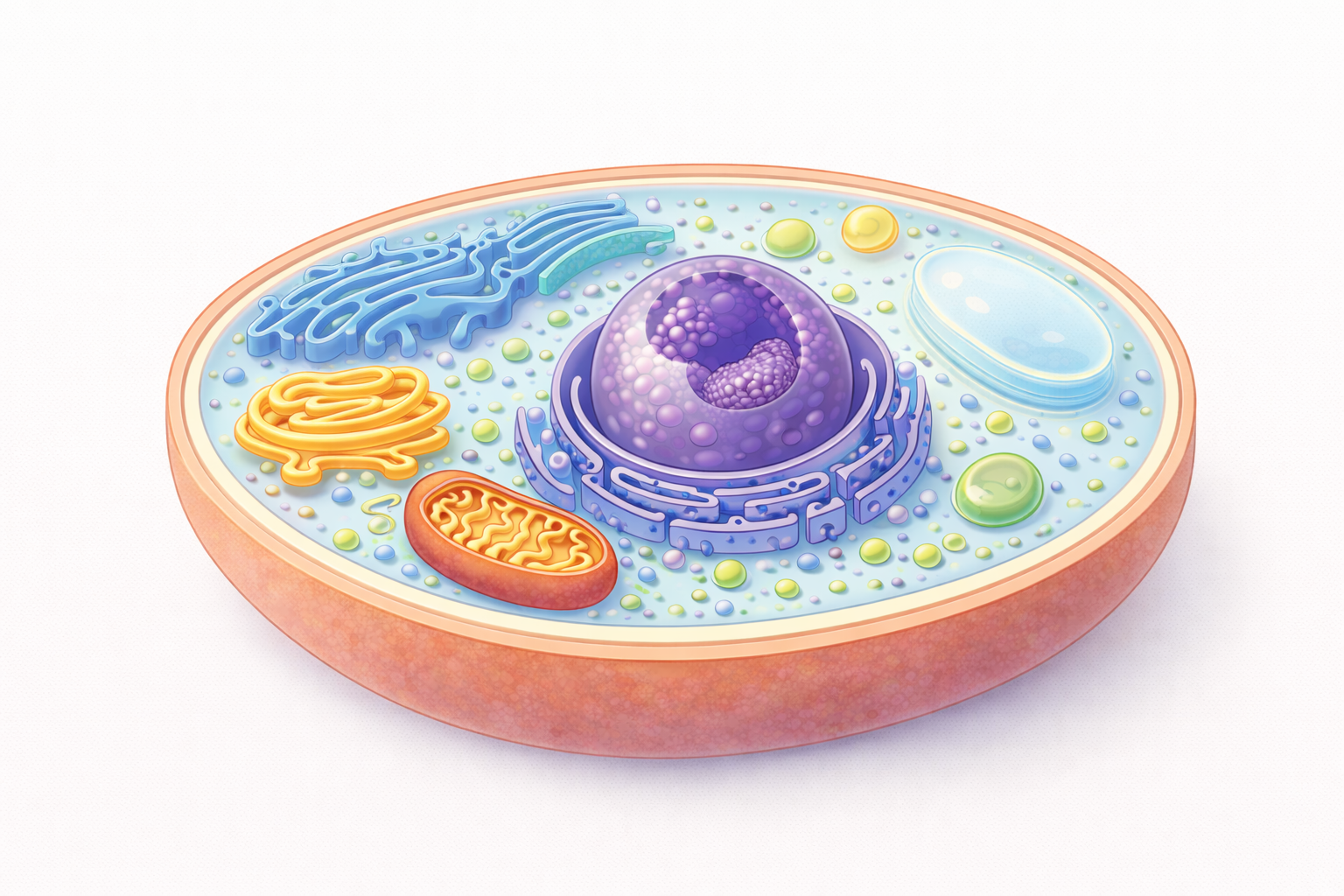
A cell is the smallest unit of life capable of carrying out all vital functions — growth, metabolism, reproduction, and response to stimuli.
All living organisms are made up of cells. Some are simple (like bacteria), while others are highly complex (like human nerve cells). Inside every cell, specialised structures called organelles perform specific jobs that keep the cell alive.
Think of a cell as a tiny factory. The factory has a manager's office (nucleus), a power plant (mitochondria), assembly lines (ribosomes), a packaging department (Golgi), and walls with security gates (cell membrane). Every worker has a role, and together they keep the factory running.
What Are the Key Definitions?
Cell
The smallest unit of life
Organelle
A specialised structure with a specific function inside a cell
Cytoplasm
Jelly-like substance where organelles are suspended
Cell biology forms the foundation for genetics, biotechnology, medicine, and microbiology. Many diseases occur when cell structures stop functioning properly.
2What Is the Difference Between Prokaryotic and Eukaryotic Cells?
There are two major types of cells. The key difference is whether the cell has a membrane-bound nucleus.
Prokaryotic Cells
- No membrane-bound nucleus
- DNA floats freely in cytoplasm
- Smaller and simpler
- Few or no membrane-bound organelles
- Example: Bacteria
Eukaryotic Cells
- True nucleus enclosed by a membrane
- DNA stored inside the nucleus
- Larger and more complex
- Many membrane-bound organelles
- Examples: Plant & animal cells
Both prokaryotic and eukaryotic cells have DNA, ribosomes, a cell membrane, and cytoplasm. The difference is organisation, not the absence of genetic material.
"Pro = Before the nucleus. Eu = True nucleus."
3What Are the Major Organelles and Their Functions?
Each organelle has a specific job. Together, they keep the cell alive and functioning — like specialised departments in a factory.
NucleusNucleolusRough ERSmooth ERGolgi ApparatusMitochondrionVacuoleLysosome / PeroxisomeCytoplasmCell MembraneWhat Does the Nucleus Do?
The nucleus is the control centre of the cell. It contains DNA, which stores genetic instructions for making proteins and regulating all cell activities. The nucleus is surrounded by a double membrane called the nuclear envelope with pores that allow molecules in and out.
Why Are Mitochondria Called the Powerhouse?
Mitochondria produce ATP (adenosine triphosphate) through cellular respiration. ATP is the energy currency that powers virtually every process inside the cell — from protein synthesis to muscle contraction.
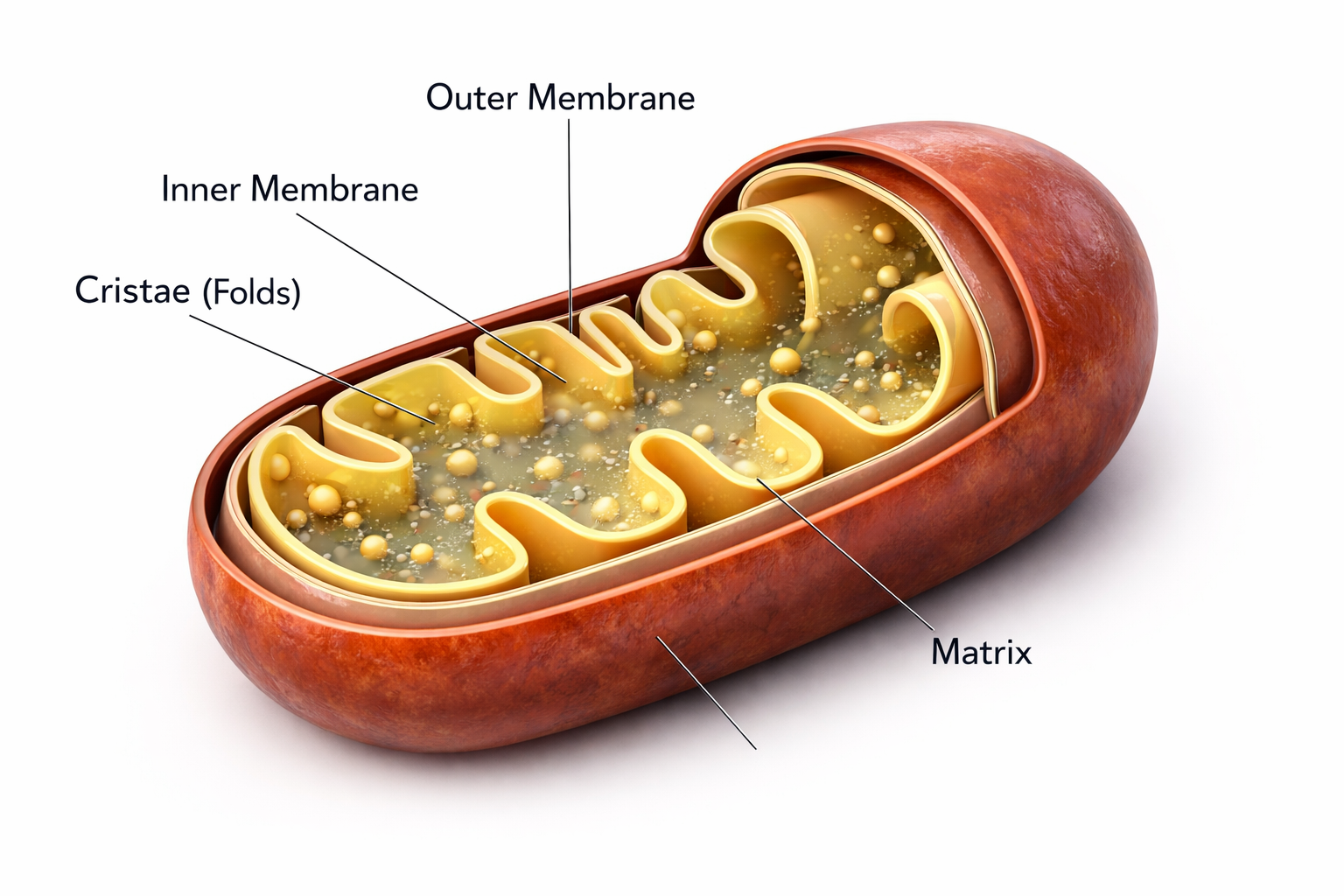
"Mito Makes Power" — Mitochondria produce energy.
What Do Ribosomes Do?
Ribosomes are the site of protein synthesis. They read the instructions from messenger RNA and assemble amino acids into proteins. Ribosomes can be free-floating in the cytoplasm or attached to the rough endoplasmic reticulum.
What Is the Endoplasmic Reticulum?
The ER is a network of membranes running through the cell. Rough ER is studded with ribosomes and makes proteins. Smooth ER lacks ribosomes and makes lipids, detoxifies chemicals, and stores calcium.
Rough ER
Has ribosomes → makes & transports proteins
Smooth ER
No ribosomes → makes lipids & detoxifies
What Does the Golgi Apparatus Do?
The Golgi apparatus modifies, packages, and distributes proteins and lipids. Think of it as the post office of the cell — it receives parcels (proteins) from the ER, labels them, and ships them to the right address.
What Are Lysosomes?
Lysosomes contain digestive enzymes that break down waste materials, worn-out organelles, and foreign invaders like bacteria. They are the recycling and waste disposal system of the cell.
What Is the Role of the Vacuole?
Vacuoles store water, nutrients, and waste. In plant cells, the large central vacuole is filled with cell sap and pushes outward on the cell wall, helping the plant maintain its shape through turgor pressure.
What Do Chloroplasts Do?
Chloroplasts are found only in plant cells and some algae. They contain chlorophyll, the green pigment that captures sunlight energy and converts it into glucose through photosynthesis.
What Is the Difference Between the Cell Membrane and Cell Wall?
Cell Membrane
Thin, flexible, selective barrier found in all cells. Controls what enters and leaves.
Cell Wall
Rigid outer layer found in plant cells (cellulose) and bacteria. Provides support and protection.
Think of the cell membrane as a security guard at a gate — it decides who enters and who leaves. The cell wall is like the concrete wall around a factory — it's rigid and provides structural protection.
4How Do Organelles Work Together?
Organelles do not work in isolation — they cooperate like departments in a factory. Here is an example of how they collaborate to make and deliver a protein:
Nucleus provides the DNA instructions for building the protein.
Ribosomes read the mRNA message and build the protein.
Rough ER folds and transports the protein.
Golgi apparatus modifies, packages, and labels it for delivery.
Vesicles carry the finished product to its destination.
Throughout this entire process, mitochondria supply the ATP energy required at every step. In plant cells, chloroplasts capture sunlight to make glucose, which mitochondria then convert into ATP.
Imagine ordering a custom product: the head office (nucleus) sends the blueprint, the factory floor (ribosomes) assembles it, quality control (ER) checks it, the packaging department (Golgi) wraps it, and the delivery truck (vesicle) ships it out — all powered by the electricity grid (mitochondria).
5How Do Plant and Animal Cells Differ?
Plant and animal cells are both eukaryotic, but they have key structural differences. Understanding these differences is one of the most commonly tested topics in biology.
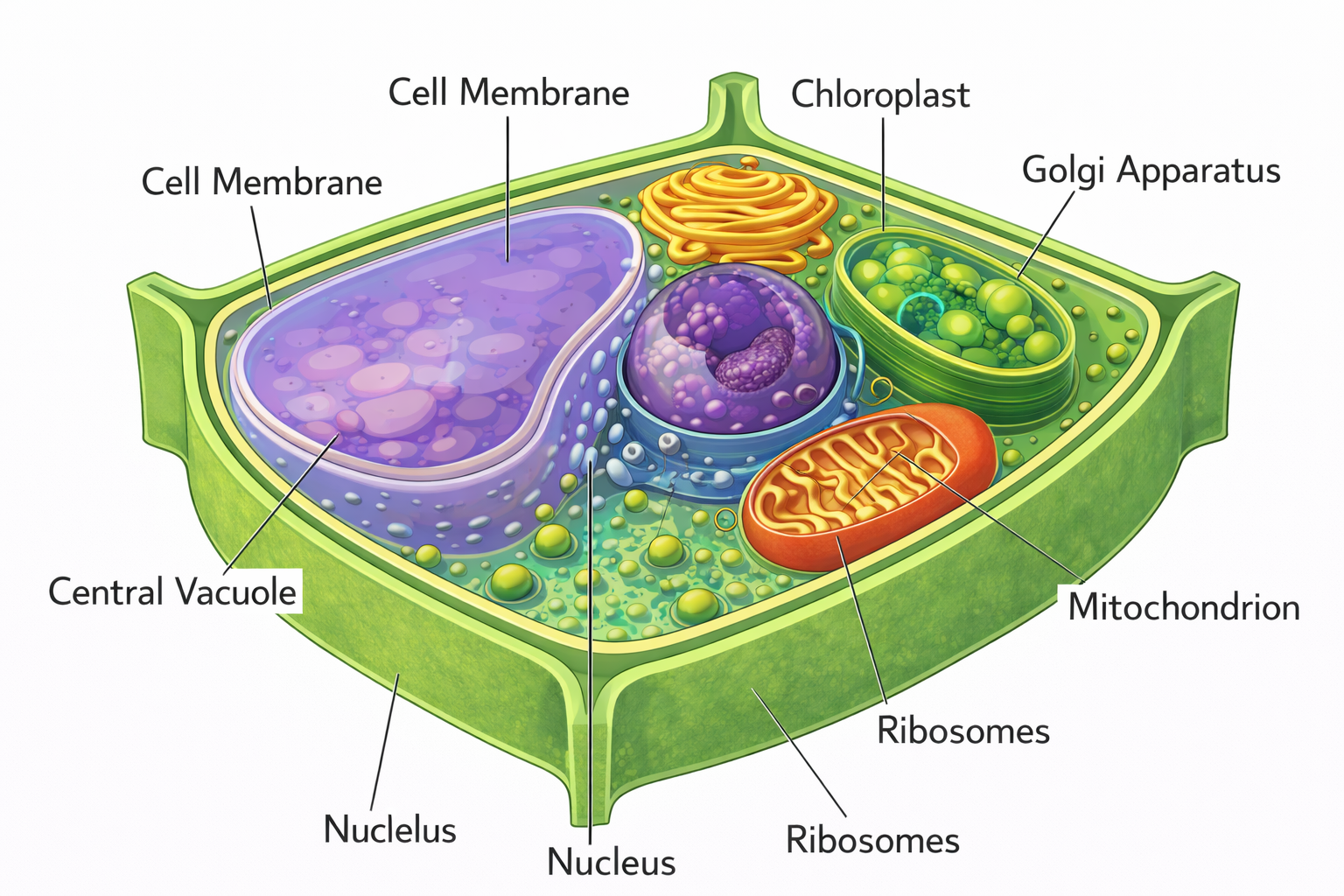
| Feature | Plant Cell | Animal Cell |
|---|---|---|
| Cell Wall | Yes (cellulose) | No |
| Chloroplasts | Yes | No |
| Large Central Vacuole | Yes | No (small vacuoles) |
| Centrioles | No | Yes |
| Shape | Fixed, rectangular | Irregular, round |
Don't confuse the cell membrane with the cell wall. All cells have a cell membrane, but only plant cells (and bacteria) have a cell wall. The cell wall is outside the membrane.
"Plants have Walls, Chloroplasts, and big Vacuoles — WCV. Animals have Centrioles."
6How Do Substances Cross the Cell Membrane?
The cell membrane is a selectively permeable barrier. It controls what enters and leaves the cell. There are three main methods of transport:
Diffusion
Movement of molecules from high to low concentration. No energy required.
Osmosis
Diffusion of water across a semi-permeable membrane from dilute to concentrated solution.
Active Transport
Movement against the concentration gradient. Requires ATP energy.
Diffusion and osmosis are passive — they don't require energy. Active transport goes against the gradient and requires ATP.
Diffusion is like a perfume spreading through a room — molecules naturally move from crowded areas to empty areas. Active transport is like swimming upstream — it takes energy to move against the flow.
Frequently Asked Questions
- What is the difference between prokaryotic and eukaryotic cells?
- Prokaryotic cells (e.g. bacteria) are small, simple cells with no membrane-bound nucleus — their DNA floats freely in the cytoplasm. Eukaryotic cells (e.g. plant and animal cells) are larger, contain a true nucleus enclosed by a membrane, and have many specialised organelles.
- Why are mitochondria called the powerhouse of the cell?
- Mitochondria carry out cellular respiration, breaking down glucose to produce ATP — the molecule cells use as energy currency. Without mitochondria, the cell would have no efficient way to generate the energy it needs for growth, transport, and repair.
- What organelles do plant cells have that animal cells do not?
- Plant cells have chloroplasts (for photosynthesis), a large central vacuole (for water storage and turgor pressure), and a rigid cell wall made of cellulose. Animal cells lack all three of these structures.
- What is the role of the Golgi apparatus?
- The Golgi apparatus receives proteins from the endoplasmic reticulum, modifies them (e.g. adding sugar chains), packages them into vesicles, and ships them to their destination — either inside the cell or outside via secretion.
- How do organelles work together inside a cell?
- Organelles cooperate like departments in a factory. The nucleus provides DNA instructions, ribosomes build proteins, the rough ER transports them, the Golgi packages them, and vesicles deliver them. Mitochondria supply the ATP energy required for every step.
Practice Quiz
Test your understanding — select the correct answer for each question.
1.Which organelle produces energy (ATP) for the cell?
2.Which type of cell has a cell wall?
3.What controls most cell activities and contains DNA?
4.Which organelle is the site of protein synthesis?
5.Which structure stores water and maintains pressure in plant cells?
6.What is the main difference between prokaryotic and eukaryotic cells?
7.Which organelle modifies, packages, and ships proteins?
8.Where does photosynthesis take place?
Final Study Advice
- 1. Draw and label a plant cell and animal cell from memory — if you can draw it, you know it.
- 2. Focus on linking each organelle to its function, not just its name.
- 3. Remember the key differences: plants have walls, chloroplasts, and a large vacuole.
- 4. Use the factory analogy to explain how organelles cooperate in exam answers.