Photosynthesis
Photosynthesis is the process by which plants, algae, and some bacteria capture sunlight and convert it into chemical energy — forming the base of almost every food chain on Earth and producing the oxygen we breathe.
This guide covers the overall equation, both stages of photosynthesis (light-dependent reactions and the Calvin cycle), chloroplast structure, factors affecting rate, key formulas, memory aids, and a 10-question practice quiz.
1What Is Photosynthesis and Why Does It Matter?
Photosynthesis literally means "making with light." It is the process by which green plants and some other organisms convert light energy into chemical energy in the form of glucose.
Without photosynthesis, there would be no plants, no herbivores, and subsequently no carnivores. It is the ultimate source of energy for almost all life on Earth, forming the foundation of nearly every food chain. A crucial byproduct is oxygen (O₂), which makes aerobic respiration possible for most living organisms.
Imagine the chloroplast as a bustling factory. The thylakoids are solar panel rooms — sunlight hits them, water is brought in, and they generate little energy battery packs (ATP) and power tools (NADPH). The stroma is the assembly line floor where workers (enzymes like RuBisCO) use those battery packs to build sugar from carbon dioxide.
Overall Equation
6CO₂ + 6H₂O + Light Energy → C₆H₁₂O₆ + 6O₂
6CO₂ = carbon dioxide (from the atmosphere)
6H₂O = water (absorbed by roots)
C₆H₁₂O₆ = glucose (the plant's food)
6O₂ = oxygen (released into the air)
Where Does Photosynthesis Happen?
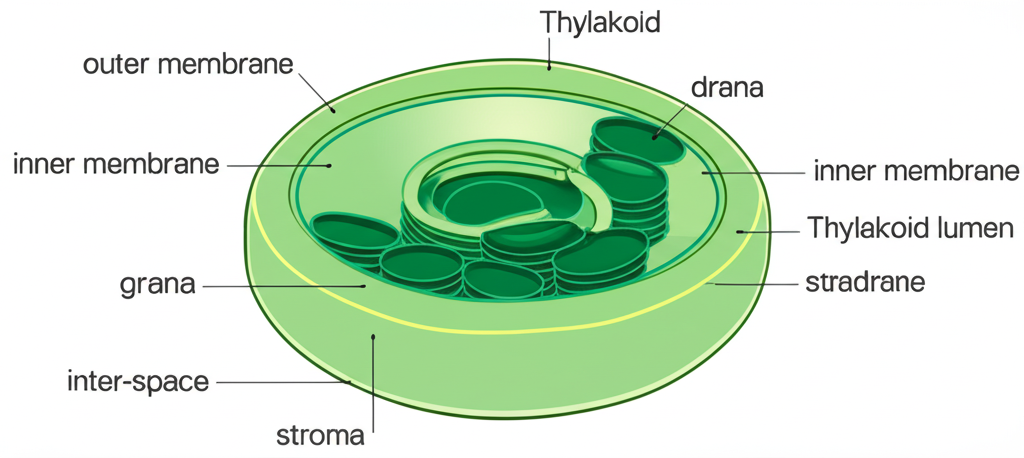
Photosynthesis occurs inside chloroplasts, which are organelles found in plant cells and some algae. The chloroplast has two key compartments where the two stages of photosynthesis take place.
Light-Dependent Reactions
Occur in the thylakoid membranes. Convert light energy into ATP and NADPH.
Calvin Cycle
Occurs in the stroma. Uses ATP and NADPH to fix CO₂ into glucose.
2What Are the Key Terms You Need to Know?
Mastering these terms is essential for understanding the rest of the topic. Refer back here as needed.
Chlorophyll
Green pigment that absorbs light (red & blue), reflects green
Chloroplast
Organelle where photosynthesis takes place
Thylakoid
Flattened membrane sac; site of light-dependent reactions
Grana
Stacks of thylakoid discs inside the chloroplast
Stroma
Fluid-filled space around grana; site of Calvin cycle
ATP
Adenosine triphosphate — the cell's energy currency
NADPH
Electron carrier; provides reducing power for the Calvin cycle
Photolysis
Splitting of water using light energy, releasing O₂
Carbon Fixation
Incorporating CO₂ into an organic molecule (first step of Calvin cycle)
RuBisCO
Enzyme that fixes CO₂ to RuBP — the most abundant enzyme on Earth
Stomata
Tiny pores on leaves for gas exchange (CO₂ in, O₂ out)
Autotroph
Organism that produces its own food (e.g. plants)
3How Do the Light-Dependent Reactions Work?
The light-dependent reactions are the "photo" part of photosynthesis. They occur in the thylakoid membranes and convert light energy into chemical energy — ATP and NADPH.
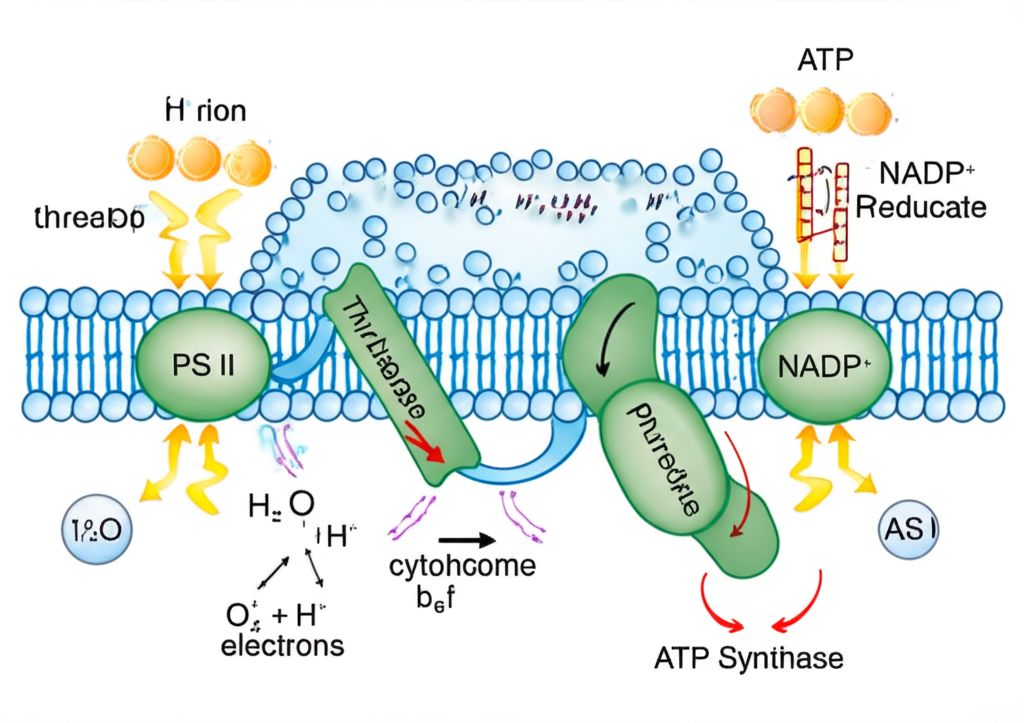
Sunlight absorption: Chlorophyll in Photosystem II (PSII) absorbs light energy, exciting electrons to a higher energy level.
Photolysis (water splitting): To replace lost electrons, water molecules are split: 2H₂O → 4H⁺ + 4e⁻ + O₂. This releases the oxygen we breathe.
Electron transport chain: Excited electrons pass along protein complexes in the thylakoid membrane. The released energy pumps H⁺ ions into the thylakoid lumen, building a proton gradient.
ATP production (chemiosmosis): H⁺ ions flow back through ATP synthase, driving the synthesis of ATP from ADP + Pi.
NADPH production: Electrons reach Photosystem I (PSI), get re-energised by light, and are used to reduce NADP⁺ to NADPH.
Inputs
Light energy, H₂O, ADP, NADP⁺
Outputs
ATP, NADPH, O₂
"A.N.O. — what happens next?" ATP, NADPH, O₂ are the products of the light reactions.
4How Does the Calvin Cycle Build Sugar?
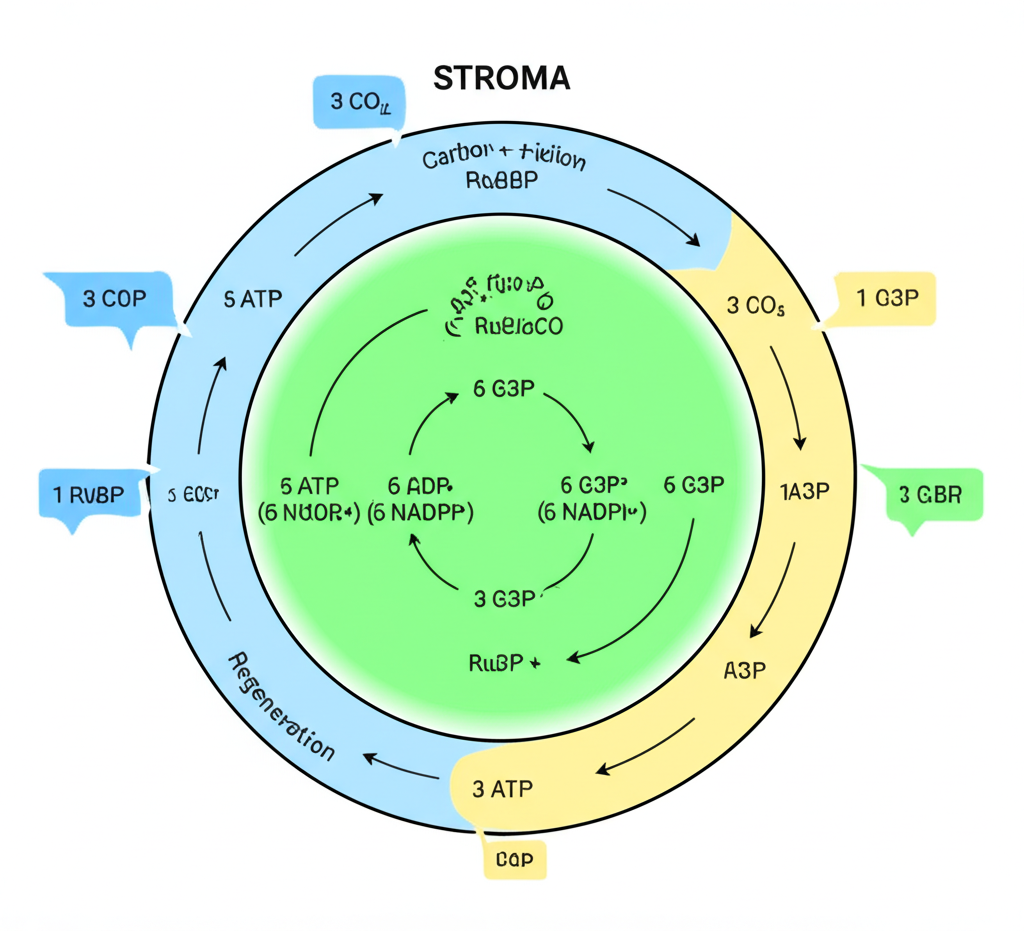
The Calvin cycle is the "synthesis" part of photosynthesis. It occurs in the stroma and uses the ATP and NADPH from the light reactions to convert CO₂ into glucose. It has three phases:
Phase 1: Carbon Fixation
- CO₂ from the atmosphere combines with RuBP (a 5-carbon sugar)
- This reaction is catalysed by the enzyme RuBisCO
- The unstable 6-carbon compound immediately splits into two molecules of 3-PGA (3-carbon)
Phase 2: Reduction
- Each 3-PGA is converted into G3P (glyceraldehyde-3-phosphate)
- This requires energy from ATP and electrons from NADPH
- For every 6 G3P produced, 1 G3P exits the cycle to be used in making glucose
Phase 3: Regeneration
- The remaining 5 G3P molecules are rearranged to regenerate 3 RuBP
- This requires additional ATP
- The cycle is now ready to fix more CO₂
It takes 6 turns of the Calvin cycle to produce 1 molecule of glucose (fixing 6 CO₂ molecules total). Don't confuse "light-independent" with "dark reactions" — the Calvin cycle does not require darkness and usually runs during the day.
Tracing the Path of Carbon (Worked Example)
CO₂ enters the leaf through stomata.
In the stroma, RuBisCO fixes CO₂ to RuBP (5C) → 2 molecules of 3-PGA (3C).
ATP and NADPH from light reactions reduce 3-PGA to G3P.
Some G3P exits the cycle to form glucose; the rest regenerates RuBP.
6 turns of the cycle fix 6 CO₂ to produce 1 glucose molecule.
5What Factors Affect the Rate of Photosynthesis?
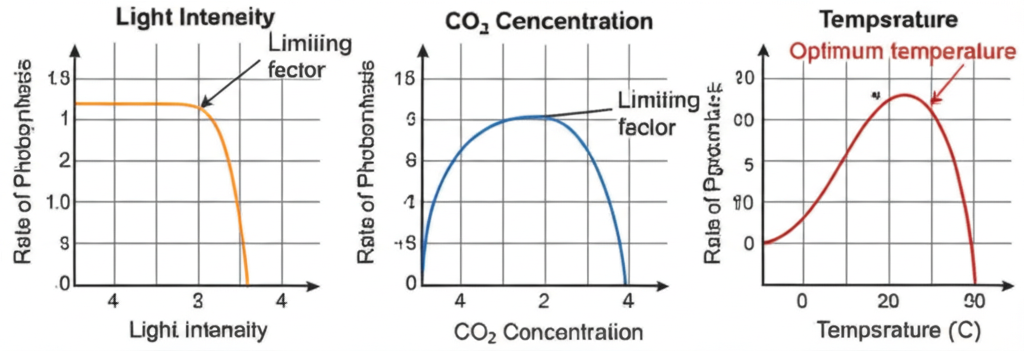
Three main environmental factors influence how fast photosynthesis occurs. Understanding their effects — and the concept of limiting factors — is essential for exam questions and real-world applications like agriculture.
Light Intensity
Increasing light increases the rate initially, then it plateaus as other factors become limiting.
CO₂ Concentration
More CO₂ boosts the rate initially, then it plateaus — another factor limits the process.
Temperature
Bell curve — peaks at ~25-30°C. Too cold = slow enzymes. Too hot = enzymes denature.
Greenhouses control all three factors — bright lights, elevated CO₂, and warm temperatures — to maximise crop growth by keeping photosynthesis running at its fastest possible rate.
6Key Formulas and Equations
| Equation | Formula |
|---|---|
| Overall photosynthesis | 6CO₂ + 6H₂O + light → C₆H₁₂O₆ + 6O₂ |
| Light reactions | H₂O + light + ADP + NADP⁺ → ATP + NADPH + O₂ |
| Calvin cycle | CO₂ + ATP + NADPH → G3P → glucose + ADP + NADP⁺ |
What Does Each Formula Mean?
The overall equation shows six molecules of CO₂ and six of water, energised by light, are rearranged into one glucose molecule and six oxygen molecules. This demonstrates both conservation of matter and energy conversion (light to chemical).
The light reaction equation shows that light energy splits water, producing oxygen and generating the energy carriers (ATP and NADPH) needed for the next stage.
The Calvin cycle equation shows CO₂ being fixed into organic molecules using the ATP and NADPH, while the "spent" carriers (ADP, NADP⁺) return to the light reactions for recharging.
7Memory Aids
"Photo = Light, Synthesis = Making" — Light reactions make energy carriers; the Calvin cycle makes sugar.
"A.N.O." — the light-reaction products: ATP, NADPH, O₂.
"Thylakoids = Tiny O₂" and "Stroma = Sugar" — remember where each product is made.
The chloroplast is a factory with two departments. The Solar Panel Room (thylakoids) captures sunlight, splits water, and charges up battery packs (ATP) and power tools (NADPH), sending out waste oxygen. The Assembly Line (stroma) receives the batteries and tools, pulls in carbon dioxide, and builds glucose. Once the batteries are drained, they go back to the Solar Panel Room for recharging.
"Calvin Fixes, Reduces, then Regenerates" — the three phases in order: Carbon Fixation → Reduction → Regeneration.
8Common Mistakes Students Make
"Plants only do photosynthesis, not respiration."
Plants perform both photosynthesis and cellular respiration. They respire 24/7, just like animals.
"Oxygen comes from carbon dioxide."
The O₂ released comes from the splitting of water (H₂O) during photolysis, not from CO₂.
"The Calvin cycle only happens at night (dark reactions)."
The Calvin cycle typically runs during the day because it depends on ATP and NADPH from the light reactions. "Light-independent" means it doesn't directly use light, not that it requires darkness.
"Plants get their mass from water and sunlight."
The vast majority of a plant's dry mass comes from carbon dioxide (CO₂) absorbed from the air, which is incorporated into organic molecules.
"Chlorophyll is a reactant in the equation."
Chlorophyll is a pigment that absorbs light — it acts as a catalyst/mediator, not a reactant that gets consumed.
"Glucose is the only product of photosynthesis."
Glucose is the primary sugar, but it's often converted into starch (storage), cellulose (structure), fats, and proteins. And oxygen is also a key product.
Frequently Asked Questions
- What is photosynthesis and why is it important?
- Photosynthesis is the process by which plants, algae, and some bacteria convert light energy, carbon dioxide, and water into glucose and oxygen. It is the foundation of nearly every food chain on Earth and produces the oxygen we breathe.
- Do plants respire at night?
- Plants respire all the time — day and night. During the day, photosynthesis typically exceeds respiration, so net oxygen is released. At night, only respiration occurs, so the plant consumes oxygen and releases carbon dioxide.
- Why is water split during photosynthesis?
- Splitting water (photolysis) during the light-dependent reactions provides electrons and hydrogen ions (H⁺) needed to drive the electron transport chain and produce NADPH. Oxygen gas (O₂) is released as a byproduct.
- Can photosynthesis occur under artificial light?
- Yes — any light source with the right wavelengths (especially red and blue light) can drive photosynthesis. This is why indoor grow lights work for plants.
- What is the difference between the light reactions and the Calvin cycle?
- The light-dependent reactions occur in the thylakoid membranes and convert light energy into ATP and NADPH, releasing oxygen. The Calvin cycle occurs in the stroma and uses ATP and NADPH to fix carbon dioxide into glucose.
Practice Quiz
Test your understanding of photosynthesis — select the correct answer for each question.
1.Which of the following is an input (reactant) for the overall process of photosynthesis?
2.Where do the light-dependent reactions of photosynthesis take place?
3.What is the primary role of chlorophyll in photosynthesis?
4.The oxygen gas released during photosynthesis comes directly from the splitting of which molecule?
5.Which molecules carry chemical energy from the light-dependent reactions to the Calvin cycle?
6.The enzyme responsible for carbon fixation in the Calvin cycle is:
7.If the rate of photosynthesis is plotted against light intensity, what is typically observed?
8.A plant is placed in an environment with no carbon dioxide. Which process will be directly affected?
9.Which statement about the Calvin cycle is correct?
10.How many molecules of water are consumed to produce one molecule of glucose according to the balanced equation?
Final Study Advice
- 1. Draw and label a chloroplast from memory, showing where each stage happens.
- 2. Practice writing the overall equation and light/Calvin equations without looking.
- 3. Trace the path of a carbon atom from CO₂ through the Calvin cycle to glucose.
- 4. Sketch the three factor graphs (light, CO₂, temperature) and explain the plateau/peak.
- 5. Use the factory analogy to explain the two stages in exam answers — examiners love clear analogies.