Angles & Triangles
Angles and triangles are the fundamental building blocks of geometry — the simplest shapes from which all other polygons and spatial reasoning are built.
This guide covers angle types, complementary & supplementary relationships, triangle classification, the angle-sum theorem, triangle inequality, special right triangles, congruence postulates, triangle centers, and a practice quiz.
1Introduction
Geometry, at its core, is the study of shapes, sizes, positions, and properties of space. Angles and triangles are the simplest polygons, yet their properties are incredibly powerful — providing the logical framework for understanding how objects fit together, how forces are distributed, and how to measure distances indirectly.
The stability of roof trusses and bridge structures relies on triangles. Surveyors use triangulation to map terrain. GPS pinpoints locations using angles and distances from satellites. Artists use triangular compositions for visual balance.
Architecture & Engineering
Triangles resist deformation and distribute weight efficiently in bridges, roofs, and building frameworks.
Navigation & Surveying
Triangulation measures vast distances. GPS systems rely on angles from multiple satellites.
2Key Definitions
Angle Terms
Angle
Formed by two rays sharing a common endpoint (vertex).
Vertex
The common endpoint of the two rays forming an angle.
Acute Angle
Measures 0° to 90°.
Right Angle
Exactly 90°.
Obtuse Angle
Measures 90° to 180°.
Straight Angle
Exactly 180°.
Reflex Angle
Measures 180° to 360°.
Linear Pair
Two adjacent supplementary angles forming a line.
Triangle Terms
Scalene
No equal sides or angles.
Isosceles
At least two equal sides; base angles equal.
Equilateral
All sides equal; all angles 60°.
Altitude
Perpendicular segment from a vertex to the opposite side. Represents the height.
Median
Segment from a vertex to the midpoint of the opposite side.
3Angles
An angle is formed by two rays (called sides) sharing a common endpoint called the vertex. Angles are measured in degrees (°), with a full circle containing 360°.

Acute
< 90°
Right
= 90°
Obtuse
90°–180°
Straight
= 180°
Reflex
180°–360°
Angle Notation
- Three-letter notation: The vertex is always in the middle — e.g. ∠ABC means vertex B.
- Single letter: If unambiguous, use just the vertex — e.g. ∠B.
- Numbered: Sometimes angles are numbered (∠1, ∠2) or use Greek letters (α, β).
Angle Addition Postulate
m∠ABD + m∠DBC = m∠ABC
If point D lies in the interior of ∠ABC, the parts add up to the whole angle.
4Angle Relationships
When angles interact, they form specific relationships that are crucial for solving geometric problems.
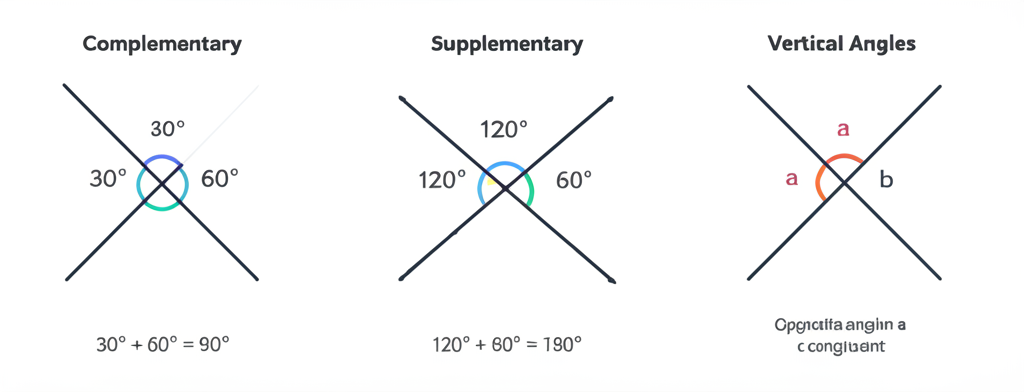
Complementary Angles
Sum to 90°.
Example: 30° + 60° = 90°
Supplementary Angles
Sum to 180°.
Example: 70° + 110° = 180°
Vertical Angles
Formed by two intersecting lines. Non-adjacent angles are always congruent.
Linear Pair
Adjacent angles forming a straight line. Always supplementary (180°).
5Triangles
A triangle is a polygon with three sides, three vertices, and three interior angles. It is the simplest polygon and a fundamental shape in geometry.
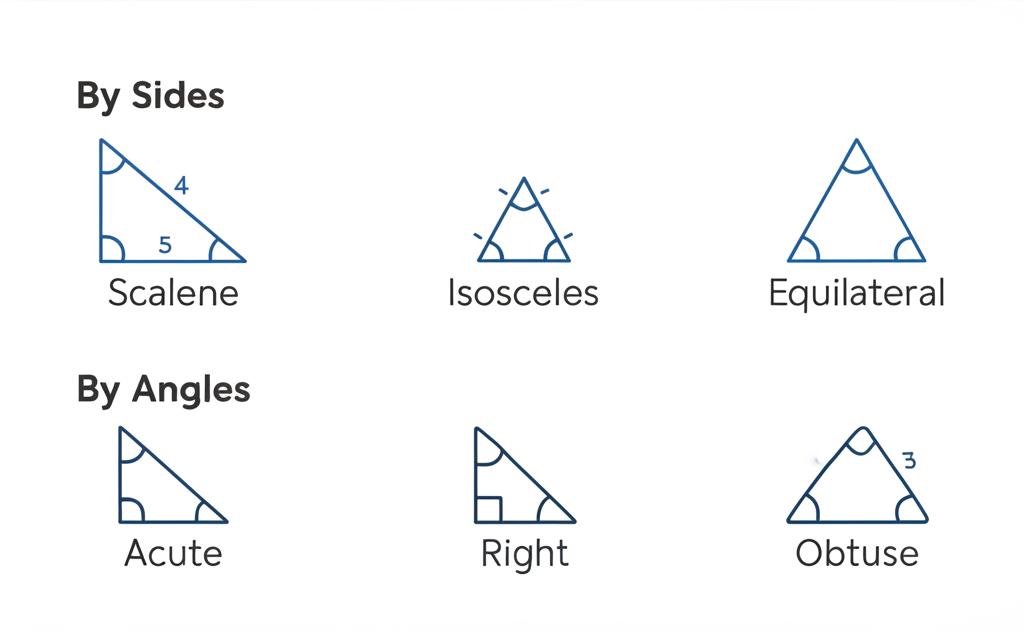
Classification by Sides
Scalene
All three sides have different lengths. No two angles are equal.
Isosceles
At least two sides are equal. Base angles opposite equal sides are congruent.
Equilateral
All three sides are equal. All angles are 60°.
Classification by Angles
Acute
All three angles are less than 90°.
Right
Exactly one 90° angle. Side opposite is the hypotenuse.
Obtuse
Exactly one angle greater than 90°.
Triangle Angle-Sum Theorem
∠A + ∠B + ∠C = 180°
The interior angles of any triangle always sum to 180°.
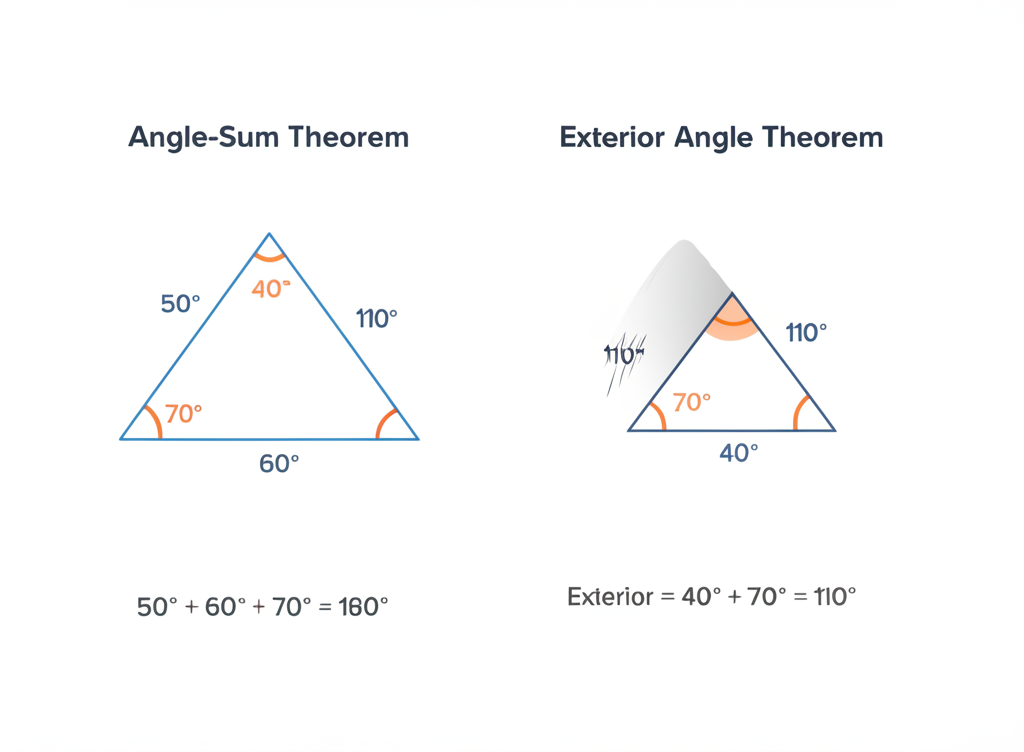
Exterior Angle Theorem
Exterior angle = Sum of two remote interior angles
An exterior angle of a triangle equals the sum of the two non-adjacent interior angles.
Interactive: Triangle Explorer
Adjust two angles and watch the triangle change shape. The third angle auto-calculates to keep the sum at 180°.
Auto-calculated: 180° − 60° − 60°
6Triangle Inequality Theorem
The sum of the lengths of any two sides of a triangle must be greater than the length of the third side.
a + b > c a + c > b b + c > a
All three conditions must be true for a valid triangle.
Can form a triangle: 3, 4, 5
3 + 4 = 7 > 5 ✓
3 + 5 = 8 > 4 ✓
4 + 5 = 9 > 3 ✓
Cannot form a triangle: 2, 3, 6
2 + 3 = 5 < 6 ✗
Fails! The two shorter sides can't "reach" each other.
7Special Triangle Properties
Isosceles Triangle Theorem
If two sides are congruent, the angles opposite those sides (the base angles) are also congruent. Conversely, if two angles are equal, the opposite sides are equal.
Pythagorean Theorem
a² + b² = c²
For right triangles: the square of the hypotenuse equals the sum of the squares of the legs.
Example
If legs are 3 and 4, find the hypotenuse:
c² = 3² + 4² = 9 + 16 = 25
c = √25 = 5
Special Right Triangles
45-45-90 Triangle
Angles: 45°, 45°, 90°
Sides: x : x : x√2
Legs are equal; hypotenuse = leg × √2
30-60-90 Triangle
Angles: 30°, 60°, 90°
Sides: x : x√3 : 2x
Short leg opposite 30°; hypotenuse = 2 × short leg
Triangle Centers
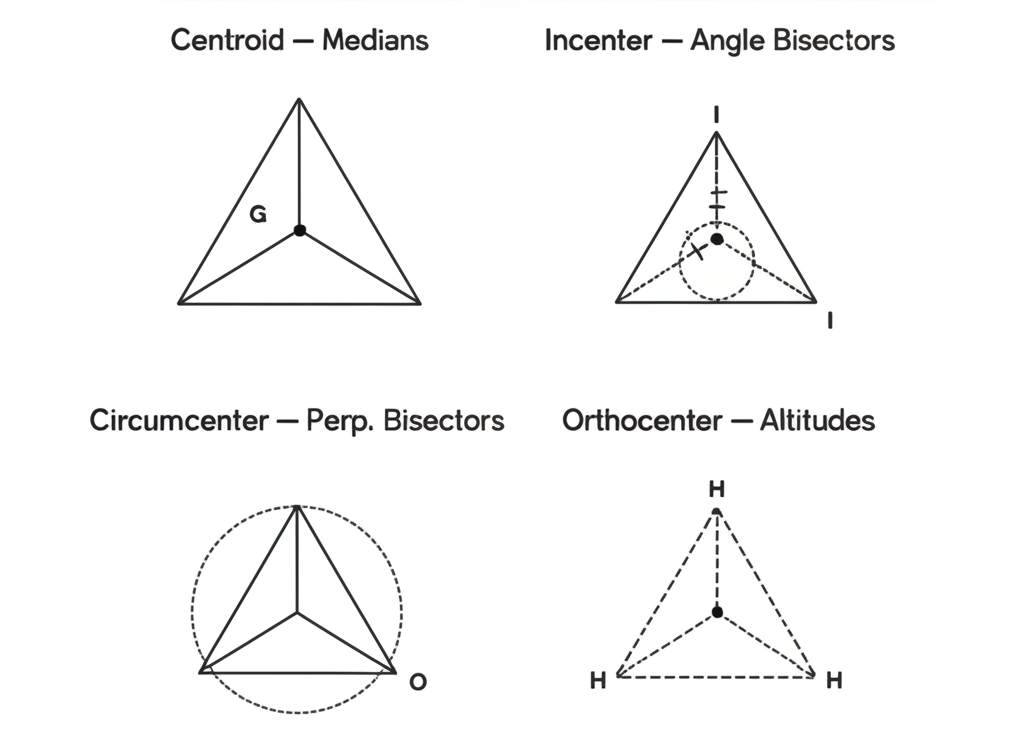
Centroid (G)
Intersection of medians. The triangle's center of gravity.
Incenter (I)
Intersection of angle bisectors. Center of the inscribed circle.
Circumcenter (O)
Intersection of perpendicular bisectors. Center of the circumscribed circle.
Orthocenter (H)
Intersection of altitudes.
8Triangle Congruence
Two triangles are congruent if they have the same size and shape — all corresponding sides and angles are equal. These postulates let us prove congruence without checking all six parts.
SSS
Three sides of one triangle are congruent to three sides of another.
SAS
Two sides and the included angle are congruent.
ASA
Two angles and the included side are congruent.
AAS
Two angles and a non-included side are congruent.
SSA (Side-Side-Angle) is NOT valid! The "ambiguous case" means two different triangles can satisfy the same SSA conditions. Never use SSA to prove congruence.
9Memory Aids
"All Really Outstanding Students Remember"
Acute, Right, Obtuse, Straight, Reflex — in order by size.
"C for Corner (90°), S for Straight (180°)"
Or: C comes before S in the alphabet, just like 90 comes before 180.
"Two short sides hug the long one"
The sum of the two shorter sides must be longer than the longest side to meet and close the triangle.
"SSS, SAS, ASA, AAS — No SSA!"
The valid congruence postulates and the one that doesn't work.
"Centroid = Medians, Incenter = Angle Bisectors, Circumcenter = Perp. Bisectors, Orthocenter = Altitudes"
Centroid = Center of Mass. Incenter = Inside circle. Circumcenter = Circle around. Orthocenter = Orthogonal (perpendicular) altitudes.
10Common Mistakes
Thinking triangle angles sum to 360°
The interior angles of a triangle sum to 180°, not 360°. A quadrilateral sums to 360°, and a full circle is 360°.
Confusing complementary and supplementary
Complementary = 90° (C for Corner). Supplementary = 180° (S for Straight). Remember: C before S, 90 before 180.
Using SSA as a congruence test
SSA (Side-Side-Angle) is the "ambiguous case" and does not guarantee congruence. Valid tests: SSS, SAS, ASA, AAS.
Mixing up interior and exterior angles
An exterior angle equals the sum of the two remote interior angles — not the adjacent interior angle. The adjacent interior and exterior angles form a linear pair (180°).
Forgetting to check triangle inequality
Before assuming three lengths form a triangle, verify that the sum of any two sides is greater than (not equal to) the third.
Confusing the triangle centers
Each center comes from a specific line type: centroid (medians), incenter (angle bisectors), circumcenter (perpendicular bisectors), orthocenter (altitudes). Don't mix them up!
Quick Revision Summary
- ✓An angle is formed by two rays sharing a vertex, measured in degrees.
- ✓Types: acute (<90°), right (90°), obtuse (90°–180°), straight (180°), reflex (180°–360°).
- ✓Complementary angles sum to 90°; supplementary angles sum to 180°.
- ✓Vertical angles are congruent; linear pairs are supplementary.
- ✓Triangles classified by sides: scalene, isosceles, equilateral.
- ✓Triangles classified by angles: acute, right, obtuse.
- ✓Triangle Angle-Sum Theorem: interior angles sum to 180°.
- ✓Exterior Angle Theorem: exterior angle = sum of two remote interior angles.
- ✓Triangle Inequality: sum of any two sides must be greater than the third.
- ✓Pythagorean Theorem: a² + b² = c² for right triangles.
- ✓Special right triangles: 45-45-90 (x : x : x√2) and 30-60-90 (x : x√3 : 2x).
- ✓Congruence: SSS, SAS, ASA, AAS are valid. SSA is NOT.
- ✓Four triangle centers: centroid (medians), incenter (angle bisectors), circumcenter (perp. bisectors), orthocenter (altitudes).
Frequently Asked Questions
- What is the difference between complementary and supplementary angles?
- Complementary angles sum to 90° (think "C" for "Corner" — a right angle). Supplementary angles sum to 180° (think "S" for "Straight" — a straight line). A handy trick: C comes before S in the alphabet, just like 90 comes before 180.
- Can a triangle have two right angles?
- No. Two right angles would already sum to 180°, leaving 0° for the third angle. Since the interior angles of any triangle must sum to exactly 180°, a triangle can have at most one right angle.
- Why is SSA not a valid triangle congruence test?
- SSA (Side-Side-Angle) can produce the "ambiguous case" where two different triangles satisfy the same conditions. Because the angle is not between the two known sides, the third side can swing to two possible positions, creating two non-congruent triangles.
- What are the special right triangles and their ratios?
- The 45-45-90 triangle has sides in the ratio x : x : x√2 (the two legs are equal, the hypotenuse is leg × √2). The 30-60-90 triangle has sides in the ratio x : x√3 : 2x (shortest side opposite 30°, medium side opposite 60°, hypotenuse opposite 90°).
- What is the difference between the four triangle centers?
- The centroid is the intersection of medians (center of mass). The incenter is the intersection of angle bisectors (center of the inscribed circle). The circumcenter is the intersection of perpendicular bisectors (center of the circumscribed circle). The orthocenter is the intersection of altitudes.
Practice Quiz
Test your understanding — select the correct answer for each question.
1.An angle that measures 105° is classified as what type of angle?
2.Two angles are complementary. If one angle measures 35°, what is the measure of the other angle?
3.Which of the following describes a linear pair?
4.A triangle has angles measuring 40° and 85°. What is the measure of the third angle?
5.Which set of side lengths CANNOT form a triangle?
6.In an isosceles triangle, if one base angle measures 70°, what is the measure of the vertex angle?
7.Which congruence postulate requires two sides and the included angle?
8.In a right triangle, if the legs measure 6 cm and 8 cm, what is the length of the hypotenuse?
9.The point of concurrency of the three medians of a triangle is called the:
10.An exterior angle of a triangle measures 120°. One of its remote interior angles measures 50°. What is the other remote interior angle?
Final Study Advice
- 1.Draw diagrams for every problem — visualizing angles and triangles helps enormously.
- 2.Always check: do the angles sum to 180°? This catches many errors.
- 3.Memorize the special right triangle ratios (45-45-90 and 30-60-90) — they appear everywhere.
- 4.Know the four congruence postulates and why SSA fails.
- 5.Practice the triangle inequality check — it's a quick way to validate side lengths.