Points, Lines & Planes
Points, lines, and planes are the three "undefined terms" of geometry — the fundamental building blocks from which all other geometric concepts are constructed.
This guide covers definitions, segments, rays, collinear and coplanar points, intersections, the midpoint and distance formulas, key postulates, and a practice quiz.
1Introduction
Geometry is the study of shapes, sizes, positions, and properties of figures in space. At its core are three concepts we cannot define using simpler terms — we call them the undefined terms. Everything else in geometry is built from these three ideas.
A specific location on a map is a point. A straight road stretching across the landscape is a line. The flat surface of a floor or wall is a plane. These everyday objects help us understand the abstract ideas of geometry.
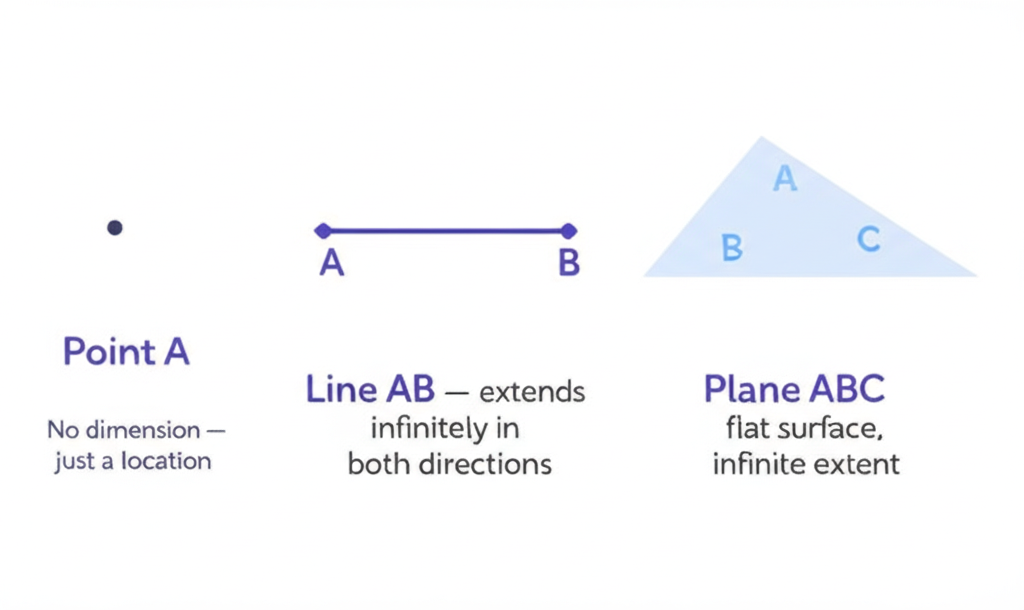
•
Point
A location
No dimensions
←——→
Line
A straight path
1 dimension (length)
▱
Plane
A flat surface
2 dimensions (length, width)
2Key Definitions
Point
A specific location in space with no dimension. Named with a capital letter (e.g. Point A).
Line
A straight path extending infinitely in two directions. 1D. Named by two points or a lowercase letter.
Plane
A flat surface extending infinitely in all directions. 2D. Named by three non-collinear points.
Line Segment
A part of a line with two endpoints and a finite length.
Ray
One endpoint, extends infinitely in one direction. Endpoint listed first.
Opposite Rays
Two rays sharing an endpoint and extending in opposite directions, forming a line.
Midpoint
The point dividing a segment into two equal parts.
Collinear
Points on the same line.
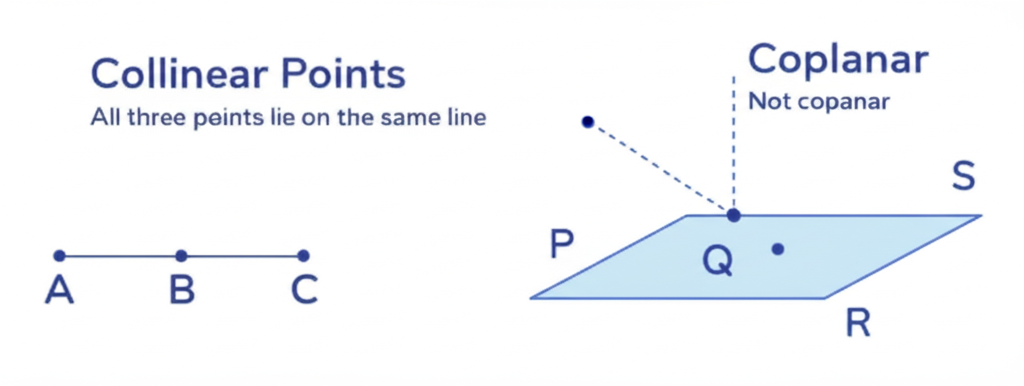
Coplanar
Points on the same plane.
Postulate
A statement accepted as true without proof. Also called an axiom.
3Points
A point is the most fundamental building block in geometry. It has no dimension — no length, width, or thickness. It simply marks a location.
Naming
Always named with a single capital letter: Point A, Point P, Point X.
Representation
We draw a dot, but the dot has size — a true geometric point does not. The dot is just a visual aid.
Any two points are always collinear (you can always draw a line through two points). It takes three or more points to potentially be non-collinear.
4Lines
A line is a straight path that extends infinitely in both directions. It has one dimension (length) but no width or thickness.
Key Postulate
Two points determine exactly one line. Given any two distinct points, there is exactly one straight line passing through both.
Line, Segment, Ray
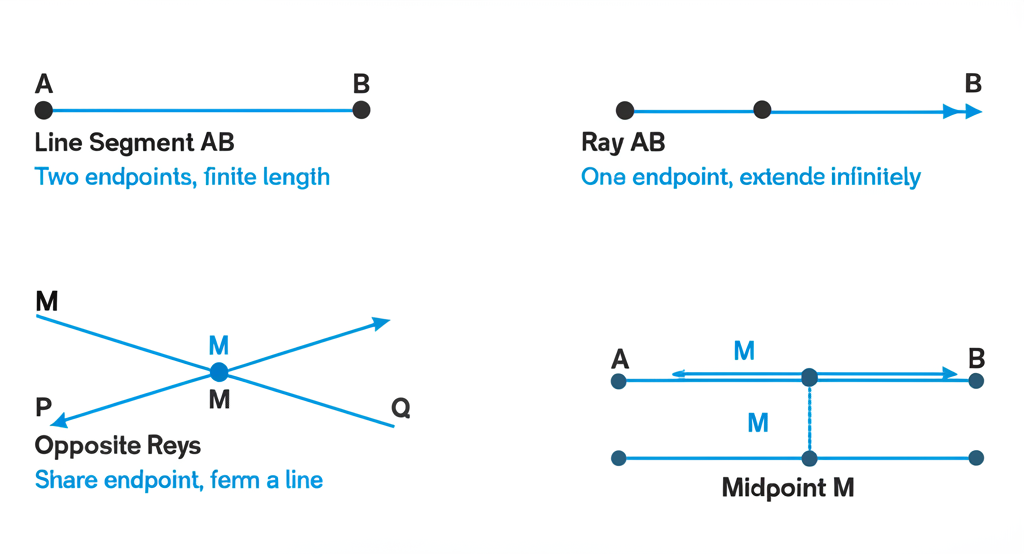
Line
No endpoints. Extends infinitely in both directions. Arrows on both ends.
Segment
Two endpoints. Finite, measurable length. No arrows.
Ray
One endpoint. Extends infinitely in one direction. One arrow.
Opposite Rays
Two rays that share the same endpoint and extend in opposite directions, together forming a complete line. If M is between P and Q, then ray MP and ray MQ are opposite rays.
5Planes
A plane is a flat, two-dimensional surface that extends infinitely in all directions. It has length and width but no thickness.
Key Postulate
Three non-collinear points determine exactly one plane. If you pick any three points not on the same line, there is exactly one flat surface containing all three.
When we draw a plane as a parallelogram, it looks like it has edges. But a true geometric plane has no boundaries — it extends forever. The shape is just a visual representation.
Naming a Plane
By three non-collinear points (Plane ABC) or a single capital script letter (Plane P).
Coplanar vs Non-coplanar
Points/lines on the same plane are coplanar. If they don't share a plane, they're non-coplanar.
6Intersections
The intersection of geometric figures is the set of points they have in common.
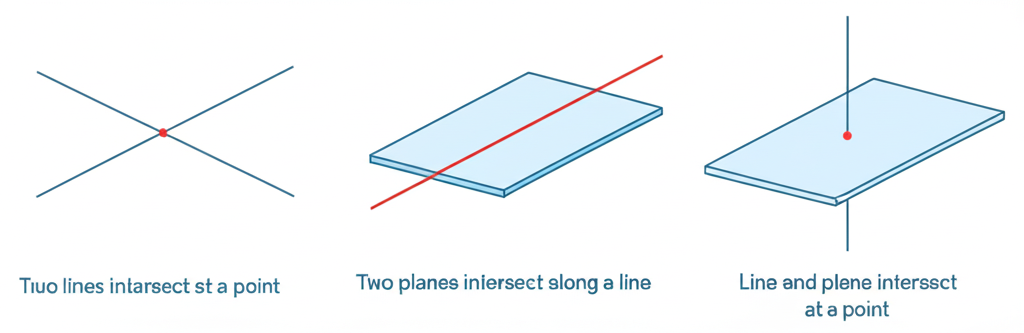
Two Lines
Intersect at a point.
Or they're parallel (same plane, never meet) or skew (different planes).
Two Planes
Intersect along a line.
Or they're parallel (never meet). Like two walls meeting at a corner.
Line & Plane
Intersect at a point.
Or the line lies in the plane, or they're parallel.
7Segment & Distance
Distance Formula
D = √((x₂ − x₁)² + (y₂ − y₁)²)
The distance between two points on a coordinate plane.
Midpoint Formula
M = ((x₁ + x₂)/2, (y₁ + y₂)/2)
The average of the x-coordinates and the average of the y-coordinates.
Segment Addition Postulate
If point B is between points A and C on a line, then:
AB + BC = AC
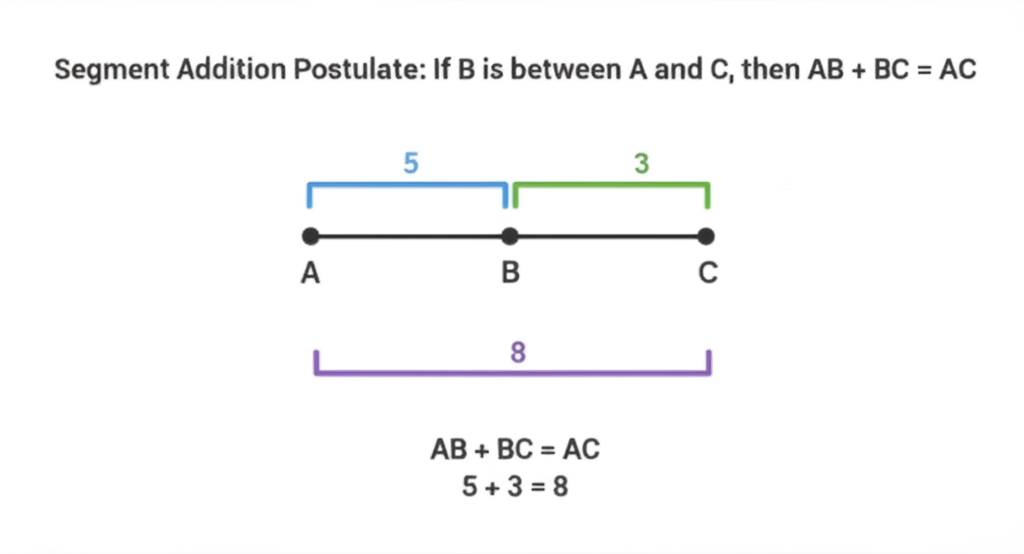
Example
If AB = 7 and BC = 5, and B is between A and C:
AC = AB + BC
AC = 7 + 5
AC = 12
8Key Postulates
Postulates are statements accepted as true without proof. They are the foundation for all geometric reasoning.
Line Postulate
Through any two distinct points, there is exactly one line.
Plane Postulate
Through any three non-collinear points, there is exactly one plane.
Line-Point Postulate
A line contains at least two points.
Plane-Point Postulate
A plane contains at least three non-collinear points.
Line in Plane Postulate
If two points lie in a plane, then the entire line containing those points lies in that plane.
Plane Intersection Postulate
If two distinct planes intersect, their intersection is a line.
Segment Addition Postulate
If B is between A and C, then AB + BC = AC.
9Memory Aids
"P.L.P. = Primary Layers of Pure geometry"
Points, Lines, Planes — the three undefined terms that form the foundation.
"Line = Long road, Segment = Short piece, Ray = Ray of sunshine"
A line goes forever (Long), a segment is cut Short, a ray starts at the sun and goes out forever.
"Co-LINE-ar = same line. Co-PLANE-ar = same plane."
The words themselves contain the answer — look for "line" and "plane" inside them.
"2 points = 1 line. 3 non-collinear points = 1 plane."
A tripod (3 legs) defines a stable flat surface. Two dots define a straight path.
"Lines cross at a Point. Planes cut along a Line."
The intersection of two lines is a 0D point. The intersection of two planes is a 1D line.
10Common Mistakes
Confusing a line with a segment
A line extends infinitely (arrows on both ends). A segment has two endpoints and finite length. They look similar but mean very different things.
Thinking a plane has edges
We draw planes as parallelograms with visible edges, but a true geometric plane extends infinitely in all directions with no boundaries.
Confusing collinear and coplanar
All collinear points are coplanar, but not all coplanar points are collinear. Three points on a plane can form a triangle — coplanar but not collinear.
Using wrong notation
Line (double arrow), segment (bar), and ray (single arrow) have specific symbols. Using the wrong one changes the meaning entirely.
Assuming collinearity from a diagram
Points that appear to be on the same line might not be — only state collinearity if explicitly given or proven.
Misapplying the Segment Addition Postulate
AB + BC = AC only works when B is between A and C on the same line. All three points must be collinear.
Quick Revision Summary
- ✓Point: no dimension, just a location. Named with a capital letter.
- ✓Line: 1D, extends infinitely both ways. Two points define exactly one line.
- ✓Plane: 2D, extends infinitely. Three non-collinear points define exactly one plane.
- ✓Segment: two endpoints, finite. Ray: one endpoint, extends one way. Opposite rays: form a line.
- ✓Collinear = same line. Coplanar = same plane.
- ✓Two lines intersect at a point. Two planes intersect along a line.
- ✓Segment Addition Postulate: If B is between A and C, then AB + BC = AC.
- ✓Midpoint formula: M = ((x₁+x₂)/2, (y₁+y₂)/2).
Frequently Asked Questions
- Why are points, lines, and planes called "undefined terms"?
- They are the basic building blocks of geometry, accepted without formal definition. Everything else in geometry (angles, triangles, circles) is defined using these three concepts. We understand them through descriptions and examples rather than strict definitions.
- What is the difference between a line, a ray, and a segment?
- A line extends infinitely in both directions (no endpoints). A ray has one endpoint and extends infinitely in one direction. A segment has two endpoints and a finite, measurable length.
- What is the difference between collinear and coplanar?
- Collinear points lie on the same line. Coplanar points lie on the same plane. All collinear points are also coplanar (a line lies in a plane), but coplanar points are not necessarily collinear.
- What is a postulate vs a theorem?
- A postulate (or axiom) is a statement accepted as true without proof — it is a starting assumption. A theorem is a statement that has been proven true using definitions, postulates, and previously proven theorems.
- How do two planes intersect?
- If two distinct planes intersect, their intersection is always a line. Think of two walls meeting at a corner — the crease where they meet forms a straight line. If the planes don't intersect, they are parallel.
Practice Quiz
Test your understanding — select the correct answer for each question.
1.Which of the following best describes a point?
2.How many distinct points are needed to determine a unique line?
3.Which notation correctly represents a line segment with endpoints P and Q?
4.If A, B, C are collinear with B between A and C, AB = 7 and BC = 5, what is AC?
5.What is the intersection of two distinct planes?
6.Which term describes points that lie on the same plane?
7.A ray has:
8.What is the midpoint of a segment with endpoints (2, 5) and (8, 1)?
9.Which statement is a postulate (accepted without proof)?
10.If M is the midpoint of AB, AM = 3x − 1 and MB = 2x + 4, what is x?
Final Study Advice
- 1.Always use the correct notation — line, segment, and ray have different symbols.
- 2.Remember that lines and planes are infinite — diagrams are just partial representations.
- 3.Know the difference between collinear (same line) and coplanar (same plane).
- 4.Memorize the key postulates — they are the foundation for every proof and theorem.
- 5.Practice the midpoint and distance formulas — they appear constantly in coordinate geometry.