Probability Basics
Probability is the branch of mathematics that quantifies the likelihood of events occurring. It provides a systematic way to analyze and predict random phenomena, forming the foundation for statistics, data science, and everyday decision-making.
This guide covers key definitions, basic probability formulas, the complement rule, compound events, counting techniques, experimental vs theoretical probability, memory aids, and a practice quiz.
1Introduction
Probability is the language of uncertainty. Instead of saying "it might rain," probability allows us to say "there's a 70% chance of rain." It provides a numerical measure of how likely an event is to occur, on a scale from 0 (impossible) to 1 (certain).
Probability is not just for card games or dice rolls. It is a foundational concept used across countless real-world fields, from insurance and medicine to finance and sports analytics. Understanding probability helps us make informed decisions in the face of uncertainty.
Imagine a pharmaceutical company developing a new drug. Before approval, they must conduct clinical trials. Probability helps them determine the likelihood that the drug is effective and that the observed results were not just due to chance. Without probability, we could not make informed decisions about life-saving treatments!
Real-World Uses
Insurance
Actuaries use probability to calculate premiums and assess risk for policies.
Medical Tests
Understanding false positive and false negative rates is vital for accurate diagnosis.
Finance
Investors use probability to assess risk and potential return on investments.
Sports Analytics
Coaches and analysts use probability to make strategic decisions during games.
2Key Definitions
Experiment
Any process that generates well-defined outcomes. Examples: flipping a coin, rolling a die, drawing a card.
Outcome
A single possible result of an experiment. Example: getting "Heads" when flipping a coin.
Sample Space (S)
The set of all possible outcomes. For a coin flip: S = {Heads, Tails}. For a die: S = {1, 2, 3, 4, 5, 6}.
Event (A, B, ...)
A subset of the sample space; one or more outcomes. "Rolling an even number" = {2, 4, 6}.
Probability P(A)
A numerical measure of the likelihood that event A occurs. Always between 0 and 1.
Certain Event
An event guaranteed to happen, with probability 1 (100%). Example: the sun rising tomorrow.
Impossible Event
An event that cannot happen, with probability 0 (0%). Example: rolling a 7 on a standard die.
Complement (A')
The event that A does not occur. Includes all outcomes in the sample space not in A.
Union (A ∪ B)
The event that A or B (or both) occurs. All outcomes in A, in B, or in both.
Intersection (A ∩ B)
The event that both A and B occur. Only outcomes common to both A and B.
Mutually Exclusive
Events that cannot occur at the same time. P(A ∩ B) = 0. Example: rolling an even and an odd number simultaneously.
Independent Events
Events where the occurrence of one does not affect the probability of the other. Example: flipping a coin twice.
3Basic Probability
The foundation of probability rests on a few key ideas: the probability scale, the formula for computing basic probability, and the concept of equally likely outcomes.
The Probability Scale
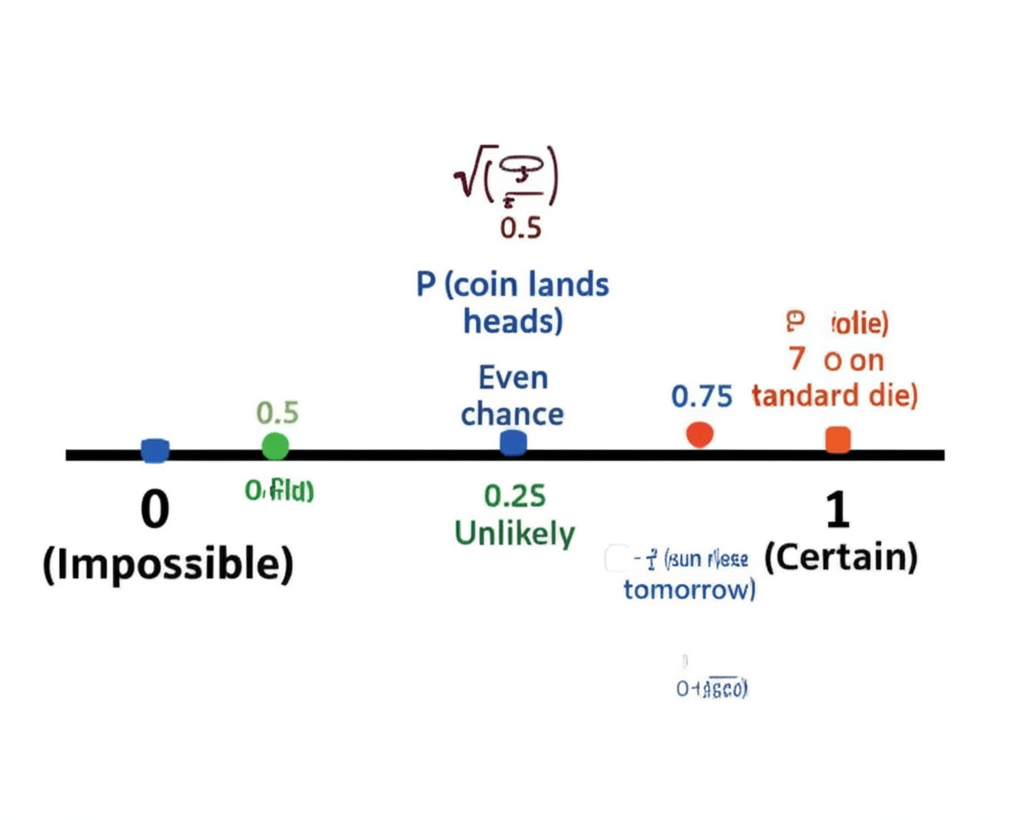
All probabilities must fall between 0 and 1, inclusive. A probability of 0 means the event is impossible, 0.5 means equally likely, and 1 means certain.
Computing Basic Probability
For events where all outcomes are equally likely, the probability of an event A is:
P(A) = Favorable Outcomes / Total Outcomes
The number of outcomes satisfying event A divided by the total number of possible outcomes in the sample space.
Worked Example: Rolling a Die
What is the probability of rolling an even number on a standard 6-sided die?
Favorable outcomes (even): {2, 4, 6} = 3 outcomes
Total outcomes: {1, 2, 3, 4, 5, 6} = 6 outcomes
P(Even) = 3/6 = 1/2 = 0.5
Worked Example: Drawing from a Bag
A bag contains 5 red, 3 blue, and 2 green marbles. What is the probability of picking a blue marble?
Total outcomes: 5 + 3 + 2 = 10 marbles
Favorable outcomes (blue): 3 marbles
P(Blue) = 3/10 = 0.3

Interactive: Dice Probability Simulator
Roll dice and watch experimental probability converge to theoretical probability (Law of Large Numbers).
Press Roll to begin
4Complement Rule
The complement of an event A (denoted A' or Ac) is the event that A does not occur. The sum of the probability of an event and the probability of its complement is always 1.
P(A') = 1 - P(A)
Equivalently: P(A) + P(A') = 1. The probability of "not A" is one minus the probability of A.
Worked Example: Weather
If the probability of rain tomorrow is P(R) = 0.70, what is the probability it does not rain?
P(R') = 1 - P(R)
P(R') = 1 - 0.70
P(R') = 0.30
Worked Example: Marbles
A bag has 5 red, 3 blue, and 2 green marbles. What is the probability of picking a marble that is NOT red?
P(Red) = 5/10 = 0.5
P(Not Red) = 1 - P(Red) = 1 - 0.5
P(Not Red) = 0.5
5Compound Events
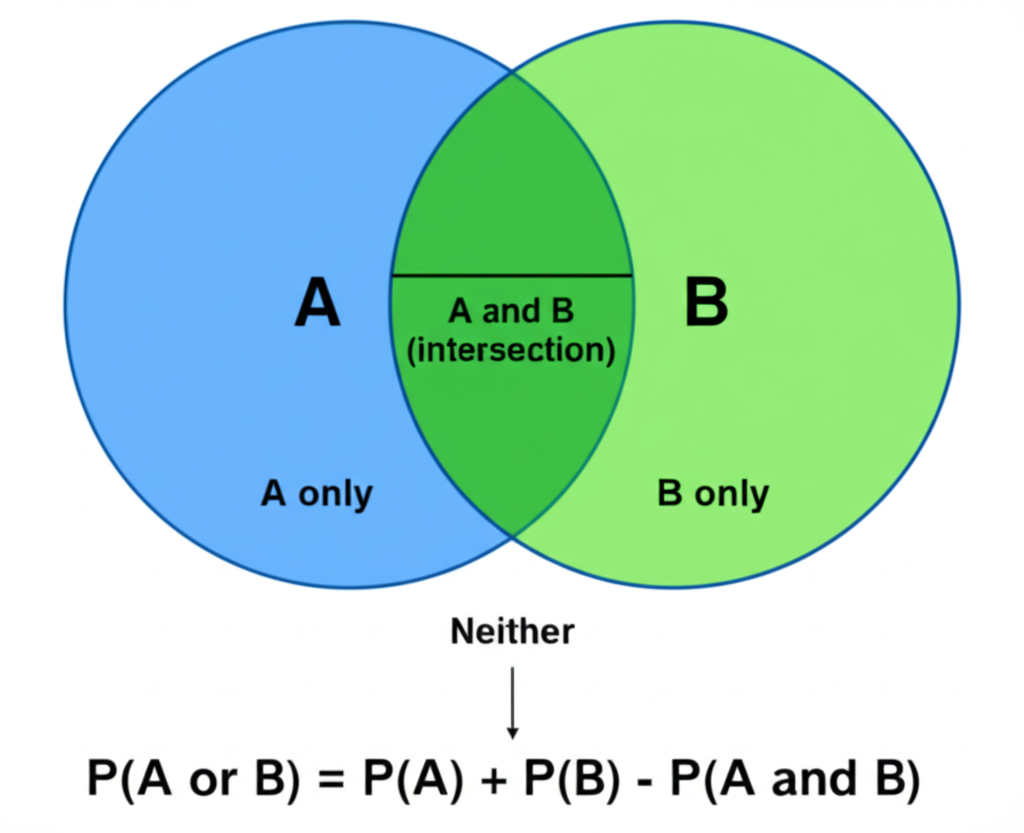
Compound events involve two or more simple events. We use "OR" (union) and "AND" (intersection) to describe them.
Interactive: Venn Diagram Explorer
Adjust the probabilities and highlight regions to visualize how probability rules work with Venn diagrams.
Addition Rule (OR / Union)
The probability that event A or event B (or both) occurs:
P(A ∪ B) = P(A) + P(B) - P(A ∩ B)
We subtract P(A ∩ B) to avoid double-counting outcomes in both events.
Special Case: Mutually Exclusive Events
P(A ∪ B) = P(A) + P(B)
When A and B cannot happen simultaneously, P(A ∩ B) = 0, so the formula simplifies.
Worked Example: Cards (Addition Rule)
What is the probability of drawing a King or a Spade from a standard 52-card deck?
P(King) = 4/52
P(Spade) = 13/52
P(King ∩ Spade) = 1/52 (King of Spades)
P(King ∪ Spade) = 4/52 + 13/52 - 1/52
= 16/52 = 4/13
Multiplication Rule (AND / Intersection of Independent Events)
If A and B are independent events (the occurrence of one does not affect the other), the probability that both occur is:
P(A ∩ B) = P(A) × P(B)
For independent events only. For dependent events, conditional probability is needed.
Worked Example: Coin Flips (Multiplication Rule)
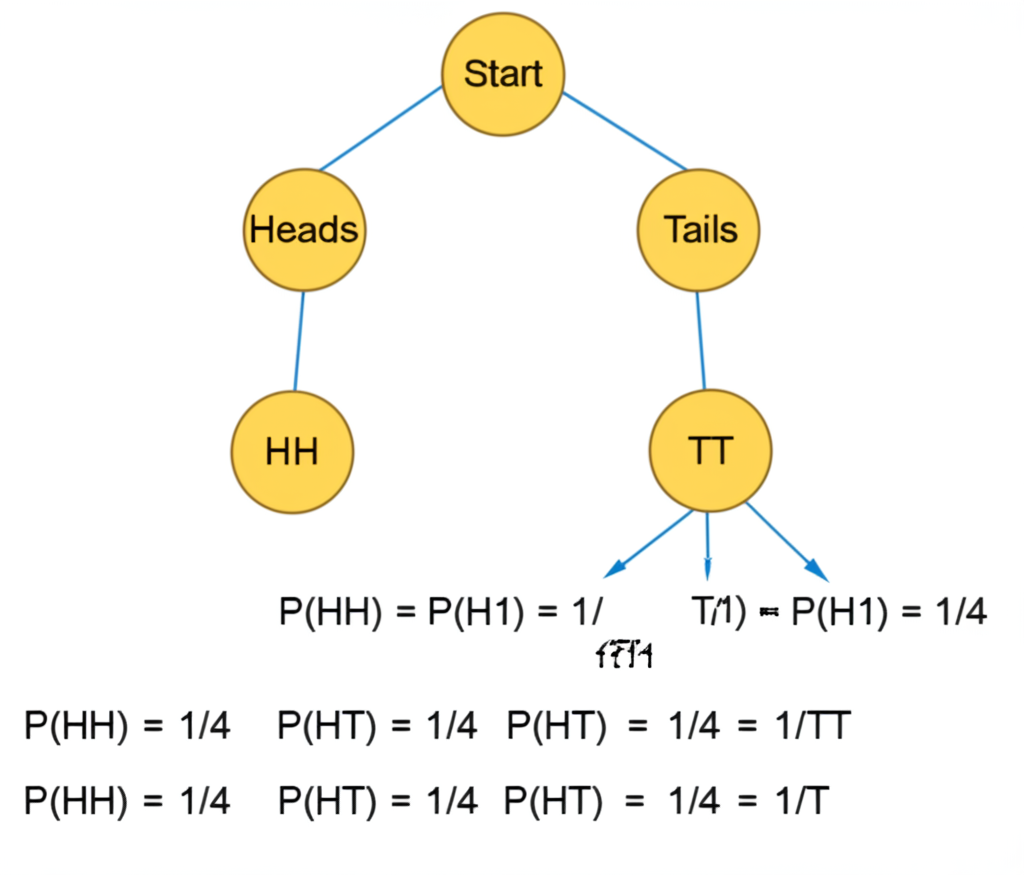
What is the probability of flipping a coin twice and getting Heads both times?
P(Heads on 1st flip) = 1/2
P(Heads on 2nd flip) = 1/2
P(HH) = 1/2 × 1/2 = 1/4
Worked Example: Die and Coin
You roll a die and flip a coin. What is the probability of rolling a 4 AND flipping Heads?
P(Rolling a 4) = 1/6
P(Flipping Heads) = 1/2
P(4 ∩ Heads) = 1/6 × 1/2 = 1/12
6Counting Techniques
Before calculating probabilities, you often need to figure out the total number of possible outcomes or favorable outcomes. Counting techniques provide systematic methods for this.
Fundamental Counting Principle
If an event can occur in m ways, and a second independent event can occur in n ways, then the two events can occur in sequence in m x n ways. This extends to any number of events.
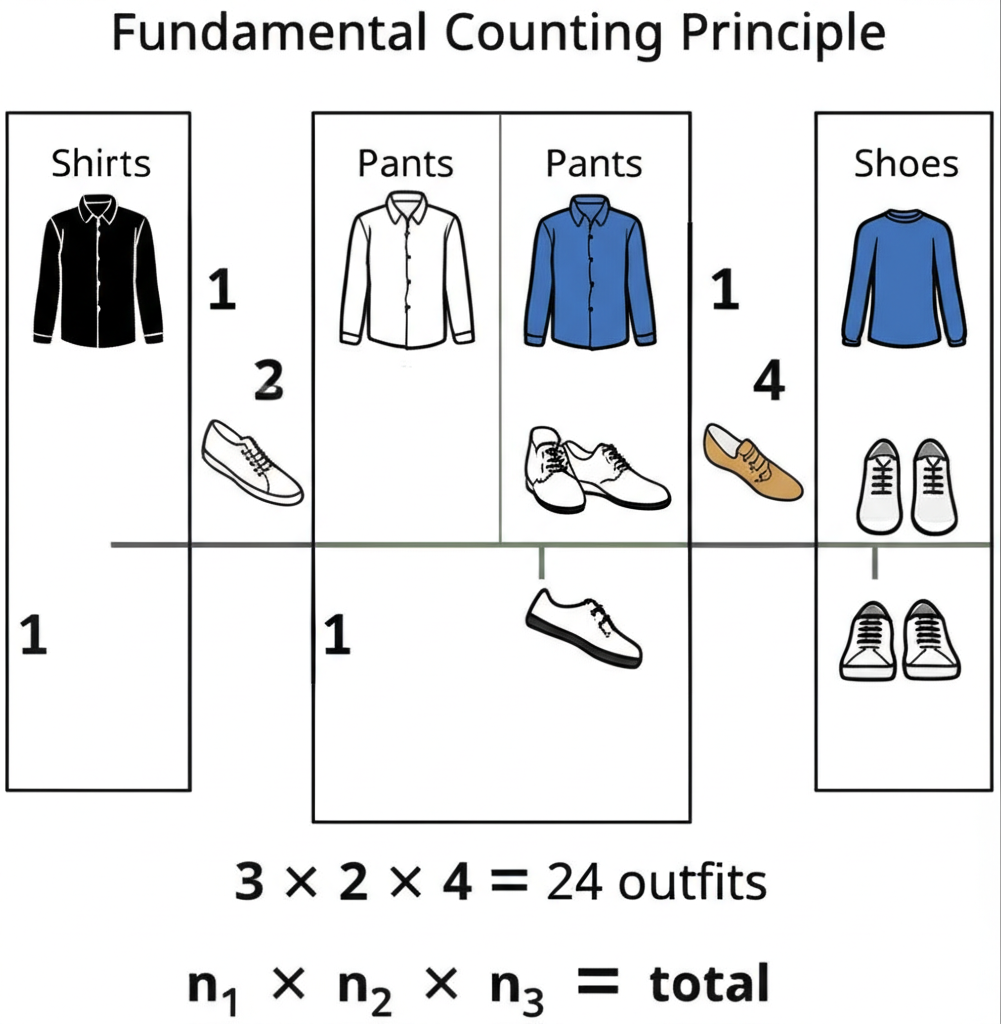
How many different outfits from 3 shirts, 2 pants, and 4 pairs of shoes?
Total outfits = 3 × 2 × 4
= 24 different outfits
Permutations (Order Matters!)
A permutation is an arrangement of objects in a specific order. The number of permutations of selecting r objects from n distinct objects is:
P(n, r) = n! / (n - r)!
Where n! (n factorial) = n x (n-1) x (n-2) x ... x 1, and 0! = 1.
In a race with 8 runners, how many ways can gold, silver, and bronze be awarded?
n = 8, r = 3
P(8, 3) = 8! / (8 - 3)! = 8! / 5!
= 8 × 7 × 6
= 336 ways
Combinations (Order Does Not Matter!)
A combination is a selection of objects where the order of selection is not important. The number of combinations of selecting r objects from n distinct objects is:
C(n, r) = n! / (r! × (n - r)!)
Choosing r items from n where rearranging the same items does not count as a different selection.
From a group of 10 students, how many ways can a committee of 3 be chosen?
n = 10, r = 3
C(10, 3) = 10! / (3! × 7!)
= (10 × 9 × 8) / (3 × 2 × 1)
= 720 / 6
= 120 ways
Permutations vs Combinations at a Glance
Permutation
P(n, r) = n! / (n - r)!
Order matters. Think "P" for "Position."
Example: Assigning president, VP, secretary.
Combination
C(n, r) = n! / (r!(n - r)!)
Order does not matter. Think "C" for "Committee."
Example: Choosing 3 people for a team.
7Experimental vs Theoretical Probability
These two types of probability help us understand the difference between what should happen and what does happen.
Theoretical Probability
Based on logical reasoning and the structure of the event.
Example: P(Heads) = 1/2 because there are two equally likely outcomes.
Experimental Probability
Based on observing outcomes of actual experiments or trials.
Formula: P(A) = (Times A occurred) / (Total trials)
The Law of Large Numbers
As the number of trials in an experiment increases, the experimental probability of an event will tend to get closer and closer to its theoretical probability.
Example: Flipping a fair coin
10 flips: You might get 7 Heads (experimental P = 0.70) — far from 0.5
100 flips: You might get 53 Heads (experimental P = 0.53) — closer to 0.5
10,000 flips: You would expect close to 5,000 Heads (experimental P near 0.50)
8Memory Aids
"AND means multiply, OR means add"
A quick reminder for compound probabilities. "And" uses the multiplication rule, "Or" uses the addition rule.
"Permutation: Position matters!"
Think of "P" for "Position." If changing the order creates a different outcome, it is a permutation.
"Combination: Committee (order doesn't matter)"
Think of "C" for "Committee." When selecting a group, the order you pick them in does not change the group itself.
"Complement is NOT"
If you want the probability of something not happening, use 1 - P(that something). Especially useful for "at least one" problems.
"More trials, closer to truth"
The Law of Large Numbers: the more times you repeat an experiment, the closer your experimental probability gets to the theoretical probability.
"Probability is always between 0 and 1"
If you get a probability outside this range, you have made a mistake! Always verify your answer falls between 0 and 1 (or 0% and 100%).
9Common Mistakes
Confusing independent and dependent events
Assuming events are independent when they are dependent (e.g., drawing cards without replacement). If the first event changes the sample space for the second, they are dependent.
Forgetting to subtract the intersection in the Addition Rule
For non-mutually exclusive events, P(A ∪ B) is not just P(A) + P(B). You must subtract P(A ∩ B) to avoid double-counting outcomes that belong to both events.
Misidentifying permutations vs combinations
Always ask: "Does the order of selection matter?" If yes, use permutations. If no, use combinations. This is one of the most common errors on probability problems.
Calculating a probability greater than 1 or less than 0
Probabilities are always between 0 and 1. An answer outside this range immediately tells you there is an error in your calculation.
Incorrectly identifying the sample space
Make sure you have listed all possible outcomes accurately and without duplication. A wrong sample space leads to wrong probabilities.
Assuming events are mutually exclusive when they are not
Just because two events are different does not mean they cannot happen at the same time (e.g., drawing a red card and drawing a face card from a deck).
Confusing "with replacement" and "without replacement"
"With replacement" means events are independent. "Without replacement" means they are dependent because the sample space changes after each draw.
Overlooking the word "at least"
"At least one" problems are often easier to solve using the complement: P(at least one) = 1 - P(none). Do not try to list every case individually.
Making factorial calculation errors
Forgetting that 0! = 1 or making arithmetic errors with large factorials. Always simplify by canceling common factorial terms before computing.
Quick Revision Summary
- ✓Probability quantifies the likelihood of an event, ranging from 0 (impossible) to 1 (certain).
- ✓The sample space lists all possible outcomes of an experiment.
- ✓P(A) = Favorable / Total for equally likely outcomes.
- ✓Complement Rule: P(A') = 1 - P(A). The probability of "not A."
- ✓Addition Rule (OR): P(A ∪ B) = P(A) + P(B) - P(A ∩ B).
- ✓Mutually exclusive: P(A ∩ B) = 0, so P(A ∪ B) = P(A) + P(B).
- ✓Multiplication Rule (AND): P(A ∩ B) = P(A) × P(B) for independent events.
- ✓Fundamental Counting Principle: multiply the number of ways for each stage.
- ✓Permutations (order matters): P(n, r) = n! / (n - r)!
- ✓Combinations (order does not matter): C(n, r) = n! / (r! × (n - r)!)
- ✓Law of Large Numbers: experimental probability approaches theoretical probability as trials increase.
- ✓Always verify your probability is between 0 and 1.
Frequently Asked Questions
- What is the main difference between theoretical and experimental probability?
- Theoretical probability is based on ideal conditions and mathematical calculations (what should happen), while experimental probability is based on actual trials and observations (what did happen). The Law of Large Numbers connects them, showing that experimental probability approaches theoretical probability as the number of trials increases.
- When do I use permutations versus combinations?
- Use permutations when the order of selection or arrangement is important (e.g., assigning specific roles like president, vice-president, and secretary). Use combinations when the order does not matter and you are simply choosing a group or subset (e.g., selecting a committee or choosing pizza toppings).
- Can a probability ever be negative or greater than 1?
- No. A probability must always be between 0 and 1, inclusive (or equivalently, between 0% and 100%). If your calculation results in a number outside this range, it indicates an error in your work.
- What does "mutually exclusive" mean, and why is it important?
- Mutually exclusive (or disjoint) events are events that cannot occur at the same time. For example, rolling an even number and rolling an odd number on a single die are mutually exclusive. This matters because when events are mutually exclusive, their intersection is 0, simplifying the Addition Rule to P(A or B) = P(A) + P(B).
- How do Venn diagrams help in understanding probability?
- Venn diagrams visually represent the relationships between events within a sample space. They clearly show the intersection (A and B), union (A or B), and complements of events, making it easier to apply the Addition Rule and understand complex probability scenarios involving overlapping events.
Practice Quiz
Test your understanding — select the correct answer for each question.
1.Probability scale ranges from:
2.P(A') equals:
3.For independent events A and B, P(A and B) = ?
4.P(A or B) formula is:
5.A deck has 52 cards. P(Heart) = ?
6.Flipping two coins, P(two heads) = ?
7.Mutually exclusive events:
8.Rolling a die, P(even) = ?
9.Combination vs permutation:
10.Theoretical probability approaches experimental with:
Final Study Advice
- 1.Always identify what type of problem you are dealing with first — basic probability, complement, union, intersection, or counting.
- 2.Ask yourself: "Does order matter?" to decide between permutations and combinations.
- 3.Draw a Venn diagram or tree diagram to visualize compound events before calculating.
- 4.For "at least one" problems, consider using the complement: P(at least one) = 1 - P(none).
- 5.Always check your answer — probability must be between 0 and 1, and all probabilities in a sample space must sum to 1.