Quadratic Equations
Quadratic equations are polynomial equations of the second degree — they contain an x² term and their graphs form parabolas. They model projectile motion, area optimization, profit curves, and countless real-world phenomena.
This guide covers solving methods (factoring, completing the square, quadratic formula), the discriminant, the three forms, graphing parabolas, real-world applications, and a practice quiz.
1Introduction
A quadratic equation is a polynomial equation of the second degree — it contains at least one x² term. The general form is:
ax² + bx + c = 0
a = leading coefficient (a ≠ 0)
b = coefficient of x
c = constant term
If a = 0, the x² term disappears and you get a linear equation (bx + c = 0). The value of a is what makes it quadratic.
Throw a basketball toward a hoop. Its path through the air traces a parabola — a quadratic equation describes its height at any moment. The ball rises, reaches a peak (vertex), and falls back down.
Real-World Applications
Projectile Motion
The path of a ball, rocket, or any thrown object follows a parabolic trajectory.
Area Optimization
Maximize the area of an enclosure given a fixed perimeter — classic quadratic problem.
Profit & Revenue
Businesses model revenue as a quadratic to find the price that maximizes profit.
Engineering & Architecture
Parabolic shapes appear in bridges, antennas, satellite dishes, and arches.
2Key Definitions
Quadratic Equation
An equation of the form ax² + bx + c = 0, where a ≠ 0. Degree 2.
Parabola
The U-shaped curve that is the graph of a quadratic function. Opens up or down.
Vertex
The turning point — the minimum (opens up) or maximum (opens down) of the parabola.
Axis of Symmetry
The vertical line x = h through the vertex that divides the parabola into two mirror halves.
Roots / Zeros / Solutions
The x-values where ax² + bx + c = 0. Graphically, the x-intercepts of the parabola.
Discriminant
b² − 4ac. Determines the nature and number of roots (real or complex).
Leading Coefficient
The coefficient "a" of the x² term. Controls direction and width of the parabola.
Y-intercept
Where the parabola crosses the y-axis. Always (0, c) in standard form.
Standard Form
ax² + bx + c = 0. Best for quadratic formula and factoring.
Vertex Form
a(x − h)² + k. Vertex at (h, k). Best for graphing.
Factored Form
a(x − r₁)(x − r₂). Roots r₁ and r₂ visible directly.
3Solving Quadratic Equations
There are four main methods for solving quadratic equations. The best choice depends on the specific equation.
Method 1: Factoring
Rewrite the quadratic as a product of two linear factors, then use the Zero Product Property: if A × B = 0, then A = 0 or B = 0.
Difference of Squares
x² − 9 = 0
(x − 3)(x + 3) = 0
x = 3 or x = −3
Trinomial (a = 1)
x² + 5x + 6 = 0
(x + 2)(x + 3) = 0
x = −2 or x = −3
Trinomial (a ≠ 1) — AC Method
Solve: 2x² + 7x + 3 = 0
a × c = 2 × 3 = 6. Find two numbers: 1 × 6 = 6, 1 + 6 = 7 ✓
2x² + 1x + 6x + 3 = 0
x(2x + 1) + 3(2x + 1) = 0
(2x + 1)(x + 3) = 0
x = −1/2 or x = −3
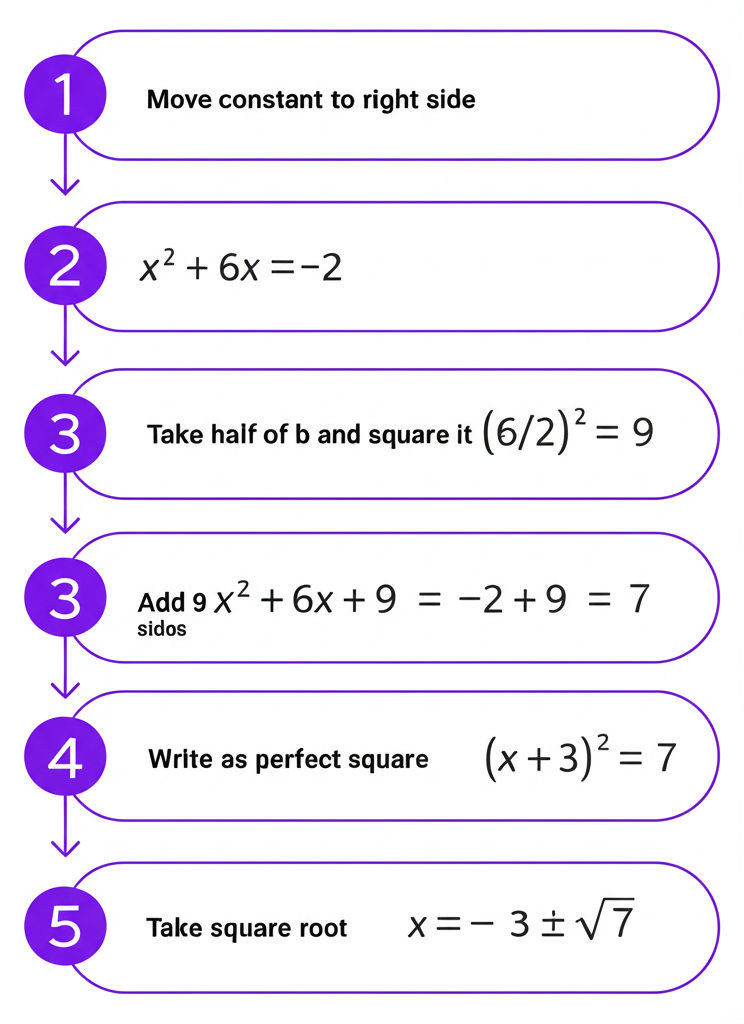
Method 2: Completing the Square
Transform the equation into a perfect square trinomial, then take the square root of both sides.
Example: x² + 6x + 2 = 0
x² + 6x = −2 (move constant)
(6/2)² = 9 (half of b, squared)
x² + 6x + 9 = −2 + 9 = 7 (add to both sides)
(x + 3)² = 7 (perfect square)
x + 3 = ±√7
x = −3 ± √7
Method 3: The Quadratic Formula
The universal method that always works, derived from completing the square on ax² + bx + c = 0.
x = (−b ± √(b² − 4ac)) / 2a
Identify a, b, c from standard form, substitute, and simplify.
Example: 2x² + 5x − 3 = 0
a = 2, b = 5, c = −3
x = (−5 ± √(25 − 4(2)(−3))) / (2 × 2)
x = (−5 ± √(25 + 24)) / 4
x = (−5 ± √49) / 4
x = (−5 ± 7) / 4
x = 1/2 or x = −3
Method 4: Square Root Method
Used when there is no bx term, or the variable is already in a squared binomial.
x² = 25
x = ±√25
x = ±5
(x − 3)² = 16
x − 3 = ±4
x = 7 or x = −1
4The Discriminant
The discriminant (Δ = b² − 4ac) is the expression under the square root in the quadratic formula. It tells you the nature and number of roots without solving.
Δ = b² − 4ac
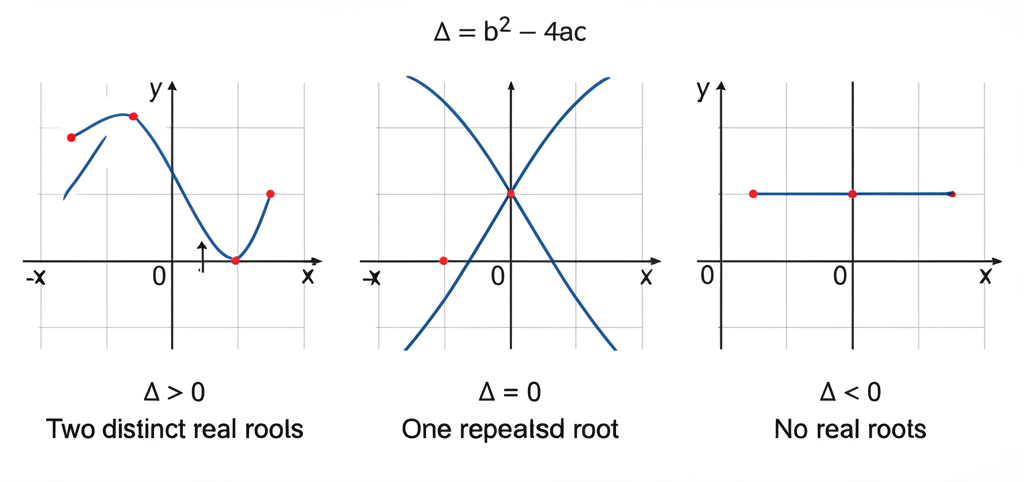
Δ > 0
Two distinct real roots
Parabola crosses x-axis at two points. If Δ is a perfect square, roots are rational.
Δ = 0
One repeated real root
Parabola touches x-axis at exactly one point (vertex on x-axis).
Δ < 0
No real roots
Parabola doesn't touch x-axis. Two complex conjugate roots.
Example: x² + 5x + 6 = 0
Δ = 5² − 4(1)(6) = 25 − 24 = 1
Δ = 1 > 0 → Two distinct real roots (rational, since 1 is a perfect square)
5Forms of Quadratic Equations
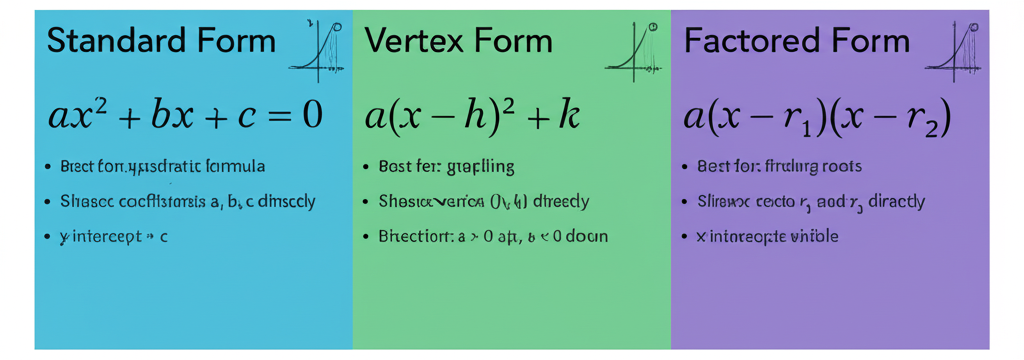
Standard Form
ax² + bx + c = 0
Best for: quadratic formula, factoring
Shows: y-intercept (0, c)
Vertex Form
a(x − h)² + k
Best for: graphing
Shows: vertex (h, k) directly
Factored Form
a(x − r₁)(x − r₂)
Best for: finding roots
Shows: x-intercepts r₁, r₂
Converting Between Forms
Standard → Vertex (using vertex formula)
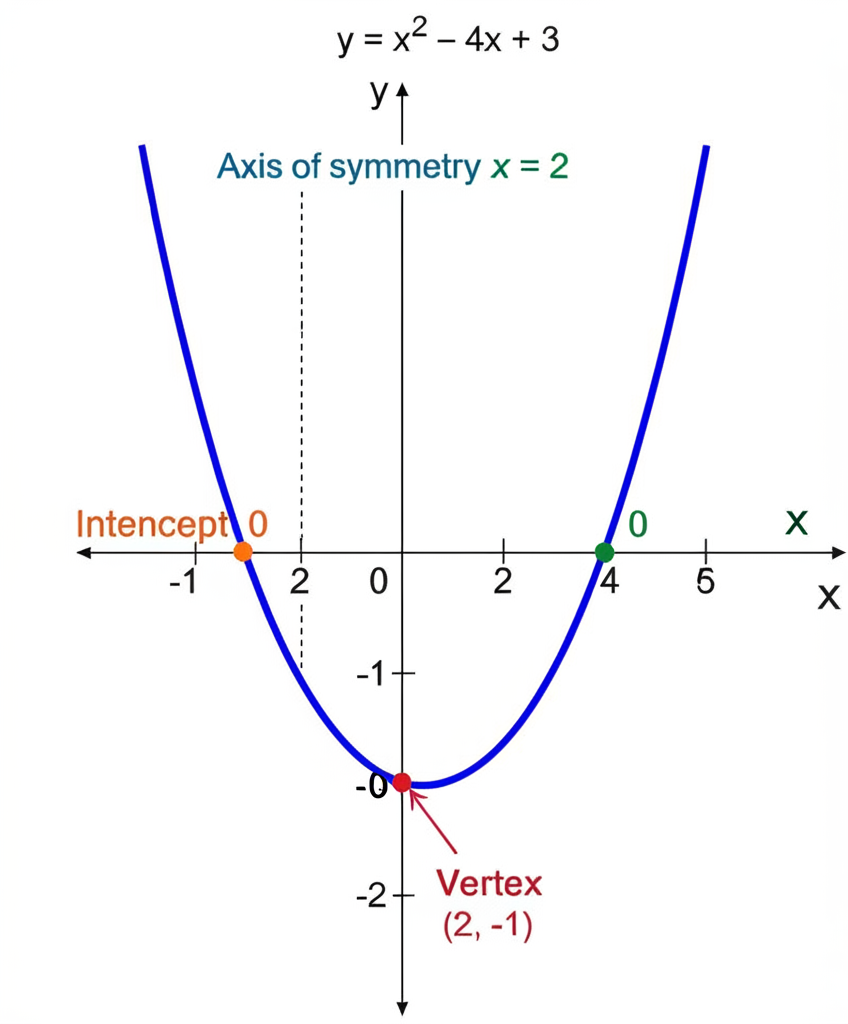
y = x² − 4x + 3
h = −(−4) / (2×1) = 2
k = (2)² − 4(2) + 3 = 4 − 8 + 3 = −1
y = (x − 2)² − 1
Vertex → Standard (expand)
y = (x − 2)² − 1
y = (x² − 4x + 4) − 1
y = x² − 4x + 3
Factored → Standard (FOIL)
y = (x − 1)(x − 3)
y = x² − 3x − x + 3
y = x² − 4x + 3
6Graphing Parabolas
Steps to Graph a Parabola
- Determine direction: a > 0 opens up, a < 0 opens down.
- Find the vertex: h = −b/(2a), then k = f(h).
- Draw the axis of symmetry: x = h (dashed vertical line).
- Find the y-intercept: Set x = 0 → y = c.
- Find x-intercepts (if any): Set y = 0, solve for x.
- Plot symmetric points: Use the axis of symmetry to mirror points.
- Draw the curve: Connect the points in a smooth U-shape.
a > 0: Opens Up
The vertex is a minimum. The parabola "smiles."
Example: y = x² (standard parabola)
a < 0: Opens Down
The vertex is a maximum. The parabola "frowns."
Example: y = −x² (inverted parabola)
Effect of |a| on Width
|a| > 1
Narrower parabola
e.g. y = 3x²
|a| = 1
Standard width
e.g. y = x²
0 < |a| < 1
Wider parabola
e.g. y = 0.5x²
Interactive: Parabola Explorer
Adjust a, h, and k to see how the parabola y = a(x − h)² + k changes. Watch how the vertex, direction, and width respond.
y = x²
7Applications & Word Problems
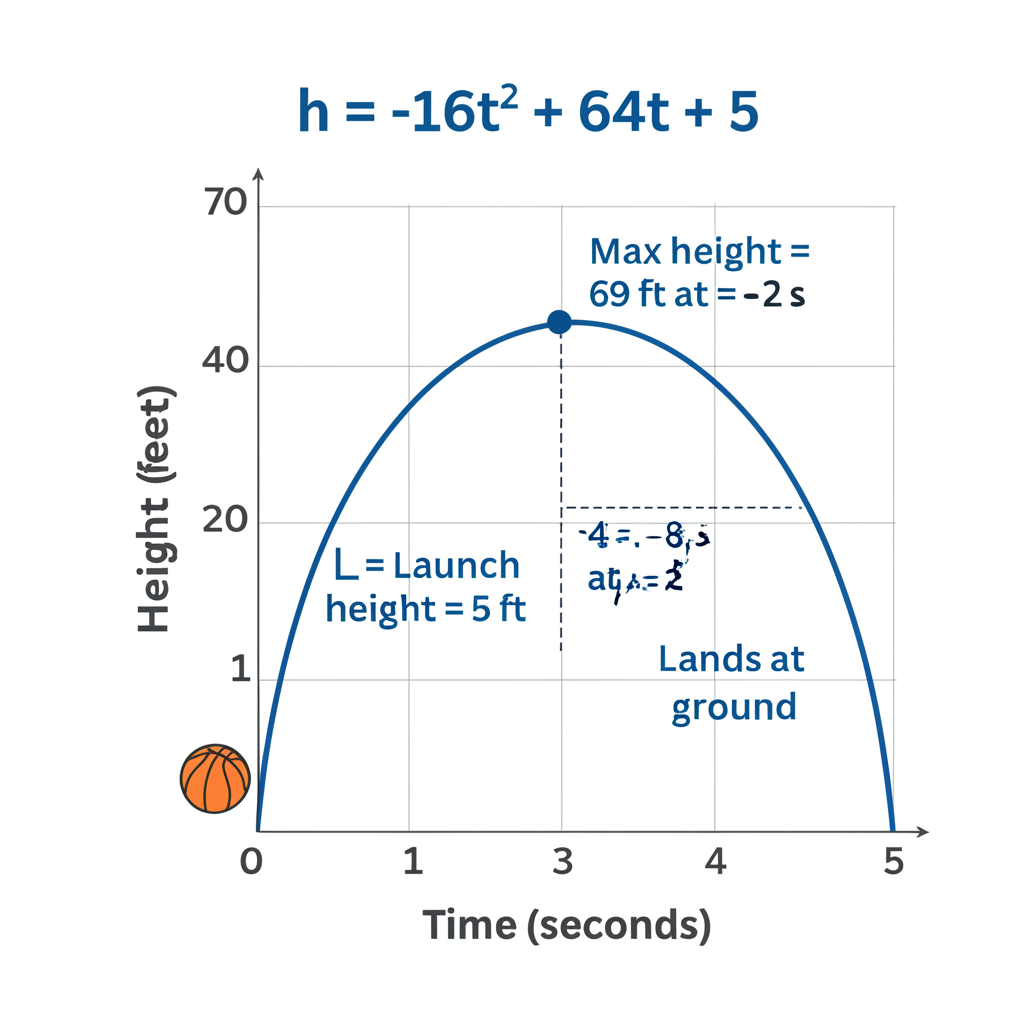
Projectile Motion
The height of an object launched upward is modeled by:
h(t) = −16t² + v₀t + h₀
h(t) = height at time t
v₀ = initial velocity (ft/s)
h₀ = initial height (ft)
Area Optimization
A farmer has 100 ft of fencing. What dimensions maximize the area?
2L + 2W = 100 → W = 50 − L
A = L(50 − L) = −L² + 50L
L = −50 / (2 × −1) = 25 ft
W = 50 − 25 = 25 ft
Max area = 25 × 25 = 625 ft²
Setting Up Word Problems
- Define variables: What are the unknowns?
- Write the equation: Translate the words into algebra.
- Solve: Use the most appropriate method.
- Check: Does the answer make sense? (Reject negative time, negative length, etc.)
8Memory Aids
"X equals negative B, plus or minus the square root, of B squared minus 4AC, all over 2A!"
Sing to the tune of "Pop Goes the Weasel" to memorize the quadratic formula.
"Two Exes, One Kiss, No Xes"
Δ > 0: "Two Exes" (two roots). Δ = 0: "One Kiss" (touches x-axis once). Δ < 0: "No Xes" (no real roots).
"Positive a smiles up, negative a frowns down!"
The sign of "a" determines if the parabola opens up (smile) or down (frown).
"h is Horizontal, k is vertiKal"
In vertex form a(x − h)² + k: h shifts horizontally (opposite sign!), k shifts vertically (same sign).
"Multiply A and C, find two numbers, split B, group, factor!"
The AC method steps for factoring trinomials when a ≠ 1.
9Common Mistakes
Forgetting ± in the quadratic formula
The formula gives two solutions: one with + and one with −. Missing ± means you only find one root.
Sign errors in the discriminant
Remember: (−b)² is always positive. If b = −5, then b² = 25, not −25. Also watch the sign of 4ac when c is negative.
Incorrect squaring of binomials
(x + 3)² = x² + 6x + 9, NOT x² + 9. You must FOIL or use the formula (a + b)² = a² + 2ab + b².
Losing the "a" coefficient
When converting forms, don't forget the leading coefficient "a". The vertex form is a(x − h)² + k, not just (x − h)² + k.
Mixing up h and k signs in vertex form
In a(x − h)² + k: h is the opposite of what's in the parenthesis. (x + 2)² means h = −2, not +2. k keeps its sign.
Dividing both sides by x
Never divide by x — you might lose x = 0 as a valid solution. Instead, move all terms to one side and factor.
Not checking word problem answers
Negative time, negative length, or unreasonable values should be rejected. Always verify solutions make sense in context.
Confusing x-intercepts and y-intercept
X-intercepts: set y = 0 and solve. Y-intercept: set x = 0, giving (0, c). These are fundamentally different operations.
Quick Revision Summary
- ✓Quadratic equations have the form ax² + bx + c = 0, where a ≠ 0.
- ✓Their graphs are parabolas — U-shaped curves that open up (a > 0) or down (a < 0).
- ✓Four solving methods: factoring, completing the square, quadratic formula, square root method.
- ✓The quadratic formula x = (−b ± √(b² − 4ac)) / 2a always works.
- ✓The discriminant (Δ = b² − 4ac) tells you: Δ > 0 = two roots, Δ = 0 = one root, Δ < 0 = no real roots.
- ✓Three forms: standard (ax² + bx + c), vertex (a(x − h)² + k), factored (a(x − r₁)(x − r₂)).
- ✓The vertex is at (−b/2a, f(−b/2a)). It's the max or min point of the parabola.
- ✓Applications include projectile motion, area optimization, and profit maximization.
Frequently Asked Questions
- What does the discriminant tell you about a quadratic equation?
- The discriminant (b² − 4ac) tells you how many real solutions exist: if positive, there are two distinct real roots; if zero, there is one repeated root; if negative, there are no real roots (only complex ones).
- What is the difference between standard form, vertex form, and factored form?
- Standard form (ax² + bx + c = 0) is best for the quadratic formula and finding the y-intercept. Vertex form (a(x − h)² + k) directly shows the vertex and is best for graphing. Factored form (a(x − r₁)(x − r₂)) directly shows the roots/x-intercepts.
- When should I use the quadratic formula vs factoring?
- Factoring is faster when the equation factors neatly with integers. Use the quadratic formula when factoring is difficult or impossible, or when you need exact irrational or complex roots. The quadratic formula always works for any quadratic equation.
- How do I find the vertex of a parabola?
- Use the vertex formula: h = −b/(2a) gives the x-coordinate, then substitute h back into the equation to find k = f(h). The vertex is (h, k). Alternatively, complete the square to convert to vertex form a(x − h)² + k.
- Why can't "a" equal zero in a quadratic equation?
- If a = 0, the x² term disappears, leaving bx + c = 0, which is a linear equation. The "a" coefficient is what makes the equation quadratic (degree 2) and gives the graph its parabolic shape.
Practice Quiz
Test your understanding — select the correct answer for each question.
1.Which of the following is the standard form of a quadratic equation?
2.What is the vertex of the parabola y = 2(x − 3)² + 4?
3.For 3x² − 5x + 2 = 0, what is the discriminant?
4.If the discriminant of a quadratic equation is 0, how many real roots does it have?
5.Which method always works to solve any quadratic equation?
6.A parabola opens downwards when:
7.What are the roots of x² − 49 = 0?
8.What is the y-intercept of y = x² + 2x − 8?
9.An object is launched upward at 48 ft/s from 5 ft high. Which equation models its height h after t seconds?
10.To convert a quadratic from standard form to vertex form, you typically use:
Final Study Advice
- 1.Memorize the quadratic formula — it's on almost every exam and always works.
- 2.Always calculate the discriminant first to know how many solutions to expect.
- 3.Practice converting between all three forms — vertex, standard, and factored.
- 4.Sketch a quick graph to check your answers visually — does the vertex make sense?
- 5.In word problems, check solutions — reject negative time, negative length, etc.