Polynomials
A polynomial is an expression consisting of variables and coefficients, involving only addition, subtraction, multiplication, and non-negative integer exponents. Polynomials are a cornerstone of algebra used throughout mathematics, science, and engineering.
This guide covers operations (adding, subtracting, multiplying), factoring methods, polynomial division, finding roots, worked examples with full algebraic steps, and an interactive graph explorer.
1Introduction to Polynomials
At its core, a polynomial is an expression like 3x² - 5x + 7 or y&sup4; + 2y³ - y. Even a plain number like 4 counts as a polynomial (a constant).
Polynomials are fundamental across many fields — from physics (projectile motion, energy), to engineering (structures, circuits), economics (cost functions, growth rates), and computer science (graphics, cryptography).
Imagine you're building with LEGOs. Each LEGO brick is like a "term" in a polynomial, and the studs on the brick represent the exponent of the variable. You can connect these bricks (add/subtract them) or combine entire sections (multiply them). The biggest, most complex brick you use determines the "degree" of your entire LEGO creation.
- • Negative exponents:
x²(e.g. 1/x²) - • Fractional exponents:
x1/2(e.g. √x) - • Variables in the denominator:
1/x - • Variables under a radical:
√x
2Key Definitions
Term
A single number, variable, or product of numbers and variables. Terms are separated by + or − signs.
Coefficient
The numerical factor of a term. In 3x², the coefficient is 3.
Constant Term
A term without a variable — just a number. Its degree is 0.
Variable
A symbol (usually x, y, z) representing an unknown value.
Exponent
Indicates how many times the base is multiplied by itself. In x³, the exponent is 3.
Degree of a Term
The exponent of the variable. For constants, the degree is 0.
Degree of a Polynomial
The highest degree of any term. The degree of 3x² - 5x + 7 is 2.
Leading Term & Coefficient
The term with the highest degree and its coefficient. In 3x² - 5x + 7, the leading term is 3x² and leading coefficient is 3.
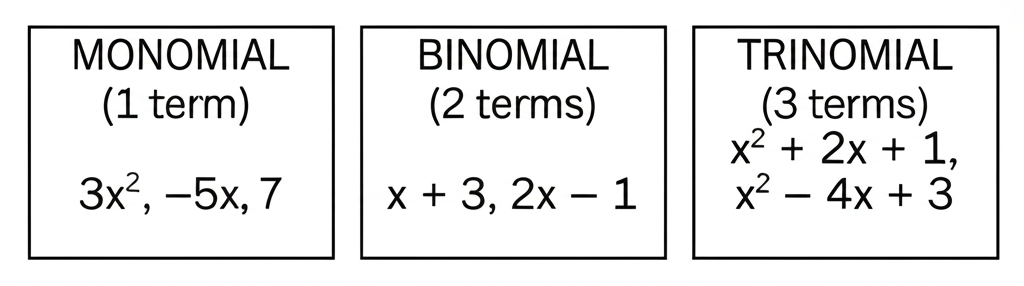
Monomial / Binomial / Trinomial
Monomial = 1 term (e.g. 5x). Binomial = 2 terms (e.g. x + 3). Trinomial = 3 terms (e.g. x² + 5x + 6).
Roots (Zeros)
Values of x that make the polynomial equal to zero. Also the x-intercepts of the graph.
Factoring
Breaking a polynomial into a product of simpler polynomials. E.g. x² - 9 = (x - 3)(x + 3).
Like Terms
Terms with the same variables raised to the same powers. Only like terms can be combined.
3Operations on Polynomials
A. Adding Polynomials
To add polynomials, simply combine like terms — add the coefficients of terms that share the same variable and exponent.
Example: (3x² + 2x + 1) + (x² - 4x + 3)
Group like terms: (3x² + x²) + (2x - 4x) + (1 + 3)
Combine: (3+1)x² + (2-4)x + (1+3)
Result: 4x² - 2x + 4
B. Subtracting Polynomials
Distribute the negative sign to every term in the second polynomial, then combine like terms.
Example: (5x³ - 2x + 8) - (2x³ + 3x - 4)
Distribute negative: 5x³ - 2x + 8 - 2x³ - 3x + 4
Group: (5x³ - 2x³) + (-2x - 3x) + (8 + 4)
Result: 3x³ - 5x + 12
C. Multiplying Polynomials
Multiply each term in the first polynomial by every term in the second, then combine like terms. Remember: when multiplying variables, add the exponents (xa · xb = xa+b).
Monomial × Polynomial
Example: 2x(x² - 3x + 5)
2x · x² = 2x³
2x · (-3x) = -6x²
2x · 5 = 10x
Result: 2x³ - 6x² + 10x
Binomial × Binomial (FOIL Method)
FOIL stands for First, Outer, Inner, Last — a mnemonic for multiplying two binomials.
FOIL Method: (x + 3)(x - 2)
F (First)
x · x = x²
O (Outer)
x · (-2) = -2x
I (Inner)
3 · x = 3x
L (Last)
3 · (-2) = -6
Combine: x² + (-2x + 3x) - 6 = x² + x - 6
Polynomial × Polynomial
Example: (x + 1)(x² + 2x - 3)
x · x² = x³, x · 2x = 2x², x · (-3) = -3x
1 · x² = x², 1 · 2x = 2x, 1 · (-3) = -3
Combine: x³ + (2x² + x²) + (-3x + 2x) - 3
Result: x³ + 3x² - x - 3
4Factoring Polynomials
Factoring is the reverse of multiplication — breaking a polynomial into a product of simpler expressions.
A. Greatest Common Factor (GCF)
Always look for a GCF first! Find the largest monomial that divides evenly into every term.
Factor: 6x³ + 9x² - 3x
GCF of (6, 9, -3) = 3
GCF of (x³, x², x) = x
Overall GCF = 3x
6x³ ÷ 3x = 2x², 9x² ÷ 3x = 3x, -3x ÷ 3x = -1
Result: 3x(2x² + 3x - 1)
B. Difference of Squares
a² - b² = (a - b)(a + b) — works whenever you have a perfect square minus another perfect square.
Factor: x² - 16
x² = (x)² and 16 = (4)²
Result: (x - 4)(x + 4)
Factor: 9y² - 25
9y² = (3y)² and 25 = (5)²
Result: (3y - 5)(3y + 5)
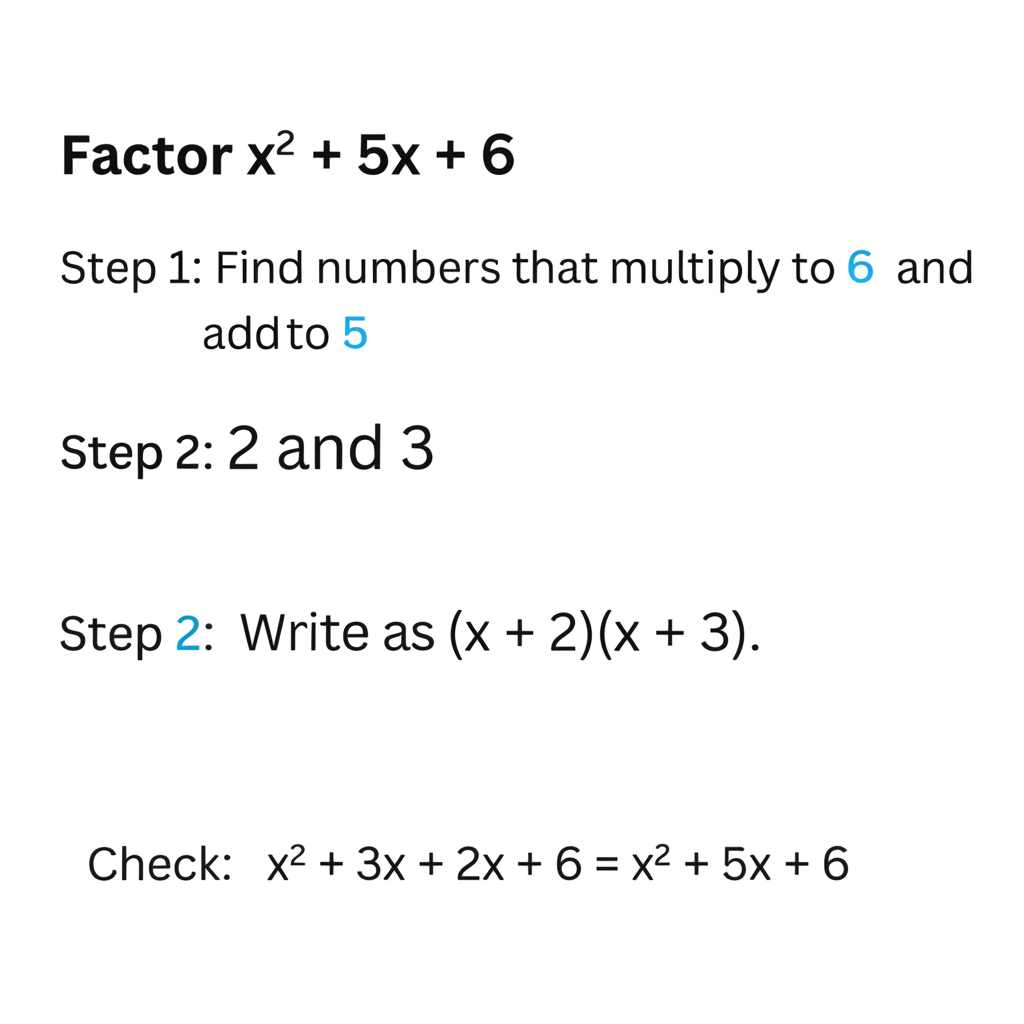
C. Factoring Trinomials (x² + bx + c)
Find two numbers that multiply to c and add to b.
Factor: x² + 5x + 6
Need two numbers: m × n = 6 and m + n = 5
Numbers: 2 and 3
Result: (x + 2)(x + 3)
Factor: x² - 7x + 10
Need: m × n = 10 and m + n = -7
Numbers: -2 and -5
Result: (x - 2)(x - 5)
D. AC Method (ax² + bx + c)
When the leading coefficient isn't 1, multiply a × c, find numbers that multiply to ac and add to b, then factor by grouping.
Factor: 2x² + 7x + 3
a = 2, b = 7, c = 3. ac = 6
Numbers that multiply to 6 and add to 7: 1 and 6
Rewrite: 2x² + 1x + 6x + 3
Group: (2x² + x) + (6x + 3)
Factor each: x(2x + 1) + 3(2x + 1)
Result: (2x + 1)(x + 3)
5Polynomial Division
A. Long Division
Works for dividing any polynomial by another. It's similar to long division with numbers.
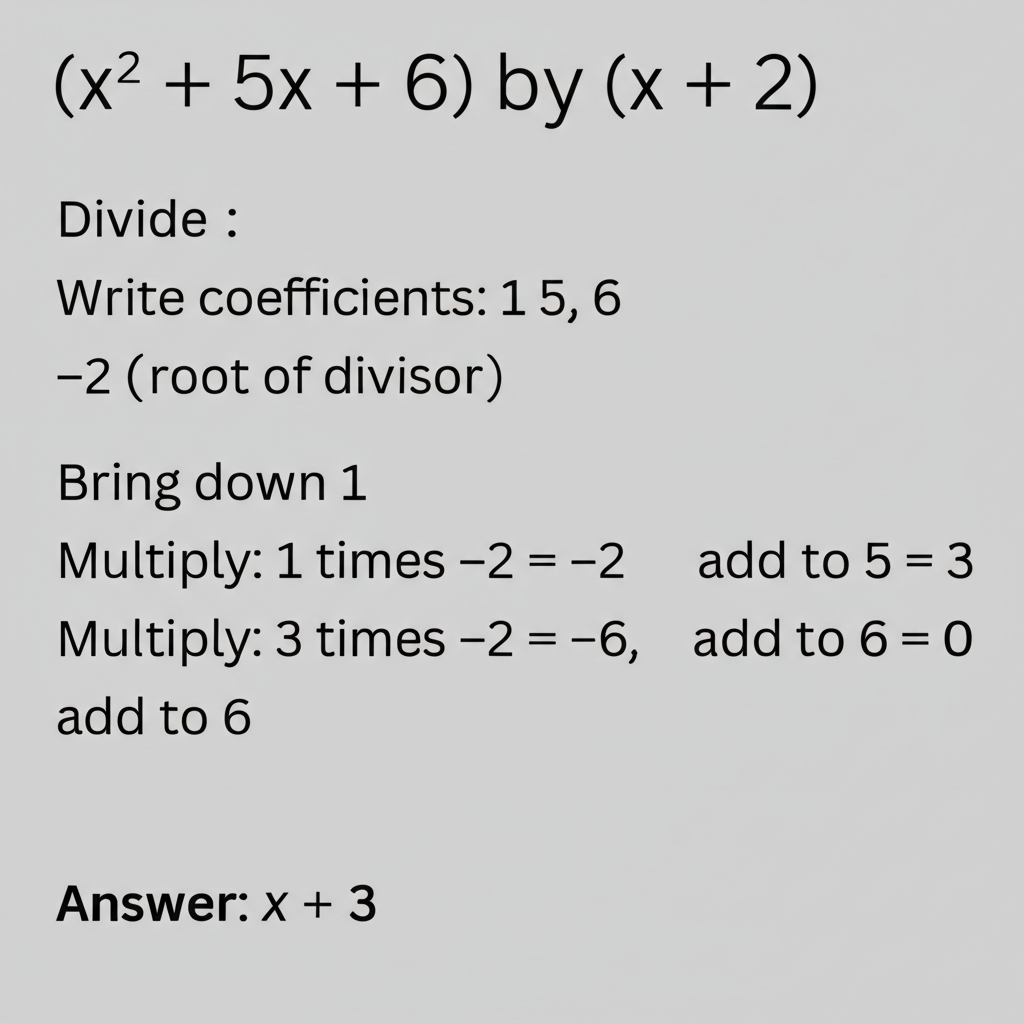
Divide: (x² + 5x + 6) ÷ (x + 2)
Step 1: x² ÷ x = x → quotient starts with x
Step 2: x · (x + 2) = x² + 2x
Step 3: (x² + 5x) - (x² + 2x) = 3x
Step 4: Bring down +6 → 3x + 6
Step 5: 3x ÷ x = 3 → quotient is now x + 3
Step 6: 3 · (x + 2) = 3x + 6
Step 7: (3x + 6) - (3x + 6) = 0
Result: x + 3 (remainder 0)
B. Synthetic Division
A shortcut for long division, but only works when dividing by (x - k).
Example: (x³ + 4x² - x - 4) ÷ (x - 1)
Divisor (x - 1), so k = 1
Coefficients: 1, 4, -1, -4
Bring down 1
1 × 1 = 1, 4 + 1 = 5
1 × 5 = 5, -1 + 5 = 4
1 × 4 = 4, -4 + 4 = 0 (remainder)
Result: x² + 5x + 4 (remainder 0)
6Finding Roots (Zeros)
Roots are the values of x where P(x) = 0. They correspond to x-intercepts on the graph.
Polynomial Graph Explorer
InteractiveAdjust the degree and coefficients to see how the polynomial curve changes shape. Green dots mark roots (zeros).
Equation
y = x² − 4
Roots (Zeros)
x = -2, x = 2
Y-Intercept
(0, -4)
Degree 2 · Quadratic
A. Factoring to Find Roots
Find roots of: x² + 5x + 6 = 0
Factor: (x + 2)(x + 3) = 0
Set each factor = 0:
x + 2 = 0 → x = -2
x + 3 = 0 → x = -3
Roots: x = -2 and x = -3
B. Quadratic Formula
For ax² + bx + c = 0, the roots are:
x = (-b ± √(b² - 4ac)) / 2a
C. Rational Root Theorem
For higher-degree polynomials with integer coefficients, possible rational roots are p/q where p divides the constant term and q divides the leading coefficient.
Find roots of: x³ - 2x² - 5x + 6 = 0
Possible rational roots: ±1, ±2, ±3, ±6
Test x = 1: 1 - 2 - 5 + 6 = 0 ✓
Synthetic division gives quotient x² - x - 6
Factor: (x - 3)(x + 2)
Roots: x = 1, x = 3, x = -2
7Worked Examples
Problem: Simplify (3x² + 2x + 1) + (x² - 4x + 3)
Step 1: Combine like terms: 3x² + x² = 4x²
Step 2: 2x - 4x = -2x
Step 3: 1 + 3 = 4
Answer: 4x² - 2x + 4
Problem: Multiply (x + 3)(x - 2)
Step 1: First: x · x = x²
Step 2: Outer: x · (-2) = -2x
Step 3: Inner: 3 · x = 3x
Step 4: Last: 3 · (-2) = -6
Step 5: Combine: x² + (-2x + 3x) - 6
Answer: x² + x - 6
Problem: Factor x² + 5x + 6
Step 1: Find two numbers that multiply to 6 and add to 5
Step 2: Numbers: 2 and 3 (2 × 3 = 6, 2 + 3 = 5)
Step 3: Rewrite: x² + 2x + 3x + 6
Step 4: Factor by grouping: x(x + 2) + 3(x + 2)
Answer: (x + 2)(x + 3)
Problem: Divide (x² + 5x + 6) ÷ (x + 2)
Step 1: x² ÷ x = x → write x in quotient
Step 2: x(x + 2) = x² + 2x
Step 3: (x² + 5x) - (x² + 2x) = 3x
Step 4: Bring down +6 → 3x + 6
Step 5: 3x ÷ x = 3
Step 6: 3(x + 2) = 3x + 6
Step 7: (3x + 6) - (3x + 6) = 0
Answer: x + 3
Problem: Solve 2x² + 5x - 3 = 0
Step 1: a = 2, b = 5, c = -3
Step 2: x = (-b ± √(b² - 4ac)) / 2a
Step 3: x = (-5 ± √(25 - 4(2)(-3))) / 4
Step 4: x = (-5 ± √(25 + 24)) / 4
Step 5: x = (-5 ± √49) / 4
Step 6: x = (-5 ± 7) / 4
Step 7: x = 2/4 = 1/2 or x = -12/4 = -3
Answer: x = 1/2 or x = -3
8Memory Aids
Use this mnemonic every time you multiply two binomials. It ensures you don't miss any terms.
For factoring x² + bx + c, find two numbers that multiply to the constant (c) and add to the middle coefficient (b).
Before attempting any other factoring method, always check if there's a greatest common factor you can pull out.
When multiplying variables: xa · xb = xa+b. You ADD the exponents, not multiply them.
The degree of a polynomial is simply the highest exponent in the entire expression. Scan all terms and pick the largest power.
9Common Mistakes to Avoid
Combining Unlike Terms
Wrong: 3x² + 2x = 5x³
Right: 3x² + 2x cannot be simplified further — the exponents don't match.
Forgetting to Distribute Negative Signs
Wrong: (5x - 2) - (x + 3) = 4x + 1
Right: (5x - 2) - (x + 3) = 5x - 2 - x - 3 = 4x - 5
Multiplying Exponents Instead of Adding
Wrong: x² · x³ = x⁶
Right: x² · x³ = x2+3 = x⁵
Not Fully Factoring Out GCF
Wrong: 2x² + 4x = x(2x + 4) (missed GCF of 2)
Right: 2x² + 4x = 2x(x + 2)
Sign Errors When Factoring
Wrong: x² - 5x + 6 = (x + 2)(x + 3)
Right: x² - 5x + 6 = (x - 2)(x - 3) — both numbers must be negative.
Forgetting Remainder in Division
Wrong: If quotient is x + 1 and remainder is 2, writing just "x + 1"
Right: x + 1 + 2/(divisor) — always include the remainder over the divisor.
Quadratic Formula Errors
Common: miscalculating b² - 4ac with negatives, dividing only part of numerator by 2a, or forgetting ±
Tip: Write out each step separately. Always divide the entire numerator by 2a, and check both the + and − solutions.
10Quick Revision Summary
- Polynomials are expressions with non-negative integer exponents.
- The degree is the highest exponent among all terms.
- Monomial (1 term), Binomial (2 terms), Trinomial (3 terms).
- Add/subtract by combining like terms. Distribute negatives when subtracting.
- Multiply using distributive property or FOIL. Add exponents of like bases.
- Factor GCF first, then check for difference of squares, trinomial patterns, or AC method.
- Long division works for any polynomial divisor; synthetic division is a shortcut for (x - k).
- Roots are where P(x) = 0. Find them by factoring, quadratic formula, or rational root theorem.
- a² - b² = (a - b)(a + b) is the difference of squares identity.
Frequently Asked Questions
What is the difference between a monomial, binomial, and trinomial?
A monomial has exactly one term (e.g. 5x), a binomial has exactly two terms (e.g. x + 3), and a trinomial has exactly three terms (e.g. x² + 5x + 6). They are all types of polynomials classified by the number of terms.
Why can't expressions with negative exponents be polynomials?
By definition, polynomials only involve non-negative integer exponents. Negative exponents (like x⁻² = 1/x²) place the variable in the denominator, which violates this rule.
When should I use synthetic division instead of long division?
Synthetic division is a shortcut that only works when dividing by a linear factor of the form (x - k). For divisors with higher degree or leading coefficients other than 1, you must use long division.
How do I know which factoring method to use?
Always start by factoring out the GCF. Then check: is it a difference of squares (a² - b²)? A simple trinomial (x² + bx + c)? A trinomial with leading coefficient (ax² + bx + c)? Use the AC method for the last case. If none work, try the quadratic formula.
What is the relationship between factors and roots?
If (x - r) is a factor of a polynomial P(x), then r is a root (zero) of P(x), meaning P(r) = 0. Conversely, if P(r) = 0, then (x - r) is a factor. This is known as the Factor Theorem.
Practice Quiz
Test your understanding — select the correct answer for each question.
1.What is the degree of 4x³ + 2x² - x + 7?
2.What type of polynomial has exactly 2 terms?
3.What is the coefficient of x² in 5x³ + 3x² - 2x + 1?
4.Multiply: (x - 4)(x + 4)
5.Factor: x² - 9
6.What is the zero of the polynomial x - 5 = 0?
7.Divide: (x² + 3x + 2) ÷ (x + 1)
8.What method finds factors that multiply to c and add to b in x² + bx + c?
9.Is x² + 4 a polynomial?
10.What is the leading coefficient of -3x⁴ + 2x² - x + 5?
Study Tips
- Practice GCF first — always look for a greatest common factor before trying other factoring techniques.
- Master FOIL — multiplying binomials is a skill you'll use constantly in algebra and beyond.
- Check by expanding — after factoring, multiply the factors back out to verify your answer.
- Draw the graph — use the interactive explorer above to visualize how coefficients affect the shape.
- Work examples without looking — cover the solution and try each worked example on your own first.