Systems of Equations
A system of equations is a set of two or more equations with the same variables. The goal is to find values that satisfy all equations simultaneously.
This guide covers three solving methods (graphing, substitution, elimination), all three solution types, worked examples with full algebraic steps, and an interactive explorer to visualize how systems work.
1Introduction
Have you ever faced a problem where you had two pieces of information and needed to find two unknown values? That's exactly what systems of equations help us solve. They are powerful tools used in science, engineering, economics, and everyday life.
From calculating how much of two ingredients to mix, to comparing phone plans, to finding where two paths cross — systems of equations are everywhere.
Imagine two roads crossing each other. Each road can be represented by a linear equation. The point where they cross is the "solution" — the one location that exists on both roads. If the roads are parallel, they never cross (no solution). If they're the same road, every point is a solution (infinitely many).
A system of two linear equations can have exactly one solution, no solution, or infinitely many solutions. There is no other possibility.
2Key Definitions
System of Equations
A set of two or more equations with the same variables that are solved simultaneously.
Solution
An ordered pair (x, y) that makes all equations in the system true at the same time.
Consistent System
Has at least one solution. Lines intersect or overlap.
Inconsistent System
Has no solution. The lines are parallel and never meet.
Dependent System
Has infinitely many solutions. The equations describe the same line.
Substitution Method
Solve one equation for a variable, then substitute that expression into the other equation.
Elimination Method
Add or subtract equations to eliminate one variable, after making coefficients opposite.
Graphing Method
Graph both equations and find the point of intersection visually.
Parallel Lines
Same slope, different y-intercepts. Never intersect → no solution.
Intersecting Lines
Different slopes. Cross at exactly one point → one solution.
Coincident Lines
Same slope, same y-intercept. Same line → infinitely many solutions.
3Three Types of Solutions
When solving a system of two linear equations, there are exactly three possible outcomes:
One Solution
Consistent & Independent
Lines cross at exactly one point. Different slopes.
y = -x + 4
Solution: (1, 3)
No Solution
Inconsistent
Lines never cross. Same slope, different y-intercepts.
y = 2x - 3
No solution
Infinitely Many
Consistent & Dependent
Lines overlap completely. Same slope and y-intercept.
4y = 8x + 4
∞ solutions
If the variables cancel and you get a false statement (like 0 = 5) → no solution. If you get a true statement (like 0 = 0) → infinitely many solutions. If you get a specific value → one solution.
4Graphing Method
Graph both equations on the same coordinate plane and find where the lines intersect.
Convert to slope-intercept form
Rewrite both equations as y = mx + b to identify slope and y-intercept.
Graph each line
Plot the y-intercept, then use slope (rise/run) to find more points. Draw the line.
Find the intersection
The point where the two lines cross is the solution (x, y).
Verify
Substitute the solution into both original equations to confirm.
Systems of Equations Explorer
InteractiveAdjust the slopes and y-intercepts of two lines to explore how systems of linear equations behave.
Equations
y = 2x + 1
y = -x + 4
Solution
One Solution: (1, 3)
Classification
Consistent & Independent
The lines cross at exactly one point.
Pros
Visual and intuitive. Easy to see the type of solution (one, none, infinite).
Cons
Imprecise for non-integer solutions. Requires accurate graphing.
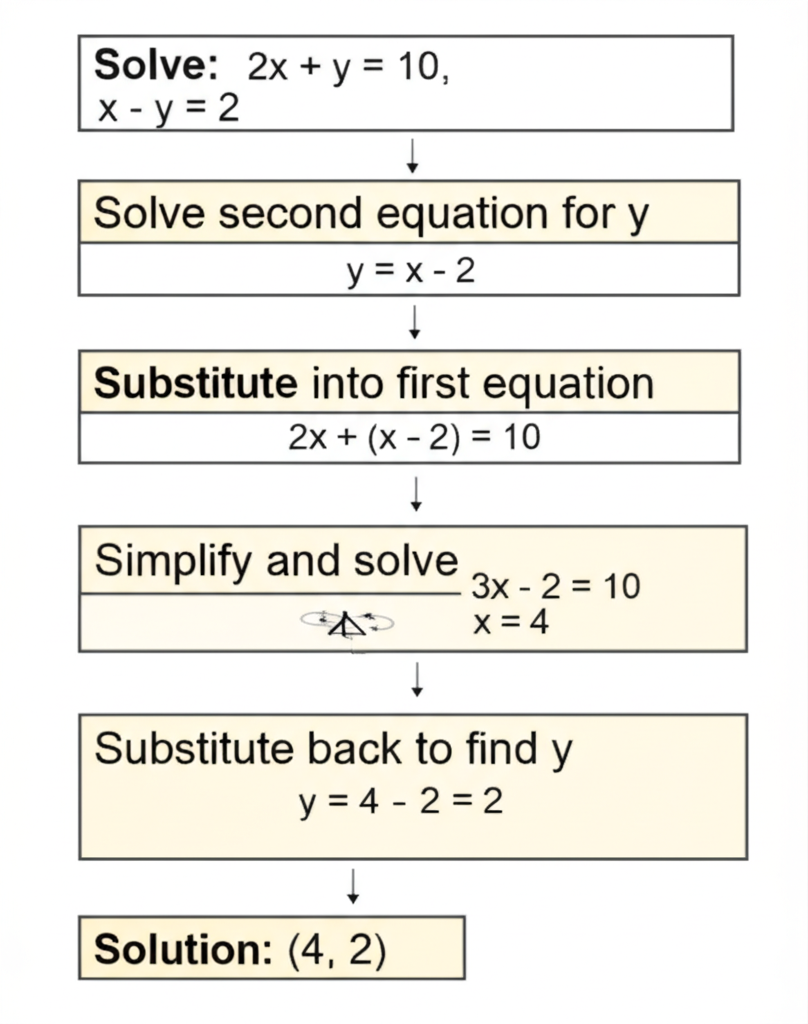
5Substitution Method
Solve one equation for one variable, then substitute that expression into the other equation.
Isolate a variable
Choose the equation and variable that's easiest to isolate (look for coefficient of 1 or -1).
Substitute into the other equation
Replace the variable with the expression. You now have one equation with one unknown.
Solve for the remaining variable
Simplify and solve the single-variable equation.
Substitute back to find the second variable
Plug the value into either original equation. Write the answer as (x, y).
Best when
A variable is already isolated or has a coefficient of 1 or -1.
Watch out for
Complex fractions and sign errors when distributing.
6Elimination Method
Manipulate the equations so that adding or subtracting them eliminates one variable.
Align terms in standard form
Write both equations as Ax + By = C, lining up x, y, and constant terms.
Create opposite coefficients
Multiply one or both equations by constants so that one variable has opposite coefficients (e.g., +3y and -3y).
Add the equations
Add the equations together to eliminate one variable. Solve for the remaining one.
Substitute back
Plug the value into either original equation to find the second variable. Write as (x, y).
Elimination Example
Given system:
2x + 3y = 12
3x - 3y = 9
Step 1: Notice +3y and -3y are opposites!
Step 2: Add the equations:
2x + 3y + 3x - 3y = 12 + 9
5x = 21
x = 21/5 = 4.2
Step 3: Substitute x = 4.2 into first equation:
2(4.2) + 3y = 12
8.4 + 3y = 12
3y = 3.6
y = 1.2
Solution: (4.2, 1.2)
Best when
Equations are in standard form (Ax + By = C) and coefficients are easy to match.
Watch out for
Multiplying only one side, and sign errors when subtracting equations.
7Word Problems
Word problems require you to translate real-world situations into equations. Here is a general approach:
Read carefully — identify what is known and what needs to be found.
Define variables — assign x and y to the unknown quantities.
Write two equations — each independent piece of information becomes one equation.
Solve and interpret — solve the system, then check your answer makes sense in context.
Common Word Problem Types
Mixture Problems
Combining items with different values or concentrations.
Distance/Rate/Time
Two scenarios involving d = rt relationships.
Money Problems
Total cost, number of items, different prices.
Geometry Problems
Finding dimensions using perimeter or area relationships.
8Worked Examples
Example 1: Basic Substitution
Solve: 2x + y = 10 and x - y = 2
Given: 2x + y = 10 | x - y = 2
Method: Substitution
Step 1: Isolate y from equation 1:
y = 10 - 2x
Step 2: Substitute into equation 2:
x - (10 - 2x) = 2
Step 3: Distribute and solve:
x - 10 + 2x = 2
3x - 10 = 2
3x = 12
x = 4
Step 4: Substitute back:
y = 10 - 2(4) = 10 - 8 = 2
Solution: (4, 2)
Example 2: Basic Elimination
Solve: x + y = 5 and x - y = 1
Step 1: y terms already have opposite signs (+y and -y). Add:
(x + y) + (x - y) = 5 + 1
2x = 6
x = 3
Step 2: Substitute x = 3 into equation 1:
3 + y = 5
y = 2
Solution: (3, 2)
Example 3: Non-Integer Solution
Solve: 2x + 3y = 12 and 3x - 3y = 9
Step 1: +3y and -3y are already opposites. Add:
(2x + 3y) + (3x - 3y) = 12 + 9
5x = 21
x = 21/5 = 4.2
Step 2: Substitute x = 4.2 into equation 1:
2(4.2) + 3y = 12
8.4 + 3y = 12
3y = 3.6
y = 1.2
Solution: (4.2, 1.2)
Example 4: Ticket Sales
Adult tickets cost $5 and student tickets cost $3. A total of 100 tickets were sold for $380. How many of each?
Step 1: Define variables:
a = adult tickets, s = student tickets
Step 2: Write equations:
a + s = 100 (total tickets)
5a + 3s = 380 (total revenue)
Step 3: Isolate s from equation 1:
s = 100 - a
Step 4: Substitute into equation 2:
5a + 3(100 - a) = 380
5a + 300 - 3a = 380
2a + 300 = 380
2a = 80
a = 40
Step 5: Find s:
s = 100 - 40 = 60
Answer: 40 adult tickets, 60 student tickets
Example 5: Three Variables
Solve: x + y + z = 6, 2x + y - z = 1, x - y + z = 2
Step 1: Add equation 2 and equation 3 to eliminate y and z:
(2x + y - z) + (x - y + z) = 1 + 2
3x = 3
x = 1
Step 2: Substitute x = 1 into equations 1 and 2:
1 + y + z = 6 → y + z = 5
2(1) + y - z = 1 → y - z = -1
Step 3: Add these two new equations:
(y + z) + (y - z) = 5 + (-1)
2y = 4
y = 2
Step 4: Substitute y = 2 back:
2 + z = 5
z = 3
Solution: (1, 2, 3)
9Memory Aids
"SEG: Substitution when Easy to isolate, Elimination for standard form, Graphing to visualize."
Pick the method based on the form your equations are already in.
"False = No solution. True = Infinite solutions."
When variables cancel: a false statement (0 = 5) means no solution (parallel). A true statement (0 = 0) means infinitely many (same line).
"Two roads: crossing = one solution, parallel = no solution, same road = infinite solutions."
Visualize each equation as a road to remember the three possible outcomes.
"Always check BOTH — plug your answer into BOTH original equations."
A solution must satisfy every equation in the system, not just one.
"Same slope? Check y-intercepts. Same = same line. Different = parallel."
Different slopes always means the lines will intersect at exactly one point.
10Common Mistakes
Sign errors when distributing
When substituting, remember to distribute negative signs to all terms. For example: x - (10 - 2x) = x - 10 + 2x, not x - 10 - 2x. The minus sign flips both terms inside the parentheses.
Forgetting to distribute to all terms
When substituting an expression like (100 - a) into 3s, you must multiply 3 by both terms: 3(100 - a) = 300 - 3a. Don't write 3(100) - a = 300 - a.
Only multiplying one side of the equation
In the elimination method, when multiplying an equation by a constant, you must multiply every term on both sides. If you multiply 2x + y = 7 by 3, the result is 6x + 3y = 21 (not 6x + 3y = 7).
Forgetting to find the second variable
After solving for one variable, you must substitute back to find the other. A solution to a 2-variable system is an ordered pair (x, y), not a single number.
Confusing "no solution" with "infinitely many"
When variables cancel: a false statement (0 = 5) means no solution (parallel lines). A true statement (0 = 0) means infinitely many solutions (same line). Don't mix these up.
Plotting errors when graphing
Incorrectly plotting the y-intercept or miscalculating the slope rise/run leads to wrong intersection points. Always double-check your plotted points and use at least two points per line.
Mixing up x and y in the final answer
Always write your answer as (x, y) — x-coordinate first. Substituting values back into both original equations is the best way to verify your x and y are correct and in the right order.
Not verifying the solution
Always check your answer by substituting into both original equations. If it only works for one, you made an error somewhere. This single habit catches most mistakes.
11Quick Revision Summary
- ✓A system of equations is two or more equations with shared variables.
- ✓Three solution types: one (intersecting), none (parallel), infinitely many (same line).
- ✓Graphing: plot both lines, find the intersection point.
- ✓Substitution: isolate a variable, substitute into the other equation, solve.
- ✓Elimination: create opposite coefficients, add equations, eliminate a variable.
- ✓Variables cancel + false statement (0 = 5) = no solution (parallel).
- ✓Variables cancel + true statement (0 = 0) = infinitely many (same line).
- ✓Parallel lines: same slope, different y-intercepts.
- ✓Always verify by substituting back into both original equations.
- ✓For word problems: define variables, write equations, solve, and interpret in context.
Frequently Asked Questions
- How do I know which method to use — graphing, substitution, or elimination?
- Use graphing when you want a visual estimate or to identify the type of solution. Use substitution when one variable is already isolated or easy to isolate (coefficient of 1 or -1). Use elimination when both equations are in standard form (Ax + By = C) and coefficients are easy to match.
- What does it mean when the variables cancel and I get 0 = 5?
- A false statement like 0 = 5 means the system has no solution — the lines are parallel. They have the same slope but different y-intercepts, so they never intersect.
- What does it mean when the variables cancel and I get 0 = 0?
- A true statement like 0 = 0 means the system has infinitely many solutions — the equations represent the same line. Every point on that line satisfies both equations.
- Can a system of equations have exactly two solutions?
- No. A system of two linear equations can only have exactly one solution (intersecting lines), no solution (parallel lines), or infinitely many solutions (same line). Two straight lines cannot cross at exactly two points.
- How do I set up a word problem as a system of equations?
- First, identify the two unknown quantities and assign variables. Then find two independent relationships (pieces of information) in the problem — each relationship becomes one equation. Solve the system using your preferred method, then check your answer makes sense in context.
Practice Quiz
Test your understanding — select the correct answer for each question.
1.What does it mean for a system to be consistent?
2.Two lines that never intersect have:
3.What is the first step in the substitution method?
4.In the elimination method, what should you create?
5.Solve: y = 2x and y = -x + 6. What is x?
6.Parallel lines have:
7.Solve by elimination: x + y = 4 and x - y = 2
8.Which method works best when equations are already in standard form (Ax + By = C)?
9.If both variables cancel and you get 0 = 0, the system has:
10.Solve: 2x + y = 7 and x - y = 2
Final Study Advice
- 1.Master all three methods — exams may specify which to use, or the problem form may favor one.
- 2.Always verify your solution in both original equations. This catches most errors.
- 3.Be extra careful with negative signs during distribution and elimination.
- 4.For word problems, define your variables clearly before writing equations.
- 5.Use the interactive explorer above to visualize how changing slopes and y-intercepts affects the solution.