Circular Motion
Circular motion is the movement of an object along the circumference of a circle. From planets orbiting the Sun to a car rounding a bend, understanding how objects move in curved paths is fundamental to physics.
This guide covers centripetal acceleration and force, angular velocity, vertical loops, banked curves, key formulas with worked examples, memory aids, and a 10-question practice quiz.
Uniform Circular Motion
1What Is Circular Motion and Why Does It Matter?
Circular motion is the movement of an object along the circumference of a circle or circular path. It's a fundamental concept in physics that connects to everything from the orbits of planets to the design of roller coasters.
Understanding circular motion is crucial for engineering (designing safe roads and rotating machinery), astronomy (orbital mechanics), sports science, and everyday life.
- Planets orbiting the Sun — gravity provides the centripetal force
- Cars turning on a curve — friction between tyres and road keeps the car on track
- Spinning carnival rides — the normal force from the wall pushes riders inward
- Washing machine spin cycle — the drum pushes clothes inward
- Ball swung on a string — tension in the string provides the force
2What Are the Key Terms You Need to Know?
Mastering these terms is essential for understanding the rest of the topic. Refer back here as needed.
Circular Motion
Movement of an object along a circular path
Uniform Circular Motion
Circular motion at constant speed (velocity direction changes)
Centripetal Acceleration
Acceleration directed towards the center; ac = v²/r
Centripetal Force
Net inward force causing circular motion; Fc = mv²/r
Centrifugal Force
Fictitious outward force felt in a rotating reference frame
Period (T)
Time for one complete revolution (seconds)
Frequency (f)
Number of revolutions per second (Hz); f = 1/T
Angular Velocity (ω)
Rate of angle change in rad/s; ω = 2π/T
Tangential Velocity
Linear speed along the circular path, tangent to the circle
Radian
SI unit of angle; 1 full circle = 2π radians
Non-Uniform Circular Motion
Circular motion where speed changes; has tangential acceleration
Tangential Acceleration
Component that changes speed; parallel or anti-parallel to velocity
3How Does Circular Motion Work?
Why Does Velocity Change Even if Speed Is Constant?
Velocity is a vector — it has both magnitude (speed) and direction. In uniform circular motion, the speed stays constant, but the direction of motion is continuously changing. Since the direction changes, the velocity changes, which means the object is accelerating.
Centripetal Acceleration
This acceleration always points towards the center of the circle. It's called centripetal acceleration (from Latin "center-seeking"). Its magnitude is:
ac = v²/r = ω²r
where v = tangential speed, r = radius, ω = angular velocity
Centripetal Force Is NOT a New Force
Centripetal force is simply the name given to the net inward force that causes circular motion. It's always provided by one or more existing forces — tension, gravity, friction, or normal force. Think of it as a "job title" rather than a new type of force.
Never draw "centripetal force" as a separate force on a free-body diagram. Instead, identify which real force (or component of a force) provides the inward centripetal force.
Angular Velocity and Tangential Speed
Speed from Period
v = 2πr/T
Circumference divided by the time for one revolution
Speed from Angular Velocity
v = ωr
Angular velocity times radius
Non-Uniform Circular Motion
When the speed changes as an object moves around a circle, we have non-uniform circular motion. The object has two components of acceleration:
Centripetal (ac)
Points towards center; changes direction of velocity
Tangential (at)
Parallel to velocity; changes speed of the object
4Key Formulas
Centripetal Acceleration
ac = v²/r = ω²r
Centripetal Force
Fc = mv²/r = mω²r
Tangential Speed
v = 2πr/T = ωr
Angular Velocity
ω = 2π/T = 2πf
| Quantity | Formula |
|---|---|
| Centripetal acceleration | ac = v²/r = ω²r |
| Centripetal force | Fc = mv²/r = mω²r |
| Tangential speed | v = 2πr/T = ωr |
| Angular velocity | ω = 2π/T = 2πf |
| Period & frequency | T = 1/f |
v = tangential speed (m/s) | r = radius (m) | m = mass (kg)
T = period (s) | f = frequency (Hz) | ω = angular velocity (rad/s)
5Worked Examples
Example 1: Car on a Flat Circular Track
A car of mass 1000 kg travels at a constant speed of 20 m/s around a flat, circular track with a radius of 50 m. Find the centripetal acceleration and the friction force required.
Step 1: Centripetal acceleration: ac = v²/r = (20)²/50 = 400/50 = 8 m/s²
Step 2: Centripetal force (friction): Fc = mac = 1000 × 8 = 8000 N
Answer: The acceleration is 8 m/s² and friction must provide 8000 N directed towards the center.
Example 2: Spinning Disc
A point on the edge of a disc (radius 0.30 m) rotates at 1200 rpm. Find (a) the angular velocity, (b) the tangential speed, and (c) the centripetal acceleration.
(a) f = 1200/60 = 20 Hz. ω = 2πf = 2π × 20 = 40π ≈ 125.66 rad/s
(b) v = ωr = 125.66 × 0.30 ≈ 37.70 m/s
(c) ac = ω²r = (125.66)² × 0.30 ≈ 4737 m/s²
Example 3: Ball Swung Vertically
A 0.5 kg ball is swung in a vertical circle of radius 1.0 m. If the tension at the lowest point is 15 N, find the speed of the ball.
At the bottom: T − mg = mv²/r
Substituting: 15 − (0.5 × 9.8) = 0.5 × v² / 1.0
Solving: 15 − 4.9 = 0.5v² → 10.1 = 0.5v² → v² = 20.2 → v ≈ 4.49 m/s
6Visual Explanation
Car on a Banked Curve
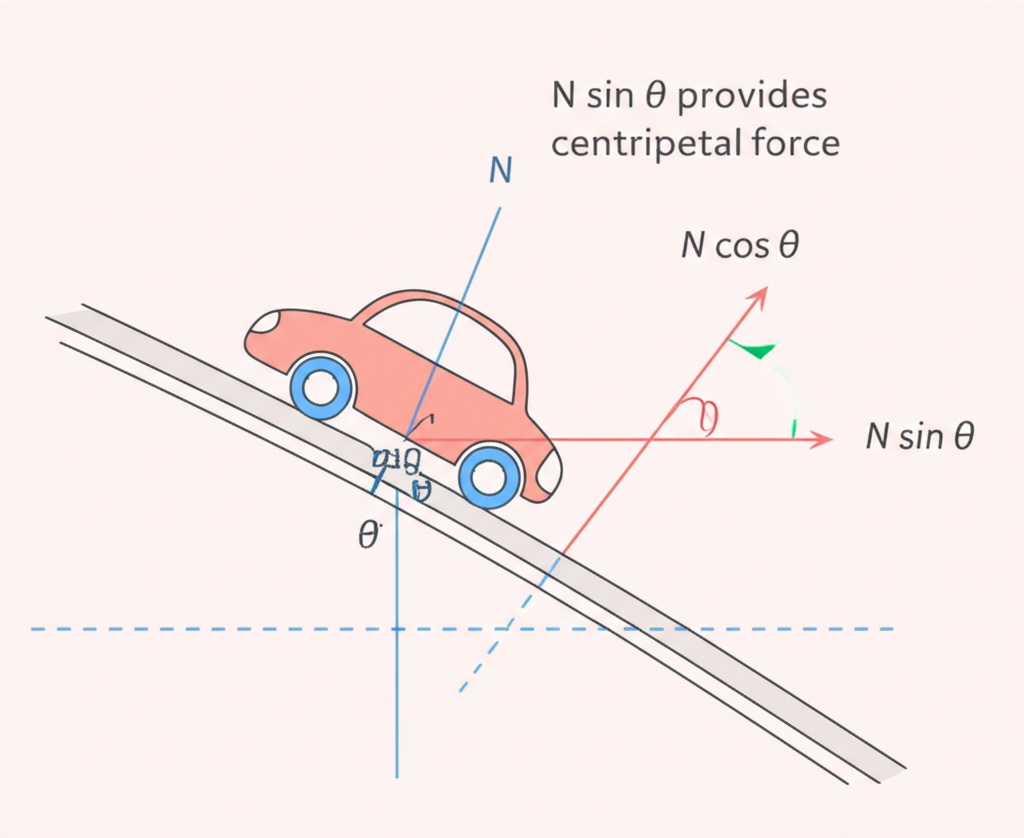
On a banked curve, the road tilts at angle θ. The normal force (N) is perpendicular to the surface. Its horizontal component (N sin θ) points towards the center of the curve, providing the centripetal force. The vertical component (N cos θ) balances gravity (mg).
Vertical Circular Motion
Vertical Circular Motion
At the Top
Both mg and N point towards center: mg + N = mv²/r
At the Bottom
N opposes mg: N − mg = mv²/r
7Memory Aids
"Centripetal means Center-Seeking!" — acceleration and force always point towards the center of the circle.
"Fc is NOT a new force!" — Centripetal force is a job title, not a new type of worker. It's always provided by existing forces (friction, tension, gravity).
"v = ωr" — speed equals omega times radius. Simple verbal recall: "v is omega times r."
Always convert angular velocity to rad/s before using formulas. RPM or degrees/s won't give correct answers!
"Direction, Direction, Direction!" — Speed may be constant, but velocity always changes in circular motion because direction changes. That's why there's always acceleration.
8Common Mistakes Students Make
"Centrifugal force pushes you outward."
Centrifugal force is fictitious — it only appears in a rotating reference frame. In reality, your body wants to continue in a straight line (inertia), and the inward centripetal force is what keeps you on the curved path.
"Centripetal force is a separate force on the FBD."
Never add "Fcentripetal" as a separate arrow on your free-body diagram. Identify which real force (friction, tension, gravity, normal force) provides the centripetal force.
"Constant speed means no acceleration."
Speed is constant in uniform circular motion, but velocity changes direction. Changing direction = changing velocity = acceleration (centripetal).
"Using degrees or RPM directly in formulas."
Angular velocity must be in radians per second (rad/s) for formulas like v = ωr and ac = ω²r. Always convert RPM → Hz → rad/s first.
"Forgetting to identify what force provides Fc."
For a satellite it's gravity, for a car turning it's friction, for a ball on a string it's tension. Always identify the source of the centripetal force in the problem.
"Sign errors in vertical circular motion."
At the top of a vertical loop, gravity adds to the centripetal force. At the bottom, gravity opposes the other inward force. Be careful with signs!
"All circular motion has constant speed."
Only uniform circular motion has constant speed. Non-uniform circular motion involves changing speed and has an additional tangential acceleration component.
"Mixing up radial and tangential components."
Centripetal (radial) acceleration changes direction. Tangential acceleration changes speed. These are perpendicular to each other.
Frequently Asked Questions
- Why does an object moving in a circle at constant speed still accelerate?
- Even though the speed (magnitude of velocity) is constant, the direction of the velocity is continuously changing. Since velocity is a vector quantity, a change in direction counts as a change in velocity, which means there is acceleration — specifically centripetal acceleration, directed towards the center.
- Is centrifugal force a real force?
- No. Centrifugal force is a fictitious (pseudo) force that appears to act outward on an object in a rotating reference frame. In an inertial (non-rotating) frame, only the inward centripetal force exists. The sensation of being pushed outward is due to inertia, not an actual force.
- What provides the centripetal force for a satellite orbiting Earth?
- Gravity provides the centripetal force. The gravitational pull from Earth acts on the satellite, directed towards Earth's center, keeping it in a circular (or near-circular) orbit.
- What happens if the centripetal force suddenly disappears?
- The object would fly off in a straight line tangent to the circle at the point where the force was removed. This is a direct consequence of Newton's first law — without a net force, the object continues in a straight line at constant speed.
- What is the difference between angular velocity and tangential velocity?
- Angular velocity (ω) measures how fast the angle changes (in rad/s) and is the same for all points on a rigid rotating body. Tangential velocity (v) is the linear speed along the circular path and depends on the radius: v = ωr. Points farther from the center have greater tangential velocity.
Practice Quiz
Test your understanding of circular motion — select the correct answer for each question.
1.Which of the following is true for an object undergoing uniform circular motion?
2.The centripetal force acting on an object in uniform circular motion is always:
3.A car is turning a corner on a flat road. What force provides the necessary centripetal force?
4.An object moving in a circle completes 10 revolutions in 5 seconds. What is its frequency?
5.What is the relationship between tangential speed (v) and angular velocity (ω) for an object moving in a circle of radius (r)?
6.An object of mass m moves in a circle of radius r with tangential speed v. If the speed is doubled and the radius is halved, how does the centripetal acceleration change?
7.Which of the following units is appropriate for angular velocity?
8.In non-uniform circular motion, if an object is slowing down, the tangential acceleration vector points:
9.A 2 kg ball is swung in a horizontal circle of radius 0.5 m with a speed of 3 m/s. What is the centripetal force acting on the ball?
10.At the top of a vertical circular loop, what is the minimum condition for an object to maintain contact with the track?
Final Study Advice
- 1. Draw free-body diagrams for every circular motion problem — identify what force provides the centripetal force.
- 2. Always convert angular velocity to rad/s before plugging into formulas.
- 3. Practice vertical loop problems — they're a favourite exam topic. Remember the force equations change at the top vs. bottom.
- 4. Sketch the velocity and acceleration vectors at different positions on the circle to build intuition.
- 5. Remember: centripetal force is always the net inward force, never a new separate force.