Newton's Laws of Motion
Newton's Laws of Motion form the foundation of classical mechanics. They explain why objects move, stop, accelerate, or remain at rest. These three laws connect force, mass, and motion in a clear mathematical framework.
This guide includes definitions, concept explanations, real-life examples, formulae, and memory joggers to help you truly understand — not just memorize — the laws of motion.
1What Is Newton's First Law of Motion?
An object at rest remains at rest, and an object in motion continues in motion with constant velocity unless acted upon by a net external force.
What Is Inertia and Why Does It Matter?
Inertia is the tendency of an object to resist changes in its motion. The greater the mass, the greater the inertia.
Imagine sitting in a car that suddenly stops. Your body continues moving forward — because your body wants to maintain its state of motion. A seatbelt is designed to provide the external force that stops you.
Mathematical Form
If ΣF = 0 → a = 0
ΣF = Net force (N)
a = Acceleration (m/s²)
Velocity remains constant (object at rest or moving uniformly)
Notice how the ball continues moving forward in a straight line after being released. No one is pushing it anymore, yet it keeps going. Only friction from the lane and the impact with the pins (external forces) will eventually change its motion. This is inertia in action.
"Objects like routine — they resist change."
Imagine a stubborn couch that refuses to move unless someone pushes it. The couch represents inertia — it resists change.
2What Is Newton's Second Law (F = ma)?
The acceleration of an object is directly proportional to the net force acting on it and inversely proportional to its mass.
F = ma
F = Net force (Newtons, N)
m = Mass (kg)
a = Acceleration (m/s²)
Interactive: F = ma Rocket Simulator
Adjust mass and acceleration to see how force changes.
Force
25
Newtons
F = 5 × 5 = 25 N
1 Newton = 1 kg·m/s². This is the force needed to accelerate a 1 kg mass at 1 m/s².
If you push a light shopping cart and a heavy shopping cart with the same force, the lighter one accelerates more. If you push harder, acceleration increases. Acceleration depends on how strong the force is and how massive the object is.
Apply the same force to a light object and a heavy object — the light one accelerates much more. If you push harder (increase F), acceleration increases. Acceleration depends on how strong the force is and how massive the object is.
How Does Acceleration Depend on Force and Mass?
More Force
→ More Acceleration
More Mass
→ Less Acceleration
"FMA — Force Makes Acceleration."
Picture pushing an empty cart versus a fully loaded cart. Same push, different acceleration — mass matters.
3What Is Newton's Third Law of Motion?
For every action, there is an equal and opposite reaction.
Forces always occur in pairs. When you push against a wall, the wall pushes back with equal force. When a rocket pushes gas downward, the gas pushes the rocket upward.
The action and reaction forces act on different objects. They do not cancel each other out because they are applied to separate bodies.
The skateboarder pushes backward on the board with his foot (action). The skateboard pushes forward on the skateboarder with equal force (reaction). As a result, the skateboard rolls backward while the person launches into the air. The forces are equal in magnitude and opposite in direction, but they act on different objects.
What Are Real-Life Examples of Newton's Third Law?
Walking
Your foot pushes backward on the ground; the ground pushes you forward
Swimming
You push water backward; water pushes you forward
"For every push, there's a push back."
When you jump off a skateboard, the board rolls backward. Your push creates an equal reaction — forces come in pairs and act on different objects.
4How Do You Draw a Free Body Diagram?
A Free Body Diagram (FBD) shows all forces acting on an object. Drawing an FBD is the first step in solving almost any Newton's Laws problem.
What Are the Common Forces in Free Body Diagrams?
Weight (W = mg)
Always points downward toward Earth's centre
Normal Force (N)
Perpendicular to the contact surface
Friction (f)
Opposes the direction of motion
Applied Force (F)
Push or pull applied by an external agent
Tension (T)
Force transmitted through a string, rope, or cable
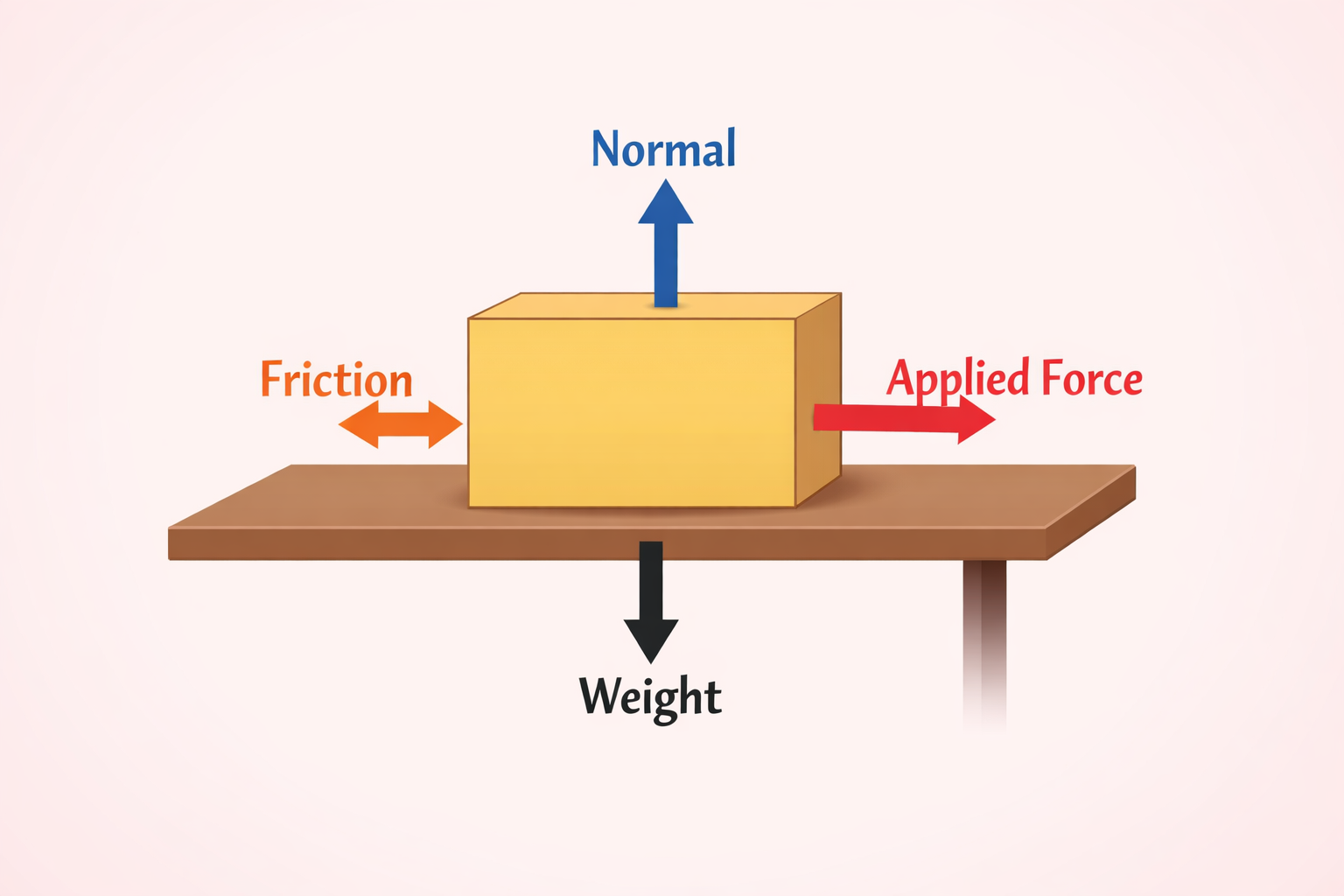
"Draw before you solve — FBDs make forces visible."
5How Do Newton's Three Laws Work Together?
Together, Newton's three laws describe all classical motion problems. Each law addresses a different aspect of how forces and motion interact.
First Law
Explains motion when no net force exists
Second Law
Explains motion when net force exists
Third Law
Explains force interactions between objects
Think of a bowling ball: it stays at rest until you push it (1st law), the harder you push the faster it goes (2nd law), and when it hits the pins, the pins push back on the ball (3rd law).
Frequently Asked Questions
- What are Newton's three laws of motion?
- Newton's First Law (Inertia) states that an object stays at rest or in uniform motion unless acted on by a net force. The Second Law states that force equals mass times acceleration (F = ma). The Third Law states that every action has an equal and opposite reaction.
- What is a real-life example of Newton's First Law?
- When a car suddenly brakes, your body continues moving forward because of inertia — you tend to maintain your state of motion. Seatbelts provide the external force needed to stop you safely.
- What is the formula for Newton's Second Law?
- F = ma, where F is the net force in Newtons (N), m is mass in kilograms (kg), and a is acceleration in metres per second squared (m/s²). This means 1 Newton equals 1 kg·m/s².
- Why don't action and reaction forces cancel each other out?
- Action and reaction forces act on different objects. When you push a wall, the wall pushes back on you — but because the two forces are applied to separate bodies, they do not cancel.
- What is a free body diagram and why is it useful?
- A free body diagram (FBD) is a sketch showing all the forces acting on a single object, represented as arrows. It helps you identify and organize forces before applying Newton's Second Law to solve problems.
Quick Formula Revision
| Concept | Formula |
|---|---|
| First Law (equilibrium) | ΣF = 0 → a = 0 |
| Second Law | F = ma |
| Weight | W = mg |
| Friction | f = μN |
Practice Quiz
Test your understanding — select the correct answer for each question.
1.An object moving at constant velocity has:
2.If the same force is applied to two objects, the object with smaller mass will:
3.When you jump off a boat, the boat moves backward. This demonstrates:
4.If net force equals zero, the object:
5.Force is measured in:
Final Study Advice
- 1. Always draw a Free Body Diagram before solving problems.
- 2. Identify the net force before solving — direction matters.
- 3. Keep track of direction and signs (positive/negative) in calculations.
- 4. Remember that forces come in action-reaction pairs acting on different objects.