Enzymes & Metabolism
Enzymes are biological catalysts that speed up virtually every chemical reaction in your body — from digesting food to building DNA. Without them, life as we know it would be impossible.
This guide covers how enzymes work (lock-and-key vs induced fit), the factors that affect their activity, competitive and non-competitive inhibition, the basics of metabolism (anabolism and catabolism), and includes diagrams, memory aids, and a 10-question practice quiz.
1What Are Enzymes and Why Do They Matter?
Enzymes are special proteins that act as biological catalysts — they accelerate the rate of specific chemical reactions without being consumed in the process. Every blink, every breath, every thought depends on enzymes.
The sum of all chemical reactions in a living organism is called metabolism. It has two branches: anabolism (building up complex molecules) and catabolism (breaking down complex molecules). Both rely heavily on enzymes.
Enzymes are like tiny, efficient machines in your body — each one designed for a particular job. They're the spark plugs of life: without them, the chemical reactions that keep you alive would be far too slow to sustain you.
Real-Life Enzyme Examples
Amylase
In saliva — breaks starch into simple sugars as you chew
Pepsin
In the stomach (pH 2) — breaks proteins into smaller polypeptides
Catalase
In most cells — breaks toxic H₂O₂ into harmless water + O₂
2What Are the Key Terms You Need to Know?
Enzyme
Protein catalyst that speeds up a specific biochemical reaction
Substrate
The molecule(s) an enzyme acts on — the reactant
Active Site
Region on enzyme where substrate binds; unique shape
Activation Energy
Minimum energy to start a reaction — enzymes lower it
Denaturation
Loss of enzyme's 3D shape (and function) from extreme conditions
Enzyme-Substrate Complex
Temporary structure formed when substrate binds the active site
Vmax
Maximum reaction rate when all active sites are saturated
Km (Michaelis Constant)
Substrate concentration at half Vmax — measures affinity
Cofactor / Coenzyme
Non-protein helpers: inorganic ions (Mg²⁺) or organic molecules (NAD⁺)
Allosteric Site
A regulatory site on the enzyme, separate from the active site
3How Do Enzymes Speed Up Reactions?
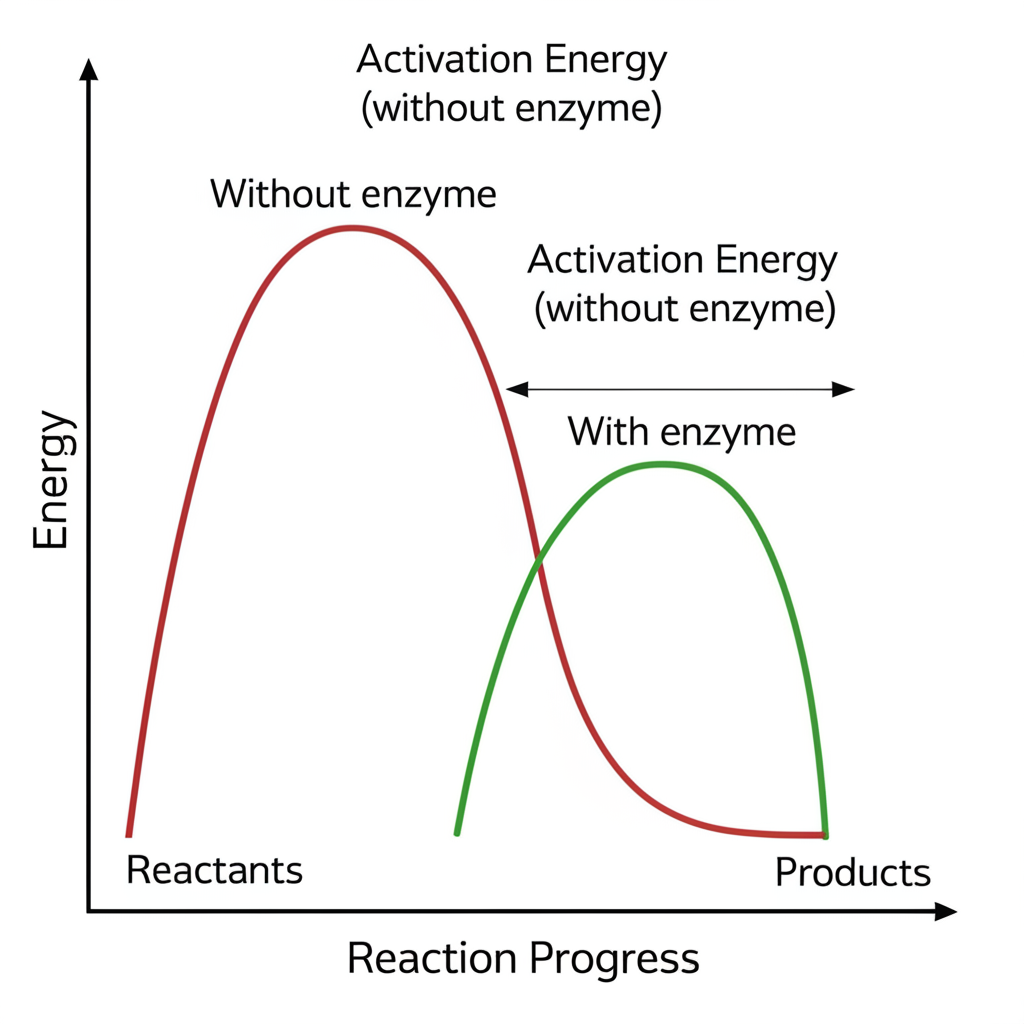
Lowering the Activation Energy
Every chemical reaction needs a minimum amount of energy to get started — the activation energy. Enzymes act like a shortcut, lowering this energy barrier so the reaction can proceed much faster. They do not change the total energy released or absorbed.
Lock-and-Key vs Induced Fit Model
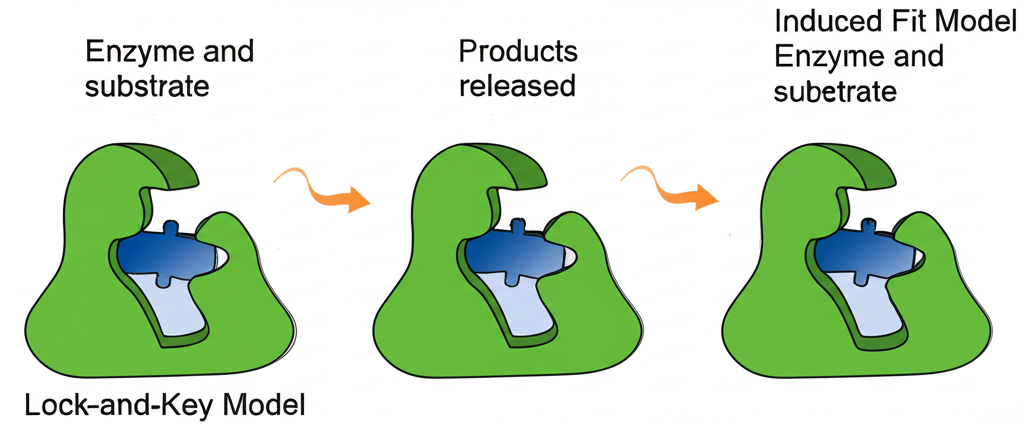
There are two models explaining how substrates bind to enzymes:
Lock-and-Key Model
- Proposed by Emil Fischer (1894)
- Active site has a rigid, fixed shape
- Substrate fits perfectly — like a key in a lock
- Simple but less accurate
Induced Fit Model
- Proposed by Daniel Koshland (1958)
- Active site is flexible
- Shape moulds around substrate — like a glove
- More accurate — currently accepted model
Step-by-Step: How an Enzyme Catalyses a Reaction
Substrate binding: The substrate diffuses into the enzyme's active site.
Induced fit: The active site flexes slightly to create a tighter fit, forming the enzyme-substrate complex.
Catalysis: The enzyme lowers the activation energy, facilitating bond breaking/forming.
Product release: Products leave the active site.
Enzyme recycled: The enzyme is free and unchanged — ready to catalyse the next reaction.
Enzymes are specific — each enzyme only catalyses one type of reaction because the active site's shape is complementary to only one substrate (or a very limited range). Enzymes are also not consumed; they are recycled.
4What Factors Affect Enzyme Activity?
Four key factors influence how fast an enzyme works. Understanding their effects — and recognising the graph shapes — is essential for exams.
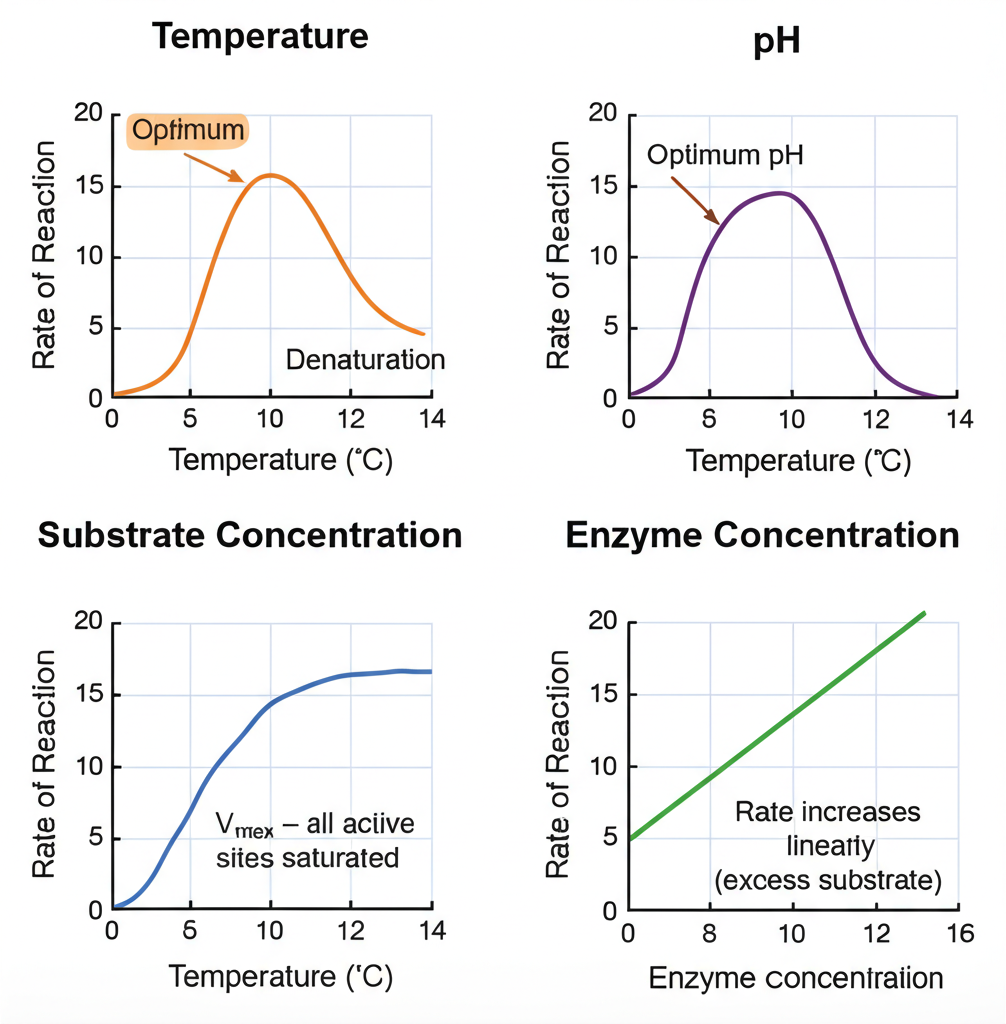
1. Temperature
- Higher temperature → faster molecular collisions → faster rate
- Optimum: ~37°C for most human enzymes (peak of bell curve)
- Above optimum: enzyme vibrates too violently → bonds break → denaturation
- Graph shape: bell curve
2. pH
- pH affects charges on amino acid side chains → affects active site shape
- Each enzyme has its own optimum pH (pepsin: pH 2, trypsin: pH 8)
- Extreme pH → disrupts ionic/hydrogen bonds → denaturation
- Graph shape: bell curve (peak varies by enzyme)
3. Substrate Concentration
- More substrate → more collisions → faster rate (initially)
- Eventually all active sites are occupied = saturation
- Rate plateaus at Vmax — adding more substrate has no effect
- Graph shape: saturation curve (rises then plateaus)
4. Enzyme Concentration
- More enzyme = more active sites available
- Rate increases linearly (if substrate is not limiting)
- Graph shape: straight line
5How Is Enzyme Activity Blocked? (Inhibition)
Enzyme inhibitors are molecules that decrease an enzyme's activity. They play crucial roles in regulating metabolic pathways and are the basis for many drugs and poisons.
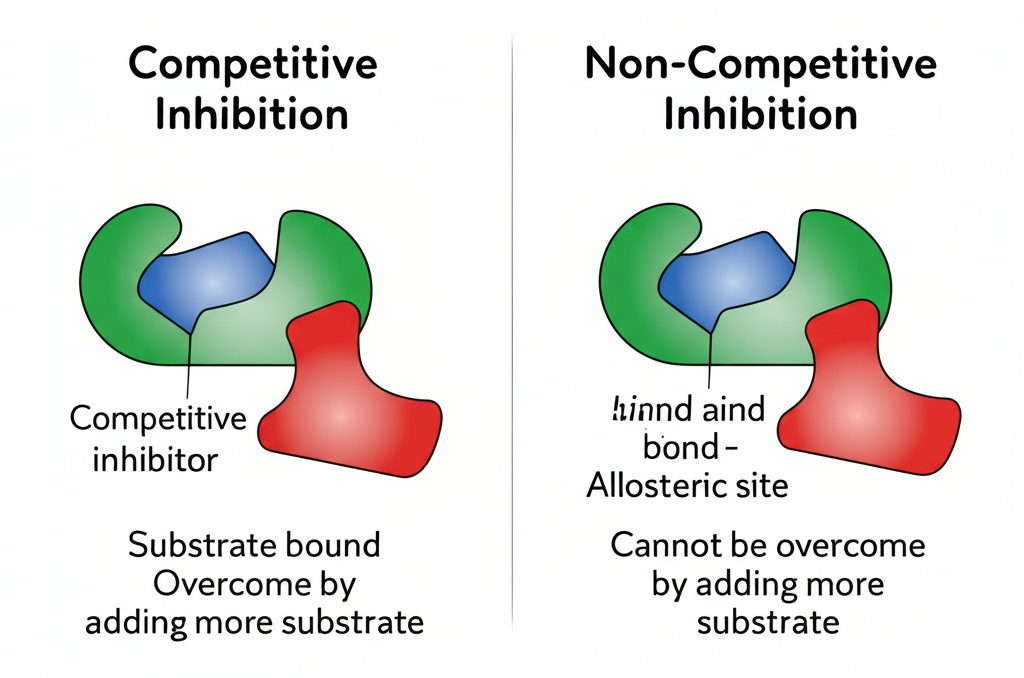
Competitive Inhibition
- Inhibitor shape is similar to substrate
- Competes for the active site
- Can be overcome by adding more substrate
- Km increases; Vmax unchanged
- Example: Statins (cholesterol drugs)
Non-Competitive Inhibition
- Inhibitor shape is different from substrate
- Binds to allosteric site → changes active site shape
- Cannot be overcome by adding more substrate
- Vmax decreases; Km unchanged
- Example: Cyanide (blocks cellular respiration)
"Competitive = Competes for Active site. Non-Competitive = Not at the active site (allosteric)."
6What Is Metabolism?
Metabolism is the sum total of all chemical reactions in a living organism. It is divided into two complementary branches that are linked by ATP — the cell's energy currency.
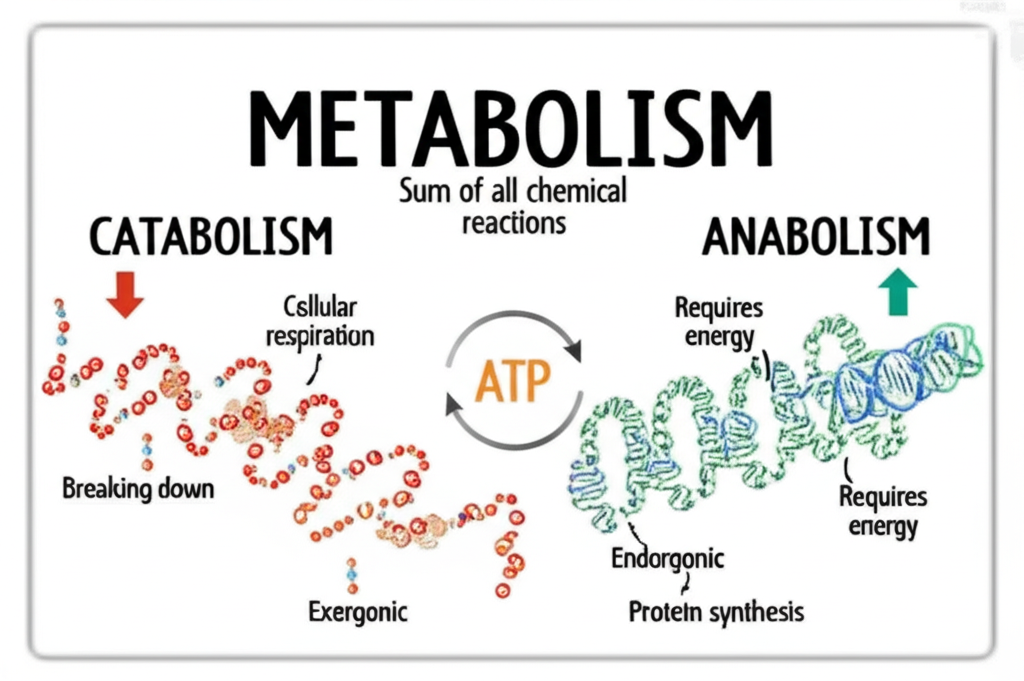
Catabolism (Breaking Down)
- Complex molecules → simpler molecules
- Releases energy (exergonic)
- Energy stored as ATP
- Examples: Cellular respiration, digestion
Anabolism (Building Up)
- Simple molecules → complex molecules
- Requires energy (endergonic)
- Powered by ATP
- Examples: Protein synthesis, DNA replication, photosynthesis
Cofactors and Coenzymes: Enzyme Helpers
Many enzymes need non-protein helpers to function properly:
Cofactors (inorganic)
Metal ions like Mg²⁺, Zn²⁺, Fe²⁺ — help enzyme adopt correct shape
Coenzymes (organic)
Molecules like NAD⁺, FAD, Coenzyme A — often derived from vitamins
"Anabolic = Build, Catabolic = Cut" — anabolism builds molecules up, catabolism cuts them down.
7Memory Aids
"L.A.S.T." — Enzymes: Lower Activation energy, are Specific, and are sensitive to Temperature & pH.
"T.P.S.E." — Factors affecting enzymes: Temperature, PH, Substrate concentration, Enzyme concentration.
"C-K-N-V" — Competitive: Km increases. Non-competitive: Vmax decreases.
Imagine an enzyme as a vending machine. The coin slot is the active site. Only the right coin (substrate) fits. A competitive inhibitor is a fake coin that jams the slot — use enough real coins and you'll eventually get one in. A non-competitive inhibitor is someone kicking the side of the machine, bending its internal mechanism — no matter how many coins you have, the machine won't work properly.
"Induced Fit = Flexible Glove" and "Lock-and-Key = Rigid Lock" — the glove moulds to your hand, the lock does not.
8Common Mistakes Students Make
"Enzymes give energy to reactions."
Enzymes lower the activation energy barrier — they do not provide energy. They don't change the total energy released or absorbed.
"Enzymes are used up in reactions."
Enzymes are catalysts — they participate but are released unchanged and can be reused many times.
"All enzymes work best at 37°C and pH 7."
Different enzymes have different optima. Pepsin works best at pH 2 in the stomach; thermophilic bacterial enzymes work at 80°C+.
"Denaturation is always reversible."
Severe denaturation (from extreme heat or pH) is usually irreversible. Think of cooking an egg — you can't uncook it.
"Lock-and-Key is the most accurate enzyme model."
The Induced Fit Model is more accurate — it accounts for the flexibility of the active site when substrate binds.
"All proteins are enzymes."
All enzymes are proteins (mostly), but not all proteins are enzymes. Proteins also serve structural, transport, and signalling roles.
Frequently Asked Questions
- Are all enzymes proteins?
- Almost all enzymes are proteins, but some RNA molecules called ribozymes can also catalyse reactions. For high school biology, it is safe to say enzymes are proteins.
- What happens when an enzyme denatures?
- Its 3D shape unfolds, the active site changes shape, and it can no longer bind its substrate. Denaturation is usually irreversible and is caused by extreme temperature or pH.
- Can enzymes work in reverse?
- Yes — enzymes catalyse reversible reactions in both directions. The net direction depends on the concentrations of reactants and products and the energy conditions.
- Why do different enzymes have different optimum pH values?
- Enzymes are adapted to the environment in which they function. Pepsin in the stomach works best at pH 2, while trypsin in the small intestine works best at pH 8. The optimum pH maintains the correct charge distribution on the enzyme for proper active-site shape.
- What is the difference between a cofactor and a coenzyme?
- Cofactors are inorganic ions (e.g. Mg²⁺, Zn²⁺) that help enzymes function. Coenzymes are organic molecules, often derived from vitamins (e.g. NAD⁺, FAD), that assist in transferring chemical groups. Coenzymes are a type of cofactor.
Practice Quiz
Test your understanding of enzymes and metabolism — select the correct answer for each question.
1.Which of the following best describes the function of an enzyme?
2.The minimum amount of energy required to initiate a chemical reaction is known as:
3.According to the Induced Fit Model, what happens when a substrate binds to an enzyme?
4.Which factor would most likely cause an enzyme to denature?
5.An enzyme has an optimum pH of 2. In which part of the human body would this enzyme most likely function?
6.What happens to the reaction rate as substrate concentration increases beyond the point of enzyme saturation?
7.A molecule that binds to the active site of an enzyme, preventing the substrate from binding, is known as a:
8.Which statement is true regarding non-competitive inhibition?
9.The metabolic process of building larger molecules from smaller ones, typically requiring energy, is called:
10.What is the role of ATP in linking anabolic and catabolic reactions?
Final Study Advice
- 1. Draw the activation energy diagram from memory — label both curves and all energy levels.
- 2. Practise sketching all four factor graphs (temperature, pH, substrate, enzyme concentration).
- 3. Be able to explain the difference between competitive and non-competitive inhibition using a diagram.
- 4. Use the vending machine analogy in exam answers — examiners love clear analogies.
- 5. Always state that enzymes lower activation energy (not "give energy") and are not consumed.