Protein Synthesis
Protein synthesis is the fundamental biological process by which all cells create proteins from genetic instructions stored in DNA. It follows the Central Dogma: DNA → RNA → Protein.
This guide covers the Central Dogma, transcription, mRNA processing, translation, the genetic code, protein folding, mutations, memory aids, common mistakes, and a 10-question practice quiz.
The Central Dogma of Molecular Biology
1What Is Protein Synthesis and Why Does It Matter?
Protein synthesis is the process by which all cells create proteins — the essential molecular workers that perform virtually every task in your body, from digesting food to fighting infections.
Understanding protein synthesis is crucial because errors in this process can lead to genetic disorders (e.g., cystic fibrosis, sickle cell anemia) and diseases like cancer. Many antibiotics work by targeting protein synthesis in bacteria, and biotechnology relies on manipulating this process to produce valuable proteins like insulin.
Imagine a massive library in the nucleus of a cell where every book is a DNA molecule, containing countless recipes (genes) for different proteins. When the cell needs a specific protein, it doesn't risk taking the valuable original book out of the library. Instead, it makes a temporary photocopy called mRNA, sends it to the factory floor (cytoplasm), where assembly machines (ribosomes) read it and build the protein piece by piece.
Health & Disease
Errors in protein synthesis cause genetic disorders and are targets for antibiotics
Cellular Function
Proteins are enzymes, structural components, transporters, and signaling molecules
Biotechnology
Manipulating protein synthesis enables genetic engineering and drug production
2What Are the Key Terms You Need to Know?
Mastering these terms is essential for understanding the rest of the topic. Refer back here as needed.
DNA
Deoxyribonucleic acid — the master blueprint for all proteins, stored in the nucleus
RNA
Ribonucleic acid — single-stranded nucleic acid that plays a central role in protein synthesis
mRNA
Messenger RNA — carries the genetic code from DNA to the ribosomes
tRNA
Transfer RNA — adapter molecule that brings amino acids to the ribosome during translation
rRNA
Ribosomal RNA — structural and catalytic component of ribosomes
Transcription
The process of synthesizing an RNA molecule from a DNA template
Translation
The process of synthesizing a polypeptide (protein) from an mRNA template
Gene
A specific segment of DNA containing instructions for a particular protein
Codon
A sequence of three mRNA nucleotides that specifies an amino acid or stop signal
Anticodon
A three-nucleotide sequence on tRNA that is complementary to an mRNA codon
Amino Acid
The monomer (building block) of proteins — there are 20 common types
Polypeptide
A chain of amino acids linked by peptide bonds, which folds into a functional protein
Ribosome
The cellular machine (rRNA + proteins) where translation occurs
RNA Polymerase
Enzyme that synthesizes RNA by reading a DNA template during transcription
Promoter
DNA sequence where RNA polymerase binds to start transcription
Start Codon
AUG — signals the beginning of translation and codes for methionine
Stop Codons
UAA, UAG, UGA — signal the termination of translation
Peptide Bond
The covalent bond linking amino acids together in a polypeptide chain
3DNA Structure and the Central Dogma
DNA is a double helix made of two strands of nucleotides. Each nucleotide contains a deoxyribose sugar, a phosphate group, and one of four nitrogenous bases: Adenine (A), Thymine (T), Guanine (G), or Cytosine (C).
DNA Base Pairing Rules
Adenine always pairs with Thymine; Guanine always pairs with Cytosine
The Central Dogma: DNA → RNA → Protein
Replication: DNA makes copies of itself before cell division.
Transcription: A gene on DNA is copied into an mRNA molecule in the nucleus.
Translation: The mRNA is decoded by ribosomes to assemble a chain of amino acids into a polypeptide.
Why Not Use DNA Directly?
Protection
DNA is the master blueprint — keeping it safe in the nucleus prevents damage
Amplification
One gene can produce many mRNA copies, each translated multiple times
Regulation
Using mRNA as an intermediate allows multiple points of control
Location
DNA stays in the nucleus; mRNA travels to the cytoplasm where ribosomes are
4How Does Transcription Work?
Transcription is the process where a segment of DNA (a gene) is copied into an RNA molecule. It occurs in the nucleus of eukaryotic cells.
Transcription Process
Initiation
RNA polymerase binds to the promoter → DNA unwinds → template strand exposed
Elongation
RNA polymerase reads template strand (3'→5') → adds RNA nucleotides (A, U, C, G) → mRNA grows (5'→3')
Termination
RNA polymerase reaches terminator sequence → detaches → pre-mRNA released → DNA re-forms
Transcription Base Pairing (DNA → RNA)
Note: RNA uses Uracil (U) instead of Thymine (T)
Pre-mRNA Processing (Eukaryotes Only)
After transcription, the pre-mRNA undergoes three critical modifications before leaving the nucleus:
5' Cap
A modified guanine nucleotide is added to the 5' end. Protects mRNA from degradation and aids ribosome binding.
Poly-A Tail
A long chain of 50-250 adenine nucleotides is added to the 3' end. Protects mRNA and helps export from the nucleus.
Splicing (Introns vs. Exons)
Introns (non-coding) are cut out; exons (coding) are joined together. Remember: Exons are expressed, introns are interruptions.
Template Strand vs. Coding Strand
Template Strand (Antisense)
The strand RNA polymerase directly reads (3'→5'). The mRNA is complementary to this strand.
Coding Strand (Sense)
Same sequence as the mRNA (except T instead of U). Not directly read by RNA polymerase.
5How Does Translation Work?
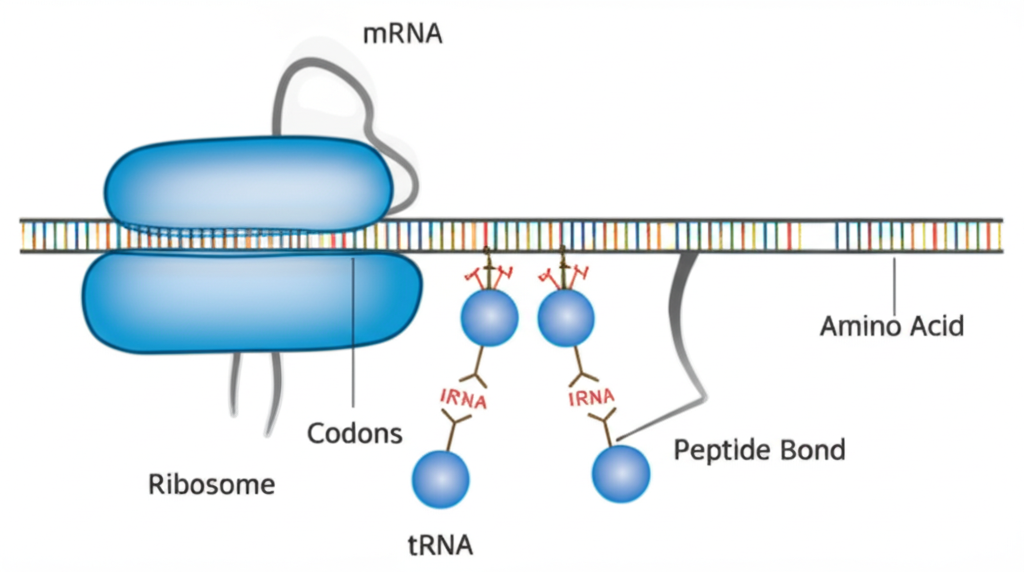
Translation is the process where the genetic information carried by mRNA is decoded to synthesize a polypeptide chain. It occurs on ribosomes in the cytoplasm.
The Genetic Code
The genetic code is read in groups of 3 nucleotides (codons). There are 64 possible codons (4³) coding for only 20 amino acids, making the code degenerate (redundant) — most amino acids are specified by more than one codon.
Interactive: Codon Translator
Enter an mRNA sequence to translate it into amino acids, or look up individual codons.
15 bases = 5 codons
Translation Result:
Amino Acid Chain:
Met – Pro – Lys – Leu | STOP
4 amino acids in this polypeptide
Key Components
mRNA
Carries the genetic message as a sequence of codons
tRNA
Has an anticodon on one end and carries a specific amino acid on the other
Ribosome
Two subunits with 3 tRNA binding sites: A site (aminoacyl), P site (peptidyl), E site (exit)
Aminoacyl-tRNA Synthetases
Enzymes that attach the correct amino acid to its corresponding tRNA ("charging")
Three Phases of Translation
Phase 1: Initiation
- Small ribosomal subunit binds to mRNA at the 5' cap
- Scans until it finds the start codon (AUG)
- Initiator tRNA (carrying methionine, anticodon UAC) binds to AUG in the P site
- Large ribosomal subunit joins, completing the functional ribosome
Phase 2: Elongation (repeating cycle)
- Codon Recognition: A new tRNA arrives at the A site, anticodon matching the mRNA codon
- Peptide Bond Formation: A peptide bond forms between amino acids at A and P sites (catalyzed by rRNA)
- Translocation: Ribosome shifts one codon along mRNA; P-site tRNA moves to E site and exits; A-site tRNA moves to P site
Phase 3: Termination
- Ribosome encounters a stop codon (UAA, UAG, or UGA) in the A site
- No tRNA recognizes stop codons — a release factor binds instead
- The completed polypeptide is released; ribosomal subunits dissociate
6Protein Folding and Modification
Once released from the ribosome, the polypeptide must fold into a specific 3D shape and may undergo further modifications to become fully functional.
Levels of Protein Structure
Primary Structure
The unique, linear sequence of amino acids in the chain, held together by peptide bonds. Determined by the genetic code.
Secondary Structure
Local folding patterns formed by hydrogen bonds between backbone atoms: alpha (α) helices (coiled springs) and beta (β) pleated sheets (accordion-like).
Tertiary Structure
The overall 3D shape from interactions between amino acid side chains (R-groups): hydrophobic interactions, hydrogen bonds, ionic bonds, and disulfide bridges.
Quaternary Structure
Multiple polypeptide subunits combining to form a functional protein complex. Not all proteins have this level (e.g., hemoglobin has 4 subunits).
Post-Translational Modifications
Phosphorylation
Addition of a phosphate group — often acts as an on/off switch for protein activity
Glycosylation
Addition of carbohydrate chains — important for cell recognition and protein targeting
Cleavage
Cutting the polypeptide into smaller active fragments (e.g., proinsulin → insulin)
Cofactor Addition
Binding non-protein components (metal ions, vitamins) essential for activity
7Factors, Mutations, and Antibiotics
What Affects Protein Synthesis Rates?
mRNA availability
More mRNA copies = more protein production
tRNA & amino acid supply
Shortages slow or halt synthesis
Ribosome availability
More ribosomes allow faster production
Energy (ATP & GTP)
Both transcription and translation require energy
Mutations and Their Effects
A mutation is a change in the DNA sequence that can alter the mRNA and ultimately the protein's structure and function.
Silent Mutation
Changes a codon but codes for the same amino acid (due to code degeneracy). No effect on protein.
Missense Mutation
Changes a codon to specify a different amino acid. Effects range from minimal to severe (e.g., sickle cell anemia).
Nonsense Mutation
Changes a codon to a stop codon, producing a prematurely truncated, often non-functional protein.
Frameshift Mutation
Insertions or deletions (not multiples of 3) shift the entire reading frame, drastically altering all downstream codons. Usually produces a completely non-functional protein.
Antibiotics That Target Translation
| Antibiotic | Mechanism |
|---|---|
| Tetracycline | Blocks tRNA binding to the A site of bacterial ribosomes |
| Streptomycin | Interferes with initiation and causes mRNA misreading in bacteria |
| Erythromycin | Binds the large ribosomal subunit, inhibiting translocation |
8Key Formulas and Equations
| Concept | Formula / Rule |
|---|---|
| Central Dogma | DNA → (Transcription) → mRNA → (Translation) → Protein |
| DNA-RNA pairing | A↔U, T↔A, G↔C, C↔G |
| Codon formula | 4³ = 64 codons → 20 amino acids |
| Start codon | AUG → Methionine |
| Stop codons | UAA, UAG, UGA → Termination |
9Memory Aids
"In Every Town" — Initiation, Elongation, Termination — the three phases of both transcription and translation.
"AUGust is the start of the school year" — AUG is the START codon. "AUG, you're Met!" — it codes for Methionine.
"U Are Away (UAA), U Are Gone (UAG), U Go Away (UGA)" — the three stop codons.
DNA = Master Blueprint (in the library/nucleus). mRNA = Photocopy of a single page (sent to factory floor/cytoplasm). tRNA = Delivery Truck (brings specific parts/amino acids). Ribosome = Assembly Line Machine (builds the product/protein).
"Exons are Expressed, Introns are In the trash" — exons stay in the mature mRNA, introns are spliced out.
10Common Mistakes Students Make
"Confusing where transcription and translation occur."
Transcription occurs in the nucleus. Translation occurs on ribosomes in the cytoplasm. DNA never leaves the nucleus.
"Thinking DNA is directly translated into protein."
DNA is first transcribed into mRNA. The mRNA then leaves the nucleus and is translated into protein. DNA never directly interacts with ribosomes.
"Confusing the template strand with the coding strand."
The template strand is read by RNA polymerase (3'→5'). The coding strand has the same sequence as the mRNA (T→U). If given the coding strand, replace T's with U's to get the mRNA.
"Believing that codons are on tRNA."
Codons are on the mRNA. tRNA carries anticodons (complementary to codons) along with the specific amino acid.
"Thinking introns are translated and lead to incorrect proteins."
Introns are non-coding regions that are spliced out of pre-mRNA before it leaves the nucleus. Only exons remain in the mature mRNA and are translated.
Quick Revision Summary
- ✓Protein synthesis builds proteins from genetic instructions via the Central Dogma: DNA → RNA → Protein.
- ✓Transcription copies a gene from DNA into mRNA in the nucleus.
- ✓RNA polymerase binds to the promoter, reads the template strand (3'→5'), and builds mRNA (5'→3').
- ✓Eukaryotic pre-mRNA is processed: 5' cap, poly-A tail, and splicing (introns out, exons joined).
- ✓Translation decodes mRNA into a polypeptide on ribosomes in the cytoplasm.
- ✓The genetic code uses 64 codons (3-nucleotide groups) to specify 20 amino acids — it is degenerate.
- ✓AUG is the start codon (methionine); UAA, UAG, UGA are stop codons.
- ✓tRNA molecules are adapters with anticodons that match mRNA codons and carry specific amino acids.
- ✓Both transcription and translation have three phases: initiation, elongation, and termination.
- ✓Ribosomes have three tRNA sites: A site (incoming), P site (peptide chain), E site (exit).
- ✓Peptide bonds link amino acids together and are catalyzed by rRNA in the ribosome.
- ✓Proteins fold into 4 structural levels: primary, secondary, tertiary, and quaternary.
- ✓Post-translational modifications (phosphorylation, glycosylation, cleavage) activate proteins.
- ✓Mutations (silent, missense, nonsense, frameshift) can alter protein structure and function.
- ✓Many antibiotics work by targeting bacterial ribosomes to block protein synthesis.
Frequently Asked Questions
- Why is RNA used as an intermediate instead of directly using DNA for protein synthesis?
- Using RNA protects the cell's master DNA blueprint from damage, allows for amplification (many RNA copies from one DNA gene), provides multiple points of regulation, and enables the genetic information to be transported from the nucleus (where DNA is) to the cytoplasm (where ribosomes are).
- What is the difference between a codon and an anticodon?
- A codon is a three-nucleotide sequence on the mRNA molecule that specifies a particular amino acid. An anticodon is a three-nucleotide sequence on a tRNA molecule that is complementary to an mRNA codon, ensuring the correct amino acid is brought to the ribosome.
- How does the cell ensure that the correct amino acid is added to the polypeptide chain during translation?
- The accuracy of translation relies heavily on aminoacyl-tRNA synthetase enzymes. Each enzyme is specific for a particular amino acid and its corresponding tRNA. It "charges" the tRNA by attaching the correct amino acid. Then, during translation, the anticodon on the charged tRNA correctly base-pairs with the codon on the mRNA.
- What are introns and exons, and why is splicing important?
- Exons are the coding regions that contain instructions for building a protein, while introns are non-coding intervening sequences. Splicing removes introns and joins exons together, creating a continuous coding sequence that can be translated into a functional protein. It also allows for alternative splicing, where different exon combinations produce different proteins from a single gene.
- Can a single mRNA molecule be used to make multiple copies of a protein?
- Yes! Once an mRNA molecule is in the cytoplasm, multiple ribosomes can attach to it simultaneously, forming a polysome (polyribosome). Each ribosome synthesizes a separate polypeptide chain, allowing the cell to produce many copies of the same protein quickly and efficiently.
Practice Quiz
Test your understanding of protein synthesis — select the correct answer for each question.
1.Which of the following describes the flow of genetic information according to the Central Dogma?
2.Where does transcription primarily occur in a eukaryotic cell?
3.Which enzyme is responsible for synthesizing mRNA from a DNA template?
4.A sequence of three nucleotides on an mRNA molecule that codes for a specific amino acid is called a:
5.Which molecule acts as an adapter, carrying a specific amino acid to the ribosome and matching it to an mRNA codon?
6.What is the start codon for translation, and what amino acid does it typically code for?
7.Which of the following is NOT a modification that typically occurs to eukaryotic pre-mRNA before it leaves the nucleus?
8.If a DNA template strand has the sequence 3'-TACGAT-5', what would be the sequence of the mRNA transcribed from it?
9.What type of mutation results in a change from an amino acid codon to a stop codon, leading to a shortened protein?
10.The formation of peptide bonds between amino acids during translation is primarily catalyzed by:
Final Study Advice
- 1. Draw the Central Dogma diagram from memory, labeling where each process occurs.
- 2. Practice converting DNA template strand sequences to mRNA to amino acid chains.
- 3. Trace the journey of information from a gene in the nucleus to a folded protein in the cytoplasm.
- 4. Use the codon translator above to practice looking up amino acids from mRNA sequences.
- 5. Know the differences between silent, missense, nonsense, and frameshift mutations and their effects.