Grammar & Sentence Structure
Grammar and sentence structure are the foundational rules and arrangements that govern how words combine to form clear, meaningful, and impactful sentences. Understanding these principles isn't just about avoiding red marks on your essays — it's about unlocking the power of language itself.
This guide covers clauses, phrases, sentence types, rhetorical devices like parallelism and anaphora, sentence variety techniques, worked examples from classic literature, and a practice quiz to test your understanding.
1Introduction
Mastering grammar and sentence structure will dramatically improve your grades in English and across all subjects, prepare you for college-level writing, enhance your communication skills in every aspect of life, and sharpen your critical thinking by allowing you to analyze how others use language to persuade or inform. It's the difference between merely having an idea and eloquently expressing it.
At its heart, this skill involves recognizing the building blocks of sentences (words, phrases, clauses), understanding how they fit together correctly, and then consciously manipulating them to create different effects. From ensuring your sentences are grammatically sound to crafting sophisticated structures that convey complex ideas or evoke specific emotions, mastering this topic transforms you from a basic writer into a compelling communicator and a perceptive reader.
You're reading a captivating novel, and a particularly powerful sentence lingers in your mind, perfectly capturing a character's despair. Now, imagine trying to express your own profound insights in an essay, but your sentences are clunky, confusing, or riddled with errors. The gap between your brilliant thoughts and their written expression can feel immense. This guide bridges that gap.
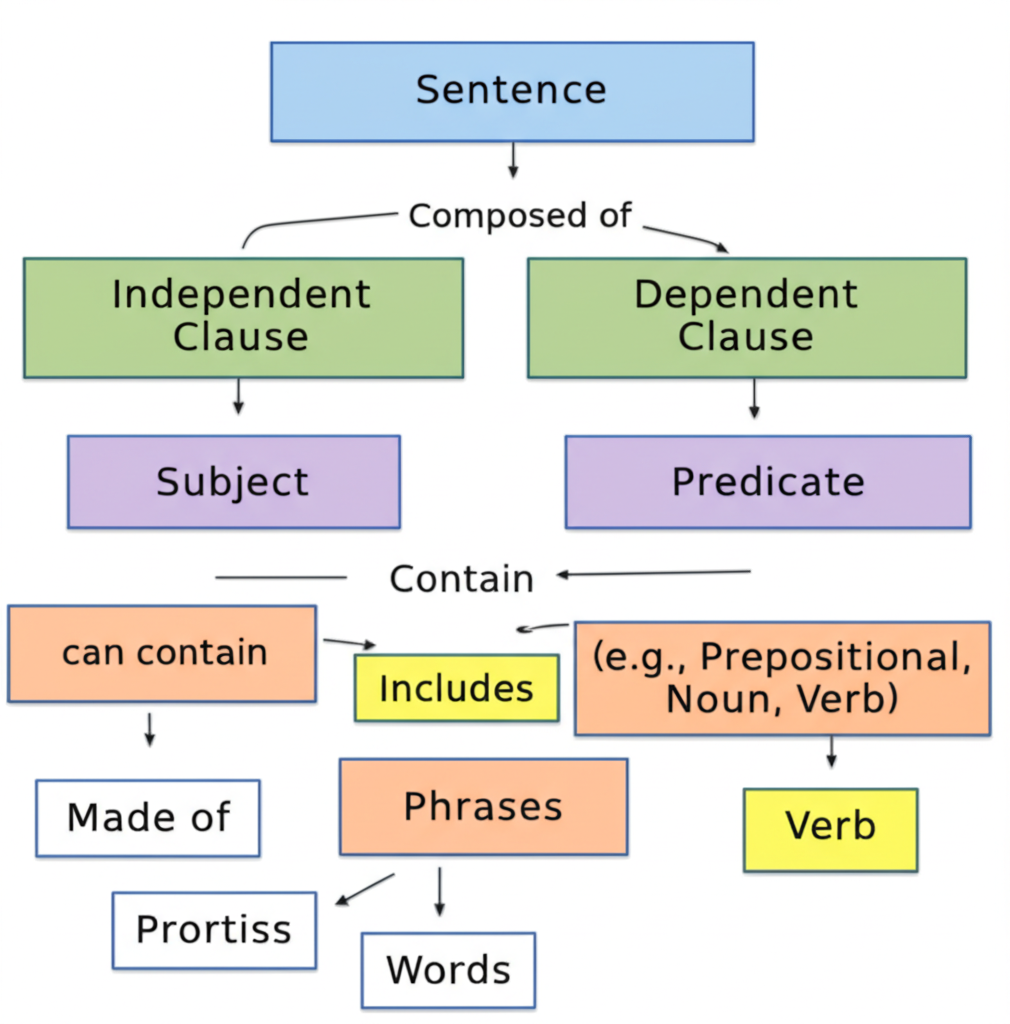
Every sentence is built from smaller units — clauses and phrases. Recognizing these units allows you to construct grammatically correct sentences and consciously vary their structure for clarity, rhythm, and impact.
2Key Definitions
Sentence Building Blocks
Clause
A group of words containing a subject and a predicate (verb). E.g., "She sings."
Phrase
A group of words that functions as a single unit but does not contain both a subject and a predicate. E.g., "running quickly," "in the house."
Subject
The noun or pronoun that performs the action of the verb or is described by the verb. E.g., "Atticus defended Tom Robinson."
Predicate
The part of the sentence containing the verb that tells something about the subject. E.g., "Atticus defended Tom Robinson."
Independent Clause
A clause that can stand alone as a complete sentence. E.g., "The bell rang."
Dependent Clause
A clause that cannot stand alone; it must be attached to an independent clause. Often begins with a subordinating conjunction. E.g., "Because the bell rang..."
Modifiers & Conjunctions
Modifier
A word or phrase that describes or limits another word or group of words (adjectives, adverbs, phrases, clauses). E.g., "The bright red car sped down the winding road."
Conjunction
A word that connects words, phrases, or clauses. Coordinating (FANBOYS: for, and, nor, but, or, yet, so) and subordinating (because, while, although).
Sentence Types
Simple Sentence
One independent clause. E.g., "Scout observed the trial."
Compound Sentence
Two or more independent clauses joined by a coordinating conjunction or semicolon. E.g., "Scout observed the trial, and she learned about justice."
Complex Sentence
One independent clause and one or more dependent clauses. E.g., "Although Scout was young, she observed the trial carefully."
Compound-Complex Sentence
Two or more independent clauses and one or more dependent clauses. E.g., "Although Scout was young, she observed the trial carefully, and she began to understand the town's prejudice."
Common Errors
Comma Splice
Two independent clauses joined only by a comma, without a coordinating conjunction or semicolon. E.g., "It was raining, I stayed inside."
Run-on Sentence
Two or more independent clauses joined without any punctuation or conjunctions. E.g., "The storm raged the power went out everyone was scared."
Rhetorical & Structural Devices
Parallelism
Using similar grammatical structures to express related ideas, creating rhythm and emphasis. E.g., "It was the best of times, it was the worst of times..."
Anaphora
Repetition of a word or phrase at the beginning of successive clauses or sentences. E.g., "We cannot dedicate -- we cannot consecrate -- we cannot hallow -- this ground."
Antithesis
Juxtaposition of contrasting ideas, often in parallel structure. E.g., "Man proposes, God disposes."
Rhetorical Question
A question asked for effect with no expectation of an answer, used to provoke thought. E.g., "Are we to sit here in idleness while our freedoms are stripped away?"
Repetition
Intentional repeating of a word, phrase, or sentence for emphasis or rhetorical effect.
Transition
A word, phrase, or sentence that connects ideas and guides the reader smoothly from one point to the next.
Thesis Statement
The central argument or main idea of an essay, usually stated in one or two sentences in the introduction.
3Foundations: Clauses, Phrases & Sentence Types
The bedrock of strong writing is understanding the fundamental units that make up sentences: clauses and phrases, and how they combine to form different sentence types. Recognizing these units allows you to construct grammatically correct sentences and consciously vary their structure for impact.
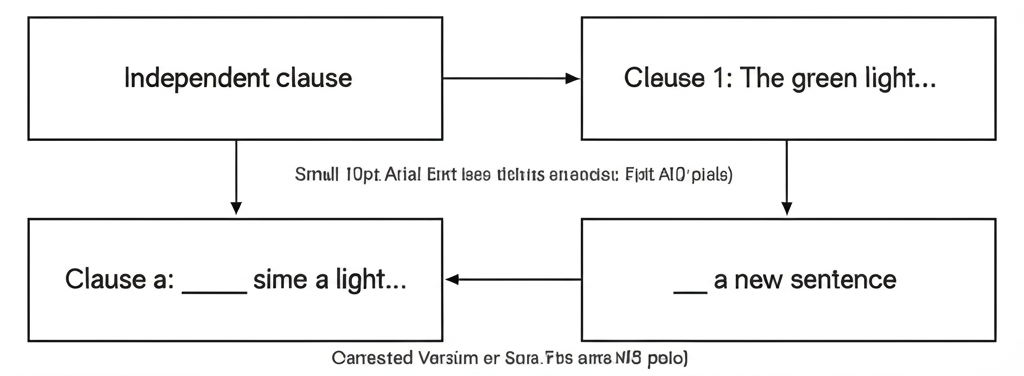
Step-by-Step: Identifying Sentence Components
1. Identify the Main Verb(s)
What action is happening, or what state of being is being described? E.g., "The boy ran quickly." (verb: ran)
2. Identify the Subject(s)
Who or what is performing the action or being described? E.g., "The boy ran quickly." (subject: The boy)
3. Determine if it's a Clause or Phrase
If you have both a subject and a predicate, it's a clause. If you have only part of a subject-predicate pair, or neither, it's a phrase.
4. Classify Clauses (Independent vs. Dependent)
Can the clause stand alone as a complete thought? If yes, Independent. Does it start with a subordinating conjunction or relative pronoun and cannot stand alone? If yes, Dependent.
5. Classify the Sentence Type
Simple = 1 independent clause. Compound = 2+ independent clauses. Complex = 1 independent + 1+ dependent. Compound-Complex = 2+ independent + 1+ dependent.
Example from The Great Gatsby
"Gatsby believed in the green light, the orgastic future that year by year recedes before us."
Step 1 (Verbs): "believed," "recedes"
Step 2 (Subjects): "Gatsby," "that" (referring to "future")
Step 3 (Clauses/Phrases): "Gatsby believed in the green light" (Clause); "the orgastic future" (Phrase - appositive); "that year by year recedes before us" (Clause)
Step 4 (Clause Types): "Gatsby believed..." (Independent); "that year by year recedes..." (Dependent - relative clause)
Step 5 (Sentence Type): Complex Sentence (one independent, one dependent)
A clause has both a subject and a verb. A phrase is a group of words but lacks either a subject, a verb, or both. Think of phrases as building blocks within clauses. If a clause starts with a subordinating conjunction and doesn't make sense on its own, it's dependent — it needs to lean on an independent clause.
4Crafting Varied & Impactful Sentences
Beyond correctness, skilled writers use sentence structure to create specific effects. Mastering sentence variety and rhetorical devices elevates your writing from merely understandable to sophisticated and persuasive.
Key Techniques
Sentence Variety
Avoid a string of simple sentences. Mix simple, compound, complex, and compound-complex sentences to maintain engagement and reflect the complexity of your ideas.
Simple: "Lennie liked soft things." (Direct, clear)
Compound: "George worried about Lennie, but he always protected him." (Two equal ideas)
Complex: "Because Lennie was so strong, George constantly feared an accident." (Cause-effect)
Compound-Complex: "Although George loved Lennie, he knew their dream was fragile, and he eventually had to make a terrible choice." (Multiple layers)
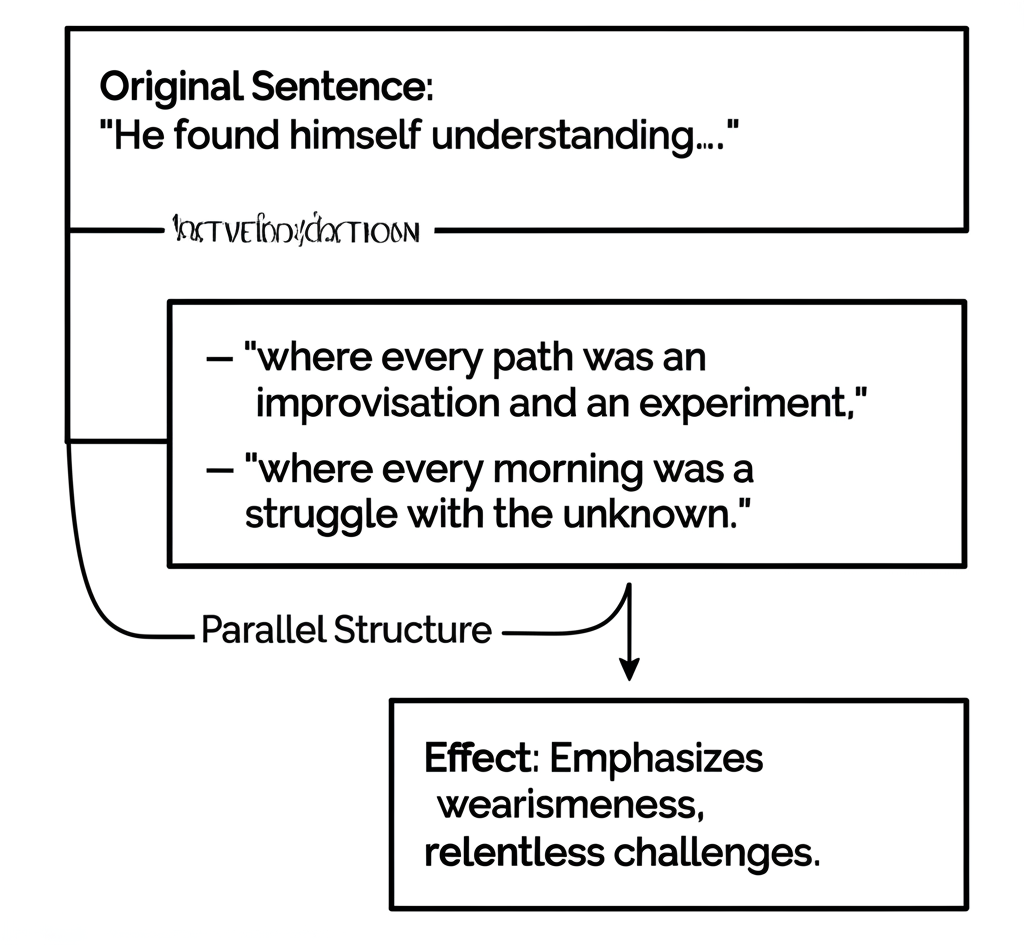
Parallelism
Repeating a grammatical structure to emphasize a series of ideas. Creates balance, rhythm, and clarity.
"I came, I saw, I conquered." (Julius Caesar — verbs in parallel)
"...where every path was an improvisation and an experiment, where every morning was a struggle with the unknown." (Lord of the Flies — parallel dependent clauses)
Anaphora
Repetition of a word or phrase at the beginning of successive clauses or sentences. Builds intensity and reinforces a central idea.
"We cannot dedicate — we cannot consecrate — we cannot hallow — this ground." (Lincoln, Gettysburg Address)
Antithesis
Juxtaposition of contrasting ideas, often in parallel structure. Highlights differences and can be very persuasive.
"War is Peace. Freedom is Slavery. Ignorance is Strength." (1984 — contrasting ideas reveal the Party's twisted logic)
Effective vs. Ineffective Use
| Feature | Ineffective | Effective |
|---|---|---|
| Sentence Length | "Gatsby was rich. He loved Daisy. She was married. He waited for her." | "Though immensely wealthy, Gatsby yearned for Daisy, whose marriage to Tom represented an insurmountable obstacle to his idealized past." |
| Punctuation | "The party was loud, people danced, music played, it was fun." | "The party was loud; people danced, and music played. It was a memorable evening." |
| Rhetorical Device | "He talked about freedom. He talked about justice. He talked about equality." | "He talked about freedom, he talked about justice, he talked about equality — ideas that resonated deeply." |
| Clarity | "The book, which was about dystopia, that Winston hated, was good." | "The dystopian novel, which Winston despised, offered a compelling critique of totalitarianism." |
SAT/ACT directly tests grammar rules (comma splices, run-ons, subject-verb agreement) and sentence combining. AP English Language requires analyzing how authors use syntax and rhetorical devices (parallelism, anaphora) to achieve their purpose.
5Analyzing Author's Purpose Through Structure
Moving beyond identifying grammar errors, true mastery involves understanding why authors make specific structural choices and how those choices contribute to the overall meaning, tone, or effect of a text. This is the heart of literary and rhetorical analysis.
From Surface-Level to Deeper Understanding
Surface-Level (Weak)
"The author uses long sentences."
Simply observes a feature without explaining its purpose.
Deeper Analysis (Strong)
"The author's use of long, winding sentences, laden with subordinate clauses, mirrors the protagonist's convoluted thought process, creating a sense of internal struggle and uncertainty."
Explains how and why the structure creates meaning.
Critical Questions to Ask
- ?Why this structure here? What purpose does it serve?
- ?What effect does it create? (urgency, confusion, formality, clarity, emphasis)
- ?How does it connect to the author's message or the character's state of mind?
- ?What would be lost if the author had used a different structure?
Selecting, Introducing & Analyzing Quotations
Select
Choose quotes that clearly demonstrate the sentence structure or rhetorical device you're discussing. Don't pick a random sentence; pick one that exemplifies your point.
Introduce
Don't "drop" quotes. Provide context and smoothly integrate the quote into your own sentence. E.g., "From the omnipresent posters declaring, 'BIG BROTHER IS WATCHING YOU,' Orwell immediately establishes the pervasive surveillance..."
Analyze
Explain how the specific sentence structure or device in your quote contributes to meaning, tone, or purpose. This is the most crucial step.
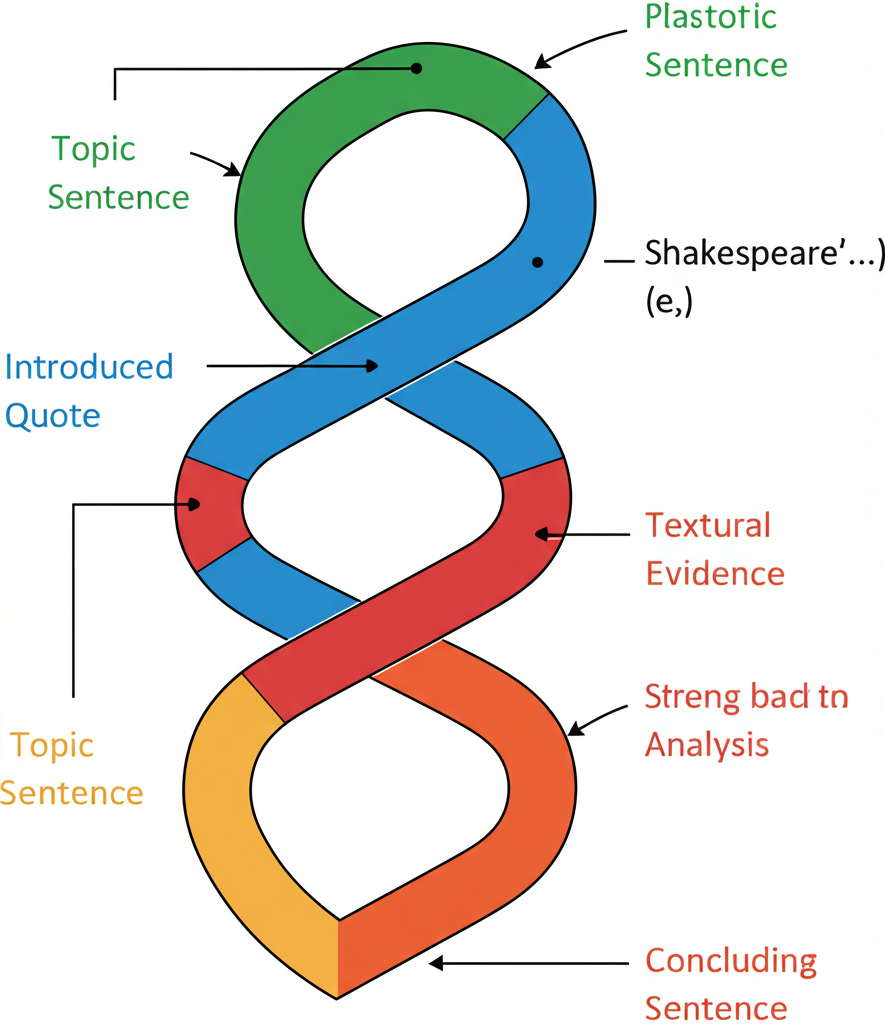
Sample Analytical Paragraph
Topic Sentence
In The Great Gatsby, F. Scott Fitzgerald masterfully employs sentence structure to underscore Gatsby's obsessive, yet ultimately futile, pursuit of the past.
Introduced Evidence
For instance, when describing Gatsby's unwavering hope, Fitzgerald writes, "He believed in the green light, the orgastic future that year by year recedes before us."
Analysis
This complex sentence, with its initial independent clause establishing Gatsby's belief, is immediately followed by a dependent clause that modifies "future." The verb "recedes" combined with "year by year" conveys a gradual, almost imperceptible loss, mirroring Gatsby's own experience: his dream is perpetually just out of reach.
Concluding Link
Thus, Fitzgerald uses the very construction of the sentence to embed the tragic irony of Gatsby's aspirations.
When writing about sentence structure in an essay, your thesis should establish an argument about the author's purpose or message, and sentence structure can be one of the methods the author uses to achieve it. E.g., "Through the strategic deployment of anaphora and varied sentence lengths, Orwell not only depicts the oppressive nature of the Party but also subtly encourages the reader to question the manipulation of language itself."
6Putting It All Together
Understanding grammar and sentence structure isn't an isolated skill — it's the engine that drives effective communication across all disciplines.
Connections to Other ELA Skills
Literary Analysis
Understanding how authors use syntax and rhetorical devices (parallelism, anaphora, antithesis) is key to analyzing their craft, tone, and themes.
Persuasive Writing
Crafting clear, logical, and impactful sentences is fundamental to building strong arguments, presenting evidence, and persuading your audience.
Vocabulary & Diction
Sentence structure works hand-in-hand with word choice. Precise vocabulary within well-structured sentences amplifies meaning.
Reading Comprehension
Breaking down complex sentences helps you understand challenging texts, especially those with archaic language or dense academic prose.
Strategies for Timed Writing & Exams
1. Prioritize Clarity and Correctness
Under timed pressure, focus on making your sentences clear and grammatically sound. Avoid major errors like comma splices, run-ons, and subject-verb agreement issues.
2. Vary Sentence Openings
Instead of starting every sentence with "The," try beginning with a dependent clause ("Although..."), a phrase ("In the beginning..."), or an adverb ("Suddenly...").
3. Use Conjunctions Wisely
Employ coordinating conjunctions (FANBOYS) to link related independent clauses, and subordinating conjunctions to show complex relationships between ideas.
4. Proofread Strategically
In the last few minutes, scan for run-ons/comma splices, homophones (their/there/they're, your/you're, its/it's), apostrophes, and subject-verb agreement.
Self-Assessment Checklist
- ✓Clarity: Is each sentence easy to understand on the first read?
- ✓Conciseness: Are there unnecessary words or phrases that could be removed?
- ✓Correctness: Are there grammar, punctuation, or spelling errors? (Focus on comma splices/run-ons)
- ✓Variety: Is there a mix of simple, compound, complex, and compound-complex sentences?
- ✓Impact: Do your sentences effectively convey your ideas? Have you used any rhetorical devices deliberately?
7Worked Examples
Example 1: Identifying Subject and Predicate
Identify the subject and predicate in the following sentence from To Kill a Mockingbird: "Jem was twelve."
Step 1: Locate the main verb: "was"
Step 2: Ask who or what "was" — "Jem" was twelve. = Subject: Jem
Step 3: Identify the predicate (verb + what it says about the subject): "was twelve" = Predicate: was twelve
Key Insight: Every complete sentence must contain at least one subject and one predicate.
Example 2: Distinguishing Between Clauses and Phrases
For each group of words, determine if it is a "Clause" or a "Phrase." If it's a clause, identify if it's "Independent" or "Dependent."
1. "running quickly" — Has a verb ("running") but no subject. = Phrase
2. "she walked home" — Has a subject ("she") and predicate ("walked home"). Expresses a complete thought. = Independent Clause
3. "because he was tired" — Has a subject ("he") and predicate ("was tired"), but starts with "because" and is incomplete. = Dependent Clause
Key Insight: The presence of both a subject and a predicate determines if a word group is a clause, while completeness of thought distinguishes independent from dependent clauses.
Example 3: Identifying Clauses in a Complex Sentence from 1984
Identify the independent and dependent clauses: "Although Winston loved Julia, he knew their relationship was dangerous."
Step 1: Find the first subject-predicate pair: "Although Winston loved Julia" — subject "Winston," predicate "loved Julia." Starts with "Although" (subordinating conjunction).
Step 2: "Although Winston loved Julia" is an incomplete thought. = Dependent Clause
Step 3: Find the second pair: "he knew their relationship was dangerous" — subject "he," predicate "knew their relationship was dangerous."
Step 4: "He knew their relationship was dangerous" expresses a complete thought. = Independent Clause
Key Insight: Complex sentences combine an independent clause with one or more dependent clauses to add depth and detail to the main idea.
Example 4: Correcting a Sentence Fragment
The following is a sentence fragment. Rewrite it to form a complete sentence: "Because Daisy was wealthy and beautiful."
Step 1: Identify the fragment type: "Because Daisy was wealthy and beautiful" starts with "Because" — it's a dependent clause fragment.
Step 2: Formulate an independent clause: "Gatsby pursued her relentlessly."
Step 3: Combine: "Because Daisy was wealthy and beautiful, Gatsby pursued her relentlessly."
Key Insight: A dependent clause cannot stand alone as a sentence; it must be joined to an independent clause to form a complete thought.
Example 5: Full Clause Analysis of a Sentence from Lord of the Flies
Analyze the following sentence by identifying all clauses and their types: "Ralph, who was still an innocent, held the conch, which gleamed in the sunlight, while the others listened intently."
Step 1: Main independent clause: "Ralph held the conch" (Subject: Ralph, Predicate: held the conch)
Step 2: First dependent clause (relative): "who was still an innocent" — modifies "Ralph"
Step 3: Second dependent clause (relative): "which gleamed in the sunlight" — modifies "conch"
Step 4: Third dependent clause (adverbial): "while the others listened intently" — starts with "while"
Step 5: Phrase: "in the sunlight" (prepositional phrase)
Key Insight: Complex sentences often weave together multiple independent and dependent clauses, along with various phrases, to convey intricate ideas and relationships.
8Memory Aids
"FANBOYS — For, And, Nor, But, Or, Yet, So"
The seven coordinating conjunctions. Use these to combine two independent clauses correctly with a comma (e.g., "I like pizza, and I like pasta.").
"ICE — Introduce, Cite, Explain"
Apply this sequence every time you include textual evidence in your essays. Introduce the quote with context, cite the actual text, and explain how it supports your point. Avoids "quote bombing."
"Comma Splice is a Crime!"
Imagine a comma as a tiny thread trying to hold two big, heavy boxes (independent clauses) together. It's not strong enough! You need a stronger bond: a period, a semicolon, or a comma + a FANBOYS conjunction.
"Simile is like a smile — both use 'like.'"
Both "simile" and "smile" start with 's' and use "like" or "as" for comparison. A metaphor is "more" — it's a stronger, direct comparison, stating one thing is another.
"Read Aloud — Your Ears Catch What Your Eyes Miss."
Reading your writing aloud forces you to slow down and hear how your sentences flow (or don't flow). It's incredibly effective for catching awkward phrasing, run-ons, and missing punctuation.
9Common Mistakes
Comma Splice
"The novel explores themes of isolation, the protagonist struggles to connect with others."
Fix: Use a semicolon ("...isolation; the protagonist..."), add a conjunction ("...isolation, and the protagonist..."), or use a period to separate the clauses.
Run-on Sentence
"Shakespeare's language is complex it requires close reading to fully understand its nuances."
Fix: "Shakespeare's language is complex, and it requires close reading to fully understand its nuances." Or use a semicolon between the clauses.
Dropping Quotations ("Quote Bombing")
"Gatsby wanted Daisy. 'He waited for her, year after year.'"
Fix: "Gatsby's singular obsession with Daisy is evident in Fitzgerald's description: 'He waited for her, year after year.'" Always introduce and analyze your quotes.
Vague Thesis Statement
"This essay is about symbolism in The Great Gatsby." (Too broad, no argument)
Fix: "Through the recurring symbolism of the green light and the valley of ashes, Fitzgerald's The Great Gatsby critiques the hollowness of the American Dream in the 1920s."
Confusing its and it's
"The dog wagged it's tail." / "Its a beautiful day."
Fix: Its = possessive ("The dog wagged its tail."). It's = "it is" ("It's a beautiful day.").
Confusing their, there, and they're
"They went to their house over there. Their going to be late."
Fix: Their = possessive. There = place. They're = "they are." Correct: "They're going to be late."
Summarizing Instead of Analyzing
"In Lord of the Flies, the boys get stranded on an island and become savages, and Ralph tries to keep order."
Fix: "In Lord of the Flies, Golding uses the boys' rapid descent into savagery, despite Ralph's efforts, to argue that humanity's inherent evil emerges in the absence of societal constraints."
10Quick Revision Summary
- ✓Grammar and sentence structure are the backbone of clear communication — they dictate how words combine to form meaning.
- ✓Understanding clauses (independent/dependent) and phrases is fundamental to building correct sentences.
- ✓Sentence types (simple, compound, complex, compound-complex) offer tools for varying rhythm and expressing complex ideas.
- ✓Parallelism, anaphora, and antithesis are structural choices authors make for emphasis, rhythm, and persuasion.
- ✓Analyzing author's purpose means asking why specific structures are used and how they contribute to meaning, tone, or effect.
- ✓Evidence must be introduced, cited, and analyzed — never leave a quote hanging without explanation (ICE method).
- ✓Avoid common errors: comma splices, run-on sentences, and quote bombing.
- ✓Varying sentence length and structure makes your writing more engaging and sophisticated.
- ✓Reading your writing aloud is a powerful technique for catching errors and awkward phrasing.
- ✓Use FANBOYS (For, And, Nor, But, Or, Yet, So) for coordinating conjunctions — they're essential for combining clauses.
- ✓Standardized tests (SAT, ACT, AP) directly assess grammar, sentence structure, and rhetorical analysis skills.
- ✓Focus on the "how" and "why" in your analysis, not just summarizing "what" happens.
Frequently Asked Questions
- How do I stop writing so many simple sentences in my essays?
- Actively practice combining related ideas. Look for opportunities to use subordinating conjunctions (e.g., because, although, when) to create complex sentences, or coordinating conjunctions (FANBOYS) with a comma to form compound sentences. Also, try opening sentences with phrases or dependent clauses instead of always starting with the subject.
- What is the difference between a comma splice and a run-on sentence?
- Both are errors where two independent clauses are incorrectly joined. A comma splice uses only a comma to join them (e.g., "I ran, I was tired."). A run-on sentence joins them without any punctuation or conjunction at all (e.g., "I ran I was tired."). Both need a period, semicolon, or a comma plus a coordinating conjunction for correction.
- How can I analyze sentence structure in a text if I don't know all the fancy terms?
- Start with basic observations: Are the sentences long or short? Are they mostly questions, statements, or commands? Does the author repeat any words or phrases? Then ask why those choices were made and what effect they create. For example, "The author uses many short sentences, which creates a sense of urgency and panic." You don't always need complex terminology to start your analysis.
- Should I always aim for long, complex sentences to sound more academic?
- Not at all! Good writing uses a variety of sentence lengths and structures. A paragraph composed entirely of long, complex sentences can be just as tedious as one with only short, choppy ones. Use short sentences for emphasis or direct statements, and longer ones for explaining intricate ideas or showing relationships. The goal is clarity and impact, not just length.
- How can I quickly check for grammar errors during a timed exam?
- Focus on the "big three" common errors: comma splices and run-ons, subject-verb agreement, and pronoun agreement. Quickly scan for periods and commas, ensuring they properly separate or join complete thoughts. Read sentences aloud (or mouth them) to catch awkward phrasing that might indicate an error. Don't try to catch every tiny mistake; prioritize clarity and major grammatical flaws.
- What is the best way to improve my grammar and sentence structure long-term?
- Read widely and actively, paying attention to how skilled authors craft their sentences. Then, write regularly, consciously applying the rules and techniques you've learned. Seek feedback from teachers or peers, and review your own work critically, focusing on specific error types each time. Consistent practice and attentive reading are key.
Practice Quiz
Test your understanding — select the correct answer for each question.
1.What is the fundamental difference between a 'phrase' and a 'clause'?
2.In the sentence, 'Because the bell rang, the students left the classroom,' what type of clause is 'Because the bell rang'?
3.Which of the following sentences is an example of a comma splice?
4.What constitutes the predicate in the sentence 'Atticus defended Tom Robinson'?
5.Beyond avoiding red marks on essays, what is the primary benefit of mastering grammar and sentence structure?
6.Identify the run-on sentence:
7.Choose the best revision for the comma splice: 'The bell rang, the students rushed out.'
8.What is the primary role of a 'modifier' in a sentence?
9.In 'The bright red car sped down the winding road,' which part functions as a modifier for the verb 'sped'?
10.According to the 'Big-Picture Overview,' what key action transforms a writer from 'basic' to a 'compelling communicator'?
Final Study Advice
- 1.Read aloud — it forces you to slow down and hear how your sentences flow. It's incredibly effective for catching run-ons and awkward phrasing.
- 2.Practice sentence combining — take three simple sentences on a topic and merge them into one compound-complex sentence.
- 3.When analyzing texts, always ask "Why this structure here?" and "What effect does it create?"
- 4.Focus on one type of error at a time during revision — don't try to fix everything at once.
- 5.Use peer review — a fresh pair of eyes can spot errors or confusing sentences you've overlooked.