Persuasive & Argumentative Writing
Persuasive and argumentative writing is the art of convincing an audience to agree with your viewpoint, take a specific action, or understand the validity of your claim through logical reasoning, credible evidence, and compelling language. Mastering this skill is fundamental for college readiness, effective communication, and developing strong critical thinking.
This guide covers claims and evidence, the C-E-R framework, rhetorical appeals (ethos, pathos, logos), counterarguments and rebuttals, rhetorical devices, worked examples from classic literature, and a practice quiz to test your understanding.
1Introduction
Persuasive and argumentative writing isn't just about getting better grades on essays — it's a fundamental skill that sharpens your critical thinking, prepares you for college-level work, and empowers you to communicate complex ideas effectively in any field. Whether you're writing an AP essay, debating a policy, or interpreting historical events, the principles of strong argumentation remain the same.
This guide will equip you with the foundational principles and practical techniques to craft arguments that are not only sound but also impactful.
You're trying to convince your parents why you deserve a later curfew, or you're debating with friends about the best superhero movie. In both scenarios, you're using persuasive and argumentative skills to present your case, support it with reasons, and hopefully, win them over.
Every strong argument is built on a clear claim, supported by credible evidence with thorough reasoning, and strengthened by addressing counterarguments using the three rhetorical appeals: ethos, pathos, and logos.
2Key Definitions
Argument Components
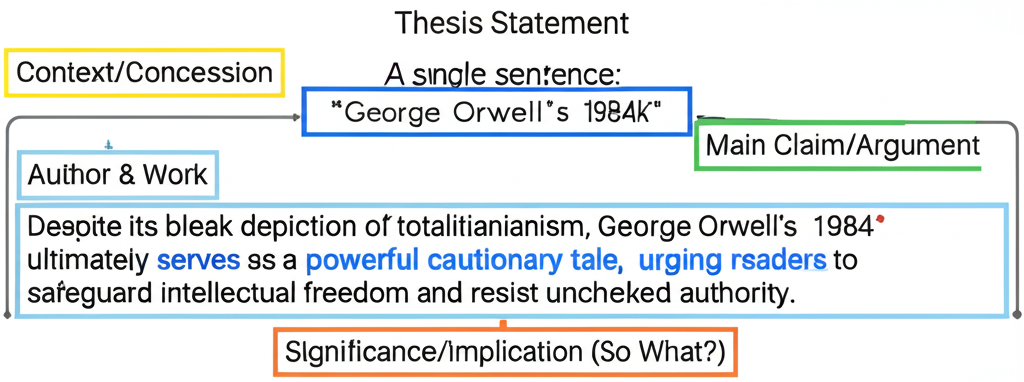
Claim / Thesis Statement
The central argument or main point of an essay, usually stated in one clear sentence in the introduction. E.g., "Atticus Finch's unwavering moral integrity serves as the ethical compass of To Kill a Mockingbird."
Evidence
Facts, statistics, examples, expert opinions, or textual details used to support a claim. E.g., Atticus's defense of Tom Robinson despite social pressure.
Reasoning / Analysis
The explanation of how and why the evidence supports the claim; it connects the dots for the reader. Answers the "so what?" question.
Counterargument
An opposing viewpoint or objection to the main argument. E.g., "Some might argue that Atticus's defense of Tom Robinson was ultimately unsuccessful."
Rebuttal
The response to a counterargument, demonstrating why the original argument is still valid or stronger. E.g., "However, Atticus's defense exposed deep-seated prejudice, planting seeds of doubt."
Transition
Words or phrases that connect ideas, sentences, and paragraphs, ensuring smooth flow. E.g., "Therefore," "In contrast," "Additionally," "However."
Rhetorical Appeals
Ethos
Appeal to credibility or character. The writer establishes themselves as trustworthy and knowledgeable. E.g., a doctor recommending a vaccine uses their medical expertise.
Pathos
Appeal to emotion. The writer evokes feelings in the audience to persuade them. E.g., an animal shelter commercial showing sad, neglected puppies.
Logos
Appeal to logic or reason. The writer uses facts, statistics, and logical arguments. E.g., a politician presenting economic data to support a policy.
Rhetorical Devices
Rhetorical Question
A question asked for effect or to make a point, rather than to elicit a direct answer. E.g., "Can we truly stand by while injustice prevails?"
Parallelism
The use of similar grammatical structures to express related ideas, creating rhythm and emphasis. E.g., "It was the best of times, it was the worst of times..."
Repetition
The repeating of a word or phrase for emphasis or rhythm. E.g., "I have a dream... I have a dream... I have a dream..." (Martin Luther King Jr.)
Anaphora
A specific type of repetition where a word or phrase is repeated at the beginning of successive clauses. E.g., "We shall fight on the beaches, we shall fight on the landing grounds..." (Churchill)
Antithesis
The juxtaposition of contrasting ideas, often in balanced phrases or clauses, to highlight their opposition. E.g., "Man proposes, God disposes."
Tone
The writer's attitude toward the subject and audience, conveyed through word choice and style. Tone shapes how the argument is perceived by the reader.
Grammar Essentials
Comma Splice
An error where two independent clauses are joined only by a comma. E.g., "The dog barked, the cat hissed." (Incorrect)
Run-on Sentence
An error where two or more independent clauses are joined without proper punctuation or conjunctions. E.g., "The dog barked the cat hissed the bird flew away." (Incorrect)
3Foundations of Persuasion: Claim, Evidence, Reasoning
The heart of any strong argument lies in its foundational structure: a clear claim, supported by relevant evidence, and explained through sound reasoning. The Claim-Evidence-Reasoning (C-E-R) framework is your blueprint for building a compelling argument.
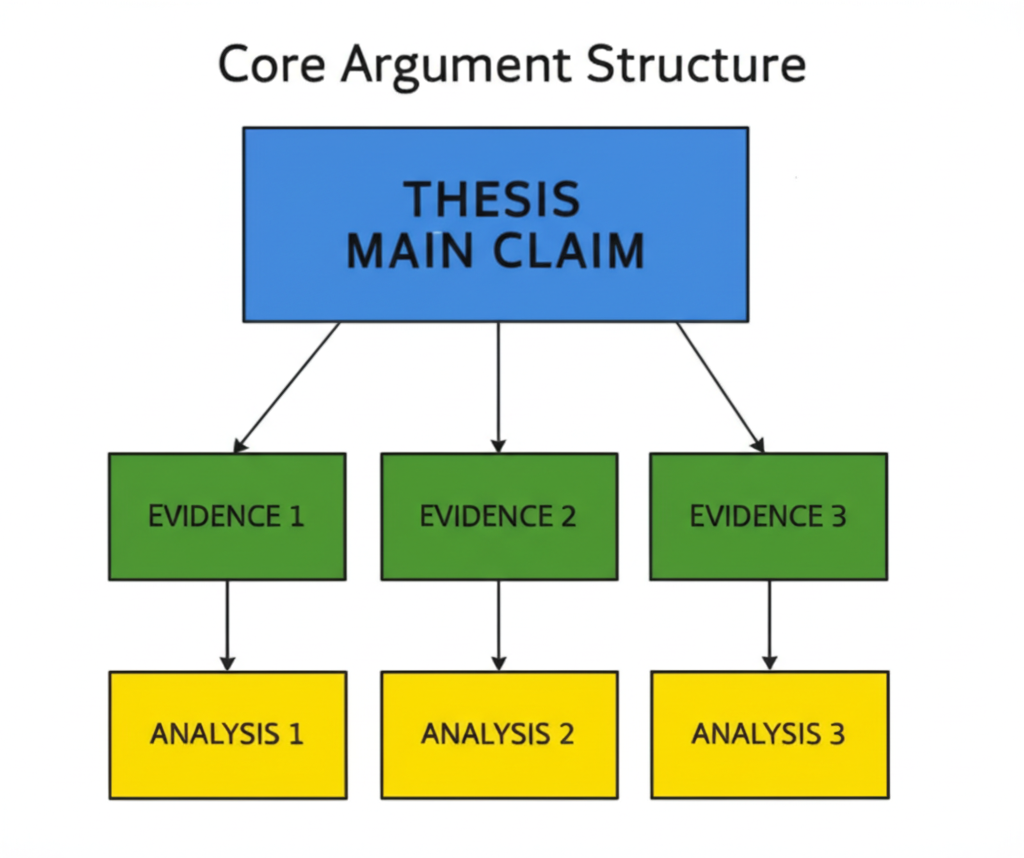
Step-by-Step: Applying the C-E-R Framework
1. Formulate a Clear Claim
What specific point are you trying to prove? This should be debatable, not just a fact. For a paragraph, this is your topic sentence. For an essay, it's your thesis statement.
2. Gather Relevant Evidence
Find specific details, quotes, facts, or data from the text or source that directly support your claim. Don't just pick any quote; choose the strongest evidence that illustrates your point.
3. Provide Thorough Reasoning / Analysis
Explain how and why your chosen evidence proves your claim. Use phrases like "This demonstrates...", "This reveals...", "The author's use of X suggests...", "This is significant because..."
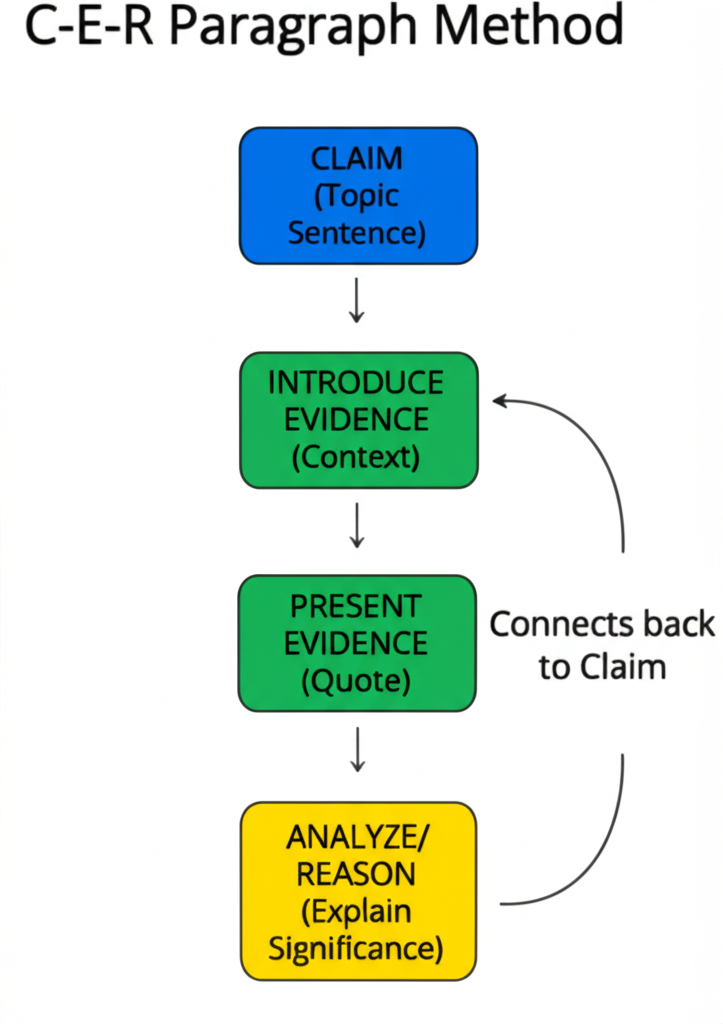
Example from Literature
Claim
In William Golding's Lord of the Flies, Jack's descent into savagery is largely fueled by his desire for power and control, which he achieves by manipulating the boys' primal fears.
Evidence
When Jack declares, "I gave you food... I gave you meat!" (Lord of the Flies, Ch. 8), he is asserting his dominance after a successful hunt.
Reasoning
This declaration highlights Jack's cunning use of basic needs to secure loyalty. By providing meat, Jack satisfies a fundamental, immediate desire, contrasting with Ralph's focus on long-term goals like shelter and rescue. Jack's emphasis on "I gave you" underscores his individual power and the boys' dependence on him, effectively solidifying his tyrannical control through a primitive form of patronage and fear-mongering.
"How much evidence do I need?" Enough to fully support your claim, usually 1-2 strong pieces per paragraph. "Is summarizing the same as reasoning?" No! Summarizing just tells what happened. Reasoning explains why it matters and how it supports your argument.
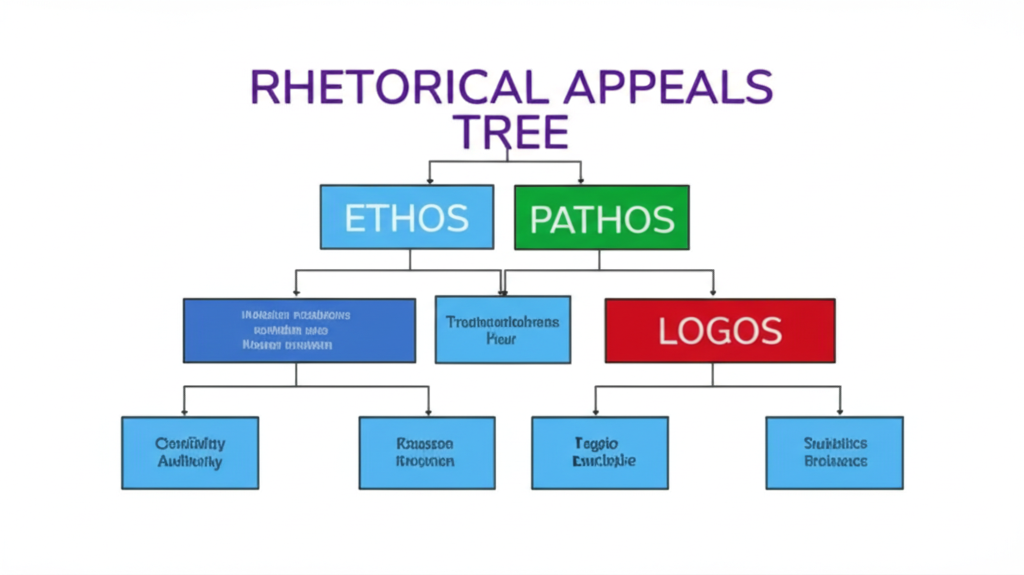
4Rhetorical Appeals: Ethos, Pathos, Logos
Effective persuasive writing doesn't just present facts; it strategically engages the audience through rhetorical appeals. These are powerful tools to influence belief and action.
A. Ethos (Appeal to Credibility / Character)
Establishes the writer's or speaker's trustworthiness, authority, or expertise. It makes the audience believe you know what you're talking about and are reliable.
In To Kill a Mockingbird: Atticus Finch embodies ethos. His calm demeanor, legal knowledge, and unwavering moral compass make him a credible voice of reason. When he advises Scout, "You never really understand a person until you consider things from his point of view," his words carry weight because he consistently lives by this principle.
B. Pathos (Appeal to Emotion)
Evokes an emotional response (sympathy, anger, fear, joy, hope) in the audience to sway their opinion. Uses vivid imagery, anecdotes, and figurative language to heighten emotional impact.
In Julius Caesar: Mark Antony's funeral oration masterfully uses pathos. He repeatedly calls Brutus and the conspirators "honourable men" while showing Caesar's wounds and reading his will, slowly turning the crowd's grief into rage. His line, "If you have tears, prepare to shed them now," is a direct emotional plea.
C. Logos (Appeal to Logic / Reason)
Uses facts, statistics, logical arguments, cause-and-effect reasoning, and clear evidence to convince the audience through their intellect. Includes deductive and inductive reasoning.
In 1984: The Party uses distorted logic (doublethink) to control the populace, but Winston grapples with true logos, recognizing the logical absurdities of the Party's claims. His attempts to understand the Party's motives are driven by a logical desire for truth.
Effective vs. Ineffective Use
| Technique | Effective Use | Ineffective Use |
|---|---|---|
| Ethos | "As a biologist with 20 years of research experience, I can confirm these findings are consistent with current scientific understanding." | "Trust me, I know what I'm talking about because I've read a few articles online." |
| Pathos | "Imagine a child, no older than yourself, forced to work instead of attending school, their future stolen before it even begins." | "You should feel bad for these people because they're sad." |
| Logos | "Studies show that communities with well-funded after-school programs experience a 30% reduction in juvenile crime rates." | "Everyone knows that after-school programs are good for kids, so we should fund them." |
AP English Language: Rhetorical analysis is a core skill for the AP exam. SAT Reading/Writing: Understanding appeals helps identify author's purpose. State ELA Exams: Many tests require identifying persuasive techniques and analyzing arguments.
5Analysis & Critical Thinking
To truly master persuasive writing, you must not only construct arguments but also critically analyze them — both your own and those of others. This means moving beyond simply summarizing to a deeper understanding of how and why arguments work.
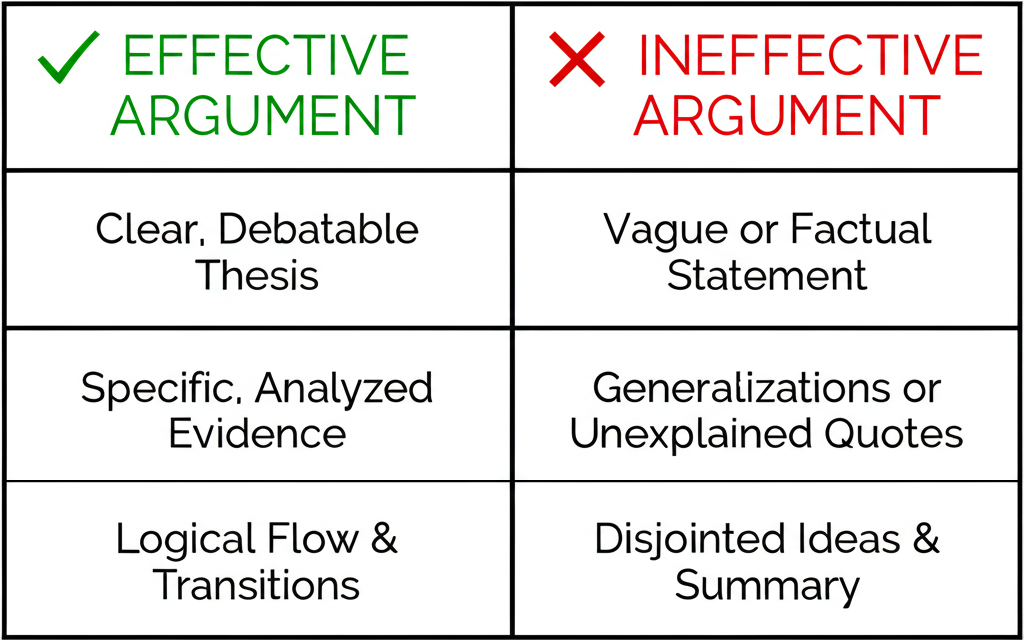
How to Think Critically
Question Everything
Don't accept claims at face value. Ask: "Is this claim supported?" "What evidence is missing?" "What assumptions is the author making?"
Identify Bias
Consider the author's background, purpose, and potential biases. How might these influence their argument?
Evaluate Evidence
Is the evidence credible, sufficient, and relevant? Is it presented fairly, or is it cherry-picked?
Unpack Reasoning
Does the logic hold up? Are there any logical fallacies (e.g., ad hominem, straw man, hasty generalization)?
Surface-Level vs. Deep Analysis
Surface-Level (Weak)
"The author uses a statistic."
Simply identifies the technique without explaining its effect.
Deep Analysis (Strong)
"The author uses the statistic '75% of voters support...' to establish logos, implying broad public consensus and thus pressuring the audience to conform to the majority opinion, even without directly addressing the policy's merits."
Explains why and how the technique persuades.
How to Select, Introduce, and Analyze Quotations
Selection
Choose quotes that are concise, impactful, and directly relevant to your point. Don't use long quotes if only a few words are crucial.
Introduction (Context)
Never "drop" a quote. Introduce it by providing context: who is speaking, when, and under what circumstances.
Analysis (Explanation)
After the quote, explain its meaning, its implications, and how it supports your argument. This is the most crucial part!
Quote Integration: Right vs. Wrong
Wrong (Quote Dropped)
"He said, 'All animals are equal.'"
Correct (With Context)
"In the early days of the revolution, the pigs declared a founding principle: 'All animals are equal' (Animal Farm, Ch. 1)."
In F. Scott Fitzgerald's The Great Gatsby, the green light across the bay functions as a potent symbol of Gatsby's elusive American Dream. Gatsby's nightly ritual of "stretching out his arms toward the dark water in a curious way" and gazing at "a single green light, minute and far away" reveals his profound yearning. The "minute and far away" description emphasizes the psychological distance between Gatsby's current reality and his idealized vision, highlighting the inherent futility of chasing a past that can never truly be recaptured.
6Putting It All Together
Persuasive and argumentative writing connects to nearly every other ELA skill. Understanding how all the pieces fit together is essential for mastering timed essays and real-world communication.
Connections to Other ELA Skills
Reading Comprehension
Understanding an author's argument requires strong comprehension of both explicit and implicit meaning.
Literary Analysis
Analyzing how authors use persuasive techniques (rhetoric, symbolism, characterization) to convey themes.
Research Skills
Finding credible evidence to support your own arguments from reliable sources.
Vocabulary & Grammar
Using precise language and correct grammar enhances your credibility (ethos) and argument clarity.
Strategies for Timed Writing and Exams
1. Deconstruct the Prompt
Identify keywords, the task (analyze, argue, compare), and any specific texts or concepts required.
2. Brainstorm & Outline
Quickly jot down your thesis, main points (topic sentences), and key evidence for each. A brief outline saves time and ensures coherence.
3. Prioritize C-E-R
For each paragraph, ensure you have a clear claim, relevant evidence, and robust analysis.
4. Manage Time
Allocate specific times for planning, drafting, and revising. Don't spend too long on any one paragraph.
5. Conclude Effectively
Briefly restate your thesis in new words and offer a concluding thought that extends beyond the essay's scope.
Self-Assessment Checklist
- ✓Thesis Statement: Is it clear, debatable, and does it address the prompt?
- ✓Topic Sentences: Does each paragraph begin with a clear topic sentence that supports the thesis?
- ✓Evidence: Is there specific, relevant textual evidence for each point? Is it properly introduced and cited?
- ✓Analysis: Does the analysis explain how and why the evidence supports the claim?
- ✓Rhetorical Appeals: Have you effectively used ethos, pathos, and logos where appropriate?
- ✓Counterargument/Rebuttal: Is an opposing view acknowledged and effectively countered?
- ✓Grammar/Mechanics: Are there minimal errors in spelling, punctuation, and sentence structure?
7Worked Examples
Example 1: Identifying Claim and Evidence
Read the following statement and identify the main claim and the piece of evidence used to support it.
Step 1: "Atticus Finch's unwavering moral integrity serves as the ethical compass of To Kill a Mockingbird, guiding both his children and the reader towards a deeper understanding of justice" = Claim
Step 2: "he defends Tom Robinson despite intense social pressure" = Evidence
Key Insight: Every strong argument begins with a clear claim supported by specific evidence.
Example 2: Crafting an Effective Thesis Statement
For an essay discussing the role of fate vs. free will in Shakespeare's Romeo and Juliet, write a concise and arguable thesis statement.
Step 1 — Brainstorm: "Romeo and Juliet die." (Too factual). "Fate causes their deaths." (Too simplistic). "Their choices lead to their deaths." (Also simplistic). Need a more nuanced, arguable position.
Step 2 — Refined thesis: "While external forces and societal pressures appear to doom Romeo and Juliet, their tragic demise is primarily a consequence of impulsive decisions, demonstrating the destructive power of individual choices rather than inevitable fate."
Key Insight: A strong thesis statement is specific, arguable, and guides the entire essay's argument.
Example 3: Analyzing Reasoning & Formulating a Counterargument
Analyze the reasoning in this excerpt about 1984, then formulate a plausible counterargument.
Step 1 — Analyze Reasoning: The essay argues that even though Winston failed to overthrow the Party, his attempt and internal desire for individuality, despite extreme oppression, signifies an unyielding core of the human spirit. The reasoning connects his actions to the larger concept of the human spirit's resilience.
Step 2 — Counterargument: "However, one could argue that Winston's ultimate submission and betrayal in Room 101, where he truly loves Big Brother, actually demonstrates the Party's horrifying effectiveness in completely crushing the human spirit, reducing him to an obedient shell devoid of individuality."
Key Insight: Strong reasoning explains the "why" and "how," while a good counterargument challenges the validity or completeness of that reasoning.
Example 4: Identifying Rhetorical Appeals in Julius Caesar
Read Mark Antony's speech and identify how he uses both Ethos and Pathos to persuade the Roman citizens.
Ethos: Antony positions himself as neutral and respectful of the conspirators ("I come to bury Caesar, not to praise him," "under leave of Brutus"), gaining initial trust. He then builds personal credibility by emphasizing his close friendship and loyalty to Caesar.
Pathos: Antony uses direct address ("Friends, Romans, countrymen") to establish a personal connection. The repeated, increasingly ironic statement "Brutus is an honourable man" gradually transforms into a powerful emotional appeal, fostering resentment and doubt about the conspirators' motives.
Key Insight: Effective speakers and writers use ethos to build trust and pathos to connect emotionally with their audience.
Example 5: Developing a Strong Rebuttal for Lord of the Flies
Claim: Ralph's leadership, despite its eventual failure, represents humanity's innate desire for order and civilization.
Counterargument: Ralph's inability to maintain control and the boys' rapid descent into savagery prove that human nature is inherently barbaric.
Step 1 — Acknowledge: While the island's circumstances undeniably bring out the boys' primal instincts and ultimately lead to chaos, this perspective overlooks the crucial initial efforts and Ralph's persistent struggle to establish rules.
Step 2 — Rebuttal: "This initial drive to form a society, coupled with Ralph's unwavering commitment to the signal fire and democratic process, even as it crumbles, highlights that the desire for order existed. The struggle itself, characterized by Ralph's desperate attempts to cling to rationality against mounting savagery, speaks to humanity's innate, albeit sometimes fragile, inclination towards civilization."
Key Insight: A rebuttal strengthens an argument by acknowledging opposing views and then demonstrating why the original claim is still more valid or nuanced.
Example 6: Constructing a Comprehensive Argument Paragraph
Thesis: Jay Gatsby's relentless pursuit of Daisy Buchanan is a fundamentally self-destructive endeavor, rooted in an idealized past that blinds him to corrupt realities.
Topic Sentence: Gatsby's entire identity becomes inextricably linked to a romanticized vision of Daisy, making his pursuit inherently self-destructive as it relies on an unattainable past.
Evidence: Fitzgerald reveals this commitment when he writes, "He had committed himself to the following of a grail" (Fitzgerald 149).
Analysis: The metaphor of the "grail" elevates Daisy from a person to a sacred, almost mythical quest, implying that Gatsby's devotion is not to the real Daisy but to an idealized symbol. This obsession forces him to build his entire life around a fantasy, leading him to engage in illicit activities and isolate himself from genuine human connection.
Counterargument & Rebuttal: While some might interpret Gatsby's unwavering dedication as a testament to profound, enduring love, this perspective overlooks the profound psychological damage and moral compromises his single-minded obsession inflicts upon him.
Key Insight: A strong argumentative paragraph integrates all components — claim, evidence, reasoning, and counterargument — to build a compelling case.
8Memory Aids
"APE for Analysis: Assert, Prove, Explain"
Assert your claim/topic sentence, Prove it with evidence, Explain your reasoning/analysis. Follow this order for every body paragraph.
"MEL-Con for Paragraphs: Main idea, Evidence, Link, Concluding sentence"
Similar to C-E-R, but adds a concluding thought to wrap up each paragraph and transition to the next.
"ELP for Rhetorical Appeals: Ethos = Legitimacy, Pathos = Emotion, Logos = Order"
Remember the three pillars of persuasion: credibility, emotion, and logic. Strong arguments use all three.
"FANBOYS for Coordinating Conjunctions: For, And, Nor, But, Or, Yet, So"
Use with a comma to join two independent clauses. This prevents comma splices and run-on sentences.
"So what?" — The question every analysis must answer.
After presenting evidence, always ask yourself "so what?" and "why is this important?" If your analysis doesn't answer these, dig deeper. Connect it to broader themes, character development, or author's purpose.
9Common Mistakes
Summarizing instead of analyzing
Don't just retell what happens in the text. After presenting evidence, explain how it proves your point and why it's significant, linking it back to your thesis.
Wrong: "Romeo sees Juliet and falls in love. He goes to her balcony." Right: "Romeo's immediate infatuation, 'Did my heart love till now?', reveals his impulsive nature, suggesting a love driven by superficial beauty rather than deep connection, foreshadowing the tragic haste of their relationship."
Writing thesis statements that are too vague or are just facts
A strong thesis is specific, debatable, and states your argument. Ask yourself: could someone reasonably disagree?
Wrong: "The Great Gatsby is a book about the American Dream." Right: "Fitzgerald critiques the hollowness of the American Dream, exposing how its pursuit can lead to moral decay and inevitable disillusionment."
Confusing theme with subject/topic
A subject is a general topic (e.g., love, war). A theme is the author's message about that topic.
Wrong: "The theme of Romeo and Juliet is love." Right: "The theme explores how impulsive love, fueled by societal feuds, can lead to devastating consequences."
Run-on sentences and comma splices
Join independent clauses correctly with a period, semicolon, or a comma + coordinating conjunction (FANBOYS).
Wrong: "The novel is complex, it explores many challenging ideas." Right: "The novel is complex; it explores many challenging ideas." OR "The novel is complex, and it explores many challenging ideas."
Dropping in quotations without introduction or analysis ("quote bombing")
Always introduce your quotes with context and follow them with thorough analysis. Never leave a quote hanging.
Wrong: "Ralph struggles for control. 'We've got to have rules and obey them.'" Right: "Early in the novel, Ralph attempts to establish order, emphatically declaring, 'We've got to have rules and obey them. After all, we're not savages.' This statement highlights Ralph's initial belief in human civility and his desperate attempt to cling to the structures of the adult world."
Confusing its/it's, their/there/they're, your/you're
Remember the rules for possessives, contractions, and homophones. If you can replace it with "it is," use it's. Otherwise, use its.
Wrong: "The dog wagged it's tail." Right: "The dog wagged its tail."
Using informal language or slang in academic writing
Maintain a formal, academic tone appropriate for high school English. Wrong: "The author totally nails the idea of power struggles." Right: "The author effectively illustrates the dynamics of power struggles."
10Quick Revision Summary
- ✓Persuasive and argumentative writing aims to convince an audience through logic, evidence, and compelling language.
- ✓A strong argument relies on a clear claim, supported by evidence, and explained by reasoning (the C-E-R framework).
- ✓Ethos appeals to credibility, pathos to emotion, and logos to logic.
- ✓Thesis statements must be specific, debatable, and serve as the roadmap for your essay.
- ✓Each body paragraph should begin with a topic sentence that supports your thesis.
- ✓Textual evidence must be properly introduced, integrated, and cited — never "quote bomb."
- ✓Analysis explains how and why evidence supports your claim — it answers "so what?"
- ✓Acknowledge and rebut counterarguments to strengthen your own position and show sophisticated thinking.
- ✓Use transitions to ensure smooth flow and logical connections between ideas.
- ✓Rhetorical devices like parallelism, repetition, anaphora, antithesis, and rhetorical questions enhance persuasion.
- ✓Pay attention to grammar and mechanics (avoid run-ons, comma splices) to maintain credibility.
- ✓Critical thinking involves questioning claims, evaluating evidence, identifying bias, and analyzing reasoning.
Frequently Asked Questions
- How do I make my thesis statement strong and not just a fact?
- A strong thesis statement needs to be debatable and specific. Instead of stating something obvious (e.g., "Romeo and Juliet fall in love"), argue a particular interpretation (e.g., "The tragic ending of Romeo and Juliet is not merely a consequence of fate, but rather a direct result of the characters' impulsive decisions and the destructive nature of their families' feud."). It should present an argument that requires evidence and analysis to prove.
- What's the difference between persuasive and argumentative writing?
- While often used interchangeably, there is a subtle distinction. Argumentative writing primarily relies on logos (logic and evidence) to present a well-reasoned case, aiming for the audience's intellectual agreement. Persuasive writing might also use logos, but it often incorporates more pathos (emotion) and ethos (credibility) to sway the audience's feelings or beliefs, sometimes even encouraging a specific action. All argumentative writing is persuasive, but not all persuasive writing is strictly argumentative in its reliance on pure logic.
- How much evidence should I include in a body paragraph?
- Typically, 1-2 strong, well-chosen pieces of evidence per body paragraph are sufficient. The key is not the quantity of evidence, but the quality and the depth of your analysis. One powerful quote thoroughly explained is far more effective than three short, unexplained quotes. Always prioritize deep analysis over simply listing evidence.
- How can I effectively incorporate counterarguments into my essay?
- Introduce a counterargument in a way that acknowledges an opposing view respectfully, often with phrases like "Some might argue that...", "Conversely, one could contend...", or "While it is true that...". After presenting the opposing view, immediately follow it with your rebuttal, explaining why that counterargument is flawed, less significant, or why your original argument still holds more weight. This demonstrates a nuanced understanding of the topic and strengthens your own credibility (ethos).
- What's the best way to improve my writing for timed exams?
- Practice outlining! Before writing, spend 5-10 minutes creating a quick outline: thesis, 2-3 main points/topic sentences, and 1-2 pieces of evidence for each point. This structure will save you time, ensure your essay is coherent, and prevent you from getting stuck. Also, practice writing full essays under timed conditions to build stamina and speed. Focus on clear claims, relevant evidence, and strong analysis.
- How do I avoid sounding repetitive in my analysis?
- Vary your sentence structure and word choice. Instead of always saying "This shows..." try "This reveals...", "This illustrates...", "The author's use of X suggests...", "This is significant because...", or "The implication here is...". Also, ensure your analysis genuinely adds new insight with each sentence, building upon the previous one rather than just rephrasing the same idea. Connect your analysis to broader themes or the author's overall purpose to deepen its impact.
Practice Quiz
Test your understanding — select the correct answer for each question.
1.What is the primary purpose of a 'rebuttal' in argumentative writing?
2.A scientist presents data from a double-blind study. Which rhetorical appeal is primarily being used?
3.Consider the example: 'Atticus Finch's unwavering moral integrity serves as the ethical compass of To Kill a Mockingbird.' This sentence best exemplifies which key term?
4.Which of the following statements best represents reasoning/analysis rather than just evidence?
5.A student argues for longer school days and acknowledges that 'some parents might worry about additional childcare costs.' What is the next crucial step?
6.Which of the following would be the strongest claim/thesis statement for an essay about recycling?
7.Phrases like 'Can we truly ignore the suffering?' or 'Is this the future we want for our children?' are examples of which rhetorical device?
8.If you primarily argued for a later curfew by showing excellent grades and responsible behavior, you would be primarily using which rhetorical appeal?
9.According to the introduction, mastering persuasive and argumentative writing is important for all of the following except:
10.What is the term for an appeal that uses facts, statistics, and logical arguments to convince an audience?
Final Study Advice
- 1.Read Widely: The more you read well-written arguments and analyses, the better your own writing will become. Pay attention to how professional writers structure their arguments.
- 2.Know Your Audience: Tailor your language, tone, and evidence to who you are trying to persuade.
- 3.Outline First: A solid outline is half the battle. It ensures your argument is logical and coherent before you even write a full sentence.
- 4.Be Specific: Vague arguments are weak arguments. Use concrete details and specific examples from texts.
- 5.Practice Under Timed Conditions: Exams reward students who can organize quickly. Spend 5-10 minutes outlining before writing.