Short Story Elements
Short story elements are the fundamental building blocks that authors use to craft compelling narratives, shaping how readers experience and understand a story. Understanding these elements transforms you from a passive reader into an active literary detective, able to dissect stories, appreciate authors' craft, and articulate your insights effectively.
This guide covers plot, conflict, character, setting, point of view, theme, symbolism, worked examples from classic literature, and a practice quiz to test your understanding.
1Introduction
Understanding short story elements is crucial because it not only leads to better grades in English class but also prepares you for college-level analysis, sharpens your critical thinking skills, and enhances your ability to communicate complex ideas. By recognizing how plot, character, setting, theme, and other elements work together, you unlock deeper meanings and gain a richer appreciation for the art of storytelling.
This guide will equip you with the foundational knowledge and practical techniques to analyze any short story with confidence and precision.
You're in a heated debate with a classmate about the ending of a short story. They insist the main character made a terrible choice, but you, armed with a deep understanding of the character's internal conflict and the story's underlying theme, can explain why that choice was inevitable and even symbolic. This isn't just about being "right" — it's about confidently making a well-supported argument, a skill invaluable in any academic or professional setting.
Every compelling short story is built on interconnected elements: plot provides structure, conflict drives the action, characters embody the struggle, setting shapes the atmosphere, point of view controls perspective, and theme delivers the deeper meaning.
2Key Definitions
Narrative Elements
Plot
The sequence of events in a story, typically including exposition, rising action, climax, falling action, and resolution.
Conflict
The struggle between opposing forces that drives the plot. Can be internal (character vs. self) or external (character vs. character, nature, society, fate).
Character
The individuals who participate in the action of a literary work. Characters can be round or flat, dynamic or static.
Setting
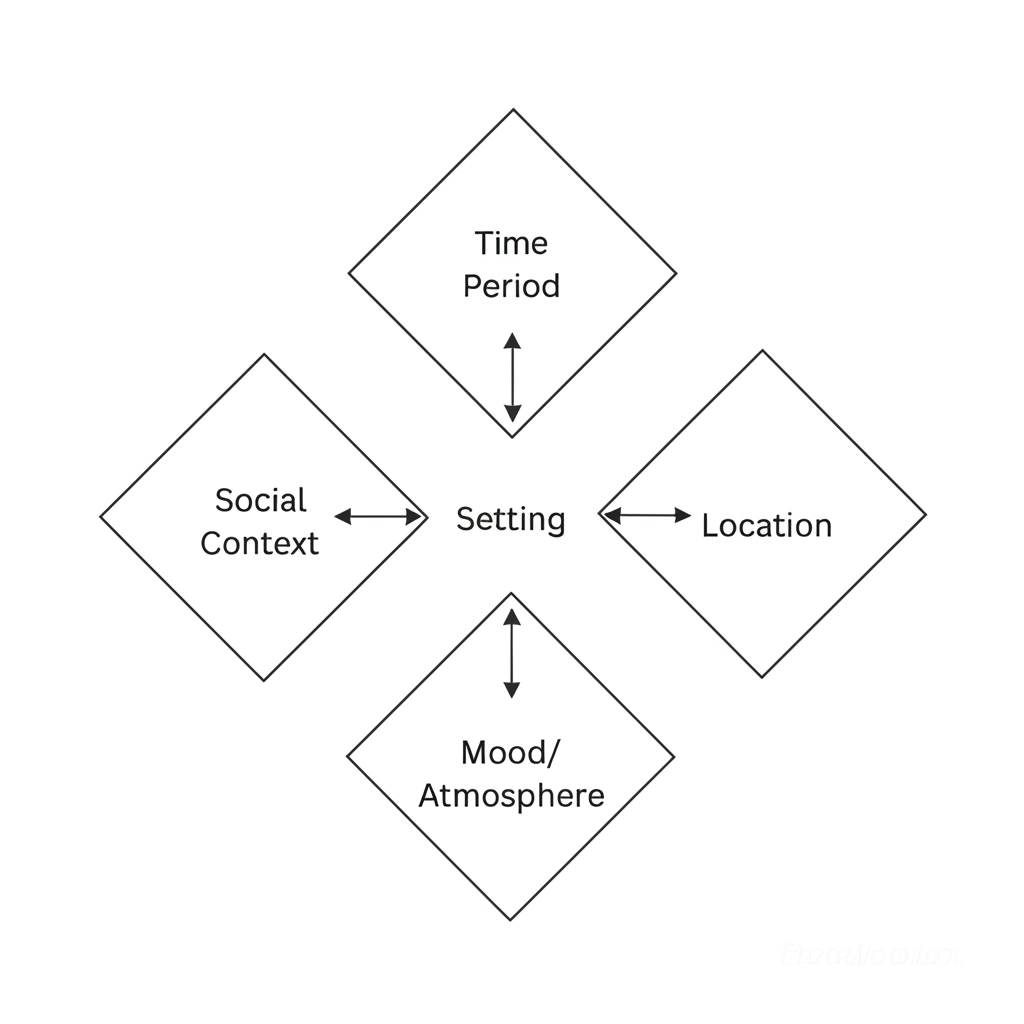
The time and place in which a story's events occur, including physical location, historical period, and social environment.
Point of View
The perspective from which a story is told: first-person ("I"), third-person limited, or third-person omniscient.
Theme
The central idea or underlying message about life, society, or human nature. A theme is a complete statement, not just a topic word.
Symbolism
The use of objects, people, or ideas to represent abstract concepts. E.g., the green light in The Great Gatsby symbolizes hope.
Character Types
Protagonist
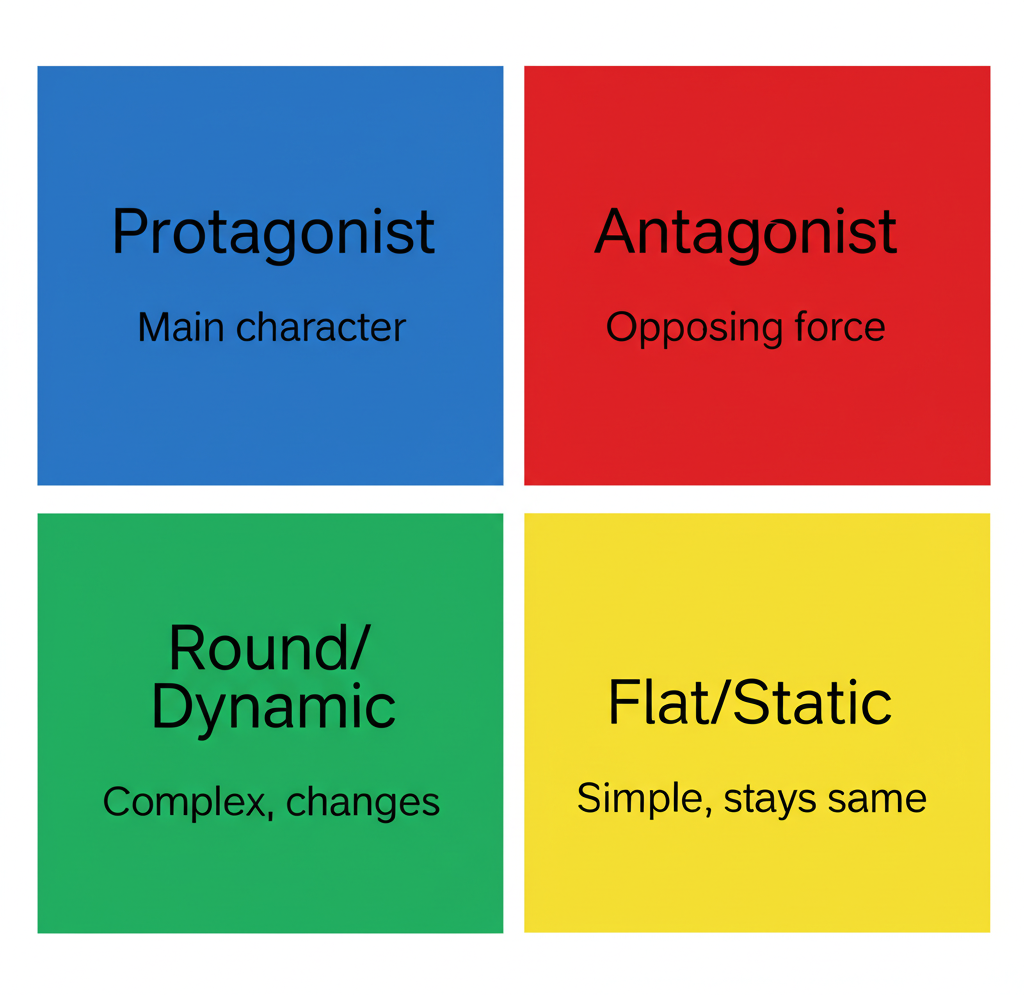
The main character who often undergoes significant change. E.g., Jay Gatsby in The Great Gatsby.
Antagonist
A character or force that opposes the protagonist, creating conflict. E.g., Tybalt in Romeo and Juliet.
Round Character
Complex and multifaceted with realistic, sometimes conflicting traits. E.g., Jay Gatsby — romantic yet deceptive.
Flat Character
Simple and one-dimensional, often serving a specific narrative purpose. E.g., minor characters like Myrtle Wilson.
Dynamic Character
Undergoes significant internal change throughout the story. E.g., Scout Finch in To Kill a Mockingbird.
Static Character
Remains largely the same throughout the story. E.g., Atticus Finch serves as a steadfast moral compass.
Literary Devices
Irony
A contrast between expectation and reality. Includes verbal, situational, and dramatic irony.
Motif
A recurring image, idea, or symbol that helps develop the theme. E.g., the conch shell in Lord of the Flies.
Foreshadowing
Hints or clues about events that will occur later. E.g., Lennie's killing of mice in Of Mice and Men.
Allusion
A brief, indirect reference to a person, place, or idea of historical or cultural significance. E.g., referring to a "Waterloo" to suggest defeat.
Imagery
Vivid descriptive language appealing to the five senses. E.g., "The crimson sunset bled across the canvas of the sky."
Figurative Language
Simile
A comparison using "like" or "as." E.g., "Her smile was as bright as the sun."
Metaphor
A direct comparison without "like" or "as." E.g., "The classroom was a zoo."
Personification
Giving human qualities to non-human things. E.g., "The wind whispered secrets through the trees."
Hyperbole
Extreme exaggeration for emphasis. E.g., "I'm so hungry I could eat a horse!"
3Plot & Conflict: The Story's Engine
The plot is the skeleton of a story — the organized sequence of events that unfolds. It's driven by conflict, the struggle that characters face, which can be internal (within a character) or external (between a character and an outside force). Understanding plot and conflict is foundational for all literary analysis.
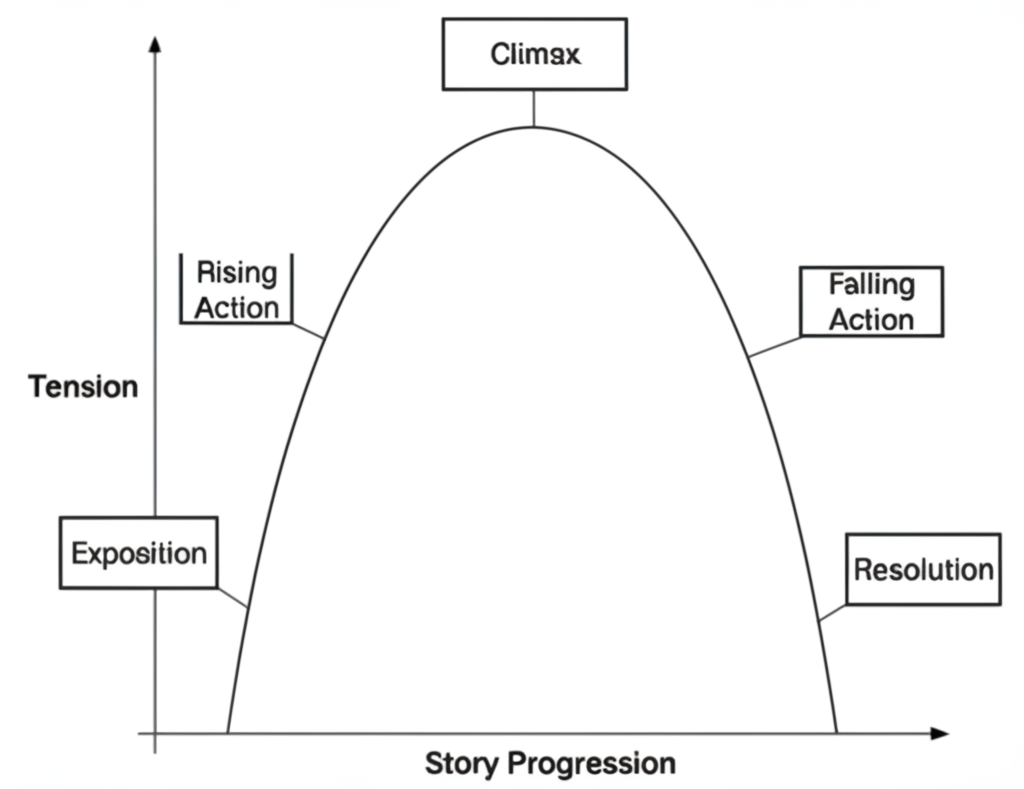
Step-by-Step: Analyzing Plot and Conflict
1. Identify the Exposition
What is the initial situation? Who are the main characters? What is the setting? What background information is provided?
2. Locate the Inciting Incident
What event kicks off the main conflict and sets the story in motion?
3. Trace the Rising Action
What series of events builds tension and complicates the plot? How does the primary conflict develop?
4. Pinpoint the Climax
What is the turning point — the moment of greatest tension or decision? The main conflict is usually confronted here.
5. Follow the Falling Action
What events occur after the climax, leading towards the resolution? How are the immediate consequences addressed?
6. Determine the Resolution
How does the story conclude? What is the final outcome of the conflict? Are loose ends tied up?
7. Identify the Main Conflict(s)
Is it internal (character vs. self) or external (character vs. character, society, nature, fate)? How does it evolve?
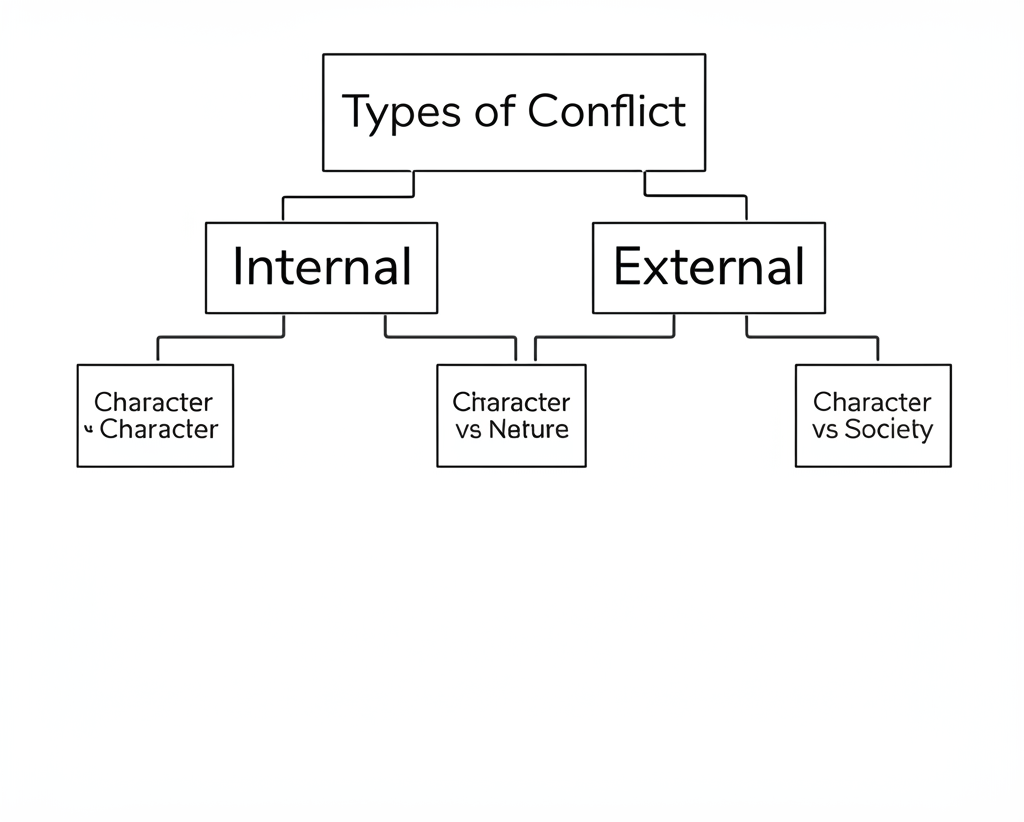
Example: Of Mice and Men by John Steinbeck
Exposition
George and Lennie, migrant workers during the Great Depression, arrive at a new ranch in California, seeking work and dreaming of owning their own land.
Rising Action
Lennie crushes Curley's hand; Candy offers his life savings for the dream farm; Curley's wife tempts Lennie; Lennie accidentally kills a puppy.
Climax
Lennie accidentally kills Curley's wife in the barn — the irreversible turning point, shattering their dream and sealing Lennie's fate.
Resolution
George, to spare Lennie a brutal death, shoots him mercifully while recounting their dream for the last time. The dream dies with Lennie.
Conflicts
External: George and Lennie vs. Society (prejudice, economic hardship). Internal: George vs. his love for Lennie and the harsh reality of their situation.
"Is the climax always the most exciting part?" Not necessarily the most exciting in terms of action, but always the moment of highest tension where the main conflict is directly confronted and the story's direction changes irreversibly. It's the point of no return.
Internal conflict is something happening inside a character's mind (a moral dilemma, a struggle with fear). External conflict is a struggle against something outside the character (another person, a storm, societal rules).
4Character & Point of View: Who Tells the Tale?
Characters are the heart of a story, and the point of view (POV) determines whose heart — or mind — we experience the story through. The author's choice of POV profoundly impacts how we understand characters, events, and themes.
Point of View Types and Their Impact
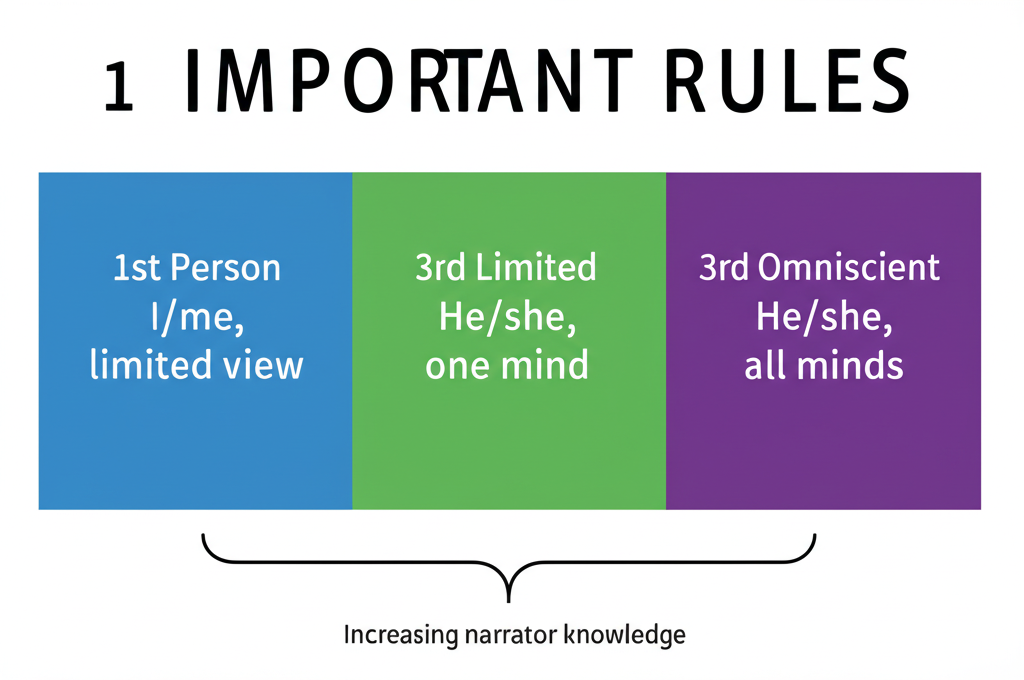
First-Person ("I")
A character within the story narrates. We see events through their eyes, hear their thoughts, and feel their emotions directly.
Examples: To Kill a Mockingbird (Scout), The Great Gatsby (Nick Carraway), "The Tell-Tale Heart" (unnamed narrator).
Creates intimacy, builds empathy, and allows for an unreliable narrator whose credibility may be compromised.
Third-Person Limited ("He/She/They" + one character's thoughts)
An outside narrator focuses on one character's experiences, thoughts, and feelings. We don't know what others are thinking.
Effect: Provides depth into one character's psychology while maintaining a sense of objective distance from others.
Third-Person Omniscient ("He/She/They" + all characters' thoughts)
An all-knowing narrator who can enter the minds of any character, move freely through time and space, and offer commentary.
Example: Lord of the Flies uses this to provide a broad view of the boys' collective decline and individual struggles.
Effective vs. Ineffective Use of POV
| POV Type | Effective Use | Ineffective Use |
|---|---|---|
| First-Person | Nick Carraway's outsider perspective in Gatsby allows deep insight and critical commentary. | A narrator who only reports facts without emotion or reflection, making the story bland. |
| Third-Person Limited | Focusing on Ralph's internal struggle in Lord of the Flies highlights the burden of leadership. | Shifting constantly between multiple limited perspectives within a single paragraph, confusing the reader. |
| Third-Person Omniscient | Revealing the inner thoughts of multiple boys in Lord of the Flies, showing collective descent into savagery. | An omniscient narrator who constantly interrupts with irrelevant personal opinions or lengthy tangents. |
POV Switch: Take a paragraph from a story you've read (e.g., a scene from To Kill a Mockingbird) and rewrite it from a different character's POV (e.g., Jem's or Calpurnia's). How does the meaning change?
5Theme & Symbolism: Uncovering Deeper Meanings
Theme is the universal message or insight a story conveys about life, while symbolism is the use of objects, people, or ideas to represent deeper, often abstract, themes. Together, they form the story's core meaning.
How to Identify Theme and Symbolism
1. Identify the Subject
What is the story about on a literal level? (e.g., love, war, coming of age, justice)
2. Formulate a Thematic Statement
What does the story say about that subject? A theme is a complete sentence, not just a word. E.g., "Love can lead to both ecstasy and destruction."
3. Spot Potential Symbols
Look for recurring objects, colors, actions, or characters that carry more weight than their literal presence. Do they appear at significant moments?
4. Connect Symbols to Theme
How does a particular symbol illustrate or reinforce a thematic idea? E.g., the mockingbird in To Kill a Mockingbird symbolizes innocence.
How to Write About Symbolism
When analyzing theme and symbolism in an essay, your goal is to explain how the author uses specific literary devices to communicate a broader message. Here's how to handle textual evidence:
Quote Bombing (Weak)
"The green light represented Gatsby's dream. 'Gatsby stretched out his arms toward the dark water in a curious way, and, far as I could see, he was trembling involuntarily.'"
Drops the quote without context or smooth integration.
Smooth Introduction (Strong)
"Fitzgerald establishes Gatsby's profound longing through the potent image of the green light, as Nick observes Gatsby 'stretched out his arms toward the dark water in a curious way, and, far as I could see, he was trembling involuntarily.'"
Integrates the quote smoothly into the writer's own sentence.
Sample Analytical Paragraph
Topic Sentence
In The Great Gatsby, the recurring motif of the green light powerfully symbolizes the elusive and ultimately corrupt nature of the American Dream.
Evidence
Fitzgerald establishes Gatsby's profound longing as Nick observes Gatsby "stretched out his arms toward the dark water in a curious way, and, far as I could see, he was trembling involuntarily."
Analysis
This poignant gesture toward the distant, shimmering light imbues it with a mystical quality, symbolizing not merely a physical object but the elusive, almost spiritual, nature of Gatsby's idealized dream and his desperate reach for a past that remains just out of grasp.
Connection to Theme
As the narrative progresses, the light's symbolic weight shifts, becoming less about pure hope and more about the unattainable quality of Gatsby's aspiration, demonstrating how the dream itself is corrupted by materialism and the past's irreversible nature.
A theme is always a complete sentence expressing an insight — not just a single word like "love" or "justice." Don't just identify a symbol; explain why the author chose that symbol and what it reveals about the human experience.
6Putting It All Together
Understanding short story elements connects to broader skills across English Language Arts. Here's how these elements tie into your overall development as a reader, writer, and thinker.
Connections to Other ELA Skills
Vocabulary & Grammar
Precisely describing literary elements requires a strong vocabulary and correct grammar.
Reading Comprehension
Identifying elements improves your understanding of any text you encounter.
Writing & Argumentation
Analyzing elements forms the basis for persuasive literary essays, where you argue your interpretation.
Rhetorical Analysis
Understanding how authors craft stories helps you analyze persuasive techniques in non-fiction.
Real-World Applications
Critical Media Literacy
You'll be able to analyze the "story" behind news articles, advertisements, movies, and political speeches, understanding how they are constructed to influence you.
Empathy & Understanding
Exploring characters' motivations and conflicts builds empathy for diverse perspectives you encounter in real life.
Effective Communication
Learning to identify and analyze narrative structures helps you craft more compelling stories, presentations, and arguments.
Strategies for Timed Writing and Exams
1. Pre-read the Prompt Carefully
Identify keywords: "analyze character development," "discuss the significance of setting," "explain how conflict drives the theme."
2. Quickly Outline
Jot down your thesis, 2-3 main points, and supporting evidence. Don't skip this step, even if it's brief.
3. Prioritize Analysis Over Summary
Don't just summarize the plot. Focus on how elements contribute to meaning. For every piece of evidence, ask "So what?"
4. Manage Your Time
Allocate specific times for planning, drafting each paragraph, and a quick revision pass.
- Is my thesis clear, arguable, and directly responsive to the prompt?
- Does each paragraph begin with a clear claim that supports the thesis?
- Is relevant textual evidence (quotes, specific examples) included?
- Does my analysis explain how evidence supports the topic sentence?
- Is the essay organized logically with clear paragraphs and transitions?
- Does the essay demonstrate sophisticated understanding of literary elements?
7Worked Examples
Example 1: Identifying Basic Plot Elements in Romeo and Juliet
Given a brief summary of the opening of Romeo and Juliet, identify the exposition, rising action, and the initial climax related to the feud.
Step 1: "In Verona, two prominent families... are locked in an ancient feud" = Exposition — the setting, characters, and core conflict are introduced.
Step 2: "Romeo and Juliet meet and instantly fall in love, beginning their secret relationship" = Rising Action — personal stakes escalate within the existing feud.
Step 3: "Tybalt recognizes Romeo at the feast and vows revenge" = Climax (initial) — directly escalating the feud's threat to the lovers.
Key Insight: Plot elements provide a structural roadmap for understanding how a story unfolds and builds tension from introduction to turning point.
Example 2: Analyzing Internal and External Conflict in Lord of the Flies
Read the following scenario and identify an example of both internal and external conflict.
Step 1 — Internal Conflict: "He felt the weight of responsibility for their survival, yet a part of him yearned to run off and play" = Ralph's struggle between his sense of duty and his primal desire for freedom and escape.
Step 2 — External Conflict: "His voice was hoarse as he tried to reason with the boys, who were increasingly drawn to Jack's hunt-obsessed group" = Ralph's struggle against the growing savagery of the other boys.
Key Insight: Conflict, whether internal or external, is the essential engine of a story, revealing character motivations and advancing the plot through opposing forces.
Example 3: Identifying Protagonist and Antagonist in The Great Gatsby
Apply the definitions of protagonist and antagonist to the central figures of The Great Gatsby.
Step 1 — Protagonist: Jay Gatsby. The entire novel revolves around his pursuit of an idealized past and his love for Daisy Buchanan. His actions, desires, and ultimately his tragic fate are the core of the story.
Step 2 — Antagonist: Tom Buchanan. He represents the established wealthy class and directly opposes Gatsby's attempts to reclaim Daisy, embodying the societal obstacles and moral corruption Gatsby faces.
Key Insight: Understanding character roles clarifies the central conflict and the driving forces behind the story's events.
Example 4: Analyzing Setting's Influence on Mood in To Kill a Mockingbird
Read this description of Maycomb, Alabama, and explain how the setting contributes to the story's mood.
Step 1 — Key Details: Physical decay ("tired old town," "sagged"), oppressive heat ("hotter then," "sweltering shade"), slow pace ("moved slowly," "no hurry"), and economic stagnation ("no money to buy it with").
Step 2 — Mood Analysis: The setting creates a pervasive mood of oppressive lethargy, stagnation, and melancholy stillness. This suggests a community deeply rooted in its traditions, resistant to progress, and perhaps passively enduring hardship — setting the tone for the ingrained social issues to be explored.
Key Insight: Setting is more than just a backdrop; it actively shapes the mood, atmosphere, and thematic concerns of a story.
Example 5: Synthesizing Internal Conflict and Societal Antagonism in 1984
Analyze how Winston Smith's internal conflict is directly a result of and exacerbated by the external conflict with the oppressive society of Oceania.
Step 1 — Internal Conflict: Winston struggles to preserve his individuality, memories, and objective truth against the Party's psychological manipulation and thought control.
Step 2 — External Conflict: Winston vs. the Party/Oceania — a totalitarian regime using constant surveillance, historical revisionism, brainwashing, and brutal violence to control every aspect of citizens' lives.
Step 3 — Synthesis: The Party's external mechanisms of control — Big Brother's omnipresent gaze, the rewriting of history, the suppression of language through Newspeak — are the direct catalysts for Winston's internal battle. His acts of writing a diary and pursuing forbidden thoughts are internal rebellions sparked by external oppression, making his mind the ultimate battleground for freedom against tyranny.
Key Insight: Internal and external conflicts are often deeply interconnected, with external forces frequently driving, intensifying, and defining the nature of a character's inner struggles.
8Memory Aids
"P.C.S.P.T.S. — Plot, Character, Setting, POV, Theme, Symbolism"
The six core short story elements. Remember: "Pretty Cool Stories Present Timeless Symbols."
"E.R.C.F.R. — Exposition, Rising action, Climax, Falling action, Resolution"
The five stages of plot structure. Think of it as a mountain: you climb up (rising action), reach the peak (climax), and come back down (falling action).
"Theme = Topic + Insight"
A theme is never just one word. It's a complete sentence that makes a claim about the topic. "Love" is a topic; "Love can lead to both ecstasy and destruction" is a theme.
"Conflict is the engine; plot is the road."
Without conflict, the story has no power to move forward. The plot is the path the conflict drives along. No engine, no journey.
"Don't just identify — analyze."
Identifying a symbol, conflict, or theme is only the first step. The real skill is explaining how it works and why it matters to the story's meaning.
9Common Mistakes
Confusing theme with topic
"Love" is a topic, not a theme. A theme is a complete statement about a topic: "Love can lead to both ecstasy and destruction." Always express themes as full sentences that convey an insight about the human experience.
Summarizing plot instead of analyzing
Don't retell what happens in the story. Instead, explain how and why specific elements create meaning. After presenting evidence, always ask "so what?" and "why does this matter?"
Dropping quotes without context or analysis
Never "quote bomb" by inserting a quote without introducing it or explaining its significance. Every piece of evidence needs a smooth introduction and your interpretation connecting it to your argument.
Calling every object a symbol without evidence
Not everything in a story is symbolic. A symbol must carry more weight than its literal presence, appear at significant moments, and connect to a thematic idea. Support your claim with textual evidence.
Misidentifying the climax
The climax is not simply the most dramatic scene — it's the turning point where the main conflict is confronted and the story's direction changes irreversibly. Look for the point of no return.
Ignoring the impact of point of view
The narrator's perspective shapes everything we know. A first-person narrator may be unreliable. Consider how a different POV would change the reader's understanding of events and characters.
Treating setting as just a backdrop
Setting actively shapes mood, influences character behavior, and reinforces themes. Always analyze how the time and place affect the story's meaning, not just where it takes place.
10Quick Revision Summary
- ✓Plot is the sequence of events: exposition, rising action, climax, falling action, resolution.
- ✓Conflict drives the plot — it can be internal (character vs. self) or external (character vs. character, society, nature, fate).
- ✓Characters can be round/flat and dynamic/static. The protagonist drives the story; the antagonist creates opposition.
- ✓Setting is time and place — it shapes mood, influences character behavior, and reinforces themes.
- ✓Point of view (first-person, third-person limited, third-person omniscient) controls what the reader knows and feels.
- ✓Theme is a complete statement about a topic — an insight about life, not just a single word.
- ✓Symbolism uses objects to represent abstract ideas. Always connect symbols to theme with textual evidence.
- ✓Know your literary devices: irony, motif, foreshadowing, allusion, imagery, figurative language.
- ✓Always analyze, don't summarize — explain how and why, not just what.
- ✓For every piece of evidence, ask "So what?" — if you can't answer it, dig deeper.
Frequently Asked Questions
- What are the main elements of a short story?
- The main elements of a short story are plot (the sequence of events), conflict (the struggle that drives the story), character (the people in the story), setting (time and place), point of view (the perspective from which the story is told), theme (the underlying message), and symbolism (objects or ideas representing deeper meanings). These elements work together to create a cohesive narrative.
- What is the difference between theme and topic in a short story?
- A topic is a single word or phrase describing what a story is about (e.g., "love," "war," "justice"). A theme is a complete statement expressing what the story says about that topic — an insight or truth about life. For example, the topic might be "loneliness," but the theme would be "Loneliness can drive people to desperate acts of connection." A theme is always a full sentence, not just a word.
- How do I identify the climax of a short story?
- The climax is the turning point of the story — the moment of greatest tension where the main conflict is directly confronted and the story's direction changes irreversibly. It is the point of no return. It is not necessarily the most exciting moment in terms of action, but rather the decisive moment that determines the outcome. Ask yourself: "After which event can nothing go back to the way it was?"
- What is the difference between first-person and third-person limited point of view?
- In first-person POV, a character within the story narrates using "I" and "me," giving direct access to their thoughts and feelings. In third-person limited, an outside narrator uses "he/she/they" but focuses on only one character's thoughts and experiences. First-person creates more intimacy and allows for unreliable narrators, while third-person limited provides depth into one character while maintaining some objective distance.
- How do I write about symbolism in a literary essay?
- To write about symbolism effectively: (1) Identify the symbol and its literal role in the story. (2) Explain what abstract concept it represents. (3) Provide textual evidence — a specific quote showing the symbol in action. (4) Analyze how the symbol reinforces the story's theme. Always connect the symbol back to the author's broader message rather than simply stating what it represents.
- What is the difference between a round character and a flat character?
- A round character is complex and multifaceted, with realistic, sometimes conflicting traits — like Jay Gatsby, who is both romantic and deceptive. A flat character is simple and one-dimensional, often serving a specific narrative purpose without much depth. Round characters feel like real people, while flat characters are more like archetypes or tools in the story.
- How does setting affect the mood of a story?
- Setting shapes mood through descriptive details about time, place, weather, and atmosphere. For example, in To Kill a Mockingbird, the oppressive heat and slow pace of Maycomb create a mood of lethargy and stagnation that mirrors the town's resistance to change. Authors carefully choose setting details to evoke specific emotional responses in readers and reinforce thematic concerns.
Practice Quiz
Test your understanding — select the correct answer for each question.
1.What is the sequence of events in a story, typically including exposition, rising action, climax, falling action, and resolution?
2.The article states, 'Internal conflict in Lord of the Flies is Ralph's struggle to maintain civility amidst the group's descent into savagery.' Which type of conflict best describes Ralph's struggle?
3.A student writes, 'The story is told in third-person limited because the narrator knows what all the characters are thinking and feeling.' What is the error in this statement?
4.Which statement accurately describes the relationship between a protagonist and an antagonist?
5.The article describes the setting of 1984 as 'The oppressive, surveillance-ridden London of 1984.' Beyond just the physical location, what other aspects of setting are highlighted here?
6.According to the introduction, understanding short story elements transforms a reader from passive to active by enabling them to do what?
7.A student argues that Tybalt in Romeo and Juliet is the protagonist because he drives much of the action early in the play. Why is this an incorrect identification?
8.A student writes: 'The story was interesting. The main character had a big problem inside his head, and he also fought with a mean guy.' Which revision best clarifies the elements described?
9.If a story describes a character using 'he' or 'she' and reveals the thoughts and feelings of all major characters, which point of view is being used?
10.Beyond getting better grades, what is another significant benefit of understanding short story elements mentioned in the introduction?
Final Study Advice
- 1.Read actively — annotate your texts! Highlight, underline, write notes in the margins, ask questions.
- 2.Discuss with peers — talking about stories helps you solidify your ideas and consider new perspectives.
- 3.Write regularly — the more you write, the more comfortable and skilled you'll become at literary analysis.
- 4.Always understand the "why" — don't just identify a symbol; explain why the author chose it and what it reveals.
- 5.Practice with timed essay prompts — exams reward students who can organize their analysis quickly and clearly.