Literary Analysis
Literary analysis is the process of examining a piece of literature to understand its deeper meaning, how it works, and what it communicates. It sharpens your critical thinking, improves your communication skills, and prepares you for college-level studies across many subjects.
This guide covers close reading, literary devices and their functions, symbolism, irony, theme identification, evidence-based analysis, worked examples from classic literature, and a practice quiz to test your understanding.
1Introduction
Literary analysis is not just about getting good grades in English class — it's a fundamental skill that sharpens your critical thinking, improves your communication skills, and prepares you for college-level studies across many subjects. It teaches you to look beyond the surface, question assumptions, and articulate complex ideas — invaluable skills in any career path or real-world situation.
This guide will break down the essential components of literary analysis, from identifying key literary devices to constructing compelling arguments in your essays. You'll learn how to read texts closely, interpret their nuances, and express your insights clearly and persuasively.
You're watching a debate, and one speaker presents compelling evidence, explains its significance, and connects it to a larger point, swaying the audience. That's literary analysis in action — understanding how arguments are built, evidence is used, and meaning is conveyed, not just in books, but in every persuasive communication you encounter.
Literary analysis is like being a detective — looking for clues the author leaves behind (literary devices, word choice, structure) to understand the bigger picture: the text's deeper meaning, themes, and purpose.
2Key Definitions
Core Literary Terms
Theme
The central idea or underlying message an author explores in a text. It's often a universal truth about life, society, or human nature.
E.g., In Lord of the Flies, a major theme is the inherent savagery of humanity when removed from civilization.
Symbol
An object, person, place, or idea that represents something else, often an abstract concept.
E.g., The green light in The Great Gatsby symbolizes Gatsby's hopes and dreams.
Motif
A recurring image, idea, sound, or action that develops or explains a theme. It's a pattern that reveals deeper meaning.
E.g., Recurring imagery of eyes and vision in The Great Gatsby represents judgment and moral blindness.
Allusion
A brief, indirect reference to a person, place, thing, or idea of historical, cultural, literary, or political significance.
E.g., Calling someone a "Scrooge" alludes to Dickens' miserly character.
Foreshadowing
Hints or clues given by the author about events that will happen later in the story.
E.g., In Romeo and Juliet, Romeo's dream about his own death before the Capulet feast.
Imagery
Language that appeals to the five senses (sight, sound, smell, taste, touch), creating vivid descriptions in the reader's mind.
E.g., "The morning wind forever blows, the poem of the world forever goes."
Types of Irony
Verbal Irony
Saying the opposite of what you mean (sarcasm is a common form).
E.g., "What lovely weather!" during a downpour.
Situational Irony
When the outcome of a situation is contrary to what was expected.
E.g., A fire station burning down.
Dramatic Irony
When the audience knows something a character does not, creating tension.
E.g., The audience knows Juliet is alive when Romeo finds her.
Narrative Elements
Protagonist
The main character of the story, often the central figure around whom the plot revolves.
E.g., Scout Finch in To Kill a Mockingbird.
Antagonist
The character or force that opposes the protagonist, creating conflict.
E.g., Bob Ewell in To Kill a Mockingbird.
Conflict
The struggle between opposing forces that drives the plot. Can be internal (character vs. self) or external (character vs. character, nature, or society).
Narrator / Point of View
The perspective from which the story is told: First person ("I"), Third person limited (one character's thoughts), or Third person omniscient (all-knowing).
Figurative Language
Simile
A comparison using "like" or "as." E.g., "He fought like a lion."
Metaphor
A direct comparison without "like" or "as." E.g., "All the world's a stage."
Personification
Giving human qualities to non-human things. E.g., "The wind whispered secrets."
Hyperbole
Exaggeration for effect. E.g., "I'm so hungry I could eat a horse."
Rhetorical Devices
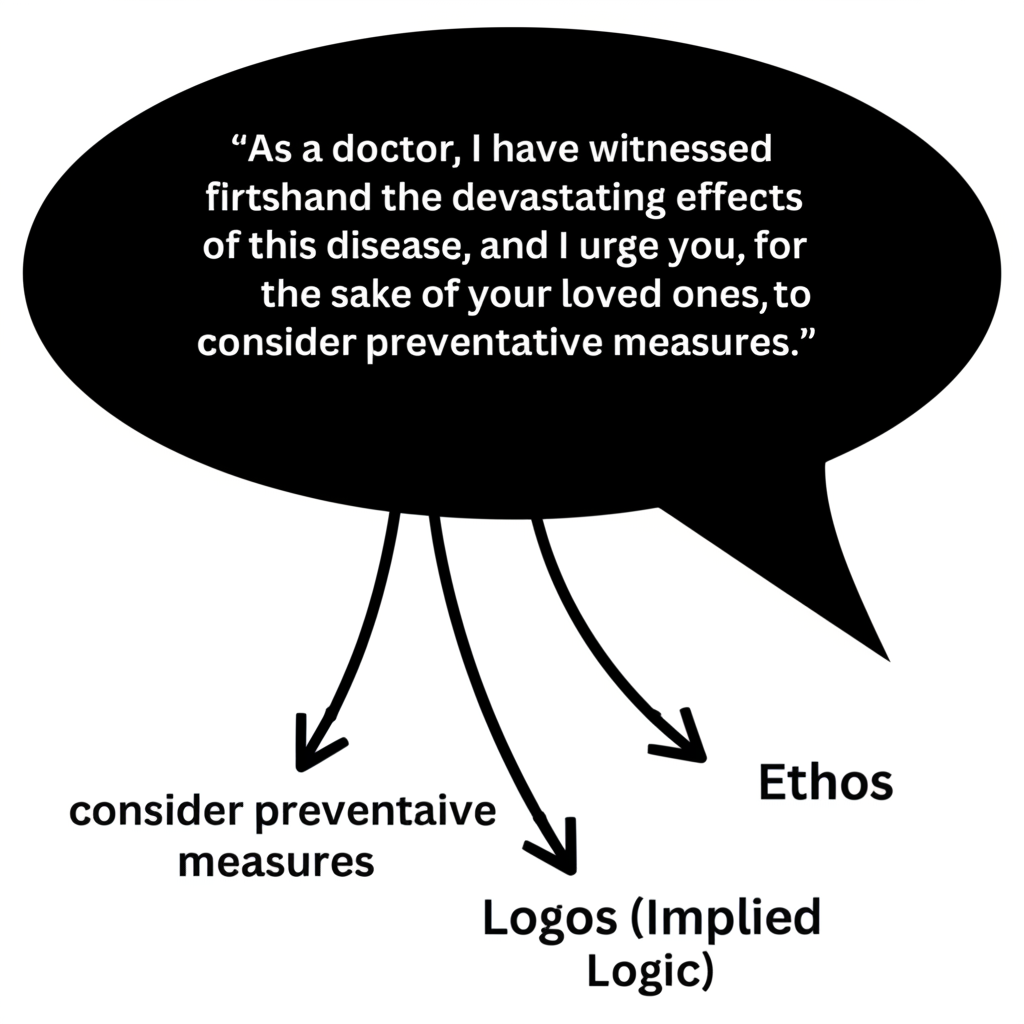
Ethos
Appeal to credibility or authority. E.g., A doctor recommending a treatment.
Pathos
Appeal to emotion, designed to evoke feelings in the audience.
Logos
Appeal to logic and reason, using facts, statistics, and rational arguments.
Additional Rhetorical Techniques
Rhetorical Question
A question asked for effect, not to elicit an answer. E.g., "Are we to stand by idly while injustice prevails?"
Parallelism
Similar grammatical constructions to express related ideas. E.g., "It was the best of times, it was the worst of times..."
Anaphora
Repetition of a word or phrase at the beginning of successive clauses. E.g., "Let freedom ring from..."
Antithesis
Juxtaposition of contrasting ideas in balanced structure. E.g., "To err is human, to forgive divine."
Essay Components
Thesis Statement
The main argument or controlling idea of an essay, usually stated in one or two sentences in the introduction.
Topic Sentence
The main idea of a paragraph, usually the first sentence, which supports the overall thesis statement.
Evidence
Specific details, examples, or quotations from the text used to support a claim or argument.
Analysis
Your interpretation of how the evidence supports the claim; connects evidence to the larger argument.
Counterargument / Rebuttal
An opposing viewpoint (counterargument) and your response demonstrating why your argument is stronger (rebuttal).
3Close Reading & Observation
Close reading is the careful, thoughtful analysis of a text. It involves paying attention not just to what the text says, but how it says it — including word choice, sentence structure, literary devices, and recurring patterns. It's the foundation of all literary analysis.
Close reading is crucial for exams (identifying devices, understanding complex passages), essay writing (finding specific evidence), and developing a deeper appreciation for literature. Without it, you might summarize the plot but miss the author's message or craft.
Step-by-Step: How to Close Read
1. Read Actively
Don't just skim. Read with a pen or highlighter. Mark anything that stands out: unusual words/phrases, figurative language, repetitions, sudden shifts in tone, and questions that arise.
2. Annotate
Write notes in the margins. Ask questions: "Why this word?" "What does this image suggest?" "How does this connect to an earlier part?" "What emotion is the author trying to evoke?"
3. Identify Patterns
Look for recurring motifs, symbols, or ideas. Do certain colors, objects, or phrases appear repeatedly? What might they signify?
4. Consider the "Why"
After identifying what the author does, ask why they do it. What effect does it have on the reader? How does it contribute to the theme, character development, or plot?
Close Reading in Action
Consider this line from The Great Gatsby describing Daisy's voice:
Active Reading: "Compelled" suggests something forceful, irresistible. "Breathlessly" implies excitement, perhaps a loss of control.
Figurative Language: This is a simile — "as if I had been running." The image of running in a "high wind" evokes exhaustion, exhilaration, and being swept away by a powerful external force.
Patterns: Daisy's voice having a powerful, almost magical effect is a recurring idea in the novel.
The "Why": Fitzgerald uses this simile to show that Daisy's voice has an almost physical, irresistible power over the narrator. It suggests that the allure of what Daisy represents (wealth, beauty, the past) is overwhelming and perhaps inescapable.
"How do I know what's important to highlight?" Start with anything that seems unusual, strong, or repeated. If a sentence makes you pause or think, it's probably important. Look for literary devices explicitly.
4Identifying Literary Devices & Their Function
Identifying literary devices (like metaphors, symbols, irony, foreshadowing) is the first step. The more crucial step is understanding their function — how they contribute to the text's meaning, tone, or effect. It's not enough to just name a device; you must explain its impact.
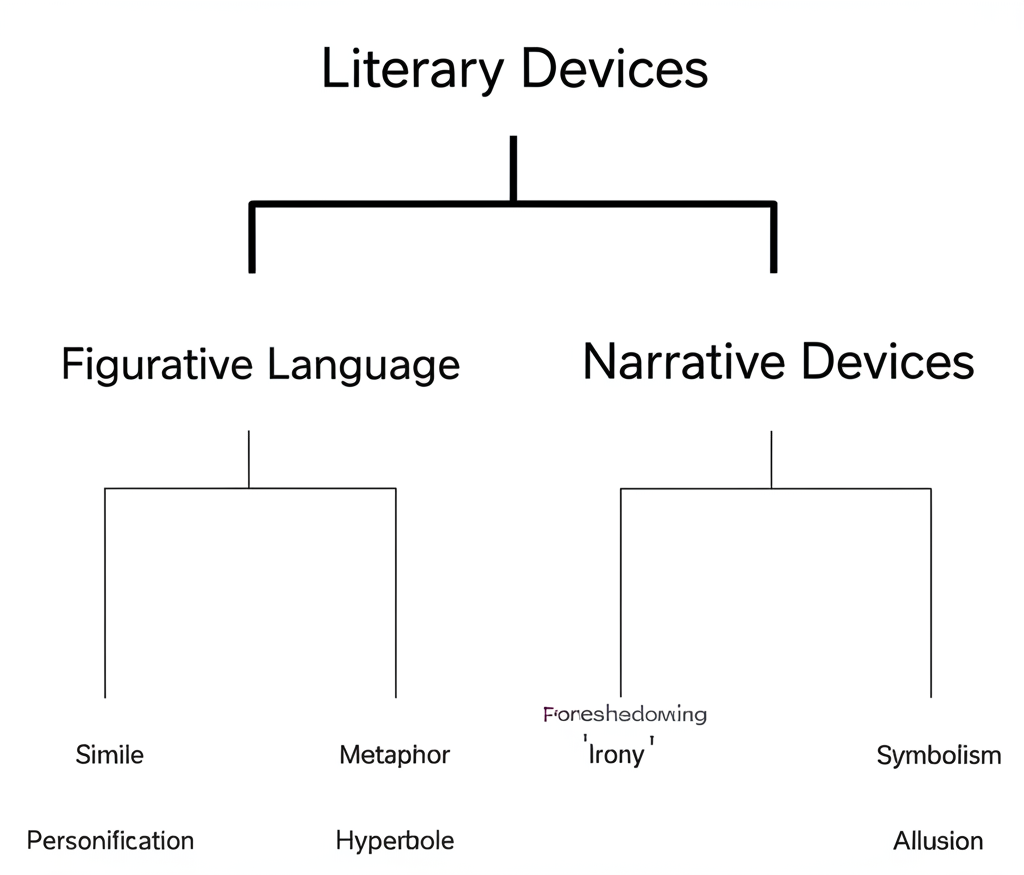
How Each Device Works
Symbolism
How it works: An object stands for a larger, often abstract, idea.
Example: In Lord of the Flies, Piggy's spectacles symbolize intellect, logic, and the power of reason.
Function: When the boys break Piggy's glasses, it symbolizes the breakdown of rational thought and the descent into savagery. Their shattering marks a critical turning point where logic loses its power.
Metaphor
How it works: Directly compares two unlike things, asserting one is the other.
Example: In Romeo and Juliet — "Juliet is the sun."
Function: Romeo uses this metaphor to convey Juliet's immense beauty, warmth, and life-giving presence. Just as the sun is central to the earth, Juliet is central to his world, elevating her to a celestial, almost divine status.
Foreshadowing
How it works: The author drops hints about future events.
Example: In Of Mice and Men, Candy's old, sick dog is shot because he's no longer useful and suffers.
Function: This foreshadows Lennie's tragic death. Just as the dog is killed when he becomes a burden, Lennie is ultimately killed by George. It primes the reader for a similar, difficult decision.
Effective vs. Ineffective Analysis
Ineffective (Just Naming)
"There is a symbol in Lord of the Flies. The conch is a symbol."
Simply identifies the device without explaining its significance or function.
Effective (Explaining Function)
"In Lord of the Flies, the conch shell symbolizes democratic order and civilized authority. Its gradual deterioration and ultimate destruction parallel the boys' descent from organized governance into savage chaos."
Names the device AND explains how it creates meaning.
Always ask: "What impact does this device have on the reader?" and "How does it deepen the text's meaning?" Identifying a device without explaining its function earns minimal credit on exams.
5Analysis & Critical Thinking
Moving from surface-level understanding (what happened) to deeper analysis (how and why it matters) involves critical thinking. This means not just identifying a literary device, but interpreting why the author used it and what effect it creates, ultimately connecting it to the text's larger meaning or theme.
How to Think Critically
Question Assumptions
Don't take anything at face value. Ask: "Is there another way to interpret this?" "What if the author intended something different?"
Look for Nuance
Avoid black-and-white thinking. Literature is often complex and ambiguous. Explore contradictions, subtle shifts, and multiple layers of meaning.
Connect the Dots
How does a specific detail relate to character development, plot, setting, or the overall theme? Think about cause and effect.
Consider Author's Purpose
What message is the author trying to convey? What comment are they making about society, human nature, or a specific issue?
Surface-Level vs. Deeper Understanding
Surface-Level (Weak)
"The green light is a symbol."
Identification only — no interpretation or connection to themes.
Deeper Understanding (Strong)
"The green light at the end of Daisy's dock symbolizes Gatsby's idealized and ultimately unreachable American Dream. Its distance and ethereal glow underscore the illusory nature of his hopes, suggesting his pursuit is founded on a romanticized vision rather than reality."
Identification + Interpretation + Connection to Theme.
Writing About Analysis in Essays
1. Claim
Start with a topic sentence that makes an arguable point about the text related to your thesis.
2. Evidence
Introduce and present specific, relevant textual evidence (quotes) that supports your claim.
3. Analysis
Explain how and why your evidence supports your claim. This is where you interpret literary devices and their effect. Don't just rephrase the quote — delve into its implications.
4. Link
Connect your analysis back to your topic sentence and, ultimately, to your overall thesis.
Using Textual Evidence
Select
Choose quotes that are concise, powerful, and directly relevant to your point. Avoid long, rambling passages.
Introduce
Don't "drop" quotes. Use signal phrases: "The narrator states," "As Shakespeare writes," "The character reveals..."
Analyze
Break down the quote. Explain significant words, identify literary devices, and connect the meaning to your argument.
Sample Analytical Paragraph
In William Golding's Lord of the Flies, the boys' descent into savagery is starkly reflected in the gradual destruction of Piggy's spectacles, which function as a powerful symbol of intellect and civilization. Initially, Piggy uses his glasses to start the signal fire, demonstrating their practical application for survival and hope. This early scene establishes the glasses as a tool of ingenuity and foresight, essential for maintaining a connection to the outside world. However, as the boys succumb to their primal instincts, Piggy's glasses are repeatedly stolen and eventually shattered. This physical violation of the spectacles directly symbolizes the boys' deliberate rejection of reason and their embrace of irrational, violent impulses. The complete destruction of the glasses signifies the tragic triumph of savagery over intellect, illustrating Golding's pessimistic view that without the structures of society, humanity's innate barbarism will prevail.
Your analysis should always answer the "so what?" question. After presenting evidence, ask yourself: "So what? Why does this matter?" If your analysis doesn't answer that, dig deeper.
6Putting It All Together
Literary analysis connects to nearly every ELA skill and extends far beyond the classroom. Here's how it all fits together.
Connections to Other ELA Skills
Writing
Literary analysis is the core of argumentative essays in ELA. It requires strong thesis statements, organized paragraphs, effective use of evidence, and clear explanations.
Vocabulary
A strong vocabulary allows you to articulate nuanced interpretations and understand sophisticated literary texts.
Grammar & Mechanics
Precise language and correct grammar are essential for clearly communicating complex analytical ideas.
Reading Comprehension
Literary analysis is advanced reading comprehension — understanding not just the plot, but the author's craft, purpose, and deeper messages.
Real-World Applications
Critical Media Literacy
Analyzing literature trains you to critically evaluate news articles, advertisements, political speeches, and social media posts. You learn to spot rhetorical strategies, underlying biases, and hidden messages.
Problem Solving
Breaking down complex texts into their components mirrors the process of dissecting real-world problems to find solutions.
Empathy & Understanding
Engaging with diverse characters and themes expands your perspective, fostering empathy and a deeper understanding of human experience.
Effective Communication
Constructing persuasive arguments with evidence and analysis directly translates to writing convincing emails, proposals, or presentations in any field.
Strategies for Timed Writing & Exams
1. Deconstruct the Prompt
Underline key terms (e.g., "analyze," "compare," "contrast," "explain how," "literary devices," "theme"). Know exactly what you're being asked.
2. Outline Quickly
Spend 5-10 minutes jotting down a thesis, 2-3 main points, and key textual evidence for each point. This prevents rambling.
3. Prioritize Analysis
In a timed setting, it's tempting to summarize. Focus your energy on explaining how the evidence supports your point and why it matters.
4. Strong Topic Sentences
Start each body paragraph with a clear topic sentence that directly supports your thesis.
5. Integrate Quotes Efficiently
Don't write out long quotes if you can embed shorter phrases. Keep evidence concise and impactful.
6. Manage Time
Allocate specific times for planning, writing the introduction, each body paragraph, and the conclusion. Leave a few minutes for proofreading.
Self-Assessment Checklist
- ✓Thesis Statement: Is it clear, arguable, and does it directly answer the prompt?
- ✓Topic Sentences: Does each paragraph start with a clear topic sentence that supports the thesis?
- ✓Evidence: Is there specific, relevant textual evidence (quotes) for each point? Is it integrated smoothly?
- ✓Analysis: Does the analysis explain how the evidence supports the topic sentence and thesis? Does it avoid summary?
- ✓Literary Devices: Have I identified relevant literary devices and explained their function and effect?
- ✓Organization: Is the essay logically structured with clear transitions between ideas and paragraphs?
- ✓Clarity & Precision: Is the language clear, precise, and free of jargon?
- ✓Conclusion: Does it effectively summarize and offer a final insight without introducing new information?
7Worked Examples
Example 1: Identifying Theme in Lord of the Flies
Read the following passage and identify a major theme it suggests.
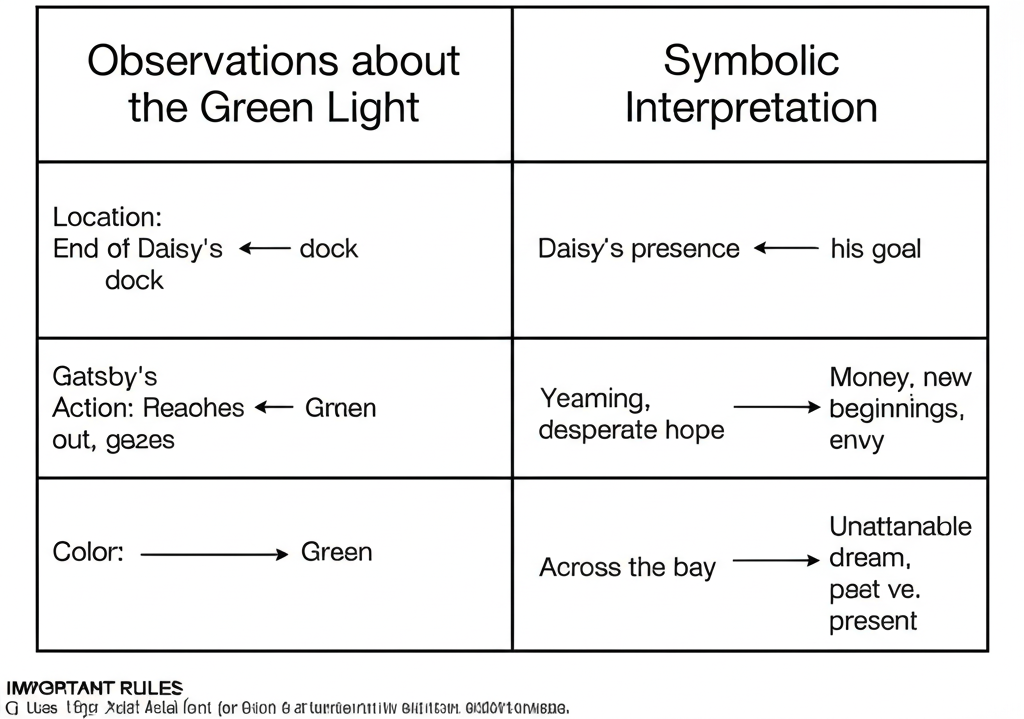
Step 1 — Identify significant objects and fates: The conch (symbol of order and democratic rule) "exploded into a thousand white fragments." Piggy (symbol of intellect and reason) is killed violently.
Step 2 — Consider the context: These events occur after the boys have been isolated from adult society and have increasingly descended into savagery under Jack's leadership.
Step 3 — Formulate the theme: A major theme is the inherent savagery of humanity when removed from civilization, and the fragility of order. Without the constraints of civilization, human beings are prone to the destruction of reason and order.
Key Insight: Themes are universal truths extrapolated from specific events and character fates within a text.
Example 2: Analyzing Symbolism in The Great Gatsby
Analyze the symbolism of the "green light" in the closing passage of The Great Gatsby.
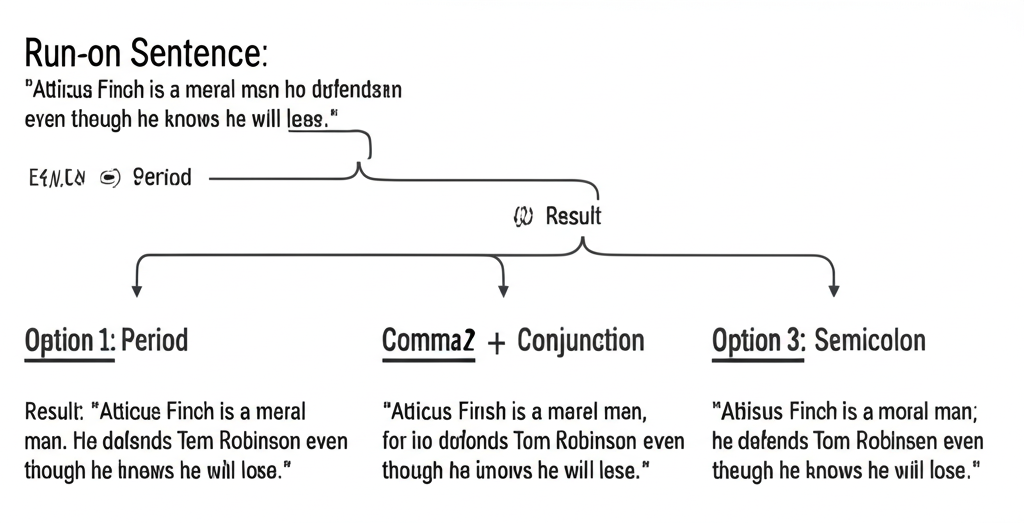
Step 1 — Identify the symbol: The "green light" at the end of Daisy's dock, across the bay from Gatsby's mansion.
Step 2 — Examine character association: Gatsby associates it with "the orgastic future" and persistent, hopeful pursuit. It represents his desire for Daisy and the past they shared.
Step 3 — Broader implications: The narrator adds that this future "recedes before us" and we are "borne back ceaselessly into the past." The green light symbolizes not just hope, but the elusive nature of the American Dream and the destructive power of idealized aspirations.
Key Insight: Symbols gain meaning through their context, character associations, and the narrative's commentary on their significance.
Example 3: Identifying Motif in The Great Gatsby
Explain how the recurring imagery of "eyes" functions as a motif, particularly referencing the "eyes of Doctor T. J. Eckleburg."
Step 1 — Identify the recurring image: The image of "eyes" appears throughout the novel, most notably Dr. T. J. Eckleburg's billboard eyes.
Step 2 — Analyze the context: The billboard eyes are in the "Valley of Ashes," a desolate wasteland. They are described as "brooding on over the solemn dumping ground," watching without intervention.
Step 3 — Connect to themes: The motif of eyes develops themes of moral judgment (or lack thereof), the loss of moral vision, and the pervasive surveillance within a decadent society. The Eckleburg eyes underscore the absence of a divine or moral authority to intervene in the characters' self-destructive pursuits.
Key Insight: Motifs are recurring patterns that, through their repetition and context, deepen understanding of a text's central themes.
Example 4: Analyzing Dramatic Irony in Romeo and Juliet
Explain the dramatic irony in the tomb scene where Romeo finds Juliet seemingly dead, but the audience knows she has taken a sleeping potion.
Step 1 — What Romeo believes: He sees Juliet's appearance and concludes she is truly dead. He resolves to die by her side.
Step 2 — What the audience knows: The audience has witnessed Friar Laurence giving Juliet a sleeping potion designed to make her appear dead for 42 hours, with the intention of reuniting her with Romeo.
Step 3 — The dramatic irony: The contrast between Romeo's tragic misunderstanding and the audience's full knowledge creates intense dramatic irony. The audience knows that if Romeo waited just a little longer, or had received the Friar's letter, the tragedy could be averted — heightening the sense of impending doom and the tragic inevitability of the lovers' fate.
Key Insight: Dramatic irony arises when the audience's superior knowledge creates a tragic or suspenseful contrast with a character's ignorance.
Example 5: Analyzing Symbolism & Theme in To Kill a Mockingbird
Analyze how the "mockingbird" functions as a symbol and contributes to a central theme, referencing Miss Maudie's explanation.
Step 1 — Determine literal characteristics: Miss Maudie describes mockingbirds as harmless creatures that "don't do one thing but make music for us." They cause no damage and only bring pleasure. Mockingbirds are innocent, benevolent beings.
Step 2 — Identify "mockingbird" characters: Tom Robinson (falsely accused and unjustly convicted) and Boo Radley (misunderstood and ostracized but ultimately saves the children) are innocent individuals harmed by society.
Step 3 — Connect to theme: The "sin to kill a mockingbird" extends to harming innocent, vulnerable individuals who do no wrong. The mockingbird symbolizes innocence, and its protection represents the theme of guarding the innocent from the destructive forces of prejudice, injustice, and societal cruelty.
Key Insight: A symbol can represent a core value or ideal, and its treatment within the narrative often reveals the central moral or thematic message of the text.
8Memory Aids
"C.E.A.L. — Claim, Evidence, Analysis, Link"
The structure of every analytical paragraph. State your claim, provide evidence, analyze it, then link it back to your thesis. Follow this order and your analysis will always be structured.
"So what?" — The question every analysis must answer.
After presenting evidence, always ask yourself "so what?" If your writing doesn't answer this question, you're summarizing, not analyzing.
"Literary analysis is detective work — you're looking for clues the author left behind."
Just like a detective examines evidence at a crime scene, you examine literary devices, word choices, and patterns to uncover the text's deeper meaning.
"Theme = Universal Truth, Symbol = Object with Deeper Meaning, Motif = Recurring Pattern"
Remember the hierarchy: themes are the big ideas, symbols are specific objects that represent those ideas, and motifs are patterns that develop or reinforce themes.
"Show, Don't Tell" — applied to analysis.
Instead of saying "the author uses good imagery," show the specific imagery and explain its effect. Always demonstrate your point with specific textual evidence.
"Ethos, Pathos, Logos — Credibility, Emotion, Logic"
The three pillars of persuasion. When analyzing rhetoric, check for all three: Does the speaker establish authority? Appeal to feelings? Use reason and evidence?
9Common Mistakes
Summarizing instead of analyzing
Don't just retell what happens in the text. Instead, explain how and why the author's choices create meaning. Summary tells the reader what happened; analysis explains how and why it matters. Always answer the "so what?" question.
Naming a literary device without explaining its function
Simply identifying "There is a metaphor here" earns minimal credit. You must explain what effect the device has on the reader and how it contributes to the text's meaning, tone, or theme.
Dropping quotes without context or analysis
Never insert a quote into your essay without introducing it with a signal phrase and following it with your interpretation. Every piece of evidence needs analysis connecting it to your argument.
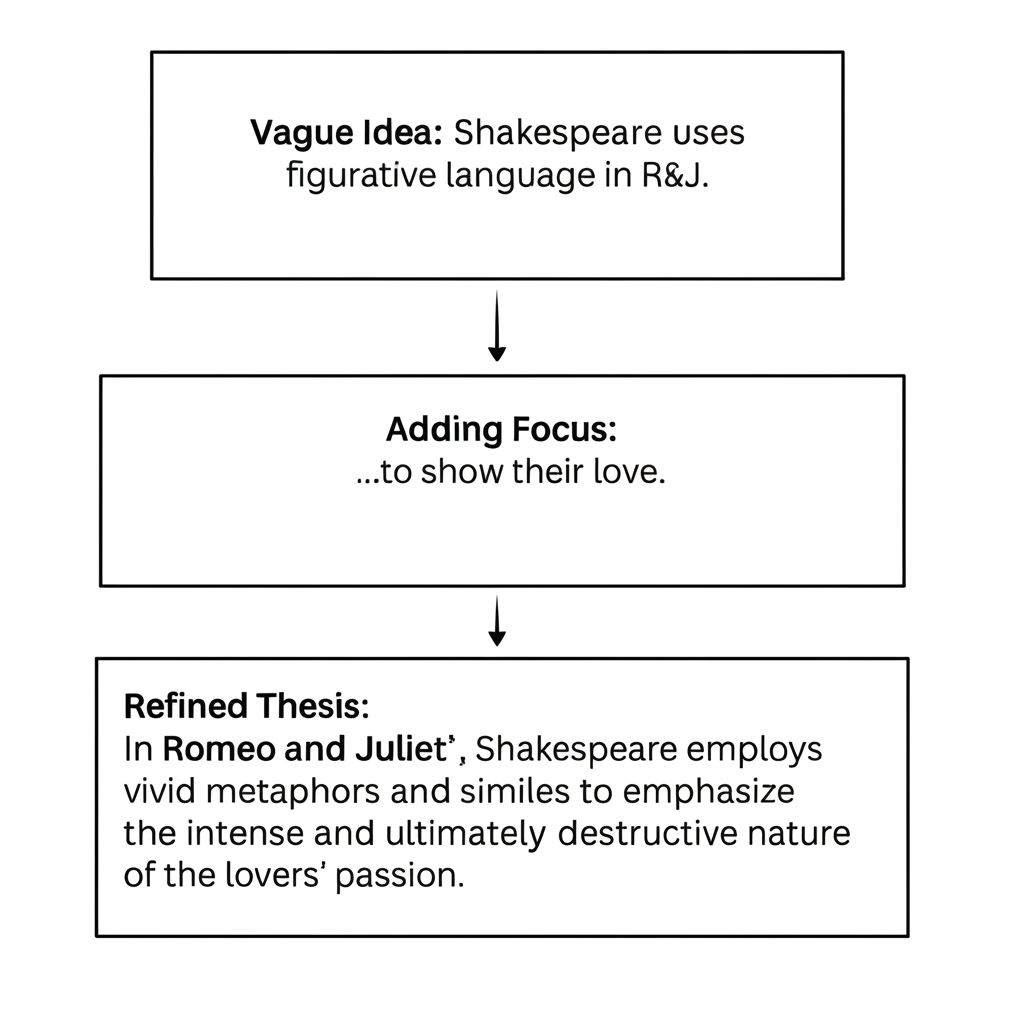
Writing a vague or factual thesis
"Shakespeare uses many literary devices" is too vague. "Romeo and Juliet is a play by Shakespeare" is just a fact. A strong thesis must be arguable, specific, and focused — stating how the author creates meaning and what effect results.
Confusing theme with topic or plot
"Love" is a topic, not a theme. "The Great Gatsby is about a man who throws parties" is plot summary. A theme is a universal truth: "The relentless pursuit of an idealized past inevitably leads to disillusionment and destruction."
Ignoring the author's craft and purpose
Don't treat literary characters as real people making independent choices. Remember that every detail is a deliberate choice by the author. Ask: "Why did the author include this? What purpose does it serve?"
Black-and-white interpretations
Literature is rarely simple. Avoid absolute statements like "This character is purely evil." Strong analysis explores nuance, contradictions, and multiple layers of meaning.
10Quick Revision Summary
- ✓Literary analysis examines how a text creates meaning, not just what it says.
- ✓Close reading is the foundation: read actively, annotate, identify patterns, and ask "why?"
- ✓A theme is a universal truth; a symbol represents an abstract idea; a motif is a recurring pattern that develops the theme.
- ✓Know the three types of irony: verbal (saying the opposite), situational (unexpected outcome), dramatic (audience knows more).
- ✓Don't just name literary devices — explain their function and effect on the reader.
- ✓Analysis answers the "so what?" question — it explains how and why evidence supports your argument.
- ✓Use the C.E.A.L. method for analytical paragraphs: Claim, Evidence, Analysis, Link.
- ✓Never leave a quote hanging — always introduce it with a signal phrase and follow it with analysis.
- ✓The three pillars of persuasion: Ethos (credibility), Pathos (emotion), Logos (logic).
- ✓Know your figurative language: simile, metaphor, personification, hyperbole.
- ✓A strong thesis is arguable, specific, focused, and provable — it states how the author creates meaning.
- ✓For exams: deconstruct the prompt, outline quickly, prioritize analysis over summary, and manage your time.
Frequently Asked Questions
- What is the difference between a theme and a motif?
- A theme is the central idea or underlying message of a text — a universal truth about life, society, or human nature (e.g., "the corrupting nature of power"). A motif is a recurring image, idea, or symbol that develops or explains a theme (e.g., the recurring imagery of eyes in The Great Gatsby reinforces the theme of moral blindness). Think of the theme as the message and the motif as a pattern that supports it.
- How do I write a strong thesis statement for a literary analysis essay?
- A strong thesis for literary analysis should be arguable (not a simple fact), specific (mentioning the author, text, and literary devices), and focused on HOW the author creates meaning. Follow this formula: [Author] uses [specific literary device(s)] in [text] to [effect/theme]. For example: "Shakespeare employs vivid metaphors and similes in Romeo and Juliet to emphasize the intense yet destructive nature of the lovers' passion."
- What is close reading and why is it important?
- Close reading is the careful, thoughtful analysis of a text, paying attention not just to what it says but how it says it — including word choice, sentence structure, literary devices, and recurring patterns. It is the foundation of all literary analysis because it allows you to find specific evidence for your arguments and understand the author's craft beyond surface-level plot summary.
- How do I analyze a quote instead of just summarizing it?
- To analyze rather than summarize, follow three steps: (1) Identify any literary devices in the quote (metaphor, symbolism, irony, etc.), (2) Explain HOW the device works — what specific words or images create the effect, and (3) Explain WHY it matters — connect it to the character's development, the theme, or your thesis. Always ask yourself "so what?" after presenting evidence.
- What are the three types of irony and how do I tell them apart?
- Verbal irony is when someone says the opposite of what they mean (like saying "Great weather!" during a storm). Situational irony is when the outcome is the opposite of what was expected (like a fire station burning down). Dramatic irony is when the audience knows something a character does not (like the audience knowing Juliet is alive when Romeo believes she is dead). The key difference is who knows what: verbal is about the speaker, situational is about events, and dramatic is about audience knowledge.
- How is literary analysis different from a book report or summary?
- A summary or book report tells WHAT happens in a text — retelling the plot, characters, and events. Literary analysis explains HOW and WHY the author creates meaning through specific techniques. Instead of saying "Gatsby reaches for the green light," analysis would explain: "The green light symbolizes the unattainable American Dream, and Gatsby's physical reaching toward it mirrors his desperate pursuit of an idealized past that can never be recaptured."
- What is the best way to integrate quotes into my analysis?
- Never "drop" a quote into your essay without context. Use signal phrases to introduce quotes smoothly (e.g., "The narrator reveals," "As Shakespeare writes," "Fitzgerald emphasizes this by stating"). Keep quotes concise — embed short, powerful phrases rather than copying long passages. Most importantly, always follow every quote with your own analysis explaining its significance.
Practice Quiz
Test your understanding — select the correct answer for each question.
1.What is the primary purpose of literary analysis according to the article?
2.Which literary term refers to 'the central idea or underlying message an author explores in a text, often a universal truth'?
3.In The Great Gatsby, the green light at the end of Daisy's dock represents Gatsby's hopes and dreams. This is an example of which literary device?
4.A recurring image of eyes and vision in a novel, which helps to develop a theme of judgment, would best be described as a:
5.If a fire station burns down, what type of irony is this an example of?
6.Romeo's dream about his own death before attending the Capulet feast is given as an example of which literary device?
7.Beyond getting good grades, which of the following is NOT listed as a key benefit of mastering literary analysis?
8.When an author describes a character as having 'the patience of Job,' they are using which literary device?
9.A student writes: 'The author uses irony when the audience knows Juliet isn't dead, but Romeo doesn't.' Which revision accurately identifies the specific type of irony?
10.Which statement correctly distinguishes between a 'theme' and a 'motif'?
Final Study Advice
- 1.Instead of saying "the author uses good imagery," show the specific imagery and explain its effect.
- 2.Read your writing aloud — it helps you catch awkward phrasing, grammatical errors, and unclear sentences.
- 3.When analyzing a device, always ask: "What impact does this have on the reader?" and "How does this deepen the text's meaning?"
- 4.Develop your analytical voice — while following academic conventions, let your unique insights shine through.
- 5.Practice, practice, practice — the more you read, annotate, and write analytical paragraphs, the better you'll become.