Poetry Fundamentals
Poetry Fundamentals is the study of the essential building blocks, techniques, and analytical approaches needed to understand, appreciate, and effectively write about poetry. Mastering these fundamentals will prepare you for college-level literary analysis, enhance your critical thinking, and deepen your appreciation for the art of language.
This guide covers poetic structure and sound, figurative language and imagery, theme, tone, and mood, worked examples from classic poetry, and a practice quiz to test your understanding.
1Introduction
Poetry is more than words arranged on a page — it is a rich art form where every word, sound, and structure is a deliberate choice. Understanding poetry fundamentals will not only lead to better grades in English and Language Arts but also sharpen your critical thinking, prepare you for college-level literary analysis, and help you communicate complex ideas with precision and power.
This guide will equip you with the tools to move beyond simply reading poems to truly understanding their intricate structures, powerful imagery, and profound messages.
You're sitting in your English class, and the teacher hands out a poem you've never seen before, asking you to analyze its meaning and techniques for an essay. Instead of feeling overwhelmed, you confidently break down its stanzas, identify its rhyme scheme, interpret its metaphors, and articulate how these elements contribute to the poem's overall message, impressing both your teacher and yourself.
Every poem is built on deliberate choices: structure (stanzas, lines, form), sound (rhyme, meter, alliteration), figurative language (simile, metaphor, personification), and meaning (theme, tone, mood). Mastering these elements unlocks any poem.
2Key Definitions
Poetic Structure
Stanza
A group of lines forming the basic recurring metrical unit in a poem; a verse. Similar to a paragraph in prose. E.g., a poem might be divided into four-line stanzas (quatrains).
Meter
The rhythmic pattern of stressed and unstressed syllables in a line of poetry. E.g., iambic pentameter (da-DUM da-DUM da-DUM da-DUM da-DUM) is common in Shakespeare.
Rhyme Scheme
The pattern of rhymes at the end of lines, denoted by letters (e.g., ABAB, AABB). Helps create musicality and structure in a poem.
Imagery
Language that appeals to the five senses (sight, sound, smell, taste, touch), creating vivid mental pictures or sensations for the reader.
Figurative Language
Simile
A comparison using "like" or "as." E.g., "O my Luve's like a red, red rose" (Robert Burns).
Metaphor
A direct comparison without "like" or "as," stating one thing is another. E.g., "All the world's a stage" (Shakespeare).
Personification
Giving human qualities to non-human things. E.g., "The wind whispered secrets through the trees."
Hyperbole
Exaggeration for emphasis or effect. E.g., "I'm so hungry I could eat a horse."
Meaning & Interpretation
Theme
The central, underlying message or insight about life that a poem explores. Expressed as a complete statement, not a single word.
Tone
The author's attitude toward the subject, revealed through word choice, imagery, and style. E.g., sarcastic, reverent, melancholic.
Mood
The emotional atmosphere the poem creates for the reader. E.g., peaceful, tense, joyful. Influenced by imagery and sensory details.
Literary & Sound Devices
Symbol
An object, person, or idea that represents something else, often abstract. E.g., the green light in The Great Gatsby symbolizes Gatsby's hopes.
Allusion
An indirect reference to a person, place, event, or literary work. E.g., calling someone a "Romeo."
Irony
A contrast between expectation and reality. Includes verbal (saying opposite of meaning), situational (unexpected outcome), and dramatic (audience knows more than character).
Motif
A recurring image, idea, or symbol that develops or explains a theme throughout a work. E.g., decay and dust imagery in The Great Gatsby.
Alliteration
Repetition of initial consonant sounds. E.g., "slippery slope." Creates musicality and draws attention to specific phrases.
Onomatopoeia
Words that imitate the sound they represent. E.g., "buzz," "hiss," "snarled." Creates vivid auditory imagery.
3Understanding Poetic Structure & Sound
Poetic structure (how a poem is organized) and sound devices (how language sounds) are not arbitrary choices — they are deliberate tools poets use to create meaning, evoke emotion, and guide the reader's experience. Recognizing and analyzing structure and sound is fundamental for close reading and forming strong arguments in essays.
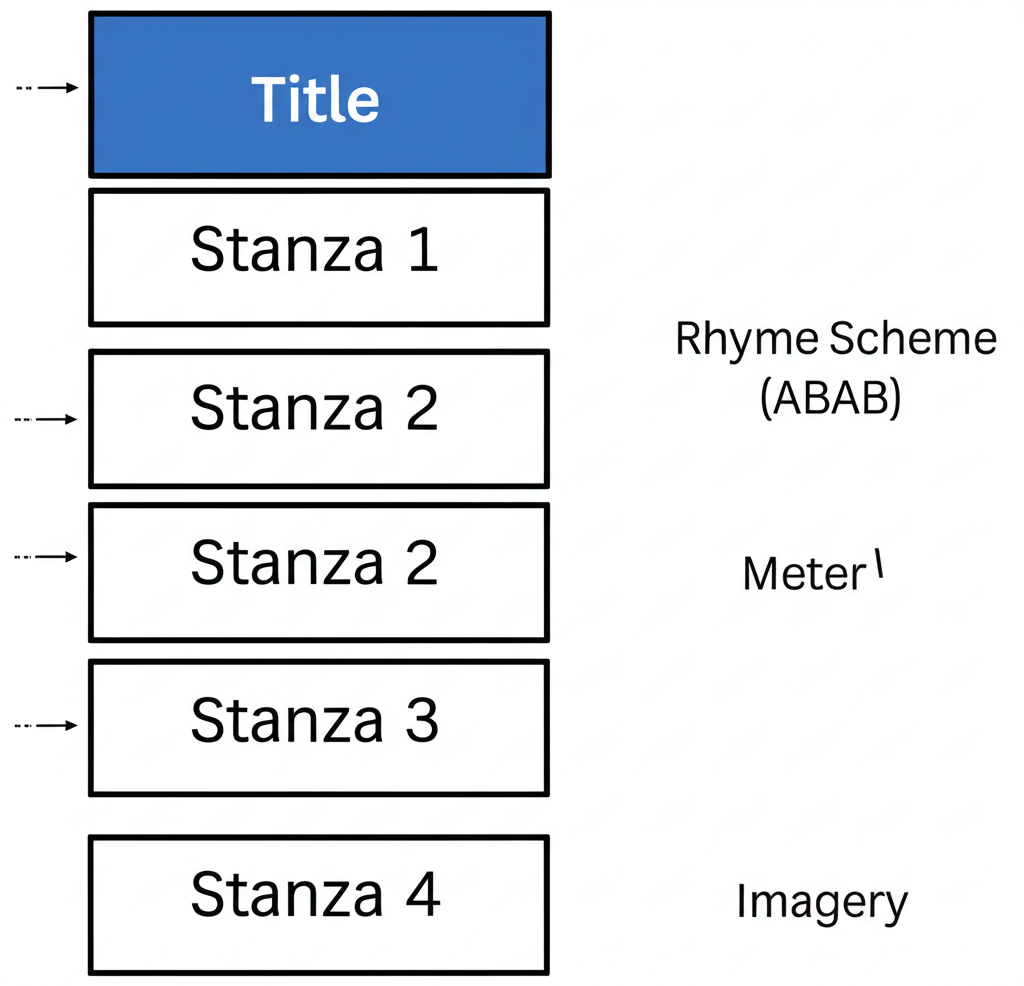
Step-by-Step: Analyzing Structure & Sound
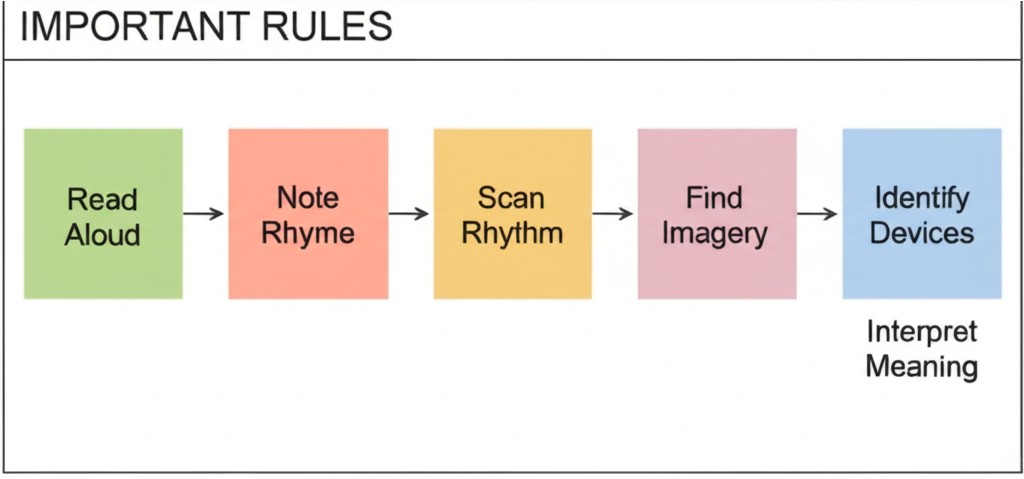
1. Read Aloud
Read the poem aloud, paying attention to rhythm, pauses, and the natural flow of words. This helps you hear sound devices and meter.
2. Identify Stanzas and Lines
Count lines per stanza. Notice if stanzas are consistent or varied. How does the visual organization affect reading?
3. Map the Rhyme Scheme
Look at the last word of each line. Assign a letter (A, B, C) to each new end sound. E.g., "cat" (A), "mat" (A), "dog" (B), "fog" (B) = AABB.
4. Listen for Meter/Rhythm
Clap out syllables or tap your foot. Are there regular patterns of stressed/unstressed syllables (da-DUM)? Is it regular meter or free verse?
5. Spot Sound Devices
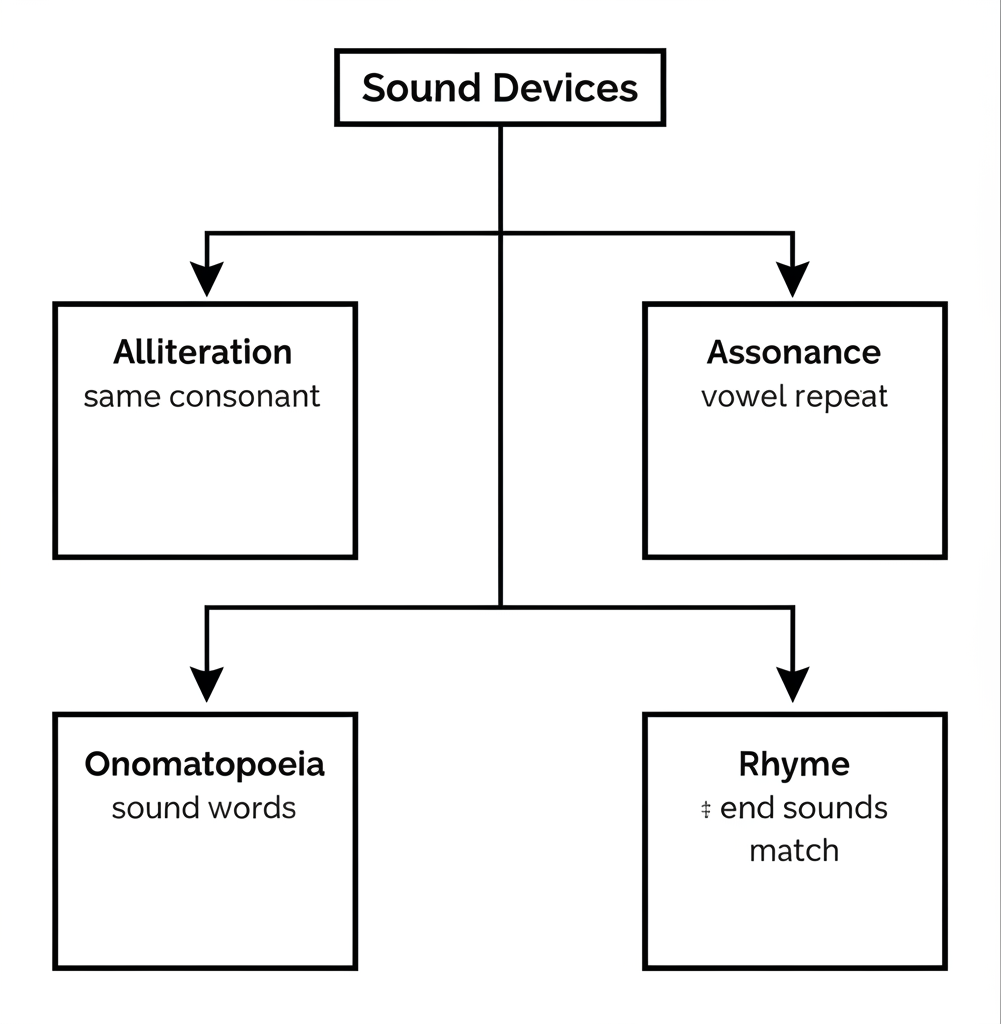
Look for alliteration (initial consonant repetition), assonance (vowel repetition), consonance (consonant repetition), and onomatopoeia (sound words).
6. Analyze the Effect
Ask: Why did the poet choose this structure or sound? How does rhyme scheme contribute to mood? How does meter create pace?
Example: Shakespeare's Sonnet 18
Thou art more lovely and more temperate: (B)
Rough winds do shake the darling buds of May, (A)
And summer's lease hath all too short a date: (B)"
Structure: A quatrain (four-line stanza). Sonnet 18 has three quatrains and a final couplet (14 lines total).
Rhyme Scheme: ABAB. The consistent, alternating rhyme creates a harmonious, pleasing sound fitting for a love poem.
Meter: Iambic Pentameter — each line has 10 syllables with alternating unstressed/stressed pattern (da-DUM). Creates a dignified, natural speaking rhythm.
Effect: The regular structure, rhyme, and meter give the poem a classical, elegant, and timeless feel, reinforcing the speaker's admiration for the beloved's enduring beauty.
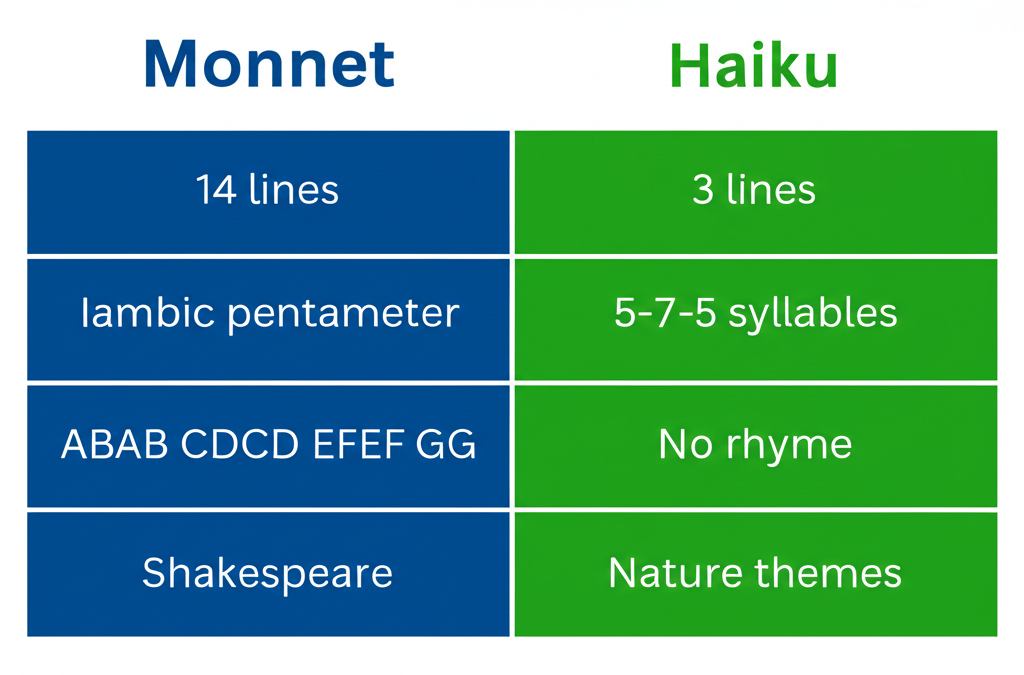
If a poem has no regular rhyme scheme, it is likely free verse. The absence of rhyme is a deliberate choice — analyze why the poet chose free verse and how it affects the poem's feel. Free verse often mimics natural speech or emphasizes content over strict form.
4Decoding Figurative Language & Imagery
Poets use figurative language and imagery to add layers of meaning, evoke strong emotions, and create memorable experiences. Identifying and analyzing these devices is a cornerstone of literary analysis — frequently tested on AP Literature, SAT Reading, and essential for sophisticated essay writing.
Imagery: Engaging the Senses
Sight
"The yellow fog that rubs its back upon the window-panes" — T.S. Eliot
Sound
"The buzz-saw snarled and rattled in the yard" — Robert Frost
Smell
"The smell of steaks in passageways" — T.S. Eliot
Touch
"The cold, hard ground beneath his feet"
Taste
"A sweet, lingering taste of honey"
Figurative Language in Action
Simile
Compares two unlike things using "like" or "as."
"O my Luve's like a red, red rose" (Robert Burns) — Compares love to a rose, suggesting beauty, freshness, and passion.
Metaphor
Directly states one thing is another, without "like" or "as."
"All the world's a stage, / And all the men and women merely players" (Shakespeare) — Implies life is a performance.
Personification
Gives human qualities or actions to non-human things.
"Because I could not stop for Death — / He kindly stopped for me —" (Emily Dickinson) — Death is personified as a polite gentleman.
Hyperbole
Exaggerates for emphasis, not meant literally.
"I've told you a million times!" — Emphasizes frustration through extreme exaggeration.
Effective vs. Ineffective Use
| Device | Weak | Strong |
|---|---|---|
| Simile | "The dog was as big as a house." (Cliche) | "The dog's bark was like a rusty hinge." (Specific, vivid) |
| Metaphor | "He was a robot." (Too simple) | "His heart was a stone in his chest." (Emotional impact) |
| Imagery | "The room was pretty." (Vague) | "The room smelled of old books and dust, with sunbeams slanting through motes in the air." |
| Analysis | "The poem uses a lot of metaphors." (No explanation) | "The metaphor 'life is a broken-winged bird' conveys the fragility of existence without dreams, emphasizing despair." |
Don't just identify figurative language — always explain how it works and why the poet chose it. Connect each device to the poem's overall meaning, tone, or theme.
5Interpreting Theme, Tone & Mood
Beyond identifying poetic devices, the ultimate goal of poetry analysis is to interpret the poem's overarching theme (its message about life), its tone (the author's attitude), and the mood it evokes in the reader. Moving from surface-level to deeper analysis means always asking "So what?" after identifying a device.
Five Steps to Interpretation
1. Read for Understanding
Understand the literal story or situation. Who is speaking? What is happening? What is the poem about on the surface?
2. Identify Key Devices
Mark up imagery, figurative language, sound devices, structure, and any shifts in language or direction.
3. Connect Devices to Tone
What feelings do the words evoke? Is the language harsh, gentle, sarcastic, reverent? Do positive or negative connotations dominate? How do sound devices contribute?
4. Connect Devices to Mood
How does the poem make you feel? Is it joyful, melancholic, suspenseful, peaceful? Mood is influenced by imagery and sensory details.
5. Synthesize to Find Theme
What big idea about life do all your observations point to? A theme is a complete statement (not just "love," but "Love can be both a source of immense joy and profound suffering").
Tone vs. Mood
Tone (Author's Attitude)
Revealed through word choice, imagery, and style. A poem about war using stark, brutal imagery might have a critical or despairing tone.
Think: How does the poet feel about the subject?
Mood (Reader's Feeling)
The emotional atmosphere created for the reader. A poem with soft, flowing nature imagery and gentle alliteration might create a peaceful, contemplative mood.
Think: How does the poem make you feel?
Sample Analytical Paragraph
In Emily Dickinson's "Because I could not stop for Death," the poet employs personification to transform the abstract concept of death into a courteous, benevolent figure, thereby softening its frightening implications. Dickinson writes, "Because I could not stop for Death — / He kindly stopped for me —" (lines 1-2). By portraying Death as a gentleman caller who "kindly stopped," the speaker immediately establishes a tone of calm acceptance, rather than fear, towards mortality. The imagery of a leisurely ride past "fields of gazing grain" further contributes to a mood of peaceful transition. Through this sustained personification and the tranquil imagery, Dickinson ultimately explores the theme that death is an inevitable, yet not necessarily terrifying, part of the human experience.
How to Introduce and Analyze Quotations
Quote Bombing (Weak)
"The wind whispered secrets. This shows personification."
Drops the quote without context or integration.
Integrated Quote (Strong)
"The poet personifies nature, suggesting a mysterious atmosphere when 'the wind whispered secrets through the trees.'"
Smoothly introduces and analyzes the quote.
In "Ozymandias" by Shelley, the shattered statue and inscription suggest that power and pride are ultimately transient. Always ask yourself: what universal truth is the poet exploring through this specific poem? That's your theme.
6Putting It All Together
Poetry fundamentals connect to every area of English Language Arts. The skills of identifying theme, tone, symbolism, and figurative language transfer directly to analyzing novels, short stories, and plays. Analyzing poetry also strengthens your argumentative writing, since it requires forming a thesis, supporting it with evidence, and explaining your reasoning.
Cross-Curricular Connections
Reading Comprehension
Applying poetry fundamentals improves your ability to understand complex texts in all genres.
Literary Analysis (Prose)
Identifying theme, tone, symbolism, and figurative language transfers directly to novels, short stories, and plays.
Argumentative Writing
Analyzing poetry requires forming a thesis, supporting it with evidence, and explaining reasoning — core essay skills.
Creative Writing
Understanding how poets use devices can inspire and improve your own writing, making it more vivid and impactful.
Strategies for Timed Writing & Exams
1. Annotate Actively
Immediately mark up rhyme scheme, meter, imagery, figurative language, shifts in tone, and potential themes. Use different colors or symbols.
2. Outline Quickly
Jot down a quick thesis and 2-3 main points, each supported by a specific device and its effect.
3. Prioritize Analysis
Don't spend too much time summarizing. Focus on how the poet uses language to create meaning.
4. Integrate Evidence Smoothly
Practice introducing quotes with your own words and following them with thorough analysis.
5. Manage Time
Allocate specific amounts of time for reading, outlining, writing, and revising.
Self-Assessment Checklist
- ✓Thesis Statement: Is it clear, debatable, and does it address the prompt?
- ✓Topic Sentences: Does each paragraph begin with a clear point that supports the thesis?
- ✓Evidence: Is strong, relevant textual evidence used to support each claim?
- ✓Analysis: Does the essay explain how evidence supports the claim and connect to theme/tone?
- ✓Terminology: Are literary terms used correctly and effectively?
- ✓Clarity & Cohesion: Are ideas presented logically with smooth transitions?
7Worked Examples
Example 1: Identifying Allusion in a Sentence
Read the following sentence and identify any allusion present. Explain what it refers to.
Step 1: Read the sentence carefully. The phrase "a real Romeo" stands out as a potential reference.
Step 2: "Romeo" is a proper noun associated with a famous literary character — this is the allusion.
Step 3: Romeo is the tragic hero from Shakespeare's Romeo and Juliet, known for his passionate and romantic pursuit of Juliet. The allusion characterizes the person as deeply romantic.
Key Insight: An allusion is an indirect reference that assumes shared cultural or literary knowledge, adding depth and context to the text.
Example 2: Analyzing Verbal Irony in Dialogue
Consider the following dialogue. Identify the verbal irony and explain why it is ironic.
Step 1: The situation is negative (hours of work deleted), but Sarah's words are positive ("fantastic").
Step 2: Sarah's literal word "fantastic" contrasts sharply with the terrible situation.
Step 3: Deleting hours of work is clearly not fantastic. Sarah's tone and context reveal she is expressing frustration, not genuine delight.
Step 4: The verbal irony lies in saying "fantastic" when she means the situation is terrible, using sarcasm to express frustration.
Key Insight: Verbal irony involves saying the opposite of what is meant, often to convey sarcasm or highlight a negative situation.
Example 3: Analyzing Symbolism — The Green Light in The Great Gatsby
What does the green light at the end of Daisy's dock symbolize? Explain its significance.
Step 1: Identify the symbol: the green light at the end of Daisy's dock.
Step 2: Gatsby gazes at it from across the bay, longing for Daisy — it is associated with Gatsby's desire and longing.
Step 3: It symbolizes Gatsby's hopes and dreams, his yearning for Daisy and the idealized past, which ties into the broader American Dream.
Step 4: The light's green color (money, envy, promise) and its distant, unattainable nature underscore the elusive quality of Gatsby's aspirations and the corruptibility of the American Dream.
Key Insight: Symbols condense complex ideas into concrete images, providing deeper layers of meaning and contributing to the work's overall themes.
Example 4: Identifying a Motif in The Great Gatsby
Identify a recurring motif in the following passage and explain its contribution to atmosphere.
Step 1: Keywords: "decay," "Dust lay thick," "unused," "forgotten dreams," "overgrown," "choked with weeds," "decline" — all suggest deterioration.
Step 2: These words form a recurring cluster of related images about ruin and loss.
Step 3: The motif is "decay and dust" / "deterioration and corruption."
Step 4: This motif creates an atmosphere of disillusionment and highlights the corruption of the American Dream, suggesting that even immense wealth cannot prevent moral and physical decay.
Key Insight: Motifs are recurring elements that strengthen themes and create a consistent atmosphere, often foreshadowing or reflecting the story's core messages.
Example 5: Analyzing Dramatic Irony in Romeo and Juliet
Explain the dramatic irony in the scene where Romeo finds Juliet in the tomb and drinks poison.
Step 1: Romeo believes Juliet is truly dead, having received false news. He drinks poison to die with her.
Step 2: The audience knows Juliet has taken a sleeping potion to fake her death and will soon awaken.
Step 3: The dramatic irony lies in the audience's agonizing awareness that Juliet is alive, contrasting with Romeo's tragic ignorance, which drives him to take his own life unnecessarily. This amplifies the sense of fated doom and the devastating consequences of miscommunication.
Key Insight: Dramatic irony occurs when the audience possesses crucial information that characters lack, generating tension and often leading to tragic outcomes.
Example 6: Connecting Symbolism to Theme — Gatsby's Green Light & the American Dream
Explain how the symbolism of the green light contributes to the novel's theme about the corruption or unattainability of the American Dream.
Step 1 — Symbolism: The green light symbolizes Gatsby's fervent hopes and dreams, specifically his yearning for Daisy and the past he wishes to reclaim.
Step 2 — Personal to Universal: Gatsby's pursuit of wealth, status, and Daisy embodies a corrupted version of the American Dream — the belief that anyone can achieve success, but here built on illusions and illicit means.
Step 3 — Physical Attributes: The light is always across the bay, distant and just out of reach, glowing green (color of money, envy, promise). Gatsby reaches for it but never truly grasps it.
Step 4 — Theme: The green light's persistent unattainability and its ultimate failure to deliver Gatsby's longed-for future directly illustrates the novel's theme that the American Dream, particularly in its materialistic and nostalgic forms, is often a corrupted, illusory, and ultimately destructive pursuit.
Key Insight: A symbol's characteristics and fate within a narrative can directly illustrate and reinforce the overarching themes, providing a concrete representation of abstract ideas.
8Memory Aids
"S.I.F.T. — Symbol, Imagery, Figurative language, Tone/Theme"
When you encounter any poem, S.I.F.T. through it: identify Symbols, note Imagery, find Figurative language, and determine the Tone and Theme.
"So what?" — The question every analysis must answer.
After identifying a device, always ask "so what?" If your analysis doesn't explain why the device matters and how it contributes to meaning, dig deeper.
"A poem is a puzzle — structure is the frame, devices are the pieces, and theme is the picture that emerges."
You can't see the full picture by looking at just one piece. Analyze all elements together to understand the poem's complete meaning.
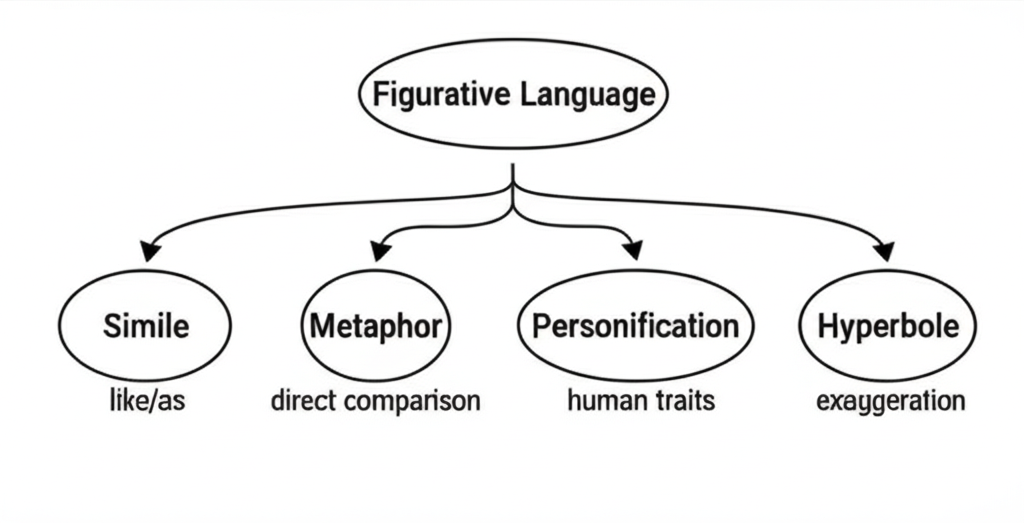
"SiMPHy" — Simile, Metaphor, Personification, Hyperbole
The four core types of figurative language. Remember SiMPHy to quickly recall and identify them when analyzing any poem or literary text.
"Tone is the poet's voice; mood is your heartbeat."
Tone is about how the author feels (their voice/attitude). Mood is about how you feel as a reader (your emotional response). They're related but distinct.
9Common Mistakes
Identifying devices without analyzing their effect
Simply saying "the poem uses a metaphor" is not enough. You must explain how the metaphor works, what it reveals, and why the poet chose it. Always connect the device to meaning, tone, or theme.
Confusing simile and metaphor
A simile uses "like" or "as" ("My love is like a rose"). A metaphor states one thing is another ("Life is a journey"). Look for those comparison words to distinguish between them.
Confusing tone and mood
Tone is the author's attitude toward the subject. Mood is the reader's emotional response. A poem can have a bitter tone but create a mood of sadness. Always specify whose perspective you're discussing.
Stating theme as a single word
"Love" or "death" are topics, not themes. A theme is a complete statement: "Love can be both a source of immense joy and profound suffering." Always express themes as sentences that convey the poem's message.
Dropping quotes without context or analysis
Never "quote bomb" — placing a quote in your essay without introducing it or explaining its significance. Always introduce the quote, cite it properly, and analyze how it supports your argument.
Summarizing the poem instead of analyzing it
Don't just retell what the poem says. Explain how the poet uses language to create meaning and why those choices matter. Analysis answers the "so what?" question; summary does not.
10Quick Revision Summary
- ✓A stanza is a group of lines (like a paragraph); meter is the rhythmic pattern of stressed/unstressed syllables.
- ✓Rhyme scheme is mapped with letters (ABAB, AABB); no rhyme scheme means free verse.
- ✓Sound devices: alliteration (initial consonants), assonance (vowels), consonance (consonants), onomatopoeia (sound words).
- ✓Figurative language: simile (like/as), metaphor (is), personification (human qualities), hyperbole (exaggeration).
- ✓Imagery appeals to the five senses — sight, sound, smell, taste, touch — creating vivid mental pictures.
- ✓Theme is the central message (a complete statement); tone is the author's attitude; mood is the reader's feeling.
- ✓Always ask "So what?" after identifying a device — explain how it works and why it matters.
- ✓Never drop quotes without introduction and analysis — integrate evidence smoothly into your writing.
- ✓Use the S.I.F.T. method: Symbol, Imagery, Figurative language, Tone/Theme — to systematically analyze any poem.
- ✓Symbols condense complex ideas into concrete images; motifs are recurring elements that reinforce themes.
Frequently Asked Questions
- What is the difference between rhyme scheme and meter?
- Rhyme scheme is the pattern of rhymes at the end of lines in a poem, denoted by letters (e.g., ABAB, AABB). Meter is the rhythmic pattern of stressed and unstressed syllables within each line, creating a regular beat. For example, iambic pentameter has five pairs of unstressed/stressed syllables per line. Both contribute to the poem's sound, but rhyme scheme organizes end-sounds while meter organizes internal rhythm.
- How do I tell the difference between a simile and a metaphor?
- A simile uses "like" or "as" to compare two unlike things (e.g., "My love is like a red, red rose"). A metaphor directly states one thing is another without using "like" or "as" (e.g., "All the world's a stage"). Both create comparisons, but metaphors make a more direct, often more powerful connection between two ideas.
- What is free verse and how do I analyze it?
- Free verse is poetry that does not follow a regular meter or rhyme scheme. The absence of strict form is a deliberate choice — poets use free verse to mimic natural speech, create an informal feel, or let the content dictate the structure. When analyzing free verse, focus on line breaks, imagery, figurative language, tone, and how the poet uses spacing and structure to create emphasis or pacing.
- How do I identify the theme of a poem?
- To find a poem's theme, look beyond what literally happens and ask: "What message about life or human nature is the poet exploring?" Identify key images, symbols, and figurative language, then connect them to broader ideas. A theme should be expressed as a complete statement (e.g., not just "love," but "Love can be both a source of immense joy and profound suffering"). The tone and mood also provide clues about the poet's perspective.
- What is the difference between tone and mood in poetry?
- Tone is the author's attitude toward the subject, revealed through word choice, imagery, and style (e.g., sarcastic, reverent, melancholic). Mood is the emotional atmosphere the poem creates for the reader (e.g., peaceful, tense, joyful). A poem can have a bitter tone but create a mood of sadness in the reader. Tone is about the poet; mood is about the reader's experience.
- Do I need to memorize all types of meter for high school English?
- No. For high school, focus on recognizing whether a poem has a regular beat (metered verse) or not (free verse), and how rhythm contributes to the poem's effect. Knowing iambic pentameter is particularly useful since it appears frequently in Shakespeare and many classic English poems. Understanding the general concept of stressed and unstressed syllables matters more than memorizing every meter type.
Practice Quiz
Test your understanding — select the correct answer for each question.
1.What term refers to the central, underlying message or insight about life that a literary work explores?
2.Which literary device is a recurring element, image, or idea that appears throughout a literary work and often contributes to its theme?
3.In Romeo and Juliet, when the audience knows Juliet is not truly dead but Romeo believes she is and drinks poison, this is an example of which type of irony?
4.The sentence 'He was a real Romeo with the ladies' is identified in the article as an example of which literary device?
5.Based on the article's explanation, what is the rhyme scheme of the first stanza of Robert Frost's 'Stopping by Woods on a Snowy Evening'?
6.A student writes, 'It was verbal irony when the fire station burned down because it was the last thing you'd expect.' What is the main error?
7.A student is analyzing The Great Gatsby and writes, 'The green light at the end of Daisy's dock is a motif representing Gatsby's hopes and dreams.' Why is the student's use of 'motif' incorrect?
8.A student writes: 'The author uses imagery to make the poem more good.' Which revision best improves this statement?
9.According to the article, which of the following lines primarily uses an iambic rhythm?
10.Which of the following phrases primarily uses imagery?
Final Study Advice
- 1.Read poems aloud — hearing the rhythm, rhyme, and sound devices brings the poem to life and reveals patterns you might miss silently.
- 2.Use the S.I.F.T. method on every poem: Symbol, Imagery, Figurative language, Tone/Theme — it gives you a systematic approach.
- 3.After identifying any device, always ask "So what?" — if you can't explain why it matters, go deeper.
- 4.Read widely — the more poetry you encounter, the more familiar you'll become with different styles and techniques.
- 5.Discuss with others — talking about poetry with classmates can open up new interpretations and deepen your understanding.