Definition of the Derivative
The derivative is a foundational concept in calculus that measures the instantaneous rate of change of a function. Geometrically, it represents the slope of the tangent line to a curve at a specific point.
This guide covers key definitions, the difference quotient, the formal limit definition of the derivative, interpretations, notation, higher-order derivatives, worked examples, memory aids, and a practice quiz.
1Introduction
Imagine you're driving a car. Your speed isn't constant; it changes as you accelerate, brake, or cruise. How fast were you going exactly at 3:17 PM? The derivative is the mathematical tool that answers these "instantaneous" questions. It gives us the exact rate of change at a single, precise moment.
The derivative is essentially the instantaneous rate of change of a function. Geometrically, it represents the slope of the tangent line to the function's graph at a specific point. Mastering the formal definition is your gateway to understanding motion, growth, optimization, and the rest of calculus.
Imagine you're on a roller coaster. Your position on the track is a function of time, s(t). As you plummet down a steep drop, your speed is rapidly increasing. At the very bottom, for a fleeting moment, you're moving at your absolute fastest. The derivative s'(t) tells you your exact speed and direction at that precise instant.
Why It Matters
Physics
Calculating velocity and acceleration from position functions, understanding forces and motion.
Economics
Determining marginal cost, marginal revenue, and marginal profit -- how one additional unit affects the total.
Engineering
Optimizing designs, analyzing stress and strain, modeling fluid flow.
Optimization
Finding maximums and minimums -- maximizing profit, minimizing material usage.
2Key Definitions
Function (f(x))
A rule that assigns exactly one output value (y) for each input value (x).
Slope
A measure of the steepness of a line, calculated as "rise over run" (Δy / Δx).
Average Rate of Change
The slope of a secant line between two points on a curve. It tells you the overall change over an interval.
Instantaneous Rate of Change
The rate of change at a single, specific point. This is what the derivative calculates.
Secant Line
A line that intersects a curve at two distinct points. Its slope represents the average rate of change between those points.
Tangent Line
A line that touches a curve at a single point and has the same slope as the curve there. Its slope is the derivative.
Difference Quotient
The expression [f(x+h) - f(x)] / h. It represents the slope of a secant line.
Limit
A fundamental concept describing the value a function approaches as the input approaches some value.
Differentiable
A function is differentiable at a point if its derivative exists there (no corners, cusps, or vertical tangents).
Derivative (f'(x))
The instantaneous rate of change of a function at a point, or the slope of the tangent line. It is a new function derived from the original.
h → 0
Notation meaning "h approaches zero." The distance between two points on the curve becomes infinitesimally small, turning the secant into a tangent.
3The Difference Quotient
The difference quotient is the heart of the derivative definition. It is simply the slope formula you already know, applied to two points on a curve where the horizontal distance between them is denoted by h.
[f(x + h) - f(x)] / h
The slope of the secant line through (x, f(x)) and (x + h, f(x + h)).
Breaking it down:
- f(x + h) -- the y-value of the function at a point slightly to the right of x.
- f(x) -- the y-value of the function at point x.
- f(x + h) - f(x) -- the "rise" or change in y between the two points.
- h -- the "run" or change in x between the two points (since (x + h) - x = h).
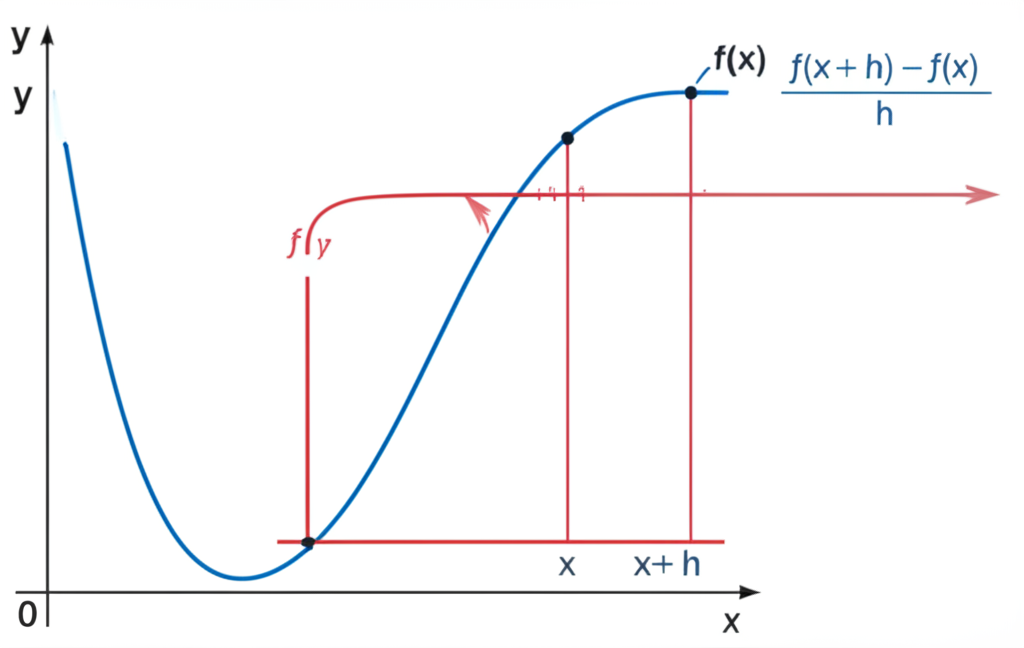
The difference quotient before taking the limit gives the average rate of change (secant line slope). After taking the limit as h approaches 0, it gives the instantaneous rate of change (tangent line slope). The limit is what transforms an average rate over an interval into an exact rate at a single point.
Worked Example: Setting Up the Difference Quotient
Set up the difference quotient for f(x) = x² + 3x - 1
f(x + h) = (x + h)² + 3(x + h) - 1
= x² + 2xh + h² + 3x + 3h - 1
[f(x + h) - f(x)] / h
= [(x² + 2xh + h² + 3x + 3h - 1) - (x² + 3x - 1)] / h
= [2xh + h² + 3h] / h
= 2x + h + 3
4The Derivative as a Limit
The core idea behind the derivative is to start with the average rate of change (the slope of a secant line) and then make the interval infinitesimally small. This transforms the average rate into an instantaneous one.
The Formal Definition
f'(x) = lim(h→0) [f(x + h) - f(x)] / h
The instantaneous rate of change of f(x) at any point x. This gives a new function f'(x).
As h gets smaller and smaller, the second point (x + h, f(x + h)) gets closer and closer to the first point (x, f(x)). This causes the secant line to "pivot" and approach the tangent line at (x, f(x)).
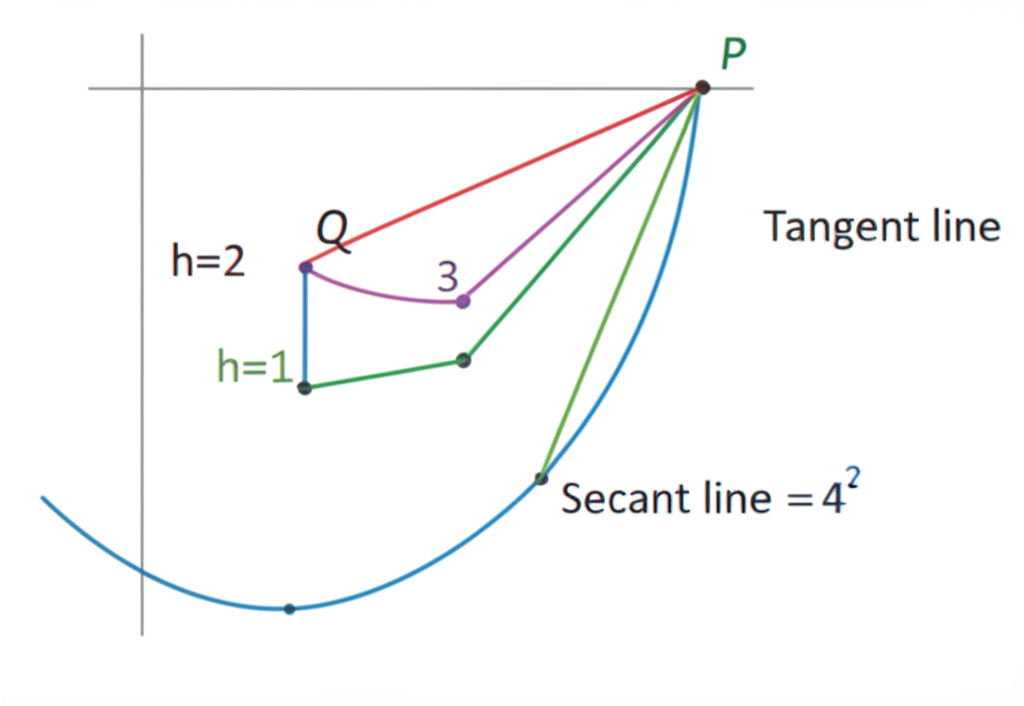
Interactive: Secant to Tangent
Drag the h slider toward 0 and watch the secant line morph into the tangent line. The slope approaches the true derivative.
f(x) = x² · f'(x) = 2x
Alternative Form (Derivative at a Point)
f'(a) = lim(x→a) [f(x) - f(a)] / (x - a)
The instantaneous rate of change of f(x) at a specific point x = a. Gives a numerical value.
In this form, as x approaches a, the point (x, f(x)) slides along the curve toward the fixed point (a, f(a)), and the secant line approaches the tangent line at (a, f(a)). This form is often cleaner when rationalizing is needed.
Worked Example 1: f(x) = x² + 3x - 1
Find f'(x) using the limit definition
f'(x) = lim(h→0) [f(x+h) - f(x)] / h
= lim(h→0) [(x+h)² + 3(x+h) - 1 - (x² + 3x - 1)] / h
= lim(h→0) [x² + 2xh + h² + 3x + 3h - 1 - x² - 3x + 1] / h
= lim(h→0) [2xh + h² + 3h] / h
= lim(h→0) h(2x + h + 3) / h
= lim(h→0) (2x + h + 3)
f'(x) = 2x + 3
Worked Example 2: f(x) = x³
Find f'(x) using the limit definition
f'(x) = lim(h→0) [(x+h)³ - x³] / h
= lim(h→0) [x³ + 3x²h + 3xh² + h³ - x³] / h
= lim(h→0) [3x²h + 3xh² + h³] / h
= lim(h→0) h(3x² + 3xh + h²) / h
= lim(h→0) (3x² + 3xh + h²)
f'(x) = 3x²
Worked Example 3: Alternative Form with f(x) = √(x + 2) at x = 2
Find f'(2) using f'(a) = lim(x→a) [f(x) - f(a)] / (x - a)
f(2) = √(2 + 2) = √4 = 2
f'(2) = lim(x→2) [√(x+2) - 2] / (x - 2)
(direct substitution gives 0/0, so rationalize)
= lim(x→2) [√(x+2) - 2] / (x - 2) · [√(x+2) + 2] / [√(x+2) + 2]
= lim(x→2) [(x+2) - 4] / [(x - 2)(√(x+2) + 2)]
= lim(x→2) (x - 2) / [(x - 2)(√(x+2) + 2)]
= lim(x→2) 1 / [√(x+2) + 2]
= 1 / [√4 + 2] = 1 / [2 + 2]
f'(2) = 1/4
Worked Example 4: Finding the Tangent Line Equation
Find the tangent line to f(x) = x² - 4x + 5 at x = 3
Step 1: Find the point
f(3) = 9 - 12 + 5 = 2 → point (3, 2)
Step 2: Find f'(x) using the limit definition
f'(x) = lim(h→0) [(x+h)² - 4(x+h) + 5 - (x² - 4x + 5)] / h
= lim(h→0) [2xh + h² - 4h] / h
= lim(h→0) (2x + h - 4) = 2x - 4
Step 3: Evaluate at x = 3
m = f'(3) = 2(3) - 4 = 2
Step 4: Point-slope form
y - 2 = 2(x - 3)
y = 2x - 4
5Interpretations of the Derivative
The derivative is a versatile tool with many real-world meanings:
Slope of the Tangent Line
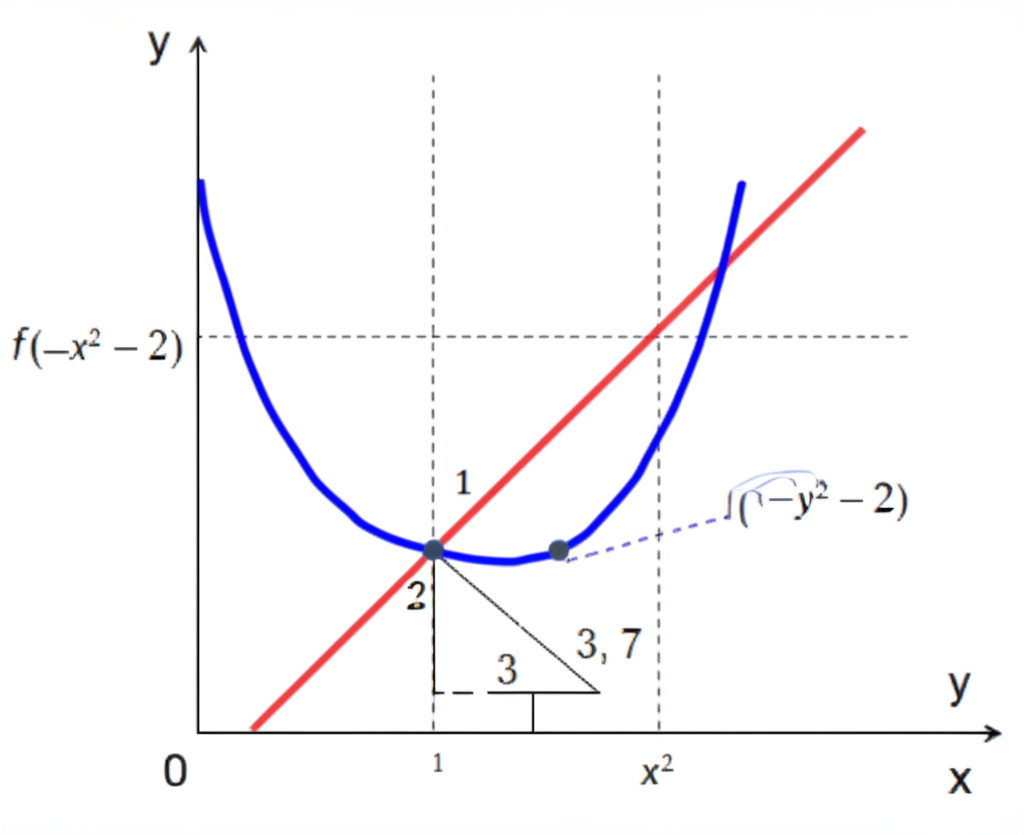
If you graph f(x), then f'(a) is the slope of the line that just "kisses" the curve at x = a. This is the geometric interpretation.
Instantaneous Rate of Change
How quickly one quantity is changing with respect to another at a precise moment. The fundamental conceptual interpretation.
Velocity (from Position)
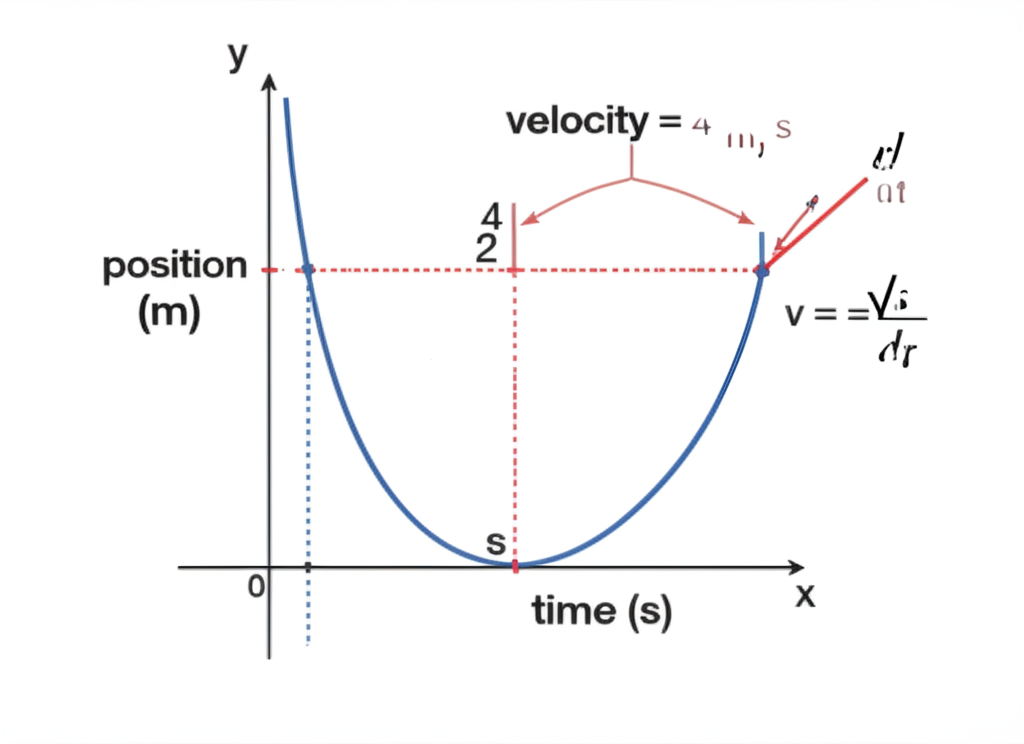
If s(t) is position, then s'(t) = v(t) is instantaneous velocity. Positive = forward, negative = backward, zero = momentarily at rest.
Marginal Cost / Revenue
If C(x) is total cost, then C'(x) is marginal cost -- the approximate cost of producing one additional item. Similarly for revenue and profit.
Worked Example: Instantaneous Velocity
The position of a particle (meters) at time t (seconds) is s(t) = 5t² - t. Find the velocity at t = 2.
s'(t) = lim(h→0) [s(t+h) - s(t)] / h
s(t+h) = 5(t+h)² - (t+h) = 5t² + 10th + 5h² - t - h
= lim(h→0) [10th + 5h² - h] / h
= lim(h→0) h(10t + 5h - 1) / h
= lim(h→0) (10t + 5h - 1)
s'(t) = 10t - 1
s'(2) = 10(2) - 1 = 20 - 1
s'(2) = 19 m/s
6Derivative Notation
Calculus uses several notations for the derivative. It is important to be familiar with all of them, as different contexts favor different notations.
Prime Notation
f'(x) -- "f prime of x"
y' -- "y prime"
Most common when the function is named f or the equation uses y.
Leibniz Notation
dy/dx -- "dee y dee x"
d/dx [f(x)] -- "dee dee x of f of x"
Emphasizes the relationship between variables. Useful for implicit differentiation and related rates.
All these notations mean the same thing. f'(x), y', dy/dx, and d/dx[f(x)] all represent the derivative. The notation dy/dx is particularly useful because it reminds us that the derivative is a ratio of infinitesimal changes -- Δy/Δx as the changes approach zero.
7Higher-Order Derivatives
Just as you can differentiate a function f(x) to get f'(x), you can differentiate f'(x) to get the second derivative, and so on. Each successive derivative describes the rate of change of the previous one.
Second Derivative
f''(x) or d²y/dx²
Rate of change of the first derivative. In physics: acceleration (how velocity is changing).
Third Derivative
f'''(x) or d³y/dx³
Rate of change of acceleration. In physics: jerk (rate of change of acceleration).
Nth Derivative
f⁽ⁿ⁾(x) or dⁿy/dxⁿ
For derivatives beyond the third, superscripts in parentheses are used to avoid confusion with exponents.
Physical Interpretation Chain
Position
s(t)
Velocity
v(t) = s'(t)
Acceleration
a(t) = v'(t) = s''(t)
8Memory Aids
"Rise over Run, as Run goes to None!"
The difference quotient is "rise" (f(x+h) - f(x)) over "run" (h). The limit as h → 0 means the "run" is getting infinitesimally small, giving the instantaneous slope.
"Secant to Tangent Dance"
Imagine two points on a curve. One is fixed. The other dances closer and closer to the fixed point. The line connecting them (secant) gradually becomes the line that just touches (tangent). The derivative is the slope of that final, perfect tangent line.
"Derivative is a New Function of Slopes!"
Remember that f'(x) is itself a function. For every x in its domain, it gives you the slope of the original function f(x) at that specific x.
"The H-Bomb Check"
After expanding f(x+h) and subtracting f(x), every term remaining in the numerator MUST have an h in it. If not, you've made an algebraic error. Once you factor out h and cancel it with the denominator, the "H-bomb" is diffused and you can safely substitute h = 0.
"The Limit is the Key to Instantaneous!"
Whenever you see "instantaneous rate of change" or "slope of the tangent line," immediately think "derivative," and therefore "limit definition."
9Common Mistakes
Forgetting the limit notation
Always write lim(h→0) at every step until you actually evaluate the limit. Dropping it early is mathematically incorrect and will cost you points on exams.
Algebraic errors expanding (x + h)ⁿ
Expanding binomials is a frequent source of error. Remember: (x + h)² = x² + 2xh + h² (NOT x² + h²). Be meticulous with distribution and signs.
Incorrect subtraction of f(x)
Distribute the negative sign to ALL terms of f(x) when subtracting: -(x² + 3x - 1) becomes -x² - 3x + 1, not -x² + 3x - 1.
Not factoring out and canceling h
You must factor out h from the numerator and cancel it with the denominator before substituting h = 0. If you cannot factor out h, you likely have an algebraic error earlier.
Confusing average rate with instantaneous rate
The difference quotient before taking the limit is the average rate of change (secant slope). After taking the limit, it becomes the instantaneous rate (tangent slope).
Using the wrong definition form
Be careful whether the problem asks for f'(x) (general derivative function) versus f'(a) (derivative at a specific point). The h → 0 form is better for f'(x), while the x → a form is often cleaner for f'(a).
Misinterpreting h as x
Remember h is the small change in x, not x itself. It is a separate variable that approaches zero.
Not recognizing non-differentiable points
A function is not differentiable where it has a sharp corner (like |x| at x = 0), a cusp, a vertical tangent line, or a discontinuity. The limit definition will fail at these points.
Quick Revision Summary
- ✓The derivative measures the instantaneous rate of change of a function at a point.
- ✓Geometrically, it is the slope of the tangent line to the curve at that point.
- ✓The Δdifference quotient [f(x+h) - f(x)] / h gives the slope of the secant line (average rate of change).
- ✓Primary definition: f'(x) = lim(h→0) [f(x+h) - f(x)] / h.
- ✓Alternative form: f'(a) = lim(x→a) [f(x) - f(a)] / (x - a).
- ✓Taking the limit as h → 0 transforms the secant line into the tangent line.
- ✓Common notations: f'(x), y', dy/dx, and d/dx[f(x)] all mean the derivative.
- ✓Higher-order derivatives: f''(x) is acceleration, f'''(x) is jerk.
- ✓Interpretations include velocity, acceleration, marginal cost/revenue, and slope of tangent.
- ✓Always expand carefully, factor out h, and cancel before substituting h = 0.
Frequently Asked Questions
- When should I use the h-to-0 definition vs. the x-to-a definition?
- The h-to-0 definition, f'(x) = lim(h->0) [f(x+h) - f(x)]/h, is generally preferred when you need to find the general derivative function f'(x) for all x. The x-to-a definition, f'(a) = lim(x->a) [f(x) - f(a)]/(x - a), is often more convenient when you only need the derivative at a specific numerical point x = a, especially when rationalizing the numerator is needed.
- What if the limit in the derivative definition does not exist?
- If the limit does not exist at a certain point, the function is not differentiable there. This happens at sharp corners (like y = |x| at x = 0), cusps, vertical tangent lines, or discontinuities. The derivative simply does not exist at these points.
- What is the difference between average rate of change and instantaneous rate of change?
- Average rate of change is the overall change in a quantity over an interval -- it is the slope of a secant line. Think of your average speed over a 2-hour road trip. Instantaneous rate of change is the rate at a single, specific moment -- it is the slope of a tangent line. Think of the exact speed on your speedometer at a particular instant. The derivative calculates the instantaneous rate.
- Why do I need to cancel h from the denominator before substituting h = 0?
- Direct substitution of h = 0 into the difference quotient always produces the indeterminate form 0/0. You must algebraically simplify -- expand, cancel terms, factor out h from the numerator, and cancel it with the denominator -- before you can substitute h = 0 to evaluate the limit. If you cannot factor out h, you likely have an algebraic error.
- Is there an easier way to find derivatives than the limit definition?
- Yes! The limit definition is foundational, but for practical calculations there are differentiation rules (Power Rule, Product Rule, Quotient Rule, Chain Rule, etc.) that are derived from the limit definition. These rules make finding derivatives much faster. However, understanding the limit definition is crucial for conceptual understanding and is commonly tested on AP exams.
Practice Quiz
Test your understanding — select the correct answer for each question.
1.What is the formal definition of derivative?
2.What does the derivative represent geometrically?
3.If f(x) = x³, what is f'(x)?
4.The derivative of position with respect to time is:
5.What is a secant line?
6.As h → 0, the secant line approaches the:
7.If f'(x) = 0 for all x, then f(x) is:
8.The derivative notation dy/dx means:
9.What is instantaneous velocity?
10.Find f'(2) if f(x) = x² - 3x
Final Study Advice
- 1.Always write the limit notation at every step until you evaluate it -- dropping it early is a common exam penalty.
- 2.After expanding f(x+h) - f(x), every term in the numerator should contain h. If not, check your algebra.
- 3.Practice both forms of the definition -- the h-to-0 form for general derivatives and the x-to-a form for derivatives at a point.
- 4.Sketch the secant-to-tangent transition to build geometric intuition for what the limit is doing.
- 5.Connect each derivative you compute to a real-world interpretation (velocity, rate of growth, marginal cost) to deepen understanding.