Friction
Friction is a contact force that opposes the relative motion or tendency of relative motion between two surfaces in contact. It affects nearly every aspect of our physical world — from walking and driving to engineering and sports.
This guide covers friction types, coefficients, inclined plane problems, worked examples with step-by-step solutions, and memory aids to help you master friction in physics.
1Introduction
Friction is an invisible yet powerful force that impacts nearly every aspect of our physical world. From the simple act of walking without slipping to the complex engineering of car brakes and tire treads, friction is essential for control, movement, and safety.
In sports, it determines how well a soccer player can grip the field or a skier can control their descent. Friction can be a helpful ally — allowing us to grip objects and move forward — or a stubborn foe, wasting energy and causing wear and tear.
Imagine pushing a heavy box across a rough concrete floor. You push harder, but it barely moves. Then you try the same box on a smooth ice rink — it slides easily. What's making such a difference? The answer is friction, the invisible force that fights against every surface trying to slide past another.
Friction is a contact force that acts parallel to the surfaces in contact, always opposing relative motion or the tendency for such motion.
2Key Definitions
Friction (Ff)
Force that opposes relative motion between two surfaces in contact. Measured in Newtons (N).
Normal Force (FN)
The perpendicular contact force between surfaces. Balances forces pressing surfaces together. Measured in Newtons (N).
Static Friction (Fs)
Friction that opposes the start of motion. Acts on objects at rest relative to each other.
Kinetic Friction (Fk)
Friction that opposes ongoing motion. Acts on surfaces already sliding past each other.
Coefficient of Friction (μ)
Dimensionless ratio of frictional force to normal force. Higher μ means more friction.
μs (Static)
Ratio of maximum static friction to normal force. Determines force needed to start motion.
μk (Kinetic)
Ratio of kinetic friction to normal force. Determines force opposing ongoing motion.
Rolling Friction (Fr)
Resistance when a round object rolls over a surface. Much smaller than sliding friction.
Angle of Repose (θr)
Steepest incline angle at which an object just begins to slide. tan θr = μs.
Applied Force (Fapp)
External force exerted on an object by a person or another object. Measured in Newtons (N).
3Understanding Friction
Microscopic vs. Macroscopic View
At a macroscopic level, surfaces might look smooth. But under a microscope, all surfaces have tiny bumps and valleys called asperities. When two surfaces are pressed together, these asperities interlock. To move one surface past another, these interlocking bumps must either deform, break, or ride over each other. This microscopic interaction is the primary source of friction.
Direction of Frictional Force
The frictional force always acts opposite to the direction of the object's motion or its impending motion:
- Push a book right → friction acts left
- Car skids left → friction acts right
- Object about to slide down an incline → static friction acts up the incline
Static vs. Kinetic Friction
Static Friction (Fs)
Object at rest. Fs = Fapp
Kinetic Friction (Fk)
Object sliding. Fapp > Fk
What Friction Does NOT Depend On
According to the classical model (Amontons's Laws), friction does NOT depend on:
Apparent Contact Area
A brick on its side or end has roughly the same friction force, as long as the normal force is constant. The actual microscopic contact area is proportional to normal force, not apparent area.
Speed of Sliding
For moderate speeds, kinetic friction is generally constant regardless of how fast the object is sliding (this breaks down at extreme speeds).
4Types of Friction
Static Friction
Prevents motion from starting. Matches applied force up to Fs,max.
Fs ≤ μs × FN
Typically largest μ
Kinetic Friction
Opposes motion of sliding objects. Generally constant for given surfaces.
Fk = μk × FN
Smaller than static
Rolling Friction
Resistance when round objects roll. Caused by slight deformation at contact.
Fr = μr × FN
Much smaller than sliding
Fluid Friction
Resistance through liquids or gases. Depends on shape, speed, and viscosity.
Fd ∝ v²
Air & water resistance
Generally: μs > μk > μr. It takes more force to start motion than to maintain it, and rolling friction is much smaller than sliding friction — which is why wheels are so useful!
5Coefficients of Friction
The coefficient of friction (μ) is a dimensionless quantity that quantifies the "stickiness" or "slipperiness" between two surfaces. A higher coefficient means more friction.
Ff = μ × FN
Ff = friction force (Newtons, N)
μ = coefficient of friction (dimensionless)
FN = normal force (Newtons, N)
Example: μ = 0.3, FN = 50 N
Ff = 0.3 × 50 = 15 N
Typical Coefficients for Common Surfaces
| Surface Pair | μs (Static) | μk (Kinetic) |
|---|---|---|
| Rubber on Concrete | 1.0 | 0.8 |
| Steel on Steel | 0.74 | 0.57 |
| Glass on Glass | 0.94 | 0.40 |
| Aluminum on Steel | 0.61 | 0.47 |
| Wood on Wood | 0.25-0.5 | 0.20 |
| Ski on Snow | 0.10 | 0.05 |
| Teflon on Steel | 0.04 | 0.04 |
| Ice on Ice | 0.10 | 0.03 |
Values are approximate and vary based on surface condition, temperature, etc.
6Key Formulas & Equations
Maximum Static Friction
Fs,max = μs × FN
Threshold force to start an object moving. If Fapp > Fs,max, the object moves.
Kinetic Friction
Fk = μk × FN
Constant friction on a sliding object. Usually Fk < Fs,max.
Normal Force (Horizontal Surface)
FN = mg
When on a flat surface with no other vertical forces. m in kg, g = 9.8 m/s².
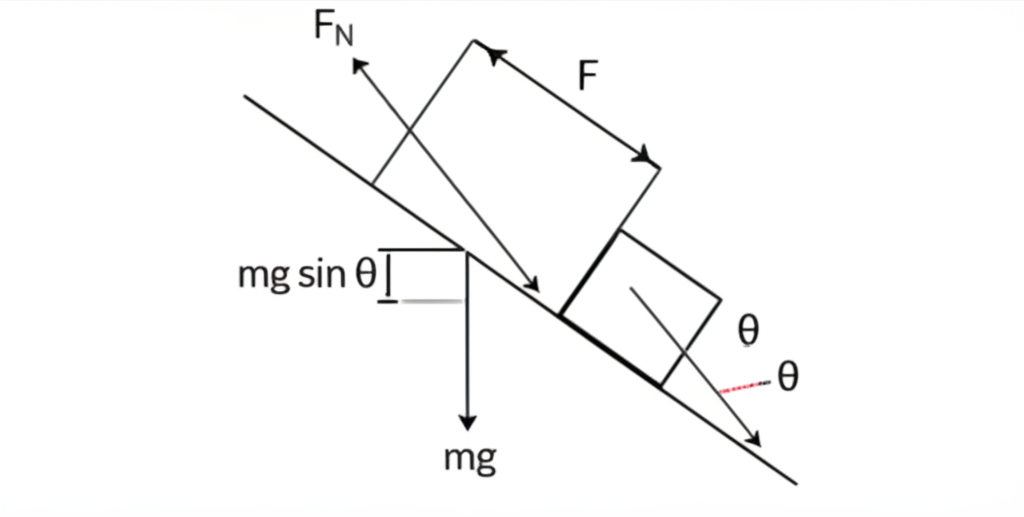
Normal Force (Inclined Plane)
FN = mg cos θ
On an incline at angle θ. The weight component parallel to the incline is mg sin θ.
Angle of Repose
tan θr = μs
Maximum incline angle before an object slides. A simple way to determine μs experimentally.
Surface Friction Simulator
InteractiveAdjust mass, friction coefficient, and applied force to explore static and kinetic friction.
Normal Force
FN = 49.0 N
Max Static
fs,max = 24.5 N
Kinetic Friction
fk = 19.6 N
Current Friction
f = 0.0 N
(static)
μk (kinetic)
0.40
= 0.8 × μs
Status
Stationary
a = 0 m/s²
7Applications & Special Cases
Friction in Everyday Life
Walking
Your foot pushes backward on the ground; static friction pushes you forward. Without it, you'd slip.
Driving & Braking
Tires rely on friction for traction. Brakes use friction pads to convert kinetic energy into heat.
Holding Objects
Friction between your hand and a cup prevents it from slipping out of your grip.
Writing
Pencil graphite creates friction with paper, leaving marks. No friction = no writing.
Reducing vs. Increasing Friction
Reducing Friction
- Lubricants (oil, grease) reduce surface contact
- Ball bearings convert sliding to rolling friction
- Streamlining reduces air/water resistance
- Polishing surfaces reduces asperity interlocking
Increasing Friction
- Rough surfaces or rubber mats add texture
- Tire treads displace water, improve grip
- Sand on ice prevents skidding on roads
- Sports gear — climbing shoes, golf grips
Friction on Inclined Planes
On an inclined plane, gravity is resolved into two components:
Perpendicular to plane
mg cos θ
Determines normal force FN
Parallel to plane
mg sin θ
Tends to pull object down the incline
8Worked Examples
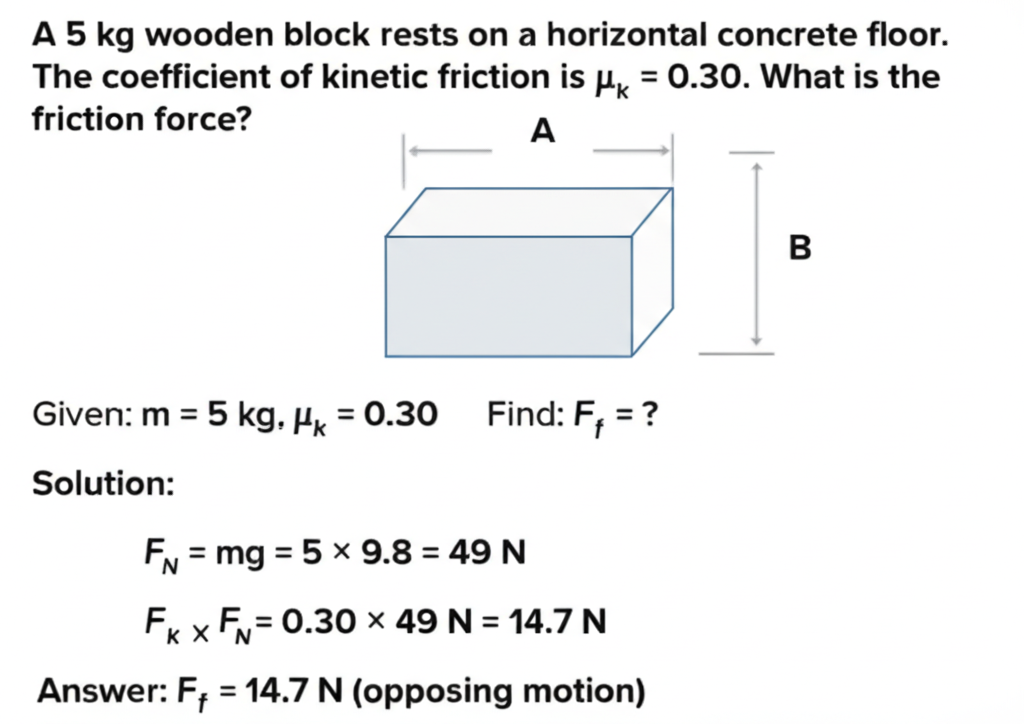
Example 1: Basic Kinetic Friction Calculation
A 2.5 kg wooden block is pulled across a horizontal wooden table. If μk = 0.20, what is the kinetic friction force? (g = 9.8 m/s²)
Given: m = 2.5 kg, μk = 0.20, g = 9.8 m/s²
Find: Fk
Step 1: FN = mg = 2.5 × 9.8 = 24.5 N
Step 2: Fk = μk × FN = 0.20 × 24.5
Fk = 4.9 N
Example 2: Comparing Static and Kinetic Friction
A 15 kg crate on a concrete floor. μs = 0.60, μk = 0.40. A horizontal force of 75 N is applied. Will it move? (g = 9.8 m/s²)
Given: m = 15 kg, μs = 0.60, μk = 0.40, Fapp = 75 N
Find: Whether crate moves, and the friction force
Step 1: FN = mg = 15 × 9.8 = 147 N
Step 2: Fs,max = μs × FN = 0.60 × 147 = 88.2 N
Step 3: Fapp (75 N) < Fs,max (88.2 N)
Crate does NOT move. Fs = 75 N
Example 3: Finding μk from a Pull Experiment
A 4.0 kg block is pulled at constant velocity by a horizontal force of 12 N. Find μk. (g = 9.8 m/s²)
Given: m = 4.0 kg, Fapp = 12 N, constant velocity (a = 0)
Find: μk
Step 1: Constant velocity → Fk = Fapp = 12 N
Step 2: FN = mg = 4.0 × 9.8 = 39.2 N
Step 3: μk = Fk / FN = 12 / 39.2
μk ≈ 0.31
Example 4: Block on an Inclined Plane
A 6.0 kg block on a 30° incline with μs = 0.50. Will it slide? (g = 9.8 m/s²)
Given: m = 6.0 kg, θ = 30°, μs = 0.50
Find: Whether the block slides
Step 1: FN = mg cos θ = 6.0 × 9.8 × cos(30°) ≈ 50.92 N
Step 2: Fg,∥ = mg sin θ = 6.0 × 9.8 × sin(30°) = 29.4 N
Step 3: Fs,max = μs × FN = 0.50 × 50.92 ≈ 25.46 N
Step 4: Fg,∥ (29.4 N) > Fs,max (25.46 N)
Block WILL slide down the incline.
Example 5: Two Blocks Connected by a Rope
Block A (4.0 kg) on a table connected by a string over a frictionless pulley to Block B (2.0 kg) hanging freely. μk = 0.25. Find the acceleration. (g = 9.8 m/s²)
Given: mA = 4.0 kg, mB = 2.0 kg, μk = 0.25
Find: Acceleration (a) of the system
Block A: T - Fk = mAa | Block B: mBg - T = mBa
Step 1: FN = mAg = 4.0 × 9.8 = 39.2 N
Step 2: Fk = μk × FN = 0.25 × 39.2 = 9.8 N
Step 3: Add equations: mBg - Fk = (mA + mB)a
Step 4: 19.6 - 9.8 = 6.0 × a
a = 9.8 / 6.0 ≈ 1.63 m/s²
9Memory Aids
"Static is Stuck, Kinetic Keeps moving."
Static friction prevents motion; kinetic friction opposes ongoing motion.
"Friction Fights Forward Force."
Always draw the friction arrow opposite to the direction of motion or the direction the object wants to move.
"Coefficients are Completely Freeless!"
μs and μk have no units. Since μ = Ff / FN, the units (N/N) cancel out.
"It's always harder to START a heavy couch moving than to KEEP it sliding."
This is why μs > μk — starting motion requires overcoming stronger bonds between stationary asperities.
"Think of two LEGO bricks sliding past each other."
More interlocking bumps = more resistance. This is exactly how microscopic asperities work on rough surfaces.
10Common Mistakes
Confusing when to use μs vs. μk
Use μs when the object is at rest and you're checking if it will move (calculate Fs,max). Use μk when the object is already sliding. Remember: Fs ≤ μsFN, but Fk = μkFN.
Thinking friction depends on contact area
In the classical model, friction is independent of the apparent contact area. A wider object with the same mass has the same friction force. Friction depends on the normal force and the nature of the surfaces (μ).
Unit conversion pitfalls
Always convert to SI units before calculating. Use kilograms (not grams) for mass, metres for distance, and seconds for time. Forces are always in Newtons (N).
Drawing friction in the wrong direction
Friction always opposes motion or the tendency of motion. On an incline, resolve gravity into components parallel (mg sin θ) and perpendicular (mg cos θ) to the surface. Always draw a clear free-body diagram.
Assuming FN = mg in all situations
FN = mg only on a horizontal surface with no other vertical forces. On an incline: FN = mg cos θ. If someone pushes down or lifts up on the object, FN changes accordingly. Always analyze perpendicular forces to find FN.
11Quick Revision Summary
- ✓Friction is a contact force that opposes relative motion between surfaces.
- ✓It arises from microscopic asperities interlocking and electromagnetic interactions.
- ✓Static friction (Fs) prevents motion; kinetic friction (Fk) opposes sliding motion.
- ✓Fs,max = μs × FN and Fk = μk × FN.
- ✓μs > μk — it takes more force to start motion than maintain it.
- ✓Friction does not depend on apparent contact area or speed (classical model).
- ✓On an incline: FN = mg cos θ, weight component down = mg sin θ.
- ✓Angle of repose: tan θr = μs.
- ✓Rolling friction is much smaller than sliding friction — that's why wheels work!
- ✓Always draw free-body diagrams and use SI units (N, kg, m/s²).
Frequently Asked Questions
- Why is the coefficient of static friction usually greater than kinetic friction?
- At rest, microscopic asperities on surfaces have more time to settle into each other, forming stronger temporary bonds. Once motion begins, these bonds are constantly being broken and reformed, resulting in slightly lower resistance to continuous sliding.
- Does friction always oppose motion?
- Friction always opposes relative motion at the contact surface. However, it can act in the direction of overall motion — for example, when walking, static friction pushes your foot forward, enabling you to move.
- Can friction ever be completely eliminated?
- In practical terms, no. Even very smooth surfaces have microscopic irregularities. However, friction can be drastically reduced using lubricants, magnetic levitation (eliminating contact), or operating in a vacuum at extremely low temperatures.
- What happens to friction at very high speeds?
- The classical model states kinetic friction is independent of speed. However, at very high speeds, especially for fluid friction (air resistance), the force increases significantly — often proportional to the square of velocity (F_d ∝ v²).
- Is friction a fundamental force of nature?
- No. Friction is a macroscopic manifestation of the electromagnetic force acting between atoms and molecules at surfaces in contact. It is not one of the four fundamental forces (strong nuclear, weak nuclear, electromagnetic, gravitational).
Practice Quiz
Test your understanding — select the correct answer for each question.
1.Which of the following best defines friction?
2.What is the SI unit for the coefficient of kinetic friction (μ_k)?
3.A 10 kg block is resting on a horizontal surface. If the coefficient of static friction is 0.5 and the coefficient of kinetic friction is 0.3, what is the maximum force that can be applied horizontally before the block starts to move? (Assume g = 9.8 m/s²)
4.Which statement about static and kinetic friction is generally true?
5.Which of the following factors does the classical model of friction state does NOT significantly affect the magnitude of the friction force?
6.An object is placed on an inclined plane. The angle of the incline is slowly increased until the object just begins to slide. This angle is known as the:
7.To reduce friction in an engine, which of the following would be most effective?
8.A block is sliding across a horizontal surface at a constant velocity. Which of the following statements is true about the forces acting on the block?
9.What is the primary reason wheels are so effective at reducing resistance to motion compared to dragging an object?
10.On an inclined plane, the normal force (F_N) acting on an object with mass m at an angle θ is given by:
Final Study Advice
- 1.Always draw a free-body diagram before solving friction problems — label all forces clearly.
- 2.Determine whether the object is at rest or moving to decide between μs and μk.
- 3.On inclined planes, always resolve forces into components parallel and perpendicular to the surface.
- 4.Remember: FN is not always equal to mg — check for inclines and additional vertical forces.
- 5.Practice rearranging Ff = μFN to solve for any unknown — exams test all three variables.