Work, Energy, and Power
Understanding Work and Energy is essential for mastering motion, forces, and conservation laws in physics. These concepts explain everything from pushing a shopping cart to launching rockets into space.
This guide expands each concept with explanations, real-life stories, and intuitive reasoning to help you truly understand — not just memorize — the formulas.
1What Is Work in Physics?
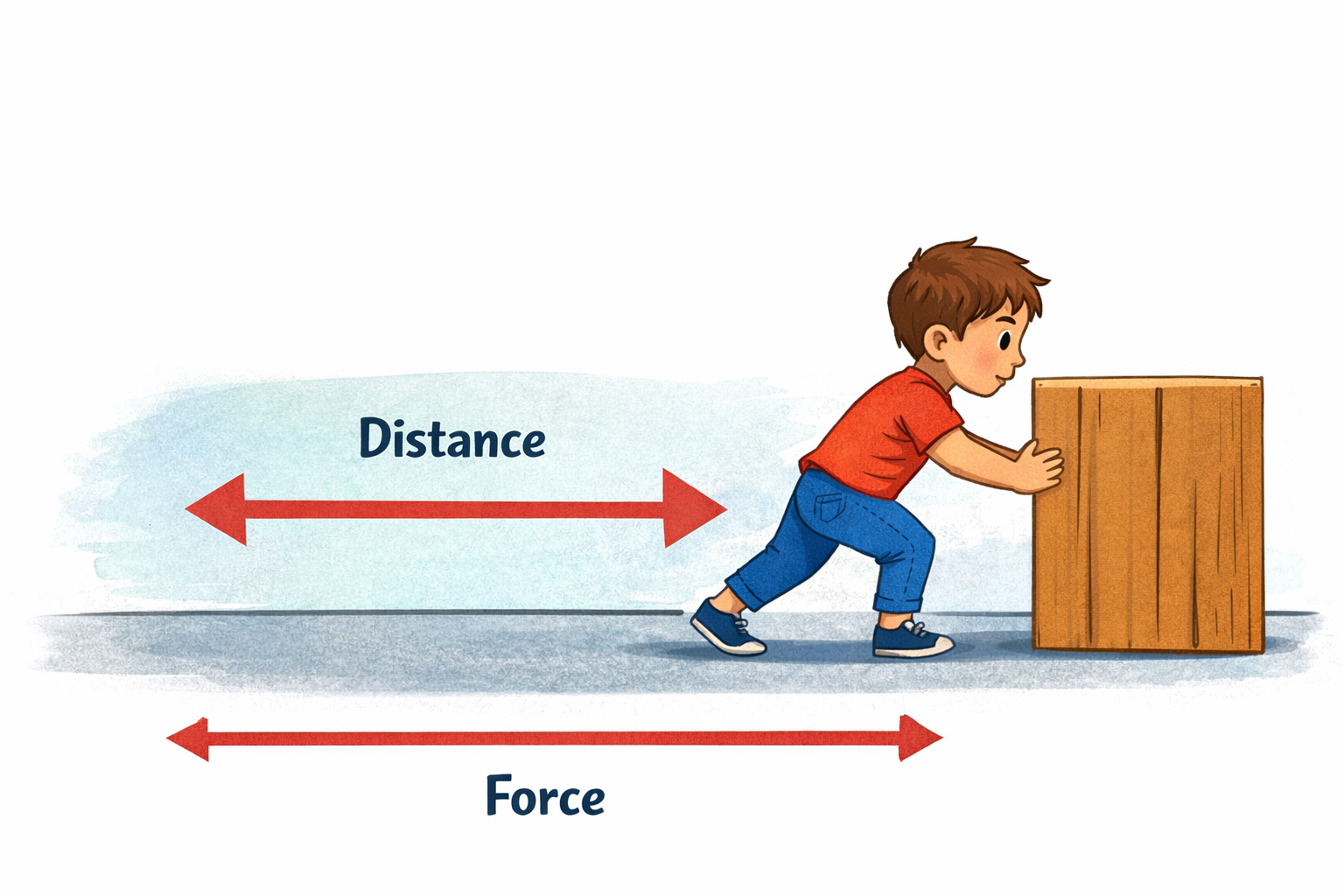
Work is done when a force causes displacement of an object.
In physics, work has a very specific meaning. You may feel tired holding a heavy backpack, but if it doesn't move, physics says no work is done. Why? Because displacement is required.
If there is no movement, there is no work done in physics.
Imagine pushing a heavy box across the floor. If the box slides forward, your force caused displacement — that is work. Push against a wall and nothing moves? Zero work done.
W = F d cos(θ)
W = Work (Joules, J)
F = Force (Newtons, N)
d = Displacement (meters, m)
θ = Angle between force and displacement
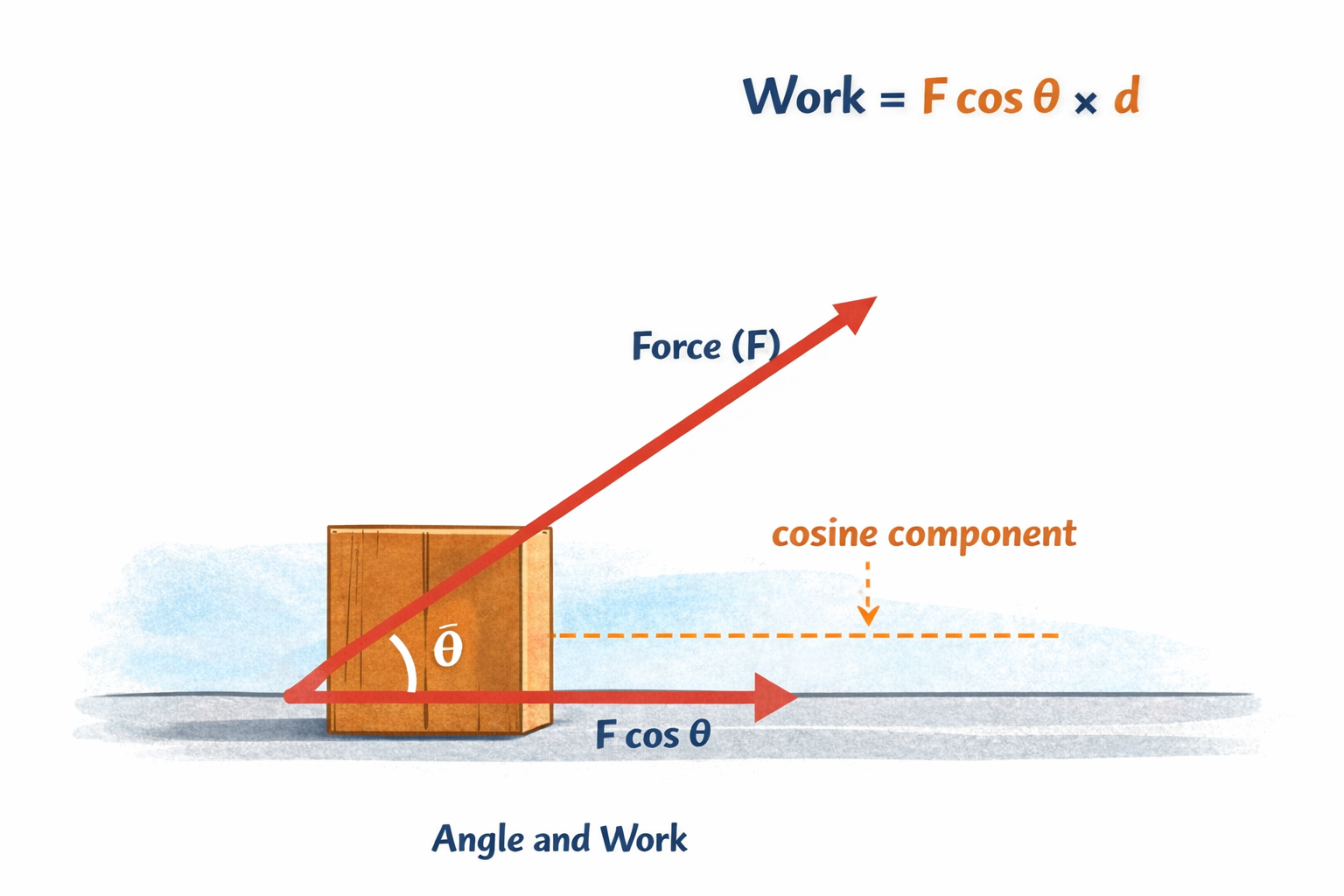
The cosine term tells us that only the part of the force in the direction of motion actually contributes to work.
What Happens When Force Is Applied at Different Angles?
θ = 0°
Maximum work
W = Fd
θ = 90°
No work done
W = 0
θ = 180°
Opposite direction
Negative work
How Does the Angle Affect Work?
Only the horizontal component of force does work. Think of pulling a suitcase with the handle tilted upward — part of your force lifts upward, but only the horizontal part moves the suitcase forward.
Work = F cos(θ) × d
"Push and Move, That's the Groove."
2What Is Kinetic Energy?
Kinetic Energy (KE) is the energy an object has because it is moving.
Whenever something moves, it carries energy. A rolling basketball, a speeding car, a flying airplane — all contain kinetic energy.
KE = ½mv²
m = mass (kg)
v = velocity (m/s)
If velocity doubles, KE becomes four times larger (because v is squared). A car at 20 km/h is not just twice as energetic as at 10 km/h — it has four times the kinetic energy.
Imagine dropping a phone from a slow-moving cart versus throwing it fast. The faster motion causes much more damage — because energy increases rapidly with speed.
"Fast and Heavy, Energy's Ready."
3What Is Gravitational Potential Energy?
Potential energy is stored energy due to position. If you lift a book onto a shelf, you are storing energy in it. That energy came from your muscles and is now stored as gravitational potential energy.
PE = mgh
m = mass (kg)
g = 9.8 m/s²
h = height (m)
Holding a ball at waist height versus standing on a ladder — the higher position means more stored energy and a stronger impact if dropped.
"More Height, More Might."
4How Does Energy Transform Between Forms?
Energy constantly changes form. As an object moves through space, stored energy turns into motion energy. Nothing disappears — it simply transforms.
Example: A falling ball
Top
PE maximum
KE = 0
Middle
PE decreasing
KE increasing
Bottom
PE minimum
KE maximum
Think of a waterfall. At the top, water has high potential energy. As it falls, that energy converts into kinetic energy — the rushing motion you see at the bottom.
5What Is Mechanical Energy?
ME = KE + PE
In systems without friction, total mechanical energy remains constant. This means if kinetic energy increases, potential energy decreases by the same amount.
A skateboarder going down and up a ramp. At the top, PE is high. At the bottom, KE is high. But total energy stays the same — ignoring friction.
6What Is the Work-Energy Theorem?
The work done on an object equals the change in kinetic energy.
W = ΔKE
W = KEfinal − KEinitial
If you push an object and it speeds up, you have done positive work. If friction slows it down, friction has done negative work.
Kicking a soccer ball — your foot does work on the ball, increasing its kinetic energy. The harder you kick, the more work you do and the faster the ball moves.
7What Is Power in Physics?
Power tells us how fast work is done. Two students lift the same box to the same height. One takes 10 seconds, the other takes 2 seconds. Both did the same work — but the faster student produced more power.
P = W / t
P = Power (Watts, W)
W = Work (J)
t = Time (s)
"Same Work, Less Time → More Power Shine."
8What Is the Law of Conservation of Energy?
Energy cannot be created or destroyed. It only transforms from one form to another. This is one of the most powerful principles in physics — it applies to engines, electricity, chemical reactions, and even the entire universe.
Example: Roller Coaster
At the Top
Mostly PE
At the Bottom
Mostly KE
At the highest point, the coaster is slow but high above the ground — high potential energy. As it descends, potential energy transforms into kinetic energy, making it rush forward at high speed.
"Energy shifts, but never drifts."
Frequently Asked Questions
- What is the difference between work and energy in physics?
- Work is the process of transferring energy by applying a force over a displacement (W = Fd cos θ). Energy is the capacity to do work. Work is a transfer mechanism; energy is what gets transferred.
- Why is velocity squared in the kinetic energy formula?
- Kinetic energy equals ½mv² because the work needed to accelerate an object increases with the square of its velocity. Doubling speed requires four times the work, so KE scales with v².
- Can work be negative?
- Yes. Work is negative when the force acts opposite to the direction of displacement (θ = 180°). Friction, for example, always does negative work because it opposes motion, removing kinetic energy from the object.
- What is the difference between kinetic energy and potential energy?
- Kinetic energy (KE = ½mv²) is the energy of motion — an object has it because it is moving. Potential energy (PE = mgh) is stored energy due to position or configuration. They can convert into each other, but their total (mechanical energy) stays constant without friction.
- How is power different from energy?
- Energy is the total amount of work that can be done (measured in Joules). Power is the rate at which that work is done (measured in Watts, where 1 W = 1 J/s). Two machines can do the same work, but the faster one has more power.
Quick Formula Revision
| Concept | Formula |
|---|---|
| Work | W = Fd cos θ |
| Kinetic Energy | KE = ½mv² |
| Potential Energy | PE = mgh |
| Mechanical Energy | ME = KE + PE |
| Work-Energy Theorem | W = ΔKE |
| Power | P = W / t |
Practice Quiz
Practice Quiz
Test your understanding — select the correct answer for each question.
1.Work is done when:
2.If velocity doubles, kinetic energy becomes:
3.What happens to PE if height increases?
4.Total mechanical energy without friction:
5.Power depends on:
6.A force of 10 N moves an object 5 m in the direction of the force. The work done is:
7.A person carries a box horizontally across a room. The work done by gravity is:
8.At the highest point of a roller coaster (ignoring friction), the energy is mostly:
9.The Work-Energy Theorem states that:
10.Two motors do the same work. Motor A takes 5 s, Motor B takes 10 s. Which has more power?
Final Study Advice
- 1. Always write the formula before solving problems.
- 2. Draw diagrams in exams — they help organize your thinking.
- 3. Watch units carefully (Joules, Newtons, meters, seconds).
- 4. Remember velocity is squared in KE problems — doubling speed quadruples energy.