The American Revolution
The American Revolution (1765-1783) was the political upheaval in which thirteen British colonies broke free from British rule to form the United States of America. It established democratic self-governance and the radical idea that government derives its authority from the consent of the governed.
This guide covers the causes, key figures, the Declaration of Independence, major battles, different perspectives on the war, and the Treaty of Paris — plus a practice quiz.
1Introduction
The American Revolution was not a sudden event but the culmination of growing tensions between the colonies and Britain over decades. After the costly French and Indian War, Britain tried to tighten control and tax the colonies — sparking resistance that escalated into full revolution.
The documents born from this era — the Declaration of Independence, the Constitution, and the Bill of Rights — still form the bedrock of American government today, and the Revolution inspired democratic movements worldwide.
Imagine standing in a crowded Boston street in 1773, watching colonists disguised as Mohawks dump 342 chests of tea into the harbor. The air crackles with defiance — this act of protest will help spark a revolution that changes the world.
Interactive: American Revolution Timeline
Click on any event to explore the key moments that led to American independence.
2Key Definitions
Stamp Act (1765)
First direct tax on colonies — required stamps on all printed materials. Led to "no taxation without representation."
Townshend Acts (1767)
Indirect taxes on imported goods (glass, lead, tea, paint, paper). Led to colonial boycotts.
Intolerable Acts (1774)
Punitive laws punishing Massachusetts for the Boston Tea Party — closed Boston Harbor, dissolved colonial government.
Boston Tea Party (1773)
Colonists dumped 342 chests of tea into Boston Harbor to protest the Tea Act and British taxation.
Continental Congress
First (1774): coordinated response to Intolerable Acts. Second (1775): managed the war effort and adopted the Declaration.
Continental Army
The unified military force of the thirteen colonies, established 1775. George Washington was its commander.
Declaration of Independence
Formal statement (July 4, 1776) declaring the colonies independent from Britain. Authored primarily by Thomas Jefferson.
Treaty of Paris (1783)
Peace treaty formally ending the war. Britain recognized American independence and established new borders.
Common Sense (1776)
Thomas Paine's influential pamphlet that argued for independence in plain language, swaying public opinion.
Natural / Unalienable Rights
Fundamental rights that cannot be taken away — "life, liberty, and the pursuit of happiness" (from Locke's philosophy).
Patriot
Colonist who supported independence
~1/3 of colonists
Loyalist
Colonist loyal to the British Crown
~1/3 of colonists
Neutral
Colonists who took neither side
~1/3 of colonists
3Causes of the Revolution
The Revolution was the culmination of growing tensions. After the costly French and Indian War (1754-1763), Britain ended its policy of salutary neglect and tried to tax the colonies to pay off its war debts — sparking fierce resistance.
Stamp Act (1765)
First direct tax on colonies — required stamps on all printed materials. Colonists cried "no taxation without representation" and organized boycotts. Eventually repealed.
Townshend Acts (1767)
Indirect taxes on imported goods (glass, lead, tea, paint, paper). Led to more boycotts and escalating tensions.
Boston Massacre (1770)
British soldiers fired into a crowd, killing five colonists. Used as propaganda by Samuel Adams and Paul Revere to fuel anti-British sentiment.
Tea Act & Boston Tea Party (1773)
Colonists disguised as Mohawks dumped 342 chests of tea into Boston Harbor to protest Britain's tea monopoly and taxation.
Intolerable Acts (1774)
Britain's harsh punishment of Massachusetts — closed Boston Harbor, dissolved colonial government. These acts united the colonies against Britain.
First Continental Congress (1774)
Delegates from twelve colonies met in Philadelphia. Called for boycott of British goods. Committees of Correspondence coordinated resistance across colonies.
4Key Figures
George Washington
Commander-in-Chief of the Continental Army. His leadership and perseverance were crucial to victory. Later became the first President.
Thomas Jefferson
Primary author of the Declaration of Independence. Drew on Locke's ideas of natural rights and self-governance.
Benjamin Franklin
Diplomat who secured the crucial French alliance. Scientist, inventor, writer — a key Founding Father.
John Adams
Passionate advocate for independence in Congress. Helped draft the Declaration and negotiate the Treaty of Paris.
Thomas Paine
Author of Common Sense (1776) — used plain language to argue for independence, swaying public opinion.
Samuel Adams
Organizer of colonial resistance, Sons of Liberty leader, planned the Boston Tea Party. Master of propaganda.
Marquis de Lafayette
French nobleman who volunteered for the Continental Army. Became Washington's trusted aide and a symbol of French support.
King George III
British monarch during the Revolution. His policies and refusal to compromise were central to the conflict.
5The Declaration of Independence
Drafted primarily by Thomas Jefferson, with edits from John Adams and Benjamin Franklin, the Declaration was adopted on July 4, 1776. It was heavily influenced by John Locke's Enlightenment ideas on natural rights.
Core Principles of the Declaration
"All men are created equal"
Unalienable rights: Life, Liberty, Pursuit of Happiness
Government by consent of the governed
Right to alter or abolish unjust government
Influenced by John Locke's philosophy of natural rights and the social contract
The Declaration also listed specific grievances against King George III — accusing him of tyranny, imposing taxes without consent, quartering troops, and denying trial by jury. It was the first formal statement by a people asserting their right to choose their own government.
6Major Battles & Turning Points
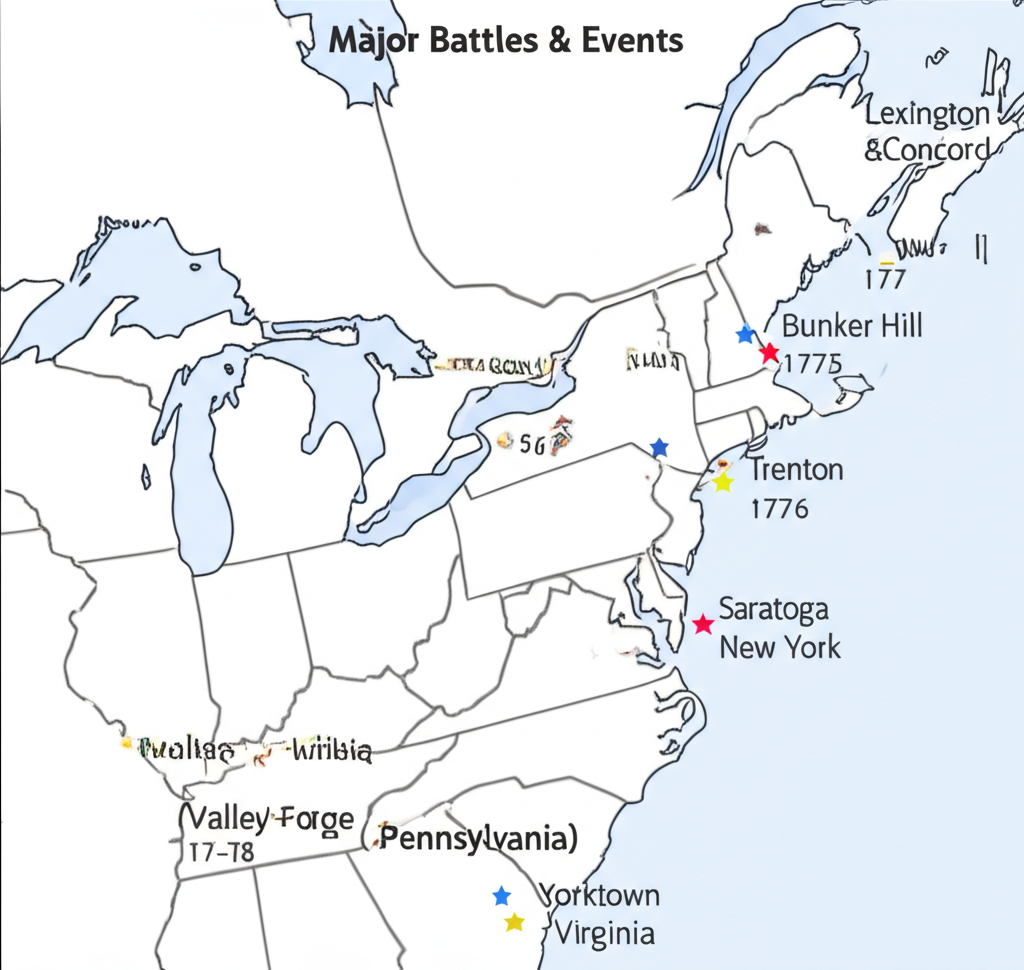
Lexington & Concord
The "shot heard round the world" — first military engagements. British marched to seize colonial arms but were confronted by minutemen, sparking the war.
Bunker Hill
British tactical victory, but with heavy casualties. Proved colonial militia could stand up to professional British army — boosted American confidence.
Trenton
Washington's daring surprise attack on Christmas night, crossing the icy Delaware River. Victory over Hessian troops boosted American morale after a string of defeats.
Saratoga — THE TURNING POINT
Decisive American victory in New York. Convinced France to ally with America, providing troops, navy, money, and supplies. Changed the course of the entire war.
Valley Forge (Winter 1777-1778)
Not a battle — a brutal winter camp. Despite terrible suffering, Baron von Steuben trained the army. The Continental Army emerged stronger and more disciplined.
Yorktown — Final Major Battle
Combined American and French forces trapped British General Cornwallis at Yorktown, Virginia. The French navy blocked escape by sea. Cornwallis surrendered, effectively ending the war.
7The Home Front & Other Perspectives
The Revolution was a complex conflict that impacted all segments of society. Not everyone supported independence, and many groups had to navigate difficult choices.
Role of Women
Women managed farms and businesses while men fought. The Daughters of Liberty made clothes, supplies, and ammunition. Some served as nurses, spies, or even disguised themselves as soldiers — like Deborah Sampson. Others provided support near battlefields, earning names like "Molly Pitcher."
African Americans
Both sides offered freedom to enslaved people who joined their ranks. Lord Dunmore's Proclamation (1775) offered freedom to those who fought for Britain. Thousands of African Americans also fought for the Patriot cause, hoping independence would bring an end to slavery — though this hope was largely unfulfilled immediately after the war.
Native Americans
Most tribes allied with the British, who promised to limit colonial expansion into their territories. They feared that an independent United States would mean unchecked westward expansion.
After Saratoga, France formally allied with America. This was a game-changer — France provided financial aid, military troops (including Lafayette), and the French navy, which proved decisive at Yorktown. Benjamin Franklin's diplomacy in Paris was crucial to securing this alliance.
8The Treaty of Paris & Aftermath
Treaty of Paris (1783)
- Britain recognized American independence — the most significant outcome
- Territory: U.S. gained land east of the Mississippi River, north to the Great Lakes, south to Florida
- Negotiated by John Adams, Benjamin Franklin, and John Jay
Challenges Ahead
War Debt
The new nation faced significant debt from the war and struggled to raise revenue.
Weak Government
The Articles of Confederation proved too weak to govern effectively, leading to the drafting of the Constitution.
Global Legacy
The American Revolution inspired the French Revolution (1789) and democratic movements worldwide, demonstrating that a people could successfully overthrow monarchical rule and establish a republic based on liberty and self-governance.
9Memory Aids
For Some Tea, Boys Threw It Carefully. = French & Indian War, Stamp Act, Townshend Acts, Boston Massacre, Tea Party, Intolerable Acts, Continental Congress.
Little Boys Try Some Very Yummy. = Lexington & Concord, Bunker Hill, Trenton, Saratoga, Valley Forge, Yorktown.
Life, Liberty, Pursuit of Happiness are Unalienable Rights from Consent of the governed.
Patriots Protested for People's Power. Loyalists were Loyal to the Lord (King).
Washington Warred (Commander). Jefferson Jotted (Declaration). Franklin Friended France (Diplomat). Adams Argued (Advocate). Paine Persuaded (Common Sense).
Quick Revision Summary
- ✓The American Revolution (1765-1783) was thirteen colonies breaking free from British rule.
- ✓British debt from the French and Indian War led to new colonial taxes.
- ✓"No taxation without representation" was the key rallying cry against the Stamp Act and Townshend Acts.
- ✓The Boston Massacre (1770) and Boston Tea Party (1773) escalated tensions dramatically.
- ✓The Intolerable Acts punished Massachusetts and united the colonies against Britain.
- ✓Thomas Jefferson authored the Declaration of Independence (July 4, 1776), drawing on Locke's ideas.
- ✓Key principles: all men created equal, unalienable rights, government by consent, right to alter/abolish.
- ✓Lexington & Concord (1775): "shot heard round the world" — first battles.
- ✓Saratoga (1777): THE TURNING POINT — convinced France to ally with America.
- ✓Valley Forge (1777-78): harsh winter, but Continental Army emerged stronger and more disciplined.
- ✓Yorktown (1781): final major battle — British surrender ended the fighting.
- ✓Colonists were divided: ~1/3 Patriots, ~1/3 Loyalists, ~1/3 neutral.
- ✓Women, African Americans, and Native Americans all played significant roles in the war.
- ✓The French alliance (1778) provided crucial troops, navy, money, and supplies.
- ✓The Treaty of Paris (1783) recognized independence and established U.S. borders.
Frequently Asked Questions
- What was the main cause of the American Revolution?
- There was no single cause — it was a series of escalating tensions. After the French and Indian War, Britain tried to tax the colonies to pay its war debts (Stamp Act, Townshend Acts, Tea Act). Colonists objected with "no taxation without representation." Harsh British responses like the Intolerable Acts pushed the colonies toward unity and independence.
- Why was the Battle of Saratoga so important?
- Saratoga (1777) is considered the turning point of the war. The decisive American victory convinced France that the Americans could actually win, leading to the French alliance. France provided troops, naval power, money, and supplies that proved essential to the eventual American victory at Yorktown.
- What are the key ideas in the Declaration of Independence?
- The Declaration, primarily written by Thomas Jefferson, states that all men are created equal with unalienable rights to life, liberty, and the pursuit of happiness. Government derives its power from the consent of the governed, and the people have the right to alter or abolish a government that fails to protect their rights.
- Did all colonists support the Revolution?
- No. Roughly one-third were Patriots (supported independence), one-third were Loyalists (supported Britain), and one-third were neutral. Loyalists had various reasons: loyalty to the crown, fear of change, economic ties to Britain, or belief that Britain would win. Many Loyalists fled to Canada or Britain during and after the war.
- How did France help the American cause?
- After the American victory at Saratoga in 1777, France formally allied with the United States in 1778. France provided crucial financial aid (loans and subsidies), military troops (including the Marquis de Lafayette), and most importantly the French navy, which was decisive at the Battle of Yorktown in trapping the British army and ending the war.
Practice Quiz
Test your understanding — select the correct answer for each question.
1.Which event is considered the 'turning point' of the American Revolution because it convinced France to support the American cause?
2.The phrase 'no taxation without representation' was a direct response to which British policy?
3.Who was the primary author of the Declaration of Independence?
4.Which of the following was NOT a key idea expressed in the Declaration of Independence?
5.What was the purpose of the Intolerable Acts?
6.Which figure was instrumental in securing the crucial French alliance for the American cause?
7.What term describes a colonist who remained loyal to the British Crown during the American Revolution?
8.The Treaty of Paris (1783) officially:
9.Which best describes the role of women during the American Revolution?
10.Thomas Paine's pamphlet Common Sense was significant because it:
Final Study Advice
- 1.Know the chain of causes — from the French and Indian War through the Intolerable Acts to the First Continental Congress.
- 2.Understand the Declaration's key ideas and how they connected to Enlightenment philosophy (especially Locke).
- 3.Remember why Saratoga was the turning point (French alliance) and how Yorktown ended the war.
- 4.Consider multiple perspectives — Patriots, Loyalists, women, African Americans, and Native Americans all experienced the Revolution differently.
- 5.Connect the Revolution to its aftermath — the Treaty of Paris, war debt, weak Articles of Confederation, and the eventual Constitution.