Colonial America
Colonial America spans from the founding of Jamestown in 1607 through the eve of the American Revolution in the 1770s. During this era, thirteen distinct British colonies developed along the eastern coast of North America, establishing the political, economic, and cultural foundations of the United States.
This guide covers the three colonial regions, economies and labor systems, self-government, colonial society, the Great Awakening and Enlightenment, and includes a practice quiz to test your knowledge.
1Introduction
Colonial America was a crucible that forged the foundations of the United States. The struggles for survival, the quest for religious freedom, the development of self-governance, and the complex relationships with Indigenous peoples and the institution of slavery all shaped the nation that would emerge.
Many modern American institutions, values, and even ongoing societal tensions trace their roots directly back to colonial origins — from the legal system and democratic ideals to regional differences in culture and economy.
Imagine stepping off a ship in 1620 onto a rocky New England shore — everything you know is thousands of miles away. You must build shelter, grow food, form a government, and coexist with Indigenous peoples who have lived here for millennia. This was the daunting reality for early colonists.
Interactive: Colonial America Timeline
Click on any event to learn more about key moments in Colonial American history.
2Key Definitions
Colony
A territory under the political control of another country, occupied by settlers from that country.
Charter
A written grant of authority from the king outlining rights and privileges for establishing a colony.
Joint-Stock Company
A business entity where investors pool money to fund a venture (like founding a colony) and share profits and losses.
Indentured Servant
A person who agreed to work for 4-7 years in exchange for passage to the New World, gaining freedom afterward.
Mercantilism
The economic theory that colonies exist to benefit the mother country by providing raw materials and markets.
Triangular Trade
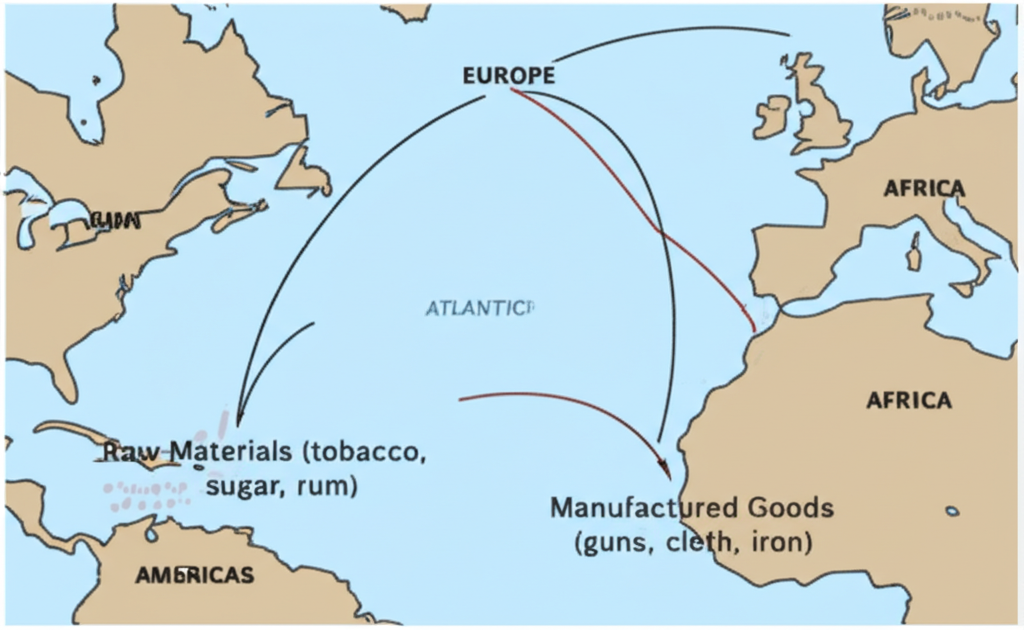
A transatlantic trade network exchanging goods, raw materials, and enslaved people between Europe, Africa, and the Americas.
Middle Passage
The brutal sea journey that forcibly transported millions of enslaved Africans across the Atlantic to the Americas.
Salutary Neglect
Britain's unofficial policy of not strictly enforcing trade laws, allowing colonies to largely govern themselves.
Cash Crop
A crop produced for commercial sale rather than personal use — tobacco, rice, and indigo in the Southern colonies.
Navigation Acts
British laws restricting colonial trade to ensure that colonies benefited the mother country under mercantilist principles.
Pilgrim
Separatist who broke from the Church of England
Plymouth, 1620
Puritan
Reformer who wanted to purify the Church of England
Massachusetts Bay, 1630
Quaker
Pacifist who believed in the "inner light" and tolerance
Pennsylvania
3The Three Colonial Regions
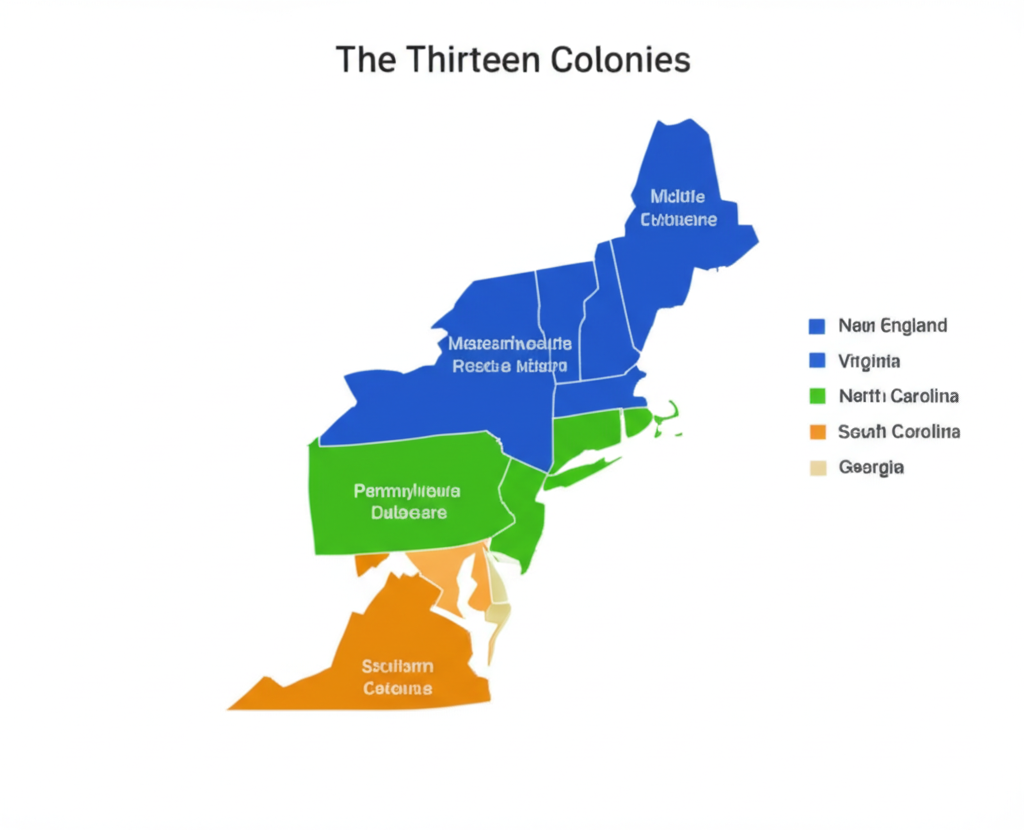
The thirteen British colonies developed distinct characteristics based on geography, climate, economy, and founding principles. They are grouped into three regions:
New England Colonies
Massachusetts, Connecticut, Rhode Island, New Hampshire
- Geography: Rocky soil, dense forests, long cold winters, short growing season
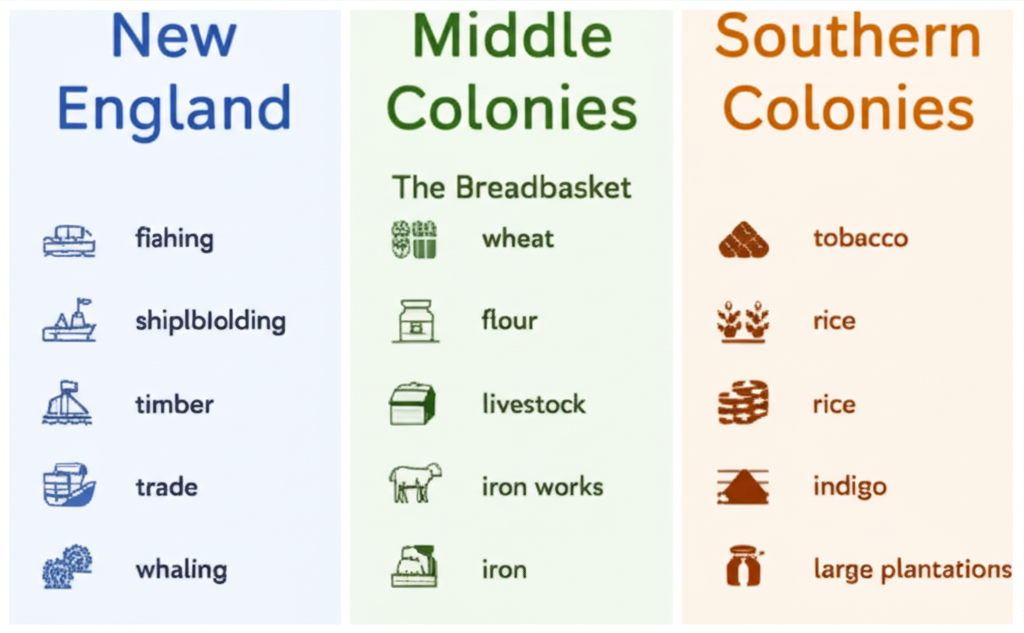
- Economy: Fishing, whaling, shipbuilding, timber, trade. Boston was a major port
- Society: Puritan religious influence, town meetings, emphasis on education and literacy
- Key settlements: Plymouth (1620, Pilgrims) and Massachusetts Bay (1630, Puritans)
Middle Colonies
New York, New Jersey, Pennsylvania, Delaware
- Geography: Fertile soil, navigable rivers, moderate climate, longer growing season
- Economy: Known as the "breadbasket" — wheat, corn, rye. Also trade and manufacturing
- Society: Religious diversity and tolerance (Quakers, Dutch Reformed). More diverse population
- Major cities: Philadelphia (Pennsylvania) and New York City
Southern Colonies
Virginia, Maryland, North Carolina, South Carolina, Georgia
- Geography: Warm climate, long growing seasons, rich fertile soil
- Economy: Plantation agriculture — cash crops like tobacco, rice, and indigo
- Society: Rigid social hierarchy, heavy reliance on enslaved labor, Anglican Church dominant
- Key settlements: Jamestown (1607, first permanent English settlement), Maryland (Catholic haven)
4Colonial Economies & Labor Systems
The economic life of the colonies was deeply shaped by European mercantilist policies and the demand for labor.
Mercantilism & the Navigation Acts
Under mercantilism, Britain viewed its colonies as a source of raw materials and a captive market for manufactured goods. The Navigation Acts required colonial goods to be shipped on English ships and pass through English ports — though salutary neglect meant these laws were loosely enforced.
The Triangular Trade
The Middle Passage
The Middle Passage was the horrific leg of the triangular trade that forcibly transported millions of enslaved Africans across the Atlantic. Conditions were brutal, with high mortality rates due to disease, starvation, and violence.
Indentured Servitude vs. Chattel Slavery
Indentured Servitude
Temporary (4-7 years). Voluntary contract in exchange for passage. Gained freedom and sometimes land afterward. Mostly European.
Chattel Slavery
Permanent and inherited. Forcible. Enslaved people were considered property with no rights. Primarily imposed on Africans and their descendants.
5Colonial Government & Self-Rule
Despite being under British rule, the colonies developed significant forms of self-government, laying the groundwork for future independence.
Key Documents & Institutions
House of Burgesses (1619)
The first representative assembly in colonial America, established in Jamestown, Virginia. Set an important precedent for elected representation.
Mayflower Compact (1620)
Signed by the Pilgrims before landing at Plymouth. Established civil government based on consent of the governed — an early social contract.
Fundamental Orders of Connecticut (1639)
Often considered the first written constitution in North America. Established a detailed framework for representative government.
Town Meetings & Salutary Neglect
Town meetings in New England were a direct form of democracy where eligible citizens gathered to discuss and vote on local issues. Meanwhile, Britain's policy of salutary neglect — not strictly enforcing trade laws — allowed the colonies to develop their own political institutions, fostering a strong tradition of self-reliance.
6Colonial Society & Daily Life
Social Hierarchy
Wealthy Planters & Merchants
Significant economic and political power, especially in the South
Small Farmers & Artisans
The largest group — the backbone of colonial society
Indentured Servants
Temporarily at the bottom, working off their passage
Enslaved People
Considered property with no rights; their labor formed the economic engine of the plantation South
Religion, Education & Family
Religion was central to colonial life: Puritanism shaped laws and education in New England, Quakerism promoted tolerance in Pennsylvania, and the Anglican Church dominated the South. New England placed a high emphasis on literacy — Massachusetts required towns to establish schools, and Harvard College was founded in 1636.
The family was the primary social and economic unit. Men held public authority, while women managed households and assisted in farm work. Child mortality rates were high.
Relations with Native Americans
Relations were complex, shifting between cooperation, trade, and violent conflict. Early interactions often involved trade, but as colonial populations grew, land disputes intensified. Major conflicts included King Philip's War (1675-1678) in New England and Bacon's Rebellion (1676) in Virginia, which was partly fueled by disputes over Native American land.
7The Great Awakening & Enlightenment
Two powerful movements — one religious, one intellectual — profoundly shaped colonial thought and helped plant the seeds for the American Revolution.
The Great Awakening (1730s-1740s)
- Powerful religious revival movement
- Jonathan Edwards: fiery sermons ("Sinners in the Hands of an Angry God")
- George Whitefield: itinerant preacher, massive crowds
- Challenged established churches, promoted individualism
- Created a shared inter-colonial identity
The Enlightenment
- Intellectual movement emphasizing reason and individual rights
- John Locke: natural rights (life, liberty, property) and social contract
- Montesquieu: separation of powers
- Benjamin Franklin: embodied Enlightenment ideals
- Provided the philosophical framework for revolution
The Great Awakening fostered a sense of individual worth and a willingness to question authority. The Enlightenment provided the intellectual justification — natural rights, popular sovereignty, and the right to resist tyranny. Together, they prepared the colonists mentally and emotionally for independence.
8Memory Aids
New England: Navigate (fishing/trade), Nip-cold (winters). Middle: Mixed (diversity), More bread (breadbasket). Southern: Sunny (warm), Slave-based (plantations).
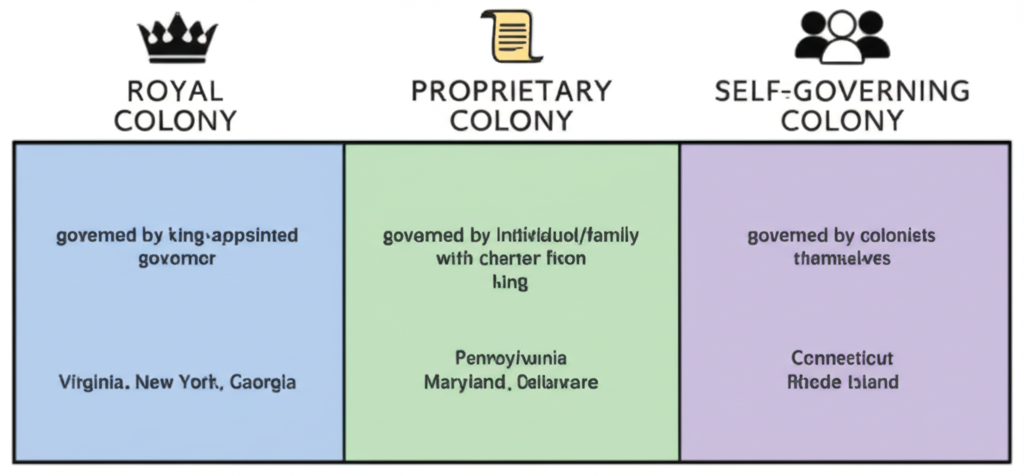
Royal: Ruler (King) is in charge. Proprietary: Person (Proprietor) owns it. Self-Governing: Self-rule (Colonists choose).
Pilgrims = Separatists, Mayflower (Plymouth, 1620) — "Pilgrims Said Move!" Puritans = Reformers, Massachusetts Bay (1630) — "Puritans Really Mean it!"
1607: Jamestown ("Just Started"). 1619: House of Burgesses ("History Happens"). 1620: Mayflower ("Many Men Made a Pact"). 1636: Harvard ("Higher Education Starts"). 1639: Fundamental Orders ("First Formal Framework").
Europe sends Manufactured goods to Africa. Africa sends Enslaved people to the Americas. Americas send Raw materials to Europe. Remember: M-E-R (like "MERchant").
Quick Revision Summary
- ✓Colonial America spans from Jamestown (1607) to the eve of the Revolution (1770s).
- ✓New England: rocky soil, fishing/trade, Puritan influence, town meetings.
- ✓Middle Colonies: fertile "breadbasket," religious diversity, major cities (Philadelphia, New York).
- ✓Southern Colonies: warm climate, plantation agriculture, cash crops, enslaved labor.
- ✓Mercantilism: colonies exist to benefit the mother country; enforced by Navigation Acts.
- ✓Triangular Trade: goods, enslaved people, and raw materials between Europe, Africa, and the Americas.
- ✓Indentured servitude was temporary; chattel slavery was permanent and inherited.
- ✓House of Burgesses (1619): first representative assembly. Mayflower Compact (1620): early social contract.
- ✓Fundamental Orders of CT (1639): often called the first written constitution.
- ✓Salutary neglect: Britain's hands-off approach allowed colonial self-governance to flourish.
- ✓Pilgrims = Separatists (Plymouth, 1620). Puritans = Reformers (Mass. Bay, 1630).
- ✓Great Awakening: religious revival promoting individualism and questioning authority.
- ✓Enlightenment: reason, natural rights (Locke), social contract — intellectual framework for revolution.
- ✓Native American relations involved trade, alliances, and conflict (King Philip's War, Bacon's Rebellion).
- ✓Both the Great Awakening and Enlightenment planted the seeds for the American Revolution.
Frequently Asked Questions
- What were the three colonial regions and how did they differ?
- The New England Colonies (Massachusetts, Connecticut, Rhode Island, New Hampshire) had rocky soil and relied on fishing, trade, and shipbuilding. The Middle Colonies (New York, New Jersey, Pennsylvania, Delaware) were the "breadbasket" with fertile soil and religious diversity. The Southern Colonies (Virginia, Maryland, the Carolinas, Georgia) had warm climates and plantation economies based on cash crops like tobacco and rice, relying heavily on enslaved labor.
- What is the difference between indentured servants and enslaved people?
- Indentured servants voluntarily agreed to work for a set number of years (typically 4-7) in exchange for passage to the colonies, and they gained freedom afterward. Enslaved people were forcibly taken from Africa, considered permanent property with no rights, and their status was inherited by their children. Indentured servitude was temporary and contractual; chattel slavery was permanent and dehumanizing.
- What was salutary neglect and why did it matter?
- Salutary neglect was Britain's unofficial policy of not strictly enforcing trade laws and regulations in the colonies. This hands-off approach allowed colonists to develop their own political institutions, local governments, and a strong sense of self-reliance — which ultimately made them less willing to accept tighter British control later on.
- What were the Mayflower Compact and the House of Burgesses?
- The Mayflower Compact (1620) was an agreement signed by the Pilgrims establishing self-government based on the consent of the governed — an early social contract. The House of Burgesses (1619) was the first representative legislative assembly in colonial America, established in Virginia. Both were important steps toward democratic self-governance.
- How did the Great Awakening and the Enlightenment influence the colonies?
- The Great Awakening (1730s-1740s) was a religious revival that promoted individualism, questioned established authority, and created a shared inter-colonial identity. The Enlightenment emphasized reason, natural rights (Locke), and the social contract. Together, they planted the intellectual and emotional seeds for the American Revolution by encouraging colonists to question authority and assert their rights.
Practice Quiz
Test your understanding — select the correct answer for each question.
1.Which of the following was the first permanent English settlement in North America, founded in 1607?
2.The economic theory that stated colonies existed to benefit the mother country by providing raw materials and markets for goods was called:
3.Which colonial region was known as the "breadbasket" for its grain production, religious diversity, and major port cities?
4.The horrific voyage that brought enslaved Africans across the Atlantic Ocean to the Americas was known as the:
5.What was the name of the first representative assembly in colonial America, established in Virginia in 1619?
6.Which document is often considered the first written constitution in North America?
7.The religious revival movement that swept through the colonies in the 1730s and 1740s, emphasizing personal religious experience, was called the:
8.Which Enlightenment philosopher greatly influenced American thought with his ideas of natural rights and the social contract?
9.What was "salutary neglect"?
10.In the Southern Colonies, which of the following was a primary cash crop that fueled the plantation economy and reliance on enslaved labor?
Final Study Advice
- 1.Learn the three colonial regions and their key differences — geography, economy, society, and religion.
- 2.Understand mercantilism and how it shaped the relationship between Britain and the colonies.
- 3.Know the key documents (Mayflower Compact, House of Burgesses, Fundamental Orders) and why they matter.
- 4.Be able to distinguish between indentured servitude and chattel slavery — both the system and its impact.
- 5.Connect the Great Awakening and Enlightenment to the causes of the American Revolution.