The Constitution & Bill of Rights
The U.S. Constitution (1787) is the supreme law of the land, establishing the framework for the federal government. The Bill of Rights (1791) — the first ten amendments — guarantees fundamental individual liberties like freedom of speech, religion, and the right to a fair trial.
This guide covers the weaknesses of the Articles of Confederation, the Constitutional Convention and its compromises, the separation of powers and checks and balances, the Bill of Rights, and the amendment process — with a practice quiz to test your knowledge.
1Introduction
The Constitution and the Bill of Rights are not just old documents — they are living blueprints that define our government, protect our freedoms, and shape our daily lives. The Constitution is the oldest written national constitution still in use today.
Together, these documents form the bedrock of American democracy. They define who holds power, how that power is exercised, and — most importantly — what rights individuals possess that the government cannot infringe upon.
It's 1787. You are a delegate at the Constitutional Convention in Philadelphia. The summer heat is oppressive, tensions are high between large and small states, and you must decide how to balance power between the federal government and the states while creating a system that will last for centuries. The fate of a young nation rests on your shoulders.
Interactive: Path to the Constitution
Click on any event to learn more about the journey from the Articles of Confederation to the Bill of Rights.
2Key Definitions
Constitution
The supreme law of the United States, establishing the structure and powers of the federal government.
Bill of Rights
The first ten amendments to the Constitution, guaranteeing fundamental individual liberties.
Federalism
A system of government where power is divided between a national (federal) government and state governments.
Separation of Powers
The division of governmental power into distinct branches: legislative, executive, and judicial.
Checks and Balances
A system preventing any one branch from becoming too powerful by giving each branch ways to limit the others.
Amendment
A formal change or addition to the Constitution.
Ratification
The formal approval or consent to a treaty, contract, or constitutional amendment.
Electoral College
A system for electing the President where electors chosen by each state cast votes based on the popular vote.
Veto
The power of the President to reject a bill passed by Congress, preventing it from becoming law.
Impeachment
The process by which a legislative body formally charges a high-ranking government official with misconduct.
Preamble
Introductory statement outlining
the Constitution's purposes
Great Compromise
Created bicameral Congress:
House (pop.) + Senate (equal)
Suffrage
The right to vote in
political elections
3The Articles of Confederation
After declaring independence, the newly formed United States adopted the Articles of Confederation in 1781. It established a "firm league of friendship" among the states but created a very weak central government.
Weaknesses of the Articles
No Power to Tax
Could not directly tax states or individuals — had to request money, which states often refused.
No Regulation of Commerce
Could not regulate interstate trade, leading to economic disputes among states.
Weak Executive & Judiciary
No strong executive to enforce laws and no national court system to resolve disputes.
Unanimous Consent for Amendments
Any amendment required approval of all 13 states — nearly impossible to adapt.
No National Currency
States printed their own money, causing economic instability and confusion.
Shays' Rebellion (1786-1787)
Farmers in Massachusetts, many Revolutionary War veterans, rebelled against debt and high taxes. Led by Daniel Shays, they protested foreclosures and tax collections. The national government was powerless to raise an army to suppress it — forcing Massachusetts to rely on its state militia. This event highlighted the urgent need for a stronger national government.
The Constitutional Convention (May-September 1787)
55 delegates from 12 states (Rhode Island boycotted) gathered in Philadelphia. Instead of merely revising the Articles, they drafted an entirely new Constitution. Key figures: George Washington (presided), James Madison ("Father of the Constitution"), Benjamin Franklin (elder statesman), Alexander Hamilton (advocate for strong national government).
4The Great Compromises
The Convention was marked by intense disagreements, particularly between large and small states. Several crucial compromises saved it from collapse.
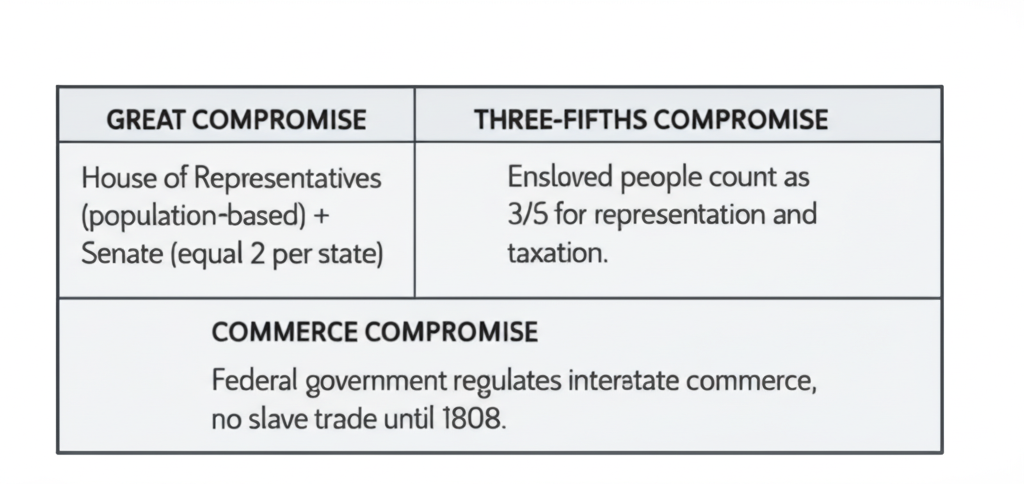
The three major compromises that shaped the Constitution
The Great Compromise (Connecticut Compromise)
Problem: Large states wanted representation based on population (Virginia Plan). Small states wanted equal representation (New Jersey Plan).
Solution: A bicameral Congress — the House of Representatives (based on population) and the Senate (two per state regardless of size).
Significance: Saved the Convention and established the basic structure of Congress we have today.
The Three-Fifths Compromise
Problem: Southern states wanted enslaved people counted for representation (more seats in Congress). Northern states disagreed.
Solution: Enslaved people would be counted as three-fifths of a person for representation and taxation.
Significance: A morally troubling concession that boosted Southern political power and perpetuated slavery.
The Commerce Compromise
Problem: Southern states feared Congress might tax exports or ban the slave trade. Northern states wanted trade regulation.
Solution: Congress could regulate interstate and foreign commerce but could not tax exports or interfere with the slave trade until 1808.
Significance: Protected Southern economic interests while granting vital federal trade powers.
5Separation of Powers & Checks and Balances
To prevent tyranny, the framers divided power into three branches and gave each branch ways to limit the others.
Three Branches of Government
Legislative
(Congress)
Makes laws, declares war, approves treaties, levies taxes
House: 435 members, 2-yr terms
Senate: 100 members, 6-yr terms
Executive
(President)
Enforces laws, commands military, conducts foreign policy
President: 4-yr term
+ VP, departments, agencies
Judicial
(Supreme Court)
Interprets laws, reviews constitutionality, resolves disputes
Supreme Court: 9 justices
+ federal appellate & district courts
How Each Branch Checks the Others
Legislative checks:
Override vetoes (2/3 vote), impeach President/judges, approve appointments & treaties
Executive checks:
Veto bills, call special sessions, appoint federal judges, grant pardons
Judicial checks:
Declare laws unconstitutional, declare presidential actions unconstitutional (judicial review)
Federalists vs. Anti-Federalists
The Constitution was not immediately accepted. Federalists (Hamilton, Madison, Jay) supported ratification and a strong federal government, writing The Federalist Papers to defend the Constitution. Anti-Federalists (Patrick Henry, George Mason) feared a powerful central government and demanded a Bill of Rights.
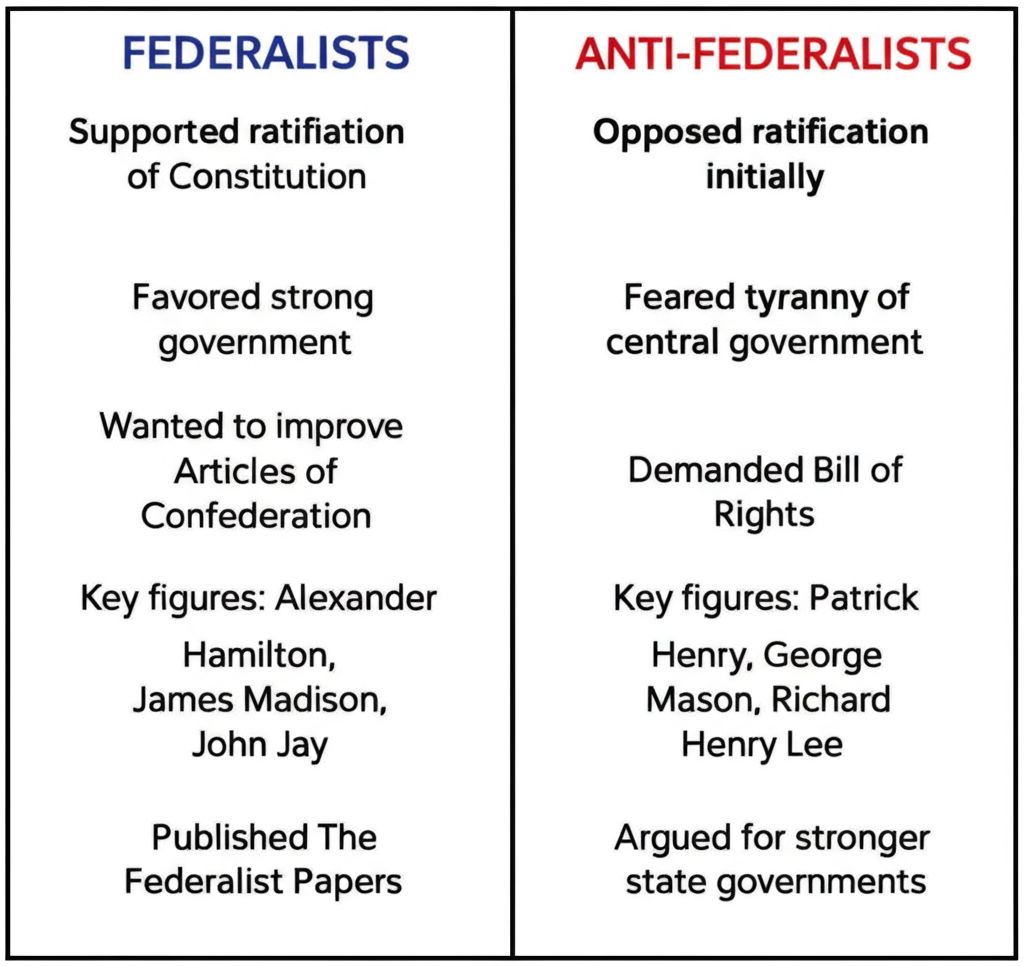
The Federalist vs. Anti-Federalist debate over ratification
Federalist No. 51 (James Madison): "Ambition must be made to counteract ambition." — arguing that the system of checks and balances would prevent tyranny by pitting branches against each other.
6The Bill of Rights
Anti-Federalists argued the Constitution lacked specific guarantees of individual liberties. To secure ratification, James Madison drafted a set of amendments. By December 1791, ten of twelve proposed amendments were ratified, becoming the Bill of Rights.
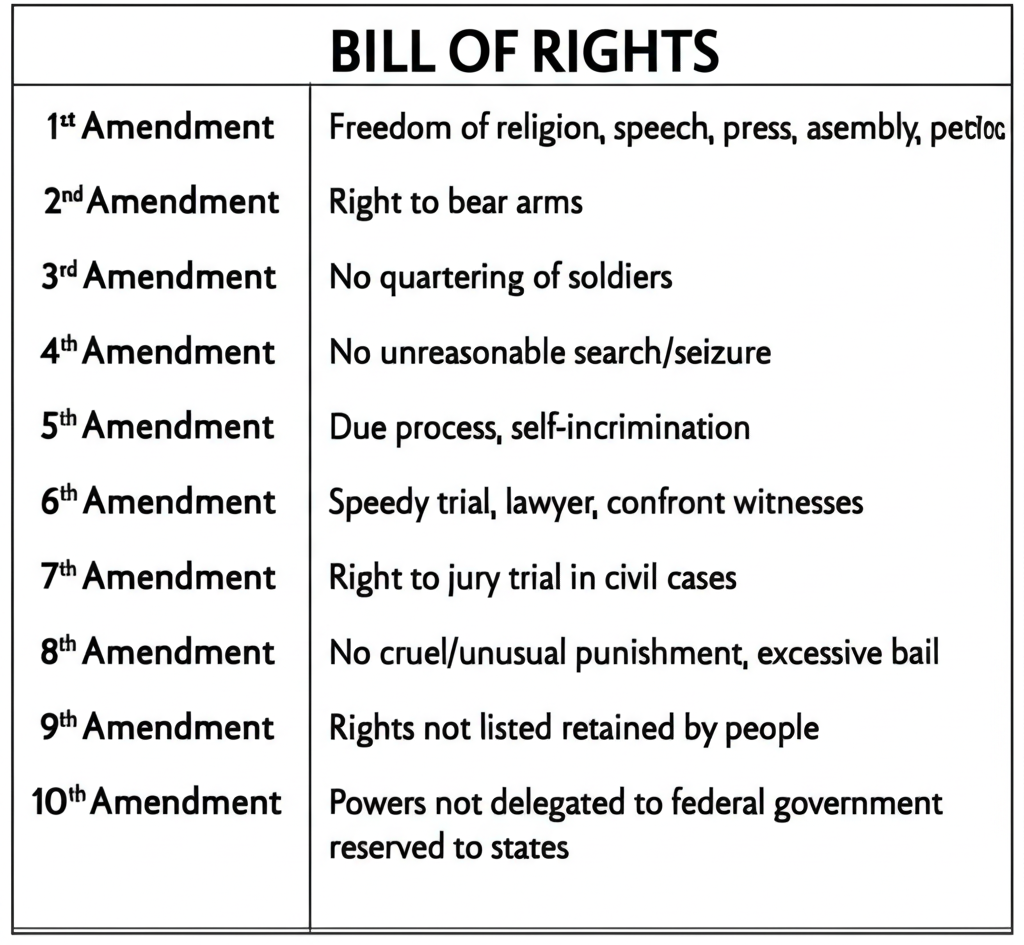
The first ten amendments and what each protects
The First Ten Amendments
Five Freedoms
Freedom of religion, speech, press, assembly, and petition.
Right to Bear Arms
Protects the right to keep and bear arms (often debated in context of militias and individual ownership).
No Quartering of Soldiers
Prohibits forcing private citizens to house soldiers in peacetime without consent.
Search & Seizure
Protects against unreasonable searches and seizures; requires warrants based on probable cause.
Due Process & Self-Incrimination
Grand jury, no double jeopardy, no self-incrimination ("taking the Fifth"), due process, and eminent domain protections.
Right to Fair Trial
Speedy and public trial, impartial jury, right to be informed of charges, confront witnesses, and have counsel (attorney).
Civil Trial by Jury
Guarantees the right to a jury trial in civil cases (disputes between individuals/organizations).
No Cruel & Unusual Punishment
Prohibits excessive bail and fines and cruel and unusual punishment.
Rights Retained by the People
Rights not listed in the Constitution are still retained by the people — the list is not exhaustive.
Powers Reserved to States
Powers not delegated to the federal government are reserved to the states or the people — reinforcing federalism.
7The Amendment Process
The framers included an amendment process in Article V, making the Constitution flexible yet difficult enough to change to prevent hasty modifications.
How to Amend the Constitution
Step 1: Proposal (choose one path)
By Congress
2/3 vote in both House & Senate
Used for all 27 amendments
By Convention
Called by 2/3 of state legislatures
Never successfully used
Step 2: Ratification (choose one path)
By State Legislatures
3/4 of state legislatures approve
Used for 26 of 27 amendments
By State Conventions
3/4 of states hold special conventions
Used once (21st Amendment)
Why So Difficult?
The high thresholds (2/3 to propose, 3/4 to ratify) ensure amendments reflect a broad national consensus, keep the Constitution stable, and prevent hasty or partisan changes. Only 27 amendments have been added in over 230 years.
8Memory Aids
Legislative (Congress — makes laws), Executive (President — enforces laws), Judicial (Supreme Court — interprets laws).
House of Representatives: "Huge" population, "Hundreds" of members (435). Senate: "Small" number (100), "States" get equal representation (2 each).
2/3 of Congress (or states) to propose, 3/4 of states to ratify. "Two-thirds propose, three-fourths make it so!"
Freedom (1st) → Arms (2nd) → Quartering (3rd) → Search (4th) → Due Process (5th) → Trials (6th & 7th) → Cruel Punishment (8th) → People's Rights (9th) → States' Rights (10th).
The "Great" Compromise dealt with the great, overarching structure of Congress (bicameral, representation). The "Three-Fifths" Compromise was a specific fraction dealing with counting enslaved people.
Quick Revision Summary
- ✓The U.S. Constitution (1787) is the supreme law, establishing the federal government framework.
- ✓The Bill of Rights (1791) — the first ten amendments — protects fundamental individual liberties.
- ✓The Articles of Confederation were too weak: no taxing power, no trade regulation, no executive.
- ✓Shays' Rebellion exposed the Articles' failures and pushed for a stronger government.
- ✓The Great Compromise created a bicameral Congress: House (population) + Senate (equal per state).
- ✓The Three-Fifths Compromise counted enslaved people as 3/5 of a person for representation.
- ✓Separation of powers: Legislative (makes laws), Executive (enforces), Judicial (interprets).
- ✓Checks and balances prevent any one branch from becoming too powerful.
- ✓Federalist Papers defended the Constitution; Anti-Federalists demanded the Bill of Rights.
- ✓The 1st Amendment protects speech, religion, press, assembly, and petition.
- ✓The 5th Amendment protects due process and against self-incrimination.
- ✓The 9th & 10th Amendments reserve rights to the people and states (federalism).
- ✓Amendments require 2/3 to propose and 3/4 to ratify — only 27 in 230+ years.
Frequently Asked Questions
- What is the difference between the Constitution and the Bill of Rights?
- The Constitution is the supreme law of the United States, adopted in 1787, establishing the framework and structure of the federal government — its three branches, their powers, and the relationship between federal and state governments. The Bill of Rights is the first ten amendments to the Constitution, ratified in 1791, which guarantee specific individual liberties like freedom of speech, religion, and the right to a fair trial. In short, the Constitution organizes the government; the Bill of Rights protects the people from the government.
- Why were the Articles of Confederation replaced?
- The Articles of Confederation created a central government that was too weak to function effectively. It could not tax citizens, regulate interstate commerce, or enforce laws. There was no executive branch to enforce laws and no national court system. Shays' Rebellion (1786-87) dramatically demonstrated these weaknesses when the national government couldn't raise an army to suppress an armed uprising. These failures led delegates to the Constitutional Convention in 1787, where they drafted an entirely new Constitution.
- What was the Great Compromise and why was it important?
- The Great Compromise (also called the Connecticut Compromise) resolved the bitter dispute between large and small states over representation in Congress. Large states wanted representation based on population (Virginia Plan), while small states wanted equal representation (New Jersey Plan). The compromise created a bicameral Congress: the House of Representatives with representation based on population (favoring large states) and the Senate with two senators per state regardless of size (favoring small states). This saved the Convention from collapse and established the structure of Congress we still use today.
- Why did Anti-Federalists demand a Bill of Rights?
- Anti-Federalists feared that the new Constitution created a federal government powerful enough to become tyrannical — just like the British monarchy they had recently fought to overthrow. They argued that without explicit, written guarantees of individual rights (such as freedom of speech, religion, and protection from unreasonable searches), the government could easily infringe on citizens' liberties. Their insistence was crucial: several states agreed to ratify the Constitution only on the condition that a Bill of Rights would be added, which James Madison delivered in 1791.
- How does the amendment process work?
- The amendment process has two stages. First, an amendment must be proposed — either by a two-thirds vote in both houses of Congress (the method used for all 27 existing amendments) or by a national convention called by two-thirds of state legislatures (never used). Second, the proposed amendment must be ratified — either by three-fourths of state legislatures (used for 26 of 27 amendments) or by special conventions in three-fourths of the states (used only once, for the 21st Amendment). The high thresholds ensure amendments reflect broad national consensus.
Practice Quiz
Test your understanding — select the correct answer for each question.
1.Which of the following was a major weakness of the Articles of Confederation?
2.The Great Compromise at the Constitutional Convention primarily resolved the dispute over:
3.The principle of separation of powers ensures that:
4.Which amendment protects freedom of speech, religion, and the press?
5.The purpose of checks and balances in the U.S. government is to:
6.Which group strongly advocated for the inclusion of a Bill of Rights in the Constitution?
7.How can an amendment to the U.S. Constitution be proposed?
8.The Three-Fifths Compromise dealt with:
9.Which branch of government is responsible for interpreting the laws and the Constitution?
10.Federalist No. 51, written by James Madison, primarily argued in favor of:
Final Study Advice
- 1.Know the weaknesses of the Articles and how Shays' Rebellion showed the need for change.
- 2.Understand the three major compromises (Great, Three-Fifths, Commerce) and what each resolved.
- 3.Be able to explain separation of powers and give examples of checks and balances.
- 4.Memorize the key amendments — especially the 1st, 2nd, 4th, 5th, 6th, 8th, and 10th.
- 5.Know the amendment process — 2/3 to propose, 3/4 to ratify — and why it's intentionally difficult.