Indigenous Peoples & Early Contact
Canada's Indigenous peoples — First Nations, Inuit, and Métis — have inhabited Turtle Island (North America) for thousands of years. Their rich histories, diverse cultures, and sophisticated governance systems are fundamental to understanding Canada.
This guide covers Indigenous nations before contact, European exploration, the fur trade, the Columbian Exchange, treaties and alliances, and key terms — plus a practice quiz.
1Introduction
Understanding Indigenous history is essential to understanding Canada's past and present — providing crucial context for ongoing discussions about treaties, the lasting impacts of residential schools, and the journey towards reconciliation.
Before contact, there were hundreds of distinct nations across Turtle Island, each with unique languages, sophisticated governance systems, spiritual traditions, and ways of life perfectly adapted to their environments.
Imagine a vast network of trade routes stretching from the Atlantic to the Pacific, with nations exchanging goods, stories, and ideas for thousands of years before any European ship appeared on the horizon. This was the reality of Indigenous life on Turtle Island.
Interactive: Early Contact Timeline
Click on any event to explore key moments in the history of Indigenous peoples and European contact.
2Key Definitions
First Nations
Hundreds of distinct nations across Canada
Largest Indigenous group
Inuit
Arctic peoples with distinct culture
Language: Inuktitut
Métis
Emerged from fur trade era
Language: Michif
Turtle Island
Indigenous name for North America, from creation stories where a great turtle carries the world.
Oral Tradition
Knowledge, history, and laws passed through generations via storytelling, songs, and ceremonies.
Potlatch
Pacific Northwest ceremonial feast involving gift-giving, performances, and affirming social status.
Wampum
Shell beads used for currency, adornment, and creating sacred belts to record treaties and laws.
Columbian Exchange
Transfer of plants, animals, diseases, and ideas between the Old World and the Americas after 1492.
Fur Trade
Exchange of animal furs (especially beaver) for European goods — the dominant colonial economy.
Royal Proclamation (1763)
Recognized Indigenous land rights; only the Crown could negotiate for Indigenous lands.
Reconciliation
The ongoing process of establishing respectful relationships between Indigenous and non-Indigenous peoples.
3Indigenous Nations Before Contact
Canada's Indigenous peoples lived in diverse geographic regions with distinct cultures adapted to their environments. Their societies were complex and sustainable, built on deep knowledge of their lands and waters.
Pacific Northwest Coast
Haida, Tlingit, Kwakwaka'wakw, Nuu-chah-nulth
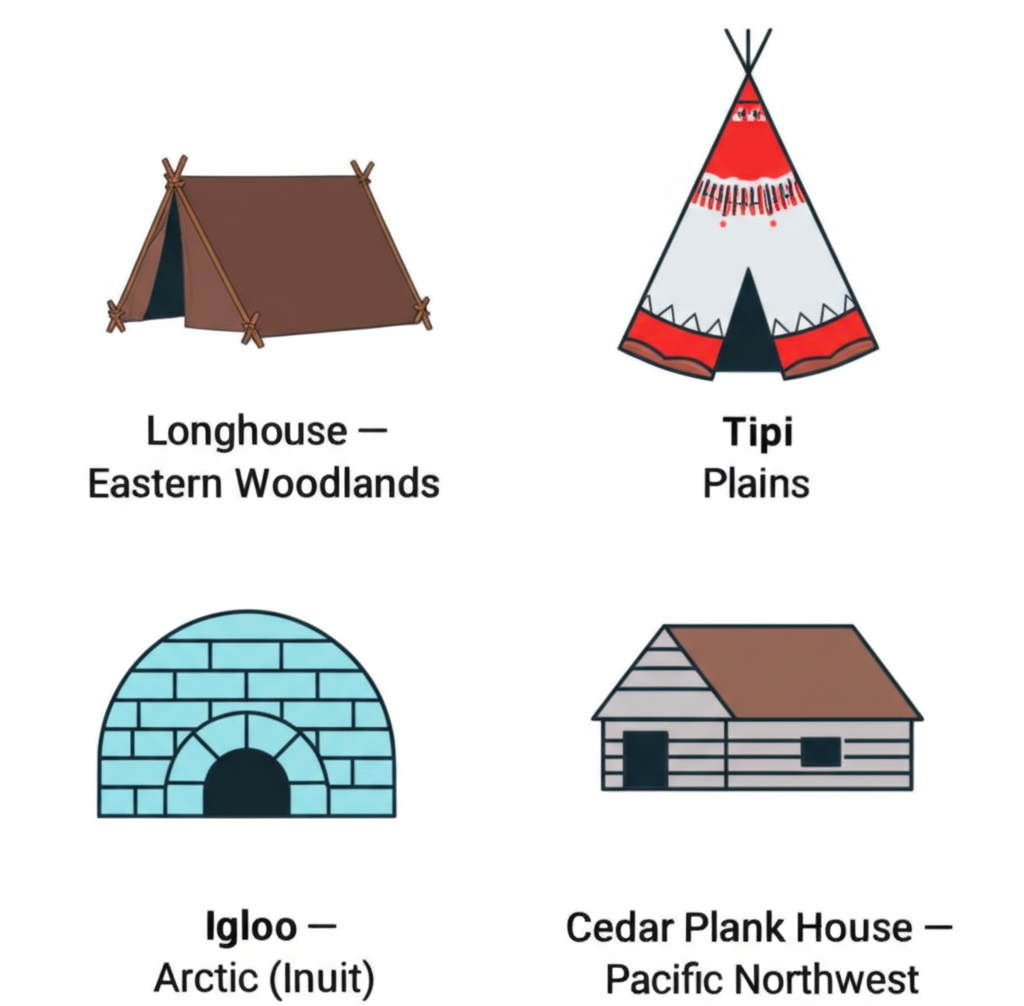
Rich marine resources (salmon), cedar forests. Known for totem poles, cedar longhouses, and elaborate potlatch ceremonies. Highly stratified societies.
Plains
Blackfoot, Cree, Sioux/Dakota, Assiniboine
Vast grasslands and buffalo herds. Nomadic tipi-dwelling, seasonal movements. Horse culture developed post-contact, revolutionizing hunting and travel.
Eastern Woodlands
Haudenosaunee, Anishinaabe/Ojibwe, Mi'kmaq, Huron-Wendat
Farming (Three Sisters: corn, beans, squash), hunting, fishing. Lived in longhouses and wigwams. Strong clan systems and confederacies.
Subarctic
Dene, Cree
Boreal forests, vast lakes and rivers. Hunting caribou and moose, trapping, fishing. Seasonal migration in small groups. Used snowshoes and canoes.
Arctic
Inuit
Treeless tundra and extreme cold. Marine mammal hunting (seals, whales). Used igloos, kayaks, and dog sleds. Rich oral traditions and remarkable survival skills.
Governance
The Haudenosaunee Confederacy (Mohawk, Oneida, Onondaga, Cayuga, Seneca, later Tuscarora) was governed by the Great Law of Peace — one of the world's oldest participatory democracies. Decisions were made through consensus with checks and balances. It even influenced the framers of the U.S. Constitution.
Spirituality
Indigenous spiritual traditions share common threads: a deep connection to the land, belief in the interconnectedness of all living things, and oral traditions for transmitting knowledge. Ceremonies like the potlatch, sweat lodge, and sundance played vital roles in community life. The Medicine Wheel teaches balance across four aspects: physical, mental, emotional, and spiritual.
4European Exploration & First Contact
Norse (Vikings)
Brief settlement at L'Anse aux Meadows, Newfoundland — the earliest known European contact. Did not lead to sustained settlement.
John Cabot
Italian explorer sponsored by England. Reached Atlantic Canada, claimed land for England, and reported abundant cod fisheries.
Jacques Cartier
French explorer who sailed up the St. Lawrence, claiming land for France. Met Iroquoian peoples at Stadacona (Quebec City) and Hochelaga (Montreal).
Samuel de Champlain
"Father of New France." Founded Quebec City and established crucial alliances with the Huron-Wendat and Algonquin, essential for French survival and the fur trade.
European Motivations
Fish & Furs
Cod fisheries and beaver pelts
Northwest Passage
Sea route to Asia
Empire & Religion
Claiming territory, spreading Christianity
5The Fur Trade
The fur trade (especially beaver pelts) became the primary economic relationship between Indigenous peoples and Europeans for over two centuries. Indigenous peoples were essential partners — not passive participants.
Indigenous Peoples as Active Partners
Indigenous peoples possessed vital knowledge of the land and trapping techniques. They served as trappers, guides, interpreters, negotiators, and suppliers of food and survival skills. They were not passive — they actively shaped the fur trade.
Hudson's Bay Company (1670)
British company with monopoly over Rupert's Land. Established trading posts along Hudson Bay.
Northwest Company
Montreal-based rival. Used voyageurs and coureurs des bois to push deeper into the interior.
Coureurs des Bois
"Runners of the woods" — independent French-Canadian traders who lived and traded in Indigenous territory.
Voyageurs
Licensed canoe-men employed by fur companies to transport furs and goods across vast distances.
Emergence of the Métis
The fur trade fostered close relationships between European traders and Indigenous women, leading to the emergence of the Métis as a distinct nation with their own culture, language (Michif), and identity — particularly in the Prairies.
Impact on Indigenous Peoples
New Goods
Metal tools, firearms, blankets, cloth
Dependency
Some nations became reliant on European goods
Disease
Smallpox, measles — devastating epidemics
Disruption
Traditional economies and social structures altered
6The Columbian Exchange & Its Impact
The Columbian Exchange was the widespread transfer of plants, animals, diseases, and ideas between the Old World and the Americas following European contact.
Americas to Europe
- Crops: Corn, potatoes, tomatoes, squash, beans, tobacco, chocolate
- Medicines: Quinine (for malaria), herbal remedies
- Technology: Canoe designs, snowshoes, toboggans
Europe to Americas
- Animals: Horses, cattle, pigs
- Goods: Metal tools, firearms, wheat, sugar
- Diseases: Smallpox, measles, influenza, typhus
Devastating Disease Impact
European diseases like smallpox, measles, and influenza were catastrophic. Indigenous peoples had no immunity, and epidemics killed up to 90% of some populations. This demographic collapse profoundly weakened societies, disrupted governance, and made communities more vulnerable to European expansion.
7Treaties, Alliances & Conflict
Early interactions involved a complex mix of alliances, trade agreements, and conflicts. The French allied with the Huron-Wendat and Algonquin, while the British later allied with the Haudenosaunee.
A foundational treaty between the Haudenosaunee and Dutch (later British). A wampum belt with two parallel rows symbolizes two vessels — canoe and ship — travelling side by side, each carrying its own people, laws, and customs, without interfering with the other. It embodies mutual respect and non-interference.
Royal Proclamation of 1763
- Issued by King George III after the Seven Years' War
- Recognized Indigenous title to lands not already ceded
- Only the Crown could negotiate for Indigenous land — not settlers or colonial governments
- Often called the "Magna Carta" of Indigenous rights in Canada
Differing Understandings of Treaties
Indigenous peoples often understood treaties as agreements for sharing the land while retaining sovereignty. Europeans often interpreted them as surrendering land and extinguishing Indigenous title. This fundamental misunderstanding laid the groundwork for future conflicts and injustices.
The Beaver Wars (1640s-1700s)
Devastating conflicts primarily between the Haudenosaunee (allied with the Dutch/British) and the Huron-Wendat and Algonquin (allied with France) over control of the fur trade. Indigenous peoples also played critical roles as allies in the larger colonial wars between France and Britain.
8Memory Aids
People Play Every Sunday Always = Pacific Northwest, Plains, Eastern Woodlands, Subarctic, Arctic.
Norse Came Carting Canoes = Norse (~1000), Cabot (1497), Cartier (1534), Champlain (1608).
Corn Brings Support = Corn (provides stalk for beans), Beans (fix nitrogen in soil), Squash (ground cover, prevents weeds). They grow together in harmony.
First Nations: diverse nations across most of Canada. Inuit: Arctic, marine hunters, Inuktitut. Métis: emerged from fur trade, Michif language, primarily Prairies. Remember: FIM.
Disease, Death, Disruption from Europe. New Food, New Tools, New Animals in both directions.
Quick Revision Summary
- ✓Canada's Indigenous peoples — First Nations, Inuit, Métis — have inhabited Turtle Island for thousands of years.
- ✓Hundreds of distinct nations with unique languages, governance, and cultures adapted to their environments.
- ✓Major cultural areas: Pacific Northwest Coast, Plains, Eastern Woodlands, Subarctic, Arctic.
- ✓The Haudenosaunee Confederacy and its Great Law of Peace — one of the world's oldest democracies.
- ✓Three Sisters: corn, beans, and squash grown together by Eastern Woodlands nations.
- ✓Norse (~1000 CE), Cabot (1497), Cartier (1534), Champlain (1608) — key European explorers.
- ✓The fur trade (beaver pelts) was the primary economic relationship. Indigenous peoples were essential active partners.
- ✓Hudson's Bay Company (1670) and Northwest Company — major fur trade rivals.
- ✓The Métis emerged as a distinct nation from unions between European traders and Indigenous women.
- ✓The Columbian Exchange brought devastating diseases (up to 90% mortality) alongside new goods and crops.
- ✓Indigenous contributions to Europe: corn, potatoes, tomatoes, tobacco, canoe technology, medicines.
- ✓The Two Row Wampum symbolizes two nations travelling side by side without interference.
- ✓The Royal Proclamation of 1763 recognized Indigenous land rights — the "Magna Carta" of Indigenous rights.
- ✓Treaties were often understood differently: Indigenous peoples saw sharing, Europeans saw surrender.
- ✓The Beaver Wars (1640s-1700s) were devastating conflicts over fur trade control.
Frequently Asked Questions
- What is the difference between First Nations, Inuit, and Métis?
- First Nations are the largest group of Indigenous peoples in Canada, comprising hundreds of distinct nations across the country. Inuit are Indigenous peoples primarily inhabiting the Arctic regions, with a distinct culture and language (Inuktitut). Métis are a distinct nation that emerged from unions between European fur traders and Indigenous women, with their own culture, language (Michif), and history, particularly in the Prairies.
- Why is the fur trade so important in Canadian history?
- The fur trade (especially beaver pelts) was the primary economic relationship between Indigenous peoples and Europeans for over two centuries. It shaped alliances, drove exploration, created the Métis nation, and fundamentally altered Indigenous economies and ways of life. Indigenous peoples were essential partners — not passive participants — serving as trappers, guides, interpreters, and negotiators.
- What was the Columbian Exchange and why did it matter?
- The Columbian Exchange was the transfer of plants, animals, diseases, and ideas between the Old World (Europe/Africa/Asia) and the New World (the Americas). Its most devastating impact was the introduction of European diseases like smallpox, which killed up to 90% of some Indigenous populations. It also brought new goods to both sides — horses and metal tools to the Americas, and corn and potatoes to Europe.
- What is the significance of the Royal Proclamation of 1763?
- The Royal Proclamation recognized Indigenous land rights and established that only the British Crown (not settlers or colonial governments) could negotiate for Indigenous lands. It is often called the "Magna Carta" of Indigenous rights in Canada and remains an important legal foundation for Crown-Indigenous relations and treaty rights today.
- What does the Two Row Wampum represent?
- The Two Row Wampum is a treaty belt symbolizing the relationship between the Haudenosaunee and European newcomers. Two parallel rows of purple beads represent two vessels (canoe and ship) travelling side by side down the river of life — each carrying its own people, laws, and customs, without interfering with the other. It embodies mutual respect and non-interference.
Practice Quiz
Test your understanding — select the correct answer for each question.
1.Which of the following terms refers to the distinct Indigenous people who emerged from unions between European fur traders and Indigenous women?
2.Which Indigenous cultural area is known for its cedar longhouses, totem poles, and potlatch ceremonies?
3.What was the primary economic relationship between Indigenous peoples and Europeans in early Canada?
4.Who was the French explorer credited with founding Quebec City in 1608 and forming alliances with the Huron-Wendat and Algonquin?
5.What was the most devastating impact of the Columbian Exchange on Indigenous populations?
6.The Haudenosaunee Confederacy is renowned for its sophisticated system of governance known as:
7.Which European explorer is associated with the earliest known European contact in North America around 1000 CE?
8.What does the Two Row Wampum belt symbolize in the context of Indigenous-European relations?
9.Which document, issued in 1763, recognized Indigenous land rights and stated that only the Crown could negotiate for Indigenous land?
10.Which Indigenous housing type was traditionally used by Plains nations and designed for nomadic buffalo hunting?
Final Study Advice
- 1.Remember that Indigenous peoples are diverse — hundreds of distinct nations, not a single group. Use specific nation names when possible.
- 2.Understand how geography shaped culture — Arctic Inuit, Plains buffalo hunters, Pacific Northwest fishers all adapted differently.
- 3.Know that Indigenous peoples were active participants in the fur trade and early alliances, not passive victims.
- 4.Understand the devastating impact of disease — it was the single most destructive consequence of the Columbian Exchange.
- 5.Connect this history to the present — treaties, residential schools, and reconciliation are ongoing issues rooted in this period.