New France
New France was the vast territory in North America colonized by France, stretching from the St. Lawrence River valley through the Great Lakes region and down the Mississippi River to the Gulf of Mexico. From the early 16th century until 1763, it shaped the cultural, political, and economic landscape of the continent.
This guide covers French exploration, the fur trade economy, colonial society and administration, Indigenous relations, the Louisiana colony, and the fall of New France — with a practice quiz to test your knowledge.
1Introduction
Understanding New France is crucial because it profoundly shaped the cultural, political, and economic landscape of North America. Its legacy is still evident today, particularly in the distinct French culture and language of Quebec, Canada, and in numerous place names and cultural traditions throughout the Mississippi River valley, especially in Louisiana.
The story of New France is one of exploration, trade, alliance, and ultimately, imperial rivalry — a tale of a colonial empire that spanned half a continent yet never attracted enough settlers to rival its British neighbor.
Imagine standing on the shores of the St. Lawrence River in 1608, watching Samuel de Champlain's small party build a wooden fort called Quebec. Around you, Indigenous hunters trade furs, and the vast interior of the continent stretches westward — a territory France claims but barely controls.
Interactive: New France Timeline
Click on any event to learn more about key moments in the history of New France.
2Key Definitions
New France (Nouvelle-France)
The area colonized by France in North America, existing from the 16th century until 1763.
Fur Trade
The primary economic activity of New France, involving the exchange of European goods for animal pelts (especially beaver) with Indigenous peoples.
Coureur de Bois
"Runners of the woods" — independent French-Canadian woodsmen who traveled into the interior to trade directly with Indigenous peoples for furs.
Voyageur
Licensed fur traders, often employees of fur companies, who transported goods and furs by canoe along trade routes.
Seigneur
A landlord who received large land grants (seigneuries) from the French crown and granted smaller plots to habitants.
Habitant
A French-Canadian farmer or tenant who lived and worked on land owned by a seigneur.
Governor
The highest-ranking official in New France, responsible for military affairs, foreign relations, and overall administration.
Intendant
The chief civil administrator in New France, responsible for justice, finance, and economic development.
Jesuit
A member of the Society of Jesus, a Catholic religious order prominent in New France for missionary work and establishing schools.
Treaty of Paris (1763)
The treaty that ended the Seven Years' War, resulting in France ceding most of its North American territories to Great Britain.
Quebec
Capital of New France, founded 1608
by Samuel de Champlain
Montreal
Major fur trade hub, founded 1642
on an island in the St. Lawrence
New Orleans
Strategic Mississippi port, founded 1718
at the mouth of the Mississippi
3Early French Exploration
French interest in North America began with fishing expeditions to the Grand Banks off Newfoundland. Soon, the allure of discovery and resources led to formal exploration.
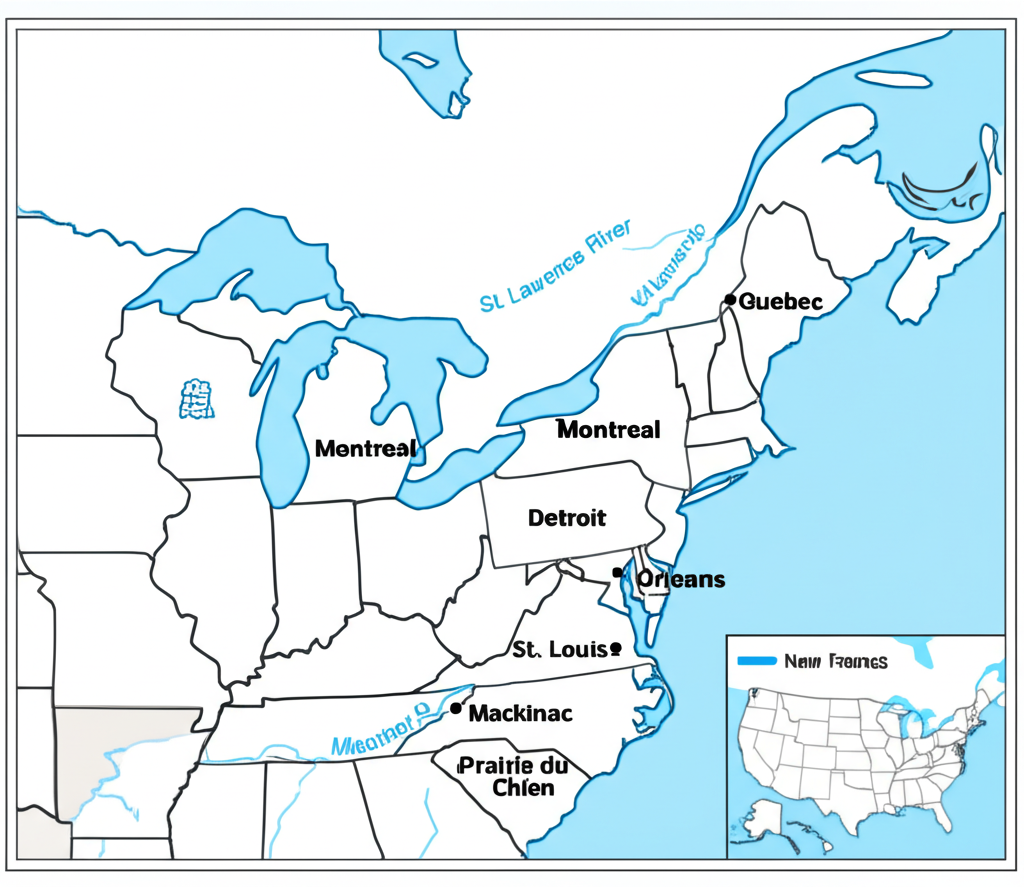
New France territory at its peak, showing key settlements along the St. Lawrence, Great Lakes, and Mississippi
Jacques Cartier (1534, 1535-36, 1541-42)
Made three voyages to North America. Claimed the Gulf of St. Lawrence for France in 1534, naming it "Canada" (from the Iroquoian word kanata meaning village). Explored the St. Lawrence River as far as present-day Montreal.
Samuel de Champlain: "Father of New France"
Founded Quebec in 1608, establishing the first permanent French settlement. A skilled cartographer and diplomat, he formed crucial alliances with the Huron and Algonquin peoples, putting the French in conflict with the Iroquois Confederacy.
Jolliet & Marquette (1673)
Explored the upper Mississippi River, confirming its southward flow and opening up the vast interior for French claims.
La Salle (1682)
Traveled the entire length of the Mississippi River, claiming the entire river valley for France and naming it Louisiana in honor of King Louis XIV.
Why did the French explore North America?
- •Establishing permanent fishing bases on the Grand Banks
- •Exploiting the lucrative fur trade
- •Searching for a mythical Northwest Passage to Asia
- •Spreading Catholicism to Indigenous peoples
4The Fur Trade Economy
The fur trade was the lifeblood of New France, shaping its geography, economy, and relations with Indigenous peoples. European demand for beaver pelts — used to make fashionable felt hats — drove the entire colonial enterprise.
How the Fur Trade Worked
Indigenous Hunters
Trapped beaver & other animals in forests
Trading Post (Fort)
Exchanged pelts for European goods
Montreal Fur Fair
Voyageurs transported furs by canoe
Shipped to France
Made into fashionable felt hats
European trade goods (metal tools, firearms, blankets, beads) flowed back in the opposite direction
Role of Indigenous Peoples
Indigenous nations were not merely suppliers — they were essential partners who controlled access to prime hunting grounds and trade routes. They taught the French survival skills, navigation, and the best methods for hunting and processing furs.
Montreal as the Hub
Montreal emerged as the central hub of the fur trade. Each summer, Indigenous traders and French voyageurs converged for annual fur fairs, exchanging goods and renewing alliances.
Impact on French Policy
The fur trade's profitability meant France had less incentive for large-scale agricultural settlement compared to the British colonies. This led to a relatively sparse French population spread over a vast territory.
5French Colonial Society & Administration
New France was administered directly by the French Crown, with a highly centralized governmental and social structure — quite different from the more self-governing British colonies.
Government Structure
👑 King of France
Ultimate authority, ruling from afar
⚔️ Governor
Military affairs, foreign policy, Indigenous relations, defense
📋 Intendant
Justice, finance, public works, civil administration
⛪ Bishop
Religious affairs, education, social services
🏰 Fort Commanders
Local military & trade control
🏪 Merchants
Trade & commerce
The dual Governor-Intendant leadership prevented any one official from gaining too much power
The Seigneurial System
The primary method of land distribution was a feudal-like system. The King granted large tracts of land (concessions) to seigneurs (lords), who divided their land into smaller strips (often measured in arpents) for habitants to farm. Habitants paid rent in goods, labor, or money and owed certain duties to their seigneur.
Social Structure
Nobility & Officials
Governor, Intendant, senior military officers, seigneurs
Merchants & Artisans
A growing middle class in towns like Quebec and Montreal
Habitants
The majority — farmers who worked the land under the seigneurial system
Coureurs de bois & Voyageurs
Independent and nomadic, bridging French and Indigenous cultures
The Catholic Church in New France
The Church was central to colonial life. Jesuit missionaries established missions to convert Indigenous peoples, often learning their languages and cultures. The Church also ran schools and hospitals, playing a vital role in education, healthcare, and moral guidance for colonists.
Population Gap
By 1760, New France had approximately 60,000 French settlers — a stark contrast to the nearly 2 million inhabitants of the British colonies. This demographic imbalance proved decisive in the final conflict between the two powers.
6French Relations with Indigenous Peoples
Unlike the British, who often sought to displace Indigenous populations for agricultural expansion, the French primarily focused on trade and military alliances, leading to a different dynamic.
Alliances
From Champlain's time, the French formed strong alliances with the Huron, Algonquin, and Odawa nations — primarily for access to furs and as military partners against the powerful Iroquois Confederacy.
Filles du Roi (Daughters of the King)
To boost the colonial population, around 800 young women were sent from France between 1663 and 1673. They were given dowries and quickly married settlers, contributing significantly to New France's population growth.
Jesuit Missions
Jesuit priests (called "Blackrobes" by Indigenous peoples) established missions, lived among Indigenous communities, learned their languages, and sought to convert them to Catholicism. Missions also served as cultural exchange points.
Cultural Exchange
The French adopted Indigenous technologies (canoes, snowshoes), foods (corn, maple syrup), and survival skills. Indigenous peoples acquired European goods, including firearms, metal tools, and textiles. However, exchange also brought devastating European diseases.
French vs. British Colonial Approaches
🇫🇷 New France
- •Population: ~60,000 (small)
- •Economy: Fur trade
- •Religion: Catholic
- •Language: French
- •Indigenous relations: Trade alliances
- •Settlement: Sparse, along rivers
- •Government: Direct royal control
🇬🇧 British Colonies
- •Population: ~2,000,000 (large)
- •Economy: Agriculture
- •Religion: Protestant (mostly)
- •Language: English
- •Indigenous relations: Displacement
- •Settlement: Dense, expanding inland
- •Government: Some self-governance
7Louisiana & the Mississippi River System
While the St. Lawrence River valley was the heart of New France, the vast Mississippi River system formed its southern and western reaches — extending French claims to an enormous territory.
Louisiana Named (1682)
La Salle named this immense territory Louisiana in honor of King Louis XIV, extending French claims from the Great Lakes down to the Gulf of Mexico — a territory larger than Western Europe.
New Orleans Founded (1718)
Founded to secure control of the Mississippi's mouth and establish a strategic port. New Orleans quickly grew into a crucial trade hub, connecting the interior fur trade with maritime routes to the Caribbean and France.
Illinois Country
The region in present-day Illinois and Missouri developed as an important agricultural area. French farmers settled here, supplying grain to southern posts and contributing to the fur trade network.
Economic Focus
Louisiana's economy centered on fur trade (especially from the Illinois Country), lead mining, and some agricultural production (tobacco, indigo, rice) using enslaved African labor, particularly around New Orleans.
Like Canada, Louisiana remained sparsely populated by French settlers, with greater reliance on enslaved labor and alliances with local Indigenous groups. Its vastness and distance from the St. Lawrence core made unified administration a constant challenge.
8The Fall of New France
The mid-18th century saw intense imperial rivalry between France and Great Britain, culminating in a global conflict that decided the fate of New France.
The French and Indian War (1754-1763)
This North American conflict was the colonial theater of the larger Seven Years' War (1756-1763) fought across Europe, Asia, and other colonial territories. It was primarily a struggle for control of North America between Britain and France, with their respective Indigenous allies.
Key Battles
Capture of Louisbourg
A crucial French fortress guarding the entrance to the St. Lawrence River. Its fall opened the way for a British attack on Quebec.
Battle of the Plains of Abraham
A decisive battle just outside Quebec between British General James Wolfe and French Marquis de Montcalm. Both commanders were killed, but the British victory led to the capture of Quebec.
Capture of Montreal
British forces converged on the last major French stronghold. Its surrender marked the effective end of French military control in North America.
Treaty of Paris (1763)
France ceded nearly all of its mainland North American territories to Britain, including Canada and eastern Louisiana. Western Louisiana was secretly ceded to Spain to prevent it from falling into British hands.
Impact on Indigenous Peoples
Indigenous nations lost a crucial ally and military counterweight against British expansion. The British became more assertive in claiming and settling Indigenous lands, leading to increased conflict such as Pontiac's War.
Despite the British victory, the French cultural and linguistic heritage of New France persisted. Quebec remained French-speaking and Catholic, forming a distinct society within British North America. French influence also lingered in Louisiana through its legal code, architecture, and Creole culture.
9Memory Aids
Champlain Launched Journeys Many Questions: Cartier (St. Lawrence, claimed Canada) → La Salle (Mississippi, Louisiana) → Jolliet & Marquette (Upper Mississippi) → Quebec (Champlain founded it).
Governor (Military & Foreign Affairs) + Intendant (Civil & Financial) + Bishop (Religious & Social).
St. Lawrence River → Great Lakes → Mississippi River → Gulf of Mexico.
1608 Quebec founded by Champlain. 1642 Montreal founded. 1763 Treaty of Paris (Fall of New France).
French: Fur, Friendship (with Indigenous), Few (population). British: Bread (agriculture), Battle (with Indigenous), Big (population).
Quick Revision Summary
- ✓New France was the French colonial empire in North America from the early 16th century to 1763.
- ✓Territory stretched from the St. Lawrence River through the Great Lakes and down the Mississippi to the Gulf of Mexico.
- ✓Jacques Cartier claimed Canada for France; Samuel de Champlain founded Quebec in 1608.
- ✓The fur trade (driven by European demand for beaver pelts) was the economic backbone.
- ✓Coureurs de bois and voyageurs were key figures in the fur trade.
- ✓Indigenous peoples were essential trade partners, not just suppliers.
- ✓Government: Governor (military) + Intendant (civil) + Bishop (religious).
- ✓The seigneurial system distributed land through seigneurs to habitants along waterways.
- ✓Population: only ~60,000 vs. nearly 2 million in British colonies.
- ✓La Salle claimed the Mississippi valley for France in 1682, naming it Louisiana.
- ✓New Orleans (1718) was a vital port at the mouth of the Mississippi.
- ✓The French and Indian War (1754-1763) ended French control of North America.
- ✓The Battle of the Plains of Abraham (1759) was the decisive turning point.
- ✓The Treaty of Paris (1763) ceded nearly all French territories to Britain.
- ✓French legacy persists in Quebec's language and culture and Louisiana's Creole heritage.
Frequently Asked Questions
- Why did New France have such a small population compared to the British colonies?
- New France's economy centered on the fur trade, which required a vast territory but few settlers. France also had strict immigration policies — only Catholics were allowed to settle. The harsh climate and the seigneurial system made farming less attractive. Meanwhile, the British colonies encouraged mass immigration and focused on agriculture, which supported dense settlement. By 1760, New France had only about 60,000 settlers compared to nearly 2 million in the British colonies.
- What was the role of coureurs de bois and voyageurs in New France?
- Coureurs de bois ('runners of the woods') were independent French-Canadian woodsmen who traveled deep into the interior to trade directly with Indigenous peoples for furs, often without official licenses. Voyageurs were licensed fur traders, typically employees of fur companies, who transported goods and furs by canoe along established trade routes. Both groups were essential to the fur trade economy and served as cultural intermediaries between French and Indigenous societies.
- How did French relations with Indigenous peoples differ from British relations?
- The French primarily sought trade partnerships and military alliances with Indigenous nations, as the fur trade depended on Indigenous hunters and their knowledge of the land. Intermarriage was more common, producing Metis communities. The British, focused on agriculture, tended to displace Indigenous peoples from their lands for farming. While both relationships involved conflict, the French approach was generally more cooperative, though it still disrupted Indigenous societies through disease, the introduction of European goods, and religious conversion efforts.
- What was the seigneurial system and how did it work?
- The seigneurial system was New France's feudal-like method of land distribution. The King granted large tracts of land (seigneuries) to seigneurs (lords), who divided them into long, narrow strips along waterways for habitants (farmers) to work. Habitants paid rent in goods, labor, or money and owed duties to their seigneur. This system promoted clustered settlement along the St. Lawrence River, facilitated defense, and maintained a hierarchical social structure similar to feudal France.
- What happened to New France after the Treaty of Paris in 1763?
- Under the Treaty of Paris (1763), France ceded nearly all of its mainland North American territories to Britain, including Canada (the St. Lawrence valley and Great Lakes region) and eastern Louisiana. Western Louisiana was secretly given to Spain. Despite British control, the French-speaking population of Quebec maintained its language, Catholic faith, and civil law traditions. The British passed the Quebec Act of 1774 to accommodate these differences. French cultural influence also persisted in Louisiana, particularly around New Orleans.
Practice Quiz
Test your understanding — select the correct answer for each question.
1.Which explorer is known as the 'Father of New France' for founding Quebec in 1608?
2.What was the primary economic activity of New France?
3.Which river system was crucial for French exploration and control of the interior, leading to the establishment of the Louisiana colony?
4.Who was responsible for military affairs and foreign relations in New France's government structure?
5.What was the term for the French-Canadian farmers who worked land granted by seigneurs?
6.Which Indigenous group was a major ally of the French against the Iroquois Confederacy?
7.The Treaty of Paris in 1763 officially ended which major conflict that resulted in France losing most of its North American territories?
8.Approximately how large was the French colonial population in New France by 1760, compared to the British colonies?
9.What was the main purpose of the 'filles du roi' program in New France?
10.Which city was founded in 1718 as a key French trade hub at the mouth of the Mississippi River?
Final Study Advice
- 1.Know the key explorers and what each one contributed — Cartier, Champlain, Jolliet & Marquette, La Salle.
- 2.Understand why the fur trade shaped everything — economy, geography, Indigenous relations, and population patterns.
- 3.Be able to compare French vs. British colonial approaches (F.F.F. vs. B.B.B.).
- 4.Learn the government structure — Governor, Intendant, Bishop — and why the dual leadership existed.
- 5.Trace the fall of New France from the French and Indian War through the Treaty of Paris (1763) and its lasting legacy.