Citations & Plagiarism
Citations and plagiarism are fundamental concepts that ensure you give proper credit for ideas and words that are not your own, upholding academic honesty in all your work. Mastering these skills is not just about avoiding trouble; it's about developing essential abilities for your academic and professional future.
This guide covers what plagiarism is and how to avoid it, MLA citation format, quoting, paraphrasing, and summarizing techniques, the Quote Sandwich method for integrating evidence, worked examples from classic literature, and a practice quiz to test your understanding.
1Introduction
Understanding citations and plagiarism isn't just about getting better grades on essays -- it's a fundamental skill that sharpens your critical thinking, prepares you for college-level work, strengthens your communication skills, and empowers you to write with credibility and integrity. Whether you're quoting To Kill a Mockingbird in an analytical essay, paraphrasing research for a history paper, or citing statistics in a persuasive argument, the principles of proper attribution remain the same.
This guide will walk you through what plagiarism is, how to identify and avoid it, and the practical steps for citing sources correctly in your essays. You'll learn how to seamlessly integrate evidence from texts into your own writing, strengthening your arguments and demonstrating your critical understanding.
Imagine you've spent hours crafting a brilliant essay for English class, carefully analyzing a character from The Great Gatsby. You submit it feeling proud, only to receive a dreaded email saying your paper has been flagged for plagiarism because you copied a sentence from a website, even if it was unintentional. Or, conversely, imagine you're reading a complex article and you find a perfect statistic to support your thesis, but you don't know how to weave it into your own words without just copying it. This guide will give you the tools to navigate these situations with confidence and integrity.
Every idea, fact, or phrase that is not your original thought or widely considered common knowledge must be attributed to its original source. The fundamental rule: if you quote, paraphrase, or summarize from a source, you must always cite.
2Key Definitions
Core Concepts
Plagiarism
Presenting someone else's words, ideas, or intellectual property as your own without proper attribution. E.g., copying a paragraph from a website about Lord of the Flies without quotation marks or a citation.
Citation
A formal reference to a published or unpublished source that you used in your research. It tells your reader exactly where you got your information. E.g., (Lee 55).
Quotation
Using an author's exact words, enclosed in quotation marks and always followed by a citation. E.g., Atticus states, "You never really understand a person until you consider things from his point of view" (Lee 39).
Paraphrasing
Restating someone else's ideas in your own words and your own unique sentence structure. Even when paraphrasing, you must still provide a citation.
Summarizing
Condensing the main ideas of a source into your own words, significantly shorter than the original. Like paraphrasing, it requires a citation.
Common Knowledge
Information widely known and accepted by the general public. This does not require citation. E.g., "William Shakespeare wrote Romeo and Juliet."
MLA Citation Components
In-text Citation
A brief reference within the body of your essay that directs readers to the full citation on your Works Cited page. Typically includes the author's last name and a page number. E.g., (Orwell 100).
Works Cited Page
A comprehensive list of all sources you formally cited within your essay, appearing at the end of your paper. Each entry provides full publication details.
Signal Phrase
A phrase that introduces a quotation, paraphrase, or summary, often including the author's name and a verb. E.g., "According to Nick Carraway..." or "As Shakespeare's Hamlet laments..."
Parenthetical Citation
A type of in-text citation enclosed in parentheses, typically at the end of a sentence containing the borrowed material. E.g., (Golding 98).
Types of Plagiarism
Patchwork Plagiarism
A subtle form where a student combines phrases and sentences from a source with their own words without proper citation, often by changing only a few words or sentence structures.
Self-Plagiarism
Reusing your own previous work or significant portions of it without proper citation or permission, especially when submitting it for a new assignment.
Academic Integrity
The commitment to honest and responsible scholarship. It means upholding ethical principles in all academic work, including research, writing, and examinations.
Attribution
The act of acknowledging the original creator or source of a work, idea, or information. Proper attribution is the antidote to plagiarism.
3Foundations: Understanding Plagiarism
Plagiarism is more than just copying; it's the act of presenting someone else's intellectual property as your own. It can be intentional (you meant to cheat) or unintentional (you didn't realize you needed to cite or cited incorrectly). Both have serious consequences.
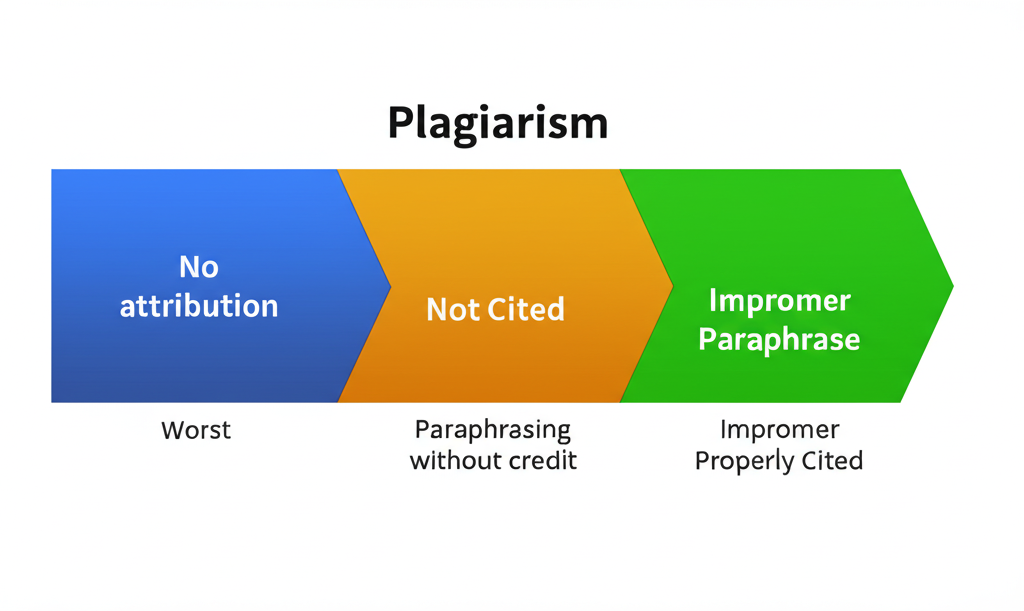
Step-by-Step: Avoiding Plagiarism
1. Identify Sources & Take Careful Notes
As you research, always record where your information comes from. Write down the author, title, and page number for every quote or idea you might use. Use different colors or sections in your notes to differentiate between direct quotes, paraphrased ideas, and your own analytical thoughts.
2. Distinguish Your Ideas from Others'
Before you start writing, review your notes. Be clear about what insights are yours and what came from a source. This mental separation is crucial.
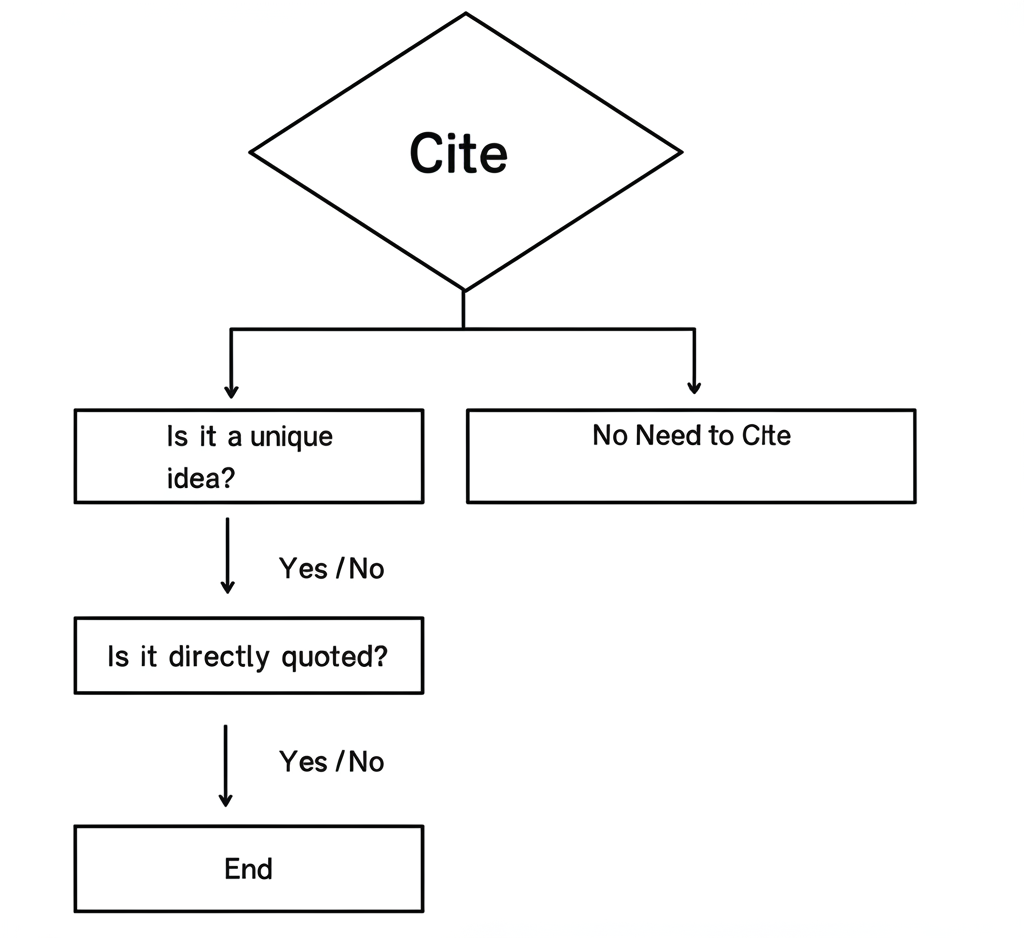
3. Know When to Cite
Always cite when you: use exact words (quotation), restate ideas in your own words (paraphrase), condense information (summary), use specific data or statistics, or refer to specific interpretations. Do NOT cite: your own original ideas or common knowledge.
Example from Literature
Plagiarism
If you write, "The Party maintained absolute control over its citizens through constant surveillance, a concept known as Big Brother," without citing Orwell, you are presenting Orwell's unique idea as your own.
Correct Usage
"In 1984, George Orwell introduces the chilling concept of 'Big Brother,' a ubiquitous, watchful figure symbolizing the Party's absolute control over its citizens' lives and thoughts" (Orwell 3).
Ask yourself these questions: "Is this piece of information something I knew before I started researching?" "Could an educated person reasonably know this without looking it up?" "Have I changed enough of the original wording to truly make this a paraphrase?" If you're unsure whether something needs a citation, it's always safer to include one.
4Techniques: Mastering Citation
Properly integrating and citing sources strengthens your arguments and demonstrates your understanding. We'll focus on MLA (Modern Language Association) style, commonly used in English and Language Arts classes.
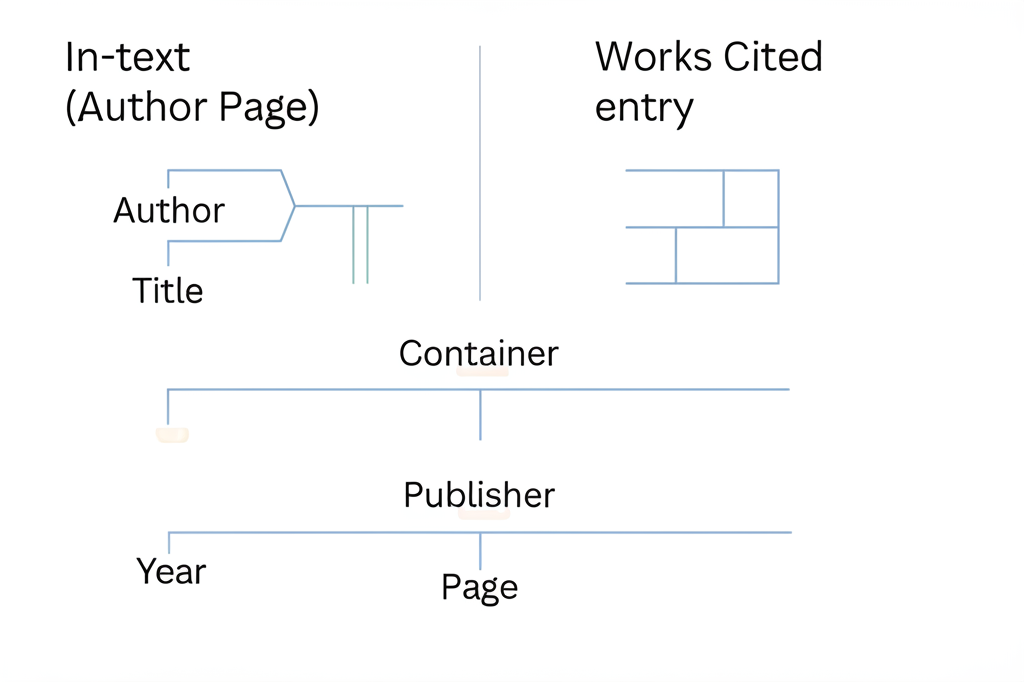
1. Direct Quotation
Use the author's exact words, enclosed in quotation marks. Introduce with a signal phrase and follow with an in-text citation.
Effective Example
Scout Finch poignantly remarks, "Until I feared I would lose it, I never loved to read. One does not love breathing" (Lee 18). This simile highlights the fundamental, almost instinctual, nature of her relationship with books.
Ineffective Example
"Until I feared I would lose it, I never loved to read. One does not love breathing." (Lee 18). (Missing quotation marks if exact, period misplaced, or too similar if intended as paraphrase.)
2. Paraphrasing
Restate the original author's ideas in your own words and sentence structure. It should be about the same length as the original, but entirely rephrased.
Original
"Ralph wept for the end of innocence, the darkness of man's heart, and the fall through the air of the true, wise friend called Piggy." (Golding 202)
Effective Paraphrase
William Golding concludes Lord of the Flies with Ralph's despair, as the boy reflects on the loss of purity, the inherent savagery within humans, and the tragic death of Piggy, his only truly sensible ally (202).
Patchwork Plagiarism
Ralph cried for the end of innocence, the darkness of humanity's heart, and the fall of the wise friend Piggy (Golding 202). (Too many original phrases retained.)
3. Summarizing
Condense the main idea of a longer passage or entire work into your own words. Much shorter than the original.
Effective Summary
Of Mice and Men serves as a poignant exploration of the American Dream's fragility, demonstrating how external forces and personal limitations can crush even the most deeply held hopes (Steinbeck 1-107).
In timed essays or exams, you might not have time for a full MLA Works Cited page. However, you are always expected to provide in-text citations. For novels/plays, simply including the author's last name or the title (e.g., (Lee) or (Romeo and Juliet)) is often sufficient. For Shakespeare, use Act.Scene.Line format (e.g., (1.5.102)).
5Analysis: Integrating Evidence
Citing isn't just a rule; it's a powerful tool for building strong arguments and engaging in academic conversations. Don't just "drop" a quote into your essay. Your job is to explain how that evidence supports your point.
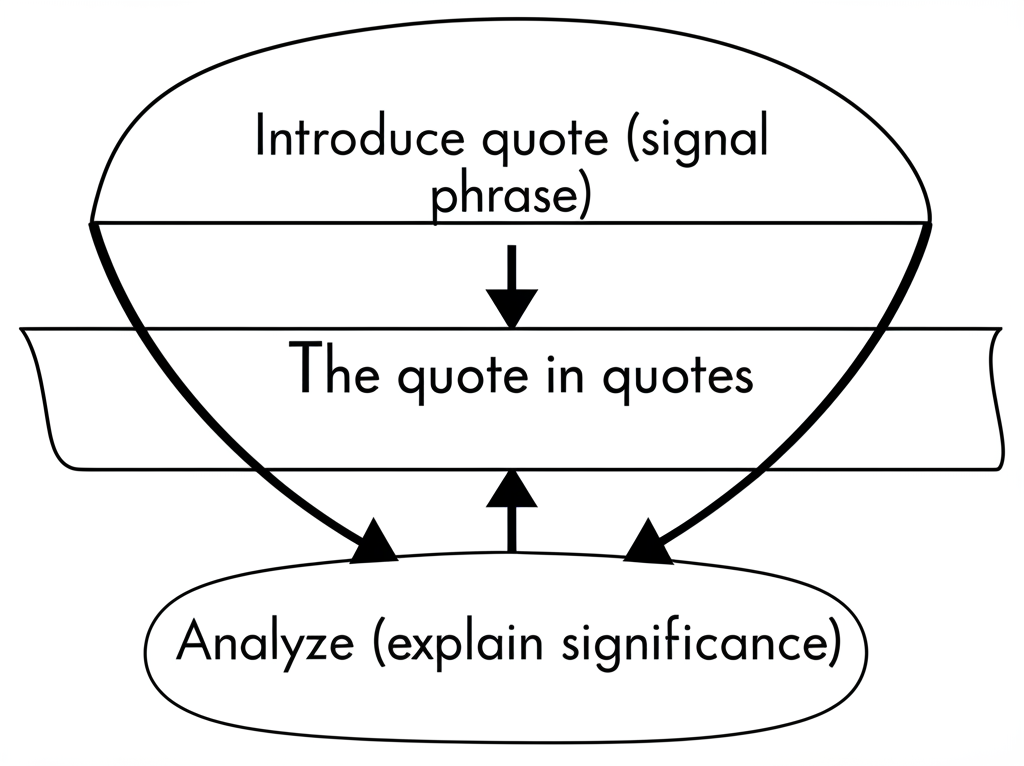
The "Quote Sandwich" Method
1. Top Bread (Introduce)
Introduce the quote or paraphrase with a signal phrase that provides context. Who is speaking? What's happening? What main idea are you supporting?
2. Filling (Integrate)
Present your evidence (the direct quote, paraphrase, or summary). Make sure it flows grammatically with your own sentence.
3. Bottom Bread (Explain/Analyze)
This is the most crucial part! Explain how the evidence supports your thesis. Don't just rephrase the quote; analyze its significance, discuss its implications, or connect it to your broader argument.
Sample Analytical Paragraph
In The Great Gatsby, F. Scott Fitzgerald masterfully uses the character of Daisy Buchanan to symbolize the unattainable and ultimately corrupting nature of the American Dream. Fitzgerald vividly illustrates this idealization through Nick Carraway's perception, describing Daisy's voice as being "full of money" (Fitzgerald 120). This unique sensory detail reveals that Gatsby isn't merely pursuing Daisy as an individual; he is chasing the immense wealth, social status, and perceived happiness she embodies within the elite class. The "money" in her voice is both a literal representation of her inherited privilege and a figurative symbol of the alluring yet ultimately empty promise of material success that drives Gatsby.
Paragraph Breakdown
Topic Sentence
Introduces the main idea about Daisy and the American Dream.
Context & Signal Phrase
"Fitzgerald vividly illustrates this idealization through Nick Carraway's perception, describing Daisy's voice as being..."
Integrated Quote
"...'full of money' (Fitzgerald 120)." Notice how it flows seamlessly into the sentence.
Analysis / Explanation
The rest of the paragraph analyzes why that quote is important, connecting it back to the symbolism of Daisy and the American Dream.
6Putting It All Together
Mastering citations and avoiding plagiarism isn't just about English class; it's a foundational skill that connects to many other areas of your life and academic career.
Connections to Other ELA Skills
Research Skills
Proper citation goes hand-in-hand with effective research, teaching you to evaluate sources, synthesize information, and organize your findings.
Argumentation
When you cite correctly, you build a stronger, more credible argument because you're showing the evidence that backs up your claims.
Critical Reading
Learning to identify and use sources helps you become a more discerning reader, able to recognize an author's claims and the evidence they use.
Synthesis
The process of combining information from multiple sources with your own ideas to create a new, coherent understanding requires careful citation.
Real-World Applications
College and Career
In college, plagiarism can lead to expulsion. In professional fields (journalism, science, business, marketing), plagiarism can destroy careers and reputations.
Creative Writing
Even in creative fields, acknowledging inspiration or sources for factual details is a sign of respect and integrity.
Ethical Communication
Understanding citation teaches you the broader ethics of communication -- giving credit, respecting intellectual property, and contributing responsibly to public discourse.
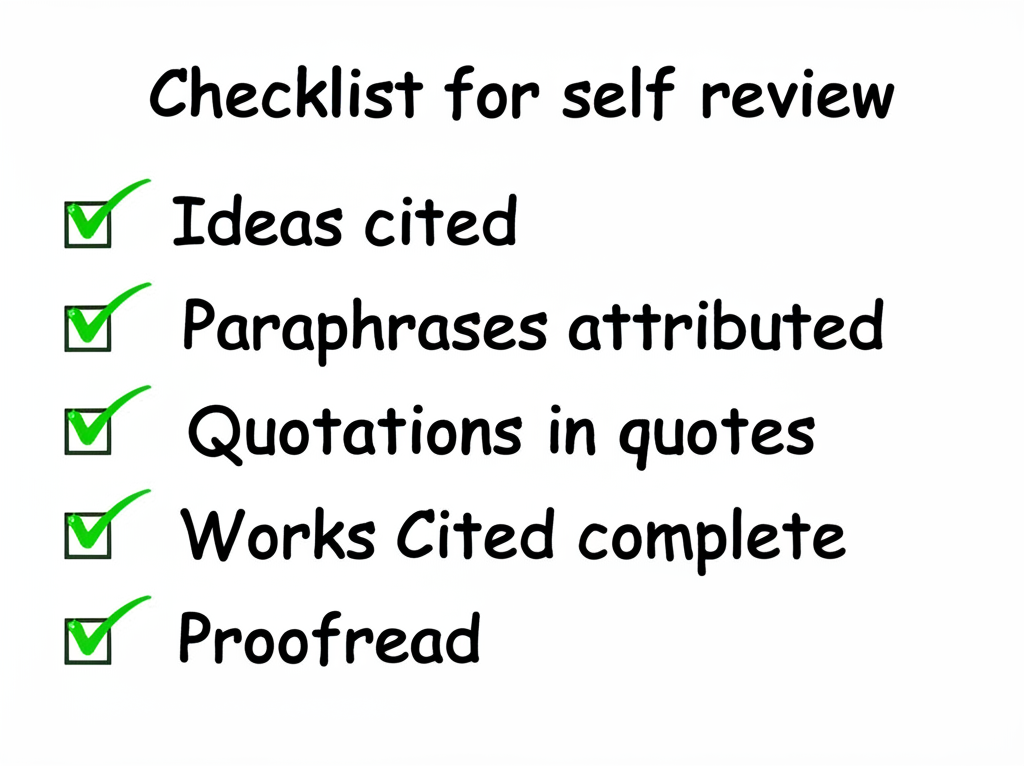
Self-Assessment Checklist
- ✓Have I put quotation marks around every single word I've taken directly from a source?
- ✓Have I rephrased all paraphrased material entirely in my own words and sentence structure?
- ✓Have I included an in-text citation for every piece of information that isn't my original idea or common knowledge?
- ✓Is there a complete Works Cited page at the end of my paper listing all the sources I used?
- ✓Have I introduced and explained all my evidence, connecting it clearly to my argument?
7Worked Examples
Example 1: Quoting a Single Sentence from a Novel
Integrate the following sentence from To Kill a Mockingbird as a direct quote: "You never really understand a person until you consider things from his point of view -- until you climb into his skin and walk around in it." (Page 39)
Step 1: Start with a signal phrase to introduce the speaker and context.
Atticus often imparts wisdom to his children, teaching them about empathy.
Step 2: Insert the exact quote with correct punctuation.
He advises Scout, "You never really understand a person until you consider things from his point of view -- until you climb into his skin and walk around in it."
Step 3: Add the MLA in-text citation before the period.
He advises Scout, "You never really understand a person until you consider things from his point of view -- until you climb into his skin and walk around in it" (Lee 39).
Step 4: Follow with analysis explaining how the quote supports your point.
Final: Atticus often imparts wisdom to his children, teaching them about empathy. He advises Scout, "You never really understand a person until you consider things from his point of view -- until you climb into his skin and walk around in it" (Lee 39). This counsel becomes a guiding principle for Scout, demonstrating the importance of perspective in understanding Maycomb's complex social dynamics.
Key Insight: Always use quotation marks for exact words and place the parenthetical citation before the final punctuation.
Example 2: Paraphrasing a Short Passage
Paraphrase the following from Lord of the Flies (p. 37): "He was a shrimp of a boy, with a fat belly and thick spectacles, and seemed to have an asthma. The others laughed at him when he tried to speak, and he was known as Piggy."
Step 1: Read the original passage carefully to understand its full meaning.
Step 2: Rewrite the information in your own words, focusing on concepts rather than exact phrasing.
Step 3: Ensure the sentence structure is different from the original.
Step 4: Add an in-text citation at the end.
Final: Piggy, a physically vulnerable boy characterized by his small stature, asthma, and thick glasses, faced ridicule from the other boys whenever he attempted to voice his opinions (Golding 37).
Key Insight: Paraphrasing requires significant rephrasing of both words and sentence structure; it's not just swapping a few synonyms.
Example 3: Summarizing a Key Plot Point
Summarize the main events leading to Lennie's death in Of Mice and Men for an essay discussing tragic endings. (Pages 90-107)
Step 1: Identify the core events: Lennie accidentally kills Curley's wife, George finds him, George kills Lennie to prevent a worse fate.
Step 2: Draft a concise version capturing the essence without excessive detail.
Step 3: Integrate this summary into a sentence that fits your essay's argument.
Final: The tragic climax of Of Mice and Men occurs when Lennie, through an unintentional act, kills Curley's wife, leading George to make the agonizing decision to end Lennie's life himself, thus shattering their shared dream (Steinbeck 90-107).
Key Insight: Summarizing focuses on the main idea and is much shorter than the original, still requiring a citation for the broader section or work.
Example 4: Integrating a Quote into an Analytical Paragraph
Integrate the following from Romeo and Juliet into an analytical paragraph: "O brawling love, O loving hate!" (Act 1, Scene 1, Line 173)
Step 1: Start with a topic sentence introducing the main point.
Romeo is initially portrayed as a character prone to dramatic and contradictory expressions of love.
Step 2: Introduce the quote with context and a signal phrase.
Before meeting Juliet, his laments about Rosaline's unrequited love are filled with striking oxymorons, as he cries, "O brawling love, O loving hate!"
Step 3: Add the in-text citation for Shakespearean plays (Act.Scene.Line).
...as he cries, "O brawling love, O loving hate!" (Romeo and Juliet 1.1.173).
Step 4: Analyze the quote, connecting it to your topic sentence.
Final: Romeo is initially portrayed as a character prone to dramatic and contradictory expressions of love. Before meeting Juliet, his laments about Rosaline's unrequited love are filled with striking oxymorons, as he cries, "O brawling love, O loving hate!" (Romeo and Juliet 1.1.173). This juxtaposition highlights Romeo's youthful intensity and emotional turbulence, suggesting a predisposition for extreme, often conflicting, feelings that will later characterize his passionate, yet ultimately tragic, relationship with Juliet.
Key Insight: Always analyze how the quote supports your argument; don't just present it. For plays, use Act.Scene.Line for specific citations.
Example 5: Identifying and Correcting Patchwork Plagiarism
Identify and correct the plagiarism in this student text paraphrasing The Great Gatsby (p. 18).
Original: "I was within and without, simultaneously enchanted and repelled by the inexhaustible variety of life."
Student (Patchwork): "Nick Carraway felt both inside and outside, at the same time charmed and pushed away by the endless diversity of life (Fitzgerald 18)."
Step 1: Compare -- "within and without" became "inside and outside", "simultaneously enchanted and repelled" became "at the same time charmed and pushed away." Structure is identical; only synonyms were swapped.
Step 2: This is patchwork plagiarism despite the citation.
Corrected Paraphrase: Nick Carraway describes experiencing a dual perspective on society, feeling both drawn to and alienated by the rich complexity of human existence (Fitzgerald 18).
Alternative (Direct Quote): Nick Carraway admits to feeling "within and without, simultaneously enchanted and repelled by the inexhaustible variety of life" (Fitzgerald 18).
Key Insight: To avoid patchwork plagiarism, focus on understanding and then explaining the idea in your own unique voice and sentence structure, rather than just changing words.
8Memory Aids
"C-I-T-E: Credit Ideas, Text, Examples"
Always give credit for ideas, exact text, and specific examples that aren't yours. If it's not your original thought, C-I-T-E it!
"Q-P-S-C: Quote, Paraphrase, Summarize -- Always Cite!"
No matter how you use someone else's information -- whether you quote their exact words, paraphrase their ideas, or summarize their argument -- a citation is always required.
"The Sandwich Method: Introduce, Quote, Explain"
Think of a sandwich: the top bread is your introduction (signal phrase), the filling is your quote or paraphrase, and the bottom bread is your explanation. Without bread, the filling falls apart -- without analysis, a quote is meaningless.
"If in doubt, cite it out!"
When you're unsure if something needs a citation, it's always safer to include one. You won't be penalized for over-citing common knowledge, but you will be penalized for under-citing.
"Plagiarism is a Red Light -- STOP!"
Think of a red stop sign or traffic light. Plagiarism means "STOP! This is wrong." It's a clear signal to pause and make sure you've properly attributed your sources before moving forward.
9Common Mistakes
Forgetting quotation marks for direct quotes
Even with a citation, using someone else's exact words without quotation marks is plagiarism.
Wrong: He says we're gonna live off the fatta the lan' (Steinbeck 14). Right: George promises, "We're gonna live off the fatta the lan'" (Steinbeck 14).
Paraphrasing too closely to the original (Patchwork Plagiarism)
Only changing a few words while keeping the original sentence structure is not true paraphrasing. You must completely rephrase in your own words and structure.
Wrong: The meeting was a small civilization that had broken apart (Golding 88). Right: Golding describes the boys' assembly as a fractured miniature society (88).
Forgetting the in-text citation entirely
Any idea or unique concept from a source needs a citation, even if it's paraphrased or generally referenced.
Wrong: Winston Smith struggled against the oppressive Party. Big Brother was always watching. Right: Winston Smith struggled against the oppressive Party, which maintained control through constant surveillance, a concept symbolized by "Big Brother" (Orwell 3).
No Works Cited page at the end of the paper
In-text citations are like pointers; the Works Cited page gives the full address. Both are essential for a complete paper.
Wrong: Having (Lee 55) throughout your essay but no corresponding list of sources. Right: Include a separate, alphabetized "Works Cited" page with full bibliographic information for every source cited.
Dropping a quote without introduction or analysis
Never just plop a quote into your essay. Use the Quote Sandwich: introduce it, present it, then analyze it.
Wrong: Romeo is very dramatic. "Love is a smoke made with the fume of sighs" (Romeo and Juliet 1.1.196). He loves Juliet a lot. Right: Romeo demonstrates his intense understanding of love, lamenting that "Love is a smoke made with the fume of sighs" (Romeo and Juliet 1.1.196). This vivid imagery highlights his youthful passion and tendency towards hyperbolic declarations.
Citing common knowledge unnecessarily
Widely known information does not require a citation. While not technically plagiarism, unnecessary citations can make your writing feel clunky.
Wrong: World War II ended in 1945 (History.com). Right: World War II ended in 1945.
Incorrect MLA formatting
The period always goes after the parenthetical citation. MLA typically doesn't use a comma between the author's name and page number.
Wrong: "It was the best of times, it was the worst of times." (Dickens, 1). Right: "It was the best of times, it was the worst of times" (Dickens 1).
10Quick Revision Summary
- ✓Citations and plagiarism are fundamental to academic integrity and ethical communication.
- ✓Plagiarism is presenting someone else's words or ideas as your own without proper attribution.
- ✓Plagiarism can be intentional or unintentional, but both have serious consequences.
- ✓Quoting means using exact words, requiring quotation marks and a citation.
- ✓Paraphrasing means restating ideas in your own words and sentence structure, always requiring a citation.
- ✓Summarizing means condensing main ideas into your own words, always requiring a citation.
- ✓Common knowledge does not require citation. If unsure, cite it.
- ✓An in-text citation (e.g., (Lee 55)) briefly points to the full source on your Works Cited page.
- ✓Use signal phrases to introduce evidence smoothly into your writing.
- ✓The Quote Sandwich method (Introduce, Quote, Explain) ensures effective integration and analysis of evidence.
- ✓Avoid patchwork plagiarism by thoroughly rephrasing ideas rather than just swapping a few words.
- ✓Proper citation enhances your credibility and strengthens your arguments.
- ✓In timed essays, prioritize author/title in-text citations and strong analysis.
- ✓Don't just drop quotes; always explain how they support your point.
- ✓Always self-check your work for proper citation and integration before submission.
Frequently Asked Questions
- What's the difference between paraphrasing and summarizing?
- Paraphrasing is restating a specific passage or idea from a source in your own words, maintaining roughly the same length as the original. Summarizing is condensing the main ideas of a longer text (a paragraph, section, or entire work) into a much shorter version, focusing only on the key points. Both require a citation.
- Do I need to cite images, videos, or music I use in a presentation or essay?
- Yes, absolutely! Any visual, audio, or multimedia content that you did not create yourself requires attribution, just like text. For images, you typically need to cite the artist/creator, title, and source (e.g., website, museum). MLA has specific guidelines for citing different media types.
- What if I find the same information in multiple sources? Do I need to cite all of them?
- If the information is truly common knowledge (e.g., the dates of the Civil War), you don't need to cite it at all. However, if it's specific data, a unique idea, or a direct quote that you found in several places, you should cite the specific source you actually used in your paper. If you synthesized information from multiple sources, you might cite two or three of the most relevant ones.
- Is it okay to use an AI tool (like ChatGPT) to write my essay or generate ideas?
- This is a rapidly evolving area, and policies vary. Generally, using AI tools to write your essay for you is considered a form of plagiarism or academic dishonesty, as you are presenting AI-generated work as your own. Using AI for brainstorming or generating initial ideas might be acceptable if explicitly permitted by your teacher and if you develop all the actual writing, analysis, and research yourself. Always check with your teacher for their specific policy on AI tools.
- What happens if I plagiarize unintentionally?
- Unintentional plagiarism still carries consequences. While the penalties might be less severe than for intentional cheating, you could still receive a failing grade for the assignment, be suspended, or even face expulsion, depending on your school's policies and the severity of the plagiarism. The key is to learn proper citation techniques and develop good habits to avoid it.
- How can I keep track of my sources effectively to avoid accidental plagiarism?
- Develop a consistent note-taking system using different colors or labels to distinguish between direct quotes (with page numbers and quotation marks), paraphrased ideas (in your own words but with source info), and your own original thoughts. Maintain a running list of all potential sources from the beginning of your research, and consider using online citation managers like EasyBib, Zotero, or Mendeley to help organize and format your citations.
Practice Quiz
Test your understanding — select the correct answer for each question.
1.Which of the following scenarios is an example of plagiarism?
2.When should you use quotation marks?
3.What is the correct MLA in-text citation for a direct quote from page 72 of Harper Lee's To Kill a Mockingbird?
4.Which of these is an example of common knowledge that typically does not require a citation?
5.You are writing an essay and want to use an idea from a source but put it in your own words. What is this called, and what must you still do?
6.What is the primary purpose of a signal phrase?
7.Which statement best describes academic integrity?
8.In the 'Quote Sandwich' method, what is the 'bottom bread'?
9.If you are summarizing a long section of a novel, what is the key difference from paraphrasing?
10.What is the most likely consequence if a student is caught intentionally plagiarizing a major essay in high school?
Final Study Advice
- 1.Practice Citation Early: Don't wait until the final draft to add citations. Record your sources from the very beginning of your research process to avoid scrambling later.
- 2.Use Citation Tools: Take advantage of free citation generators like EasyBib, Zotero, or Mendeley to help format your Works Cited page correctly. Always double-check their output.
- 3.Color-Code Your Notes: Use different colors to clearly distinguish between direct quotes (exact words), paraphrased ideas (your rewording), and your own original analysis.
- 4.Master the Quote Sandwich: For every piece of evidence you use, practice the three-step approach: introduce it, present it, then analyze it. This is the single most important skill for essay writing.
- 5.When In Doubt, Cite: It's always better to over-cite than to risk plagiarism. If you're unsure whether something is common knowledge, include a citation just to be safe.