Research & Citation
Research and citation is the essential skill of finding, evaluating, and properly attributing information from various sources to support your ideas. It helps you earn better grades, prepares you for college-level work, and sharpens your critical thinking by teaching you to discern reliable information.
This guide covers source types, the research process, the CRAAP test for source evaluation, plagiarism prevention, MLA formatting for in-text citations and Works Cited pages, worked examples, and a practice quiz to test your understanding.
1Introduction
Research and citation is not just about avoiding plagiarism — it is about becoming an informed, discerning citizen in a world flooded with information. Whether you are analyzing a novel, arguing a position, or interpreting historical events, the ability to find credible sources, evaluate their reliability, and properly attribute ideas is what separates strong academic writing from weak.
This guide will equip you with the foundational principles and practical techniques to master the research process, evaluate sources critically, avoid plagiarism, and format citations correctly using MLA style.
You're scrolling through social media, seeing a sensational headline about a new study. Without research and citation skills, you might share it without question. But armed with these tools, you'd pause, investigate the source, check for bias, and perhaps discover the "study" was actually a blog post with no scientific backing. This isn't just about avoiding plagiarism; it's about becoming an informed, discerning citizen.
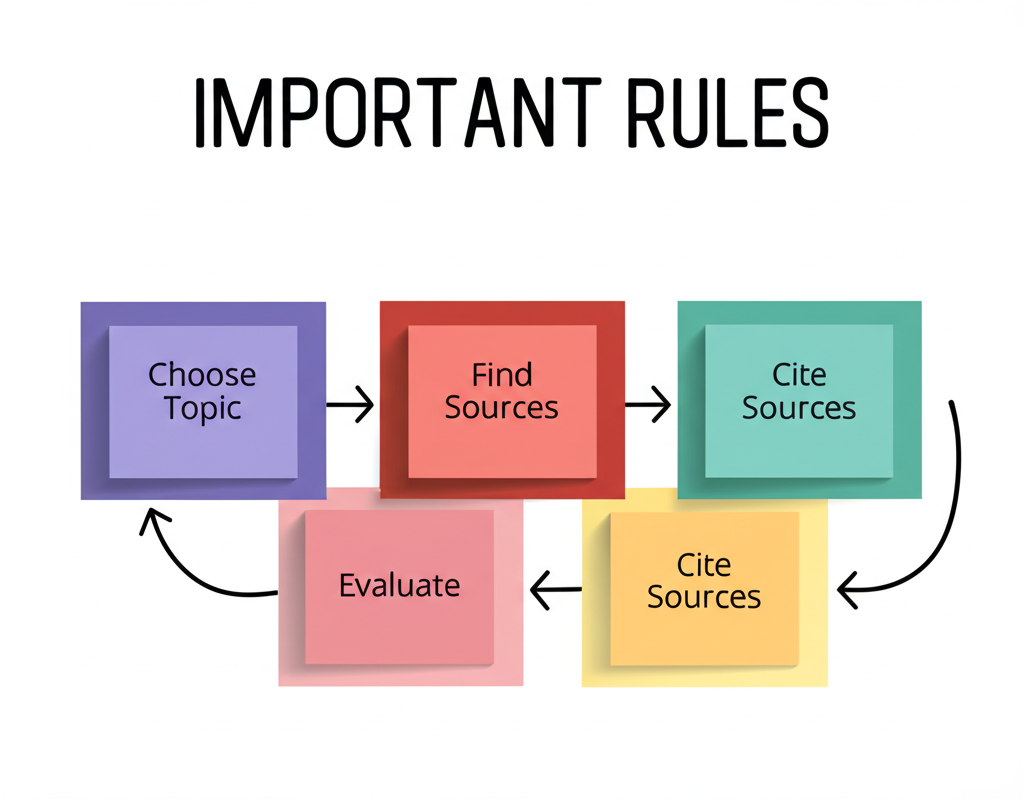
Mastering research and citation means you can build strong, evidence-based arguments and engage respectfully with the ideas of others while maintaining academic integrity.
2Key Definitions
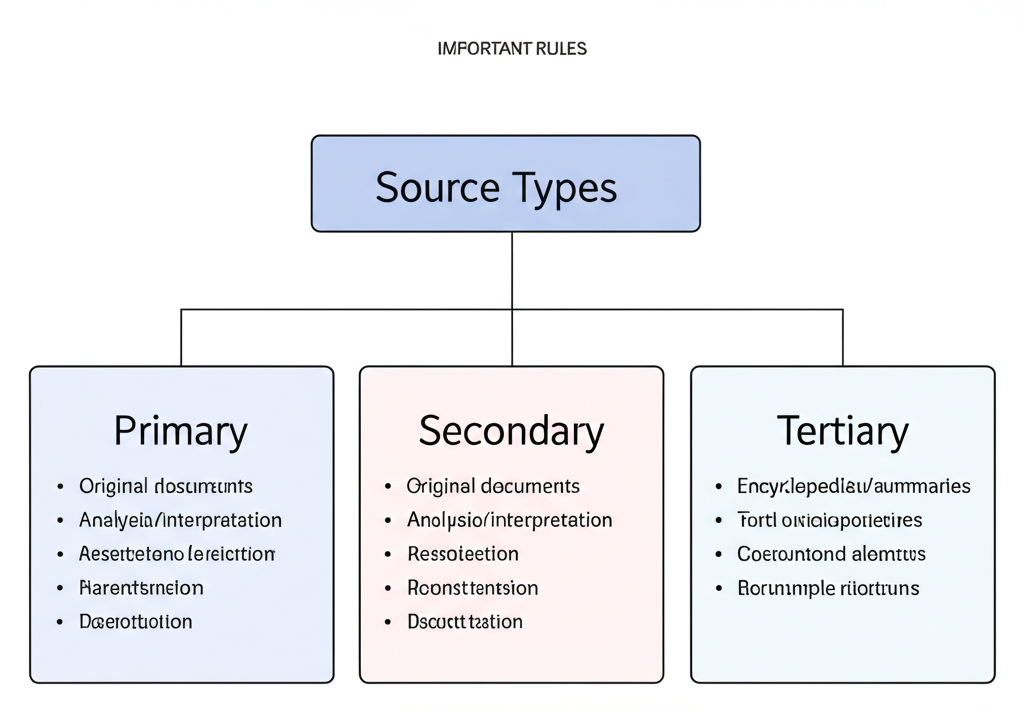
Source Types
Primary Source
Original, firsthand information created at the time of the event. E.g., novels, diaries, speeches, photographs, interviews.
Secondary Source
Information that analyzes, interprets, or discusses primary sources. E.g., literary criticism essays, textbook chapters, documentaries.
Tertiary Source
Information that compiles or indexes primary and secondary sources. E.g., encyclopedias, dictionaries, bibliographies.
Citation & Attribution
Plagiarism
Presenting someone else's words or ideas as your own without proper attribution. A serious academic offense that can lead to failing grades or expulsion.
Paraphrasing
Restating someone else's ideas in your own words while maintaining the original meaning. Still requires a citation to the original source.
In-Text Citation
A brief reference within the body of your essay that directs readers to the full citation on your Works Cited page. E.g., (Fitzgerald 180).
Works Cited Page
A list of all sources cited in your essay, formatted according to a specific style guide (like MLA), appearing at the end of your paper.
Direct Quote
Using an author's exact words, enclosed in quotation marks, and followed by an in-text citation.
Summary
A brief account of the main points of something, much shorter than the original. Still requires a citation.
Synthesis
Combining information from multiple sources to create a new understanding or argument, going beyond simple summary.
Source Quality
Credibility
The quality of being trusted and believed in; the reliability and authority of a source. A scientific journal article is more credible than an anonymous blog post.
Bias
A prejudice in favor of or against something, often influencing how information is presented. Always consider who wrote a source and why.
MLA (Modern Language Association)
A widely used citation style in the humanities (English, foreign languages, etc.). The most common format for high school English papers.
Annotation
Making notes directly on a text (underlining, highlighting, writing comments) to aid understanding and analysis during research.
3The Research Process
The research process is a systematic approach to finding, evaluating, and using information to answer a question or support an argument. It is the backbone of all academic writing, helping you move beyond simply stating opinions to building well-supported arguments.
Step-by-Step: The Research Process
1. Understand the Assignment & Formulate a Question
What is your teacher asking? What specific problem or question do you need to answer? A focused question makes research much easier. E.g., instead of "Write about Romeo and Juliet," try "How does Shakespeare use imagery of light and darkness to develop the theme of tragic love?"
2. Identify Keywords
Pull out key terms from your question to use in searches. E.g., "Shakespeare," "Romeo and Juliet," "light imagery," "darkness imagery," "tragic love," "theme."
3. Find Sources
Use library databases, reputable websites (.edu, .gov, established news organizations), and books. Avoid relying solely on general search engines.
4. Evaluate Sources (Credibility)
Don't just grab the first thing you see! Use the CRAAP Test (Currency, Relevance, Authority, Accuracy, Purpose) to determine if a source is reliable.
5. Read & Take Notes
Actively read your sources. Annotate, highlight, summarize, and paraphrase key information. Always note down the full citation information (author, title, publisher, date, page number) as you go.
6. Develop a Thesis
Based on your research, form your own argument that answers your research question.
7. Outline, Draft & Cite
Organize your notes and evidence to support your thesis, then write your essay. Include in-text citations for all borrowed information (quotes, paraphrases, summaries).
8. Create Works Cited & Review
Compile a complete list of all sources used, formatted correctly (e.g., MLA). Then review for clarity, accuracy, proper citation, and originality.
Research Process in Action: The Great Gatsby
Question
How does Jay Gatsby's pursuit of Daisy Buchanan reflect the corruption of the American Dream in the 1920s?
Keywords
"Gatsby," "Daisy Buchanan," "American Dream," "1920s," "corruption," "Fitzgerald"
Sources Found
A scholarly essay from a university's English department journal analyzing Gatsby (high credibility) and a New York Times archive article about the Jazz Age (good context).
Resulting Thesis
"Shakespeare employs contrasting light and dark imagery throughout Romeo and Juliet to symbolize the fleeting nature of their love and the inevitable, destructive forces opposing it."
Start your research early and record citation information as you go. Hunting down page numbers and publisher names at the last minute is one of the most common (and avoidable) sources of stress.
4Source Evaluation: The CRAAP Test
Not all sources are created equal. The CRAAP Test is a mnemonic for evaluating the reliability and quality of your sources. Before using any source in your research, run it through these five criteria.
C — Currency
When was the information published or last updated? Is it recent enough for your topic? A 2005 article on social media may be outdated, but a 1960s primary source on the Civil Rights Movement is perfectly valid.
R — Relevance
Does the information relate to your topic or answer your research question? Is the content at an appropriate level for your needs (not too simple or too advanced)?
A — Authority
Who is the author or publisher? What are their credentials? Is the source published by a reputable organization (.edu, .gov, university press, peer-reviewed journal)?
A — Accuracy
Is the information supported by evidence? Can you verify the facts in other sources? Are there spelling or grammatical errors that suggest carelessness? Does it have citations?
P — Purpose
Why was this information created? To inform, teach, sell, entertain, or persuade? Is the author trying to be objective, or is there a clear bias? Watch for sponsored content.
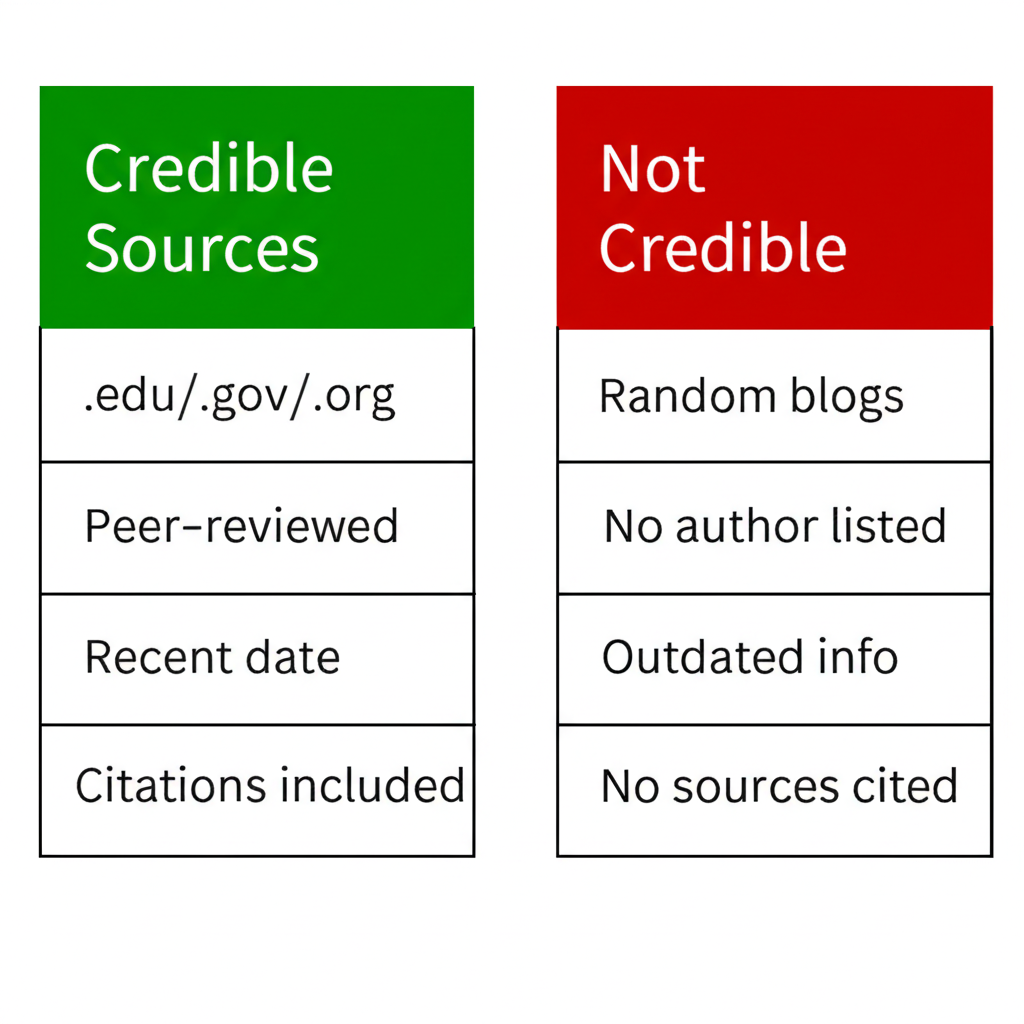
Credible vs. Non-Credible Sources
| Credible Source | Non-Credible Source |
|---|---|
| Published by a university press or peer-reviewed journal | Published on a personal blog or fan wiki |
| Author has relevant expertise and credentials | No author listed or no credentials provided |
| Includes citations and a bibliography | No sources cited, relies on personal opinion |
| Published on .edu, .gov, or reputable news site | Sponsored content or commercial website with bias |
Note-Taking Best Practices
Direct Quotes
Write exact words in quotation marks. Immediately record author, title, and page number.
Paraphrases
Read the original, put it away, then write the idea in your own words. Compare to ensure originality. Record the source.
Summaries
Condense the main idea of a passage in your own words, much shorter than the original. Record the source.
5Plagiarism & Academic Integrity
Plagiarism is the act of using someone else's ideas or words without giving them proper credit. Academic integrity is the commitment to honesty and responsibility in all academic work. These two concepts are inseparable: upholding academic integrity means actively avoiding plagiarism.
Plagiarism is a serious offense that can lead to failing grades, suspension, or even expulsion. More importantly, it undermines your own learning, prevents you from developing your critical thinking and writing skills, and devalues the hard work of others.
Steps to Avoid Plagiarism
1. Know the Rules
Familiarize yourself with your school's academic integrity policy. Understand what constitutes plagiarism: direct copying, paraphrasing without citation, submitting someone else's work.
2. Plan Your Research
Start early to avoid the rush that often leads to shortcuts. Create an organized system for your notes.
3. Take Careful Notes
Use quotation marks for direct quotes, paraphrase properly, and always include page numbers for all types of borrowed information if available.
4. Identify Common Knowledge
You don't need to cite widely known facts (e.g., "Shakespeare wrote Romeo and Juliet"). However, if you're unsure, it's always safer to cite.
5. Integrate and Cite
Introduce all borrowed information with your own words and follow it with an in-text citation. Never drop a quote without context.
6. Create a Works Cited Page
Provide a full bibliographic entry for every source you cited in your paper at the end of your essay.
Proper vs. Improper Attribution
Original passage: "Gatsby believed in the green light, the orgastic future that year by year recedes before us. It eluded us then, but that's no matter -- tomorrow we will run faster, stretch out our arms farther.... And one fine morning -- So we beat on, boats against the current, borne back ceaselessly into the past." (Fitzgerald 180)
Proper Direct Quote
As Nick Carraway famously concludes, "So we beat on, boats against the current, borne back ceaselessly into the past" (Fitzgerald 180). This poignant image captures the futility of chasing an idealized past.
Proper Paraphrase
At the novel's end, Nick reflects on humanity's persistent struggle against the tide of time, suggesting that people are constantly propelled backward even as they strive for the future (Fitzgerald 180).
Plagiarism (Incorrect Paraphrase)
Nick says that we beat on, like boats against the current, always borne back into the past. (Too close to the original wording without quotation marks and lacks a citation.)
Plagiarism (Missing Citation)
Gatsby believed in the green light, the orgastic future that year by year recedes before us. (Even without quotation marks, if it's not common knowledge and isn't your original idea, it needs a citation.)
Even when you paraphrase or summarize, you must always cite the source. Plagiarism is not just about copying word-for-word — using someone else's ideas without attribution is equally serious.
6MLA Formatting for Citations
MLA (Modern Language Association) formatting provides a standardized way to cite sources in the humanities, ensuring consistency, clarity, and proper attribution. It is the most common citation style you will use in high school English classes.

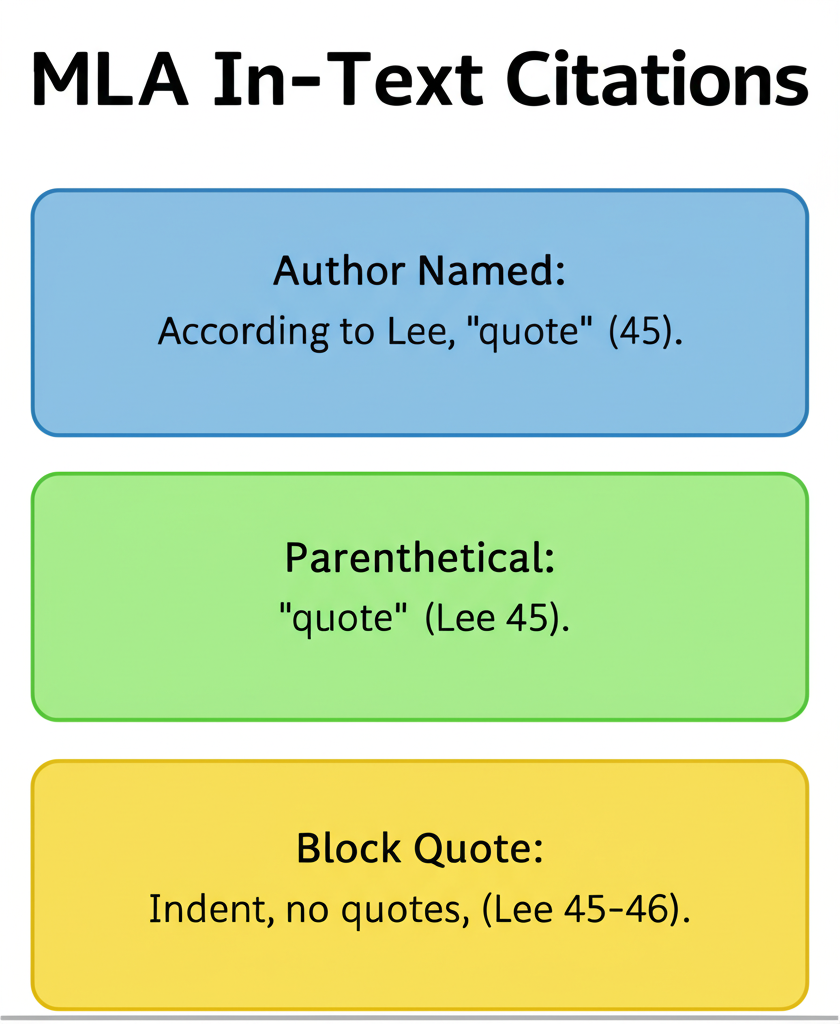
A. In-Text Citations (Parenthetical Citations)
Basic Format
(Author's Last Name Page Number). E.g., "The boys' descent into savagery is swift and brutal" (Golding 125).
No Author
Use a shortened version of the title in quotation marks. E.g., ("Lord of the Flies" 78).
Author Named in Sentence
Only include the page number in parentheses. E.g., Golding suggests that true evil lies within humanity (125).
Multiple Authors
Two authors: (Author1 and Author2 Page). Three or more: (Author1 et al. Page).
Electronic Sources (No Page Numbers)
Omit the page number. If paragraphs or sections are numbered, use (Author par. 5) or (Author sec. 2). E.g., (Smith).
B. Works Cited Page
The Works Cited page provides full bibliographic information for every source cited in your essay, allowing readers to locate them.
New Page
Start on a new page at the end of your essay.
Title
Center "Works Cited" at the top. Do NOT bold, italicize, or underline it.
Alphabetical Order
List entries alphabetically by the first word (usually the author's last name).
Double-Spaced
The entire page should be double-spaced throughout.
Hanging Indent
First line flush left; subsequent lines indented 0.5 inches.
Common MLA Entry Formats (9th Edition)
Book (Single Author)
Author's Last Name, First Name. Title of Book. Publisher, Year.
Golding, William. Lord of the Flies. Penguin Books, 1954.
Article from a Website
Author's Last Name, First Name. "Title of Article." Title of Website, Publisher, Date, URL.
Smith, John. "The Symbolism of the Conch in Lord of the Flies." Literary Analysis Today, 12 Mar. 2020, www.literaryanalysistoday.org/conch-symbolism.html.
Article from a Scholarly Journal (via Database)
Author's Last Name, First Name. "Title of Article." Title of Journal, vol. #, no. #, Year, pp. Range. Database Name, DOI or URL.
Jones, Emily. "The Fragility of Order: Leadership in Golding's Island." Journal of Modern Literature, vol. 45, no. 3, 2018, pp. 345-360. JSTOR, doi:10.1234/jml.2018.0001.
The in-text citation goes after the closing quotation mark but before the period. Example: "quote here" (Author Page). Also remember: every in-text citation must have a corresponding entry on your Works Cited page, and vice versa.
7Worked Examples
Example 1: Classifying Information Sources
You are researching the historical context of the American Civil Rights Movement. Classify the following materials as Primary, Secondary, or Tertiary sources.
Materials to classify:
- A speech by Martin Luther King Jr.
- A high school history textbook chapter on the Civil Rights Movement
- An academic journal article analyzing King's "I Have a Dream" speech
- An encyclopedia entry about Rosa Parks
- A photograph of the Selma to Montgomery march
Step 1: A speech by MLK Jr. is an original document from the time of the event. = Primary Source
Step 2: A textbook chapter synthesizes information from various sources to teach a topic. = Secondary Source
Step 3: An academic journal article discusses and interprets a primary source (the speech). = Secondary Source
Step 4: An encyclopedia entry provides a summary, compiling information from primary and secondary sources. = Tertiary Source
Step 5: A photograph captures an event as it happened, providing direct evidence. = Primary Source
Key Insight: Understanding source types (primary, secondary, tertiary) allows you to assess how close a source is to the original event or idea.
Example 2: Evaluating Credibility and Bias in Online Sources
You are writing a research paper on renewable energy. Evaluate two online sources for credibility and potential bias.
Source 1: "Solar Power: The Future of Energy" — by Dr. Sarah Chen, Environmental Scientist, published on EnergyFacts.org. Note: "Big Oil Corp." is listed as a sponsor.
Source 2: "Is Solar Energy Viable? My Personal Opinion" — by Joe Smith, Concerned Citizen, published on Joe's Personal Blog. Note: No academic credentials, filled with personal anecdotes.
Step 1 — Analyze Source 1: Author (Dr. Sarah Chen) has expertise. Publisher sounds authoritative. However, sponsorship by "Big Oil Corp." introduces a conflict of interest.
Result: Credibility: Moderate to High (author credentials). Bias: Potentially High (corporate sponsorship may skew presentation).
Step 2 — Analyze Source 2: Author lacks credentials. Personal blog is not an academic platform. Content is explicitly "personal opinion."
Result: Credibility: Low (no authority). Bias: Potentially High (purely subjective).
Conclusion: Source 1 is more credible for academic research, though its sponsorship bias must be critically considered. Source 2 is unsuitable for academic work.
Key Insight: True credibility comes from expertise and objectivity, while bias can subtly or overtly influence how information is presented.
Example 3: Avoiding Plagiarism — Paraphrasing and Citing
You are writing an essay on societal control in 1984. Paraphrase the following idea and provide a proper in-text citation.
Step 1 — Identify core argument: Party's power comes from psychological manipulation, not just force, leading citizens to internalize ideology by destroying individual thought and memory.
Step 2 — Draft paraphrase: Use completely new phrasing and sentence structure while preserving meaning.
Step 3 — Final paraphrase with citation: In 1984, the Party secures its total authority by psychologically influencing its population, systematically dismantling personal cognition and recollections until individuals adopt the Party's belief system as their own (Thompson 78).
Key Insight: To avoid plagiarism, always paraphrase ideas completely in your own words and provide an in-text citation for the original source.
Example 4: Integrating a Direct Quote with Context and Citation
Integrate the following quote from To Kill a Mockingbird into an essay on innocence and experience, providing context and a proper MLA in-text citation.
Step 1 — Provide context: Explain who is speaking and the significance of the advice being given to Scout regarding understanding others.
Step 2 — Integrate the quote: Place the quote within quotation marks and ensure it flows naturally from your introductory sentence.
Step 3 — Add in-text citation: The author is Lee (as the novelist), page 39. Citation: (Lee 39). Placed after the closing quotation mark but before the period.
Final integrated passage: Atticus Finch consistently models empathy for his children, a crucial lesson in Maycomb's prejudiced society. He advises Scout on the importance of perspective, stating, "You never really understand a person until you consider things from his point of view — until you climb into his skin and walk around in it" (Lee 39). This counsel serves as a guiding principle for Scout's moral development and highlights the novel's central message about compassion and justice.
Key Insight: Quotes must be thoughtfully introduced, smoothly integrated, and properly cited to strengthen your argument and avoid plagiarism.
Example 5: Conducting Basic Research — Keywords and Reliable Sources
You need to write a short report on the symbolism of the conch in William Golding's Lord of the Flies. Outline a basic research approach.
Step 1 — Identify keywords: "conch symbolism Lord of the Flies," "meaning of conch Golding," "Lord of the Flies symbols analysis."
Step 2 — Primary source: The novel itself (Lord of the Flies) for direct textual evidence and interpretation.
Step 3 — Reliable secondary sources: Academic journal articles (JSTOR, Project MUSE), literary criticism essays, scholarly books on Golding from university presses.
Step 4 — Sources to avoid: Personal blogs, fan wikis, unverified websites, generic study guides, forums (due to low credibility and potential for bias/inaccuracy).
Key Insight: Targeted keywords and a focus on scholarly sources are crucial first steps for any academic research project.
8Memory Aids
"CRAAP — Currency, Relevance, Authority, Accuracy, Purpose"
Run every source through this five-point test before using it. If a source fails on multiple criteria, find a better one.
"When in doubt, cite it out."
If you are unsure whether something is common knowledge, always err on the side of citing. You will never be penalized for citing too much, but you can face serious consequences for citing too little.
"Citations are like receipts — they prove you didn't steal the ideas."
Just as a receipt proves you purchased something legally, a citation proves you obtained an idea through proper academic channels and are giving credit where it is due.
"PST — Primary, Secondary, Tertiary"
Think of "PST" like a whisper getting further from the original speaker. Primary is the original voice, Secondary interprets it, and Tertiary compiles it all together.
"Read, Remove, Rewrite, Review" — the four R's of paraphrasing.
Read the original, remove it from view, rewrite the idea in your own words, then review your version against the original to make sure it is genuinely different. Then add your citation.
9Common Mistakes
Paraphrasing by only swapping a few synonyms
Simply replacing a few words with synonyms while keeping the same sentence structure is still plagiarism. You must completely rephrase the idea in your own words, restructure the sentence, and then cite the original source.
Forgetting to cite paraphrased or summarized information
Many students believe that if they put something "in their own words," no citation is needed. This is incorrect. Even paraphrases and summaries require an in-text citation because the idea still belongs to the original author.
Using non-credible sources (personal blogs, fan wikis)
Not all sources are suitable for academic work. Always use the CRAAP Test to evaluate sources. Peer-reviewed journals, books from university presses, and reputable news organizations are far more credible than personal blogs or anonymous websites.
Placing the in-text citation in the wrong position
The in-text citation goes after the closing quotation mark but before the period. E.g., "quote here" (Author Page). Many students place the period before the citation or put the citation outside the sentence entirely.
Dropping quotes without context or analysis
Never insert a quote into your essay without first introducing it (who said it, and why it matters) and then analyzing it (how does it support your argument). A quote without context is meaningless to the reader.
Missing or incomplete Works Cited entries
Every in-text citation must have a corresponding entry on your Works Cited page, and vice versa. Incomplete entries (missing author, date, or publisher) make it impossible for readers to locate your sources and can result in lost marks.
10Quick Revision Summary
- ✓Primary sources are original/firsthand; secondary sources analyze them; tertiary sources compile and index them.
- ✓Use the CRAAP Test to evaluate every source: Currency, Relevance, Authority, Accuracy, Purpose.
- ✓Plagiarism includes copying, improper paraphrasing, and using ideas without attribution — always cite your sources.
- ✓Proper paraphrasing means completely rephrasing in your own words and sentence structure, then citing.
- ✓MLA in-text citation format: (Author's Last Name Page Number), placed after the quote but before the period.
- ✓The Works Cited page goes at the end: new page, centered title, alphabetical order, double-spaced, hanging indent.
- ✓Every in-text citation must have a corresponding Works Cited entry, and vice versa.
- ✓Always introduce quotes with context, integrate them smoothly, and follow with analysis.
- ✓Record citation information (author, title, publisher, date, page) as you research — not at the end.
- ✓When in doubt about whether to cite, always cite. You cannot over-cite, but you can under-cite.
Frequently Asked Questions
- Do I have to cite if I put it in my own words?
- Yes! Paraphrasing and summarizing still mean you are using someone else's ideas. Even when you rephrase information completely in your own words, you must include an in-text citation to give credit to the original source. The only exception is common knowledge — widely known facts that can be easily verified.
- What is the difference between a primary and secondary source?
- A primary source is original, firsthand information created at the time of an event — such as a novel, diary, speech, or photograph. A secondary source analyzes, interprets, or discusses primary sources — such as a literary criticism essay, textbook chapter, or documentary. Think of primary sources as "raw material" and secondary sources as "interpretation."
- Is Wikipedia okay to use for a research paper?
- Wikipedia can be a useful starting point to get general information and find leads to more credible sources (check its references section!). However, it is generally not considered an acceptable academic source to cite directly in a formal essay because it is user-edited and can change at any time. Use it as a springboard, not a source.
- What if I change a few words in a sentence — is it still plagiarism?
- Yes, if the sentence structure and most of the original ideas remain and you do not cite it, it is still plagiarism. Proper paraphrasing requires you to significantly rephrase and reorganize the information in your own words and sentence structure, then cite the original source. Simply swapping synonyms is not enough.
- How many sources do I need for a research essay?
- This depends on the assignment. Always check your teacher's requirements. For a typical high school research essay, 3-5 credible sources is a good starting point. More important than quantity is the quality and variety of your sources — aim for a mix of primary and secondary sources from reputable publishers.
- What is the CRAAP Test and how do I use it?
- The CRAAP Test is a mnemonic for evaluating sources: Currency (is it recent enough?), Relevance (does it relate to your topic?), Authority (who is the author/publisher?), Accuracy (is the information supported by evidence?), and Purpose (why was it created — to inform, persuade, sell, or entertain?). Apply these five criteria to every source before using it.
- Where does the in-text citation go in a sentence?
- In MLA format, the in-text citation goes after the closing quotation mark (for direct quotes) but before the period at the end of the sentence. For example: "The green light symbolized hope" (Fitzgerald 180). If you mention the author's name in your sentence, only include the page number in parentheses.
Practice Quiz
Test your understanding — select the correct answer for each question.
1.According to the article, what is the most accurate definition of 'plagiarism'?
2.A student is researching the historical context of Shakespeare's Romeo and Juliet. Which of the following would be considered a primary source?
3.The introduction emphasizes becoming 'an informed, discerning citizen in a world flooded with information.' What does this statement primarily emphasize?
4.A student copies a paragraph from a website, changes a few words, includes the URL in their Works Cited page, but doesn't put quotation marks or an in-text citation. Which mistake has the student made?
5.What is the main difference between an 'in-text citation' and a 'Works Cited Page'?
6.You are researching a new dietary supplement. Which source would likely be least credible due to potential bias?
7.A student writes: 'The author argues that society is becoming increasingly isolated (Smith, 25).' Assuming MLA style, what is the most likely error?
8.Which of the following best describes a 'tertiary source'?
9.In which academic discipline would you most commonly use MLA citation style?
10.The introduction lists several benefits of mastering research and citation. Which is highlighted as the ultimate outcome?
Final Study Advice
- 1.Always record citation information (author, title, publisher, date, page) the moment you find a source — not at the end.
- 2.Run every source through the CRAAP Test before including it in your essay. Quality over quantity.
- 3.Practice the "Read, Remove, Rewrite, Review" method for paraphrasing to build the habit of putting ideas into your own words.
- 4.When in doubt about whether something is common knowledge, always cite it. You cannot be penalized for over-citing.
- 5.Before submitting, verify that every in-text citation has a matching Works Cited entry, and vice versa.