Essay Writing Fundamentals
Essay writing is the art of presenting a well-supported argument or analysis in a clear, organized, and persuasive manner. It sharpens your critical thinking, prepares you for college-level work, and empowers you to communicate complex ideas effectively in any field.
This guide covers thesis statements, body paragraph development, the T.E.A.T. method, evidence and analysis, worked examples from classic literature, and a practice quiz to test your understanding.
1Introduction
Essay writing is not just about getting good grades — it's a fundamental skill that sharpens your critical thinking, prepares you for college-level work, and empowers you to communicate complex ideas effectively in any field. Whether you're analyzing a novel, arguing a position, or interpreting historical events, the principles of strong essay writing remain the same.
This guide will equip you with the foundational principles and practical techniques to transform your ideas into compelling essays.
You're scrolling through social media, and you see a post making a bold claim. You immediately start thinking, "Is that true? What's the evidence? Are there other ways to look at this?" That's your critical thinking kicking in — and essay writing helps you structure those thoughts into a powerful, convincing response.
Every strong essay is built on a clear thesis, supported by well-developed body paragraphs with evidence and analysis, and tied together with smooth transitions.
2Key Definitions
Essay Components
Thesis Statement
The central argument or main point of your essay, usually stated in one or two sentences at the end of the introduction.
Topic Sentence
The main idea of a body paragraph, directly supporting the thesis statement.
Evidence
Specific details, facts, examples, or quotations from the text used to support your claims.
Analysis
Your interpretation of how the evidence supports your topic sentence and thesis. Answers the "so what?" question.
Transition
Words or phrases that connect ideas and paragraphs, creating smooth flow. E.g., "Furthermore," "However," "Consequently."
Counterargument
An opposing viewpoint or objection to your thesis statement that strengthens your essay when addressed.
Rebuttal
Your response to a counterargument, explaining why it is flawed or less significant than your own argument.
Literary Terms
Theme
The central idea or underlying message about life, society, or human nature explored in a literary work.
Symbol
An object, person, or idea that represents something else, often an abstract concept. E.g., the green light in The Great Gatsby.
Irony
A contrast between expectation and reality. Includes verbal, situational, and dramatic irony.
Motif
A recurring image, idea, or symbol that develops or explains a theme throughout a work.
Allusion
An indirect reference to a person, place, event, or literary work. E.g., calling someone a "Scrooge."
Rhetorical Devices
Ethos
Appeal to credibility or authority, convincing the audience of the writer's trustworthiness.
Pathos
Appeal to emotion, attempting to evoke feelings in the audience to persuade them.
Logos
Appeal to logic or reason, using facts, statistics, and rational arguments.
Figurative Language
Simile
A comparison using "like" or "as." E.g., "He fought like a lion."
Metaphor
A direct comparison without "like" or "as." E.g., "The classroom was a zoo."
Personification
Giving human qualities to non-human things. E.g., "The wind whispered secrets."
Hyperbole
Exaggeration for effect. E.g., "I'm so hungry I could eat a horse."
3The Thesis Statement: Your Essay's Blueprint
The thesis statement is the backbone of your essay. It's a single, focused sentence (sometimes two) that presents your main argument or the central point you will prove. Think of it as a promise to your reader about what your essay will discuss and argue.
A strong thesis is crucial because it provides clarity, focus, and direction. It guides your entire essay, ensuring every paragraph contributes to your main argument. It also helps you stay on track during exams, preventing rambling or summarizing.
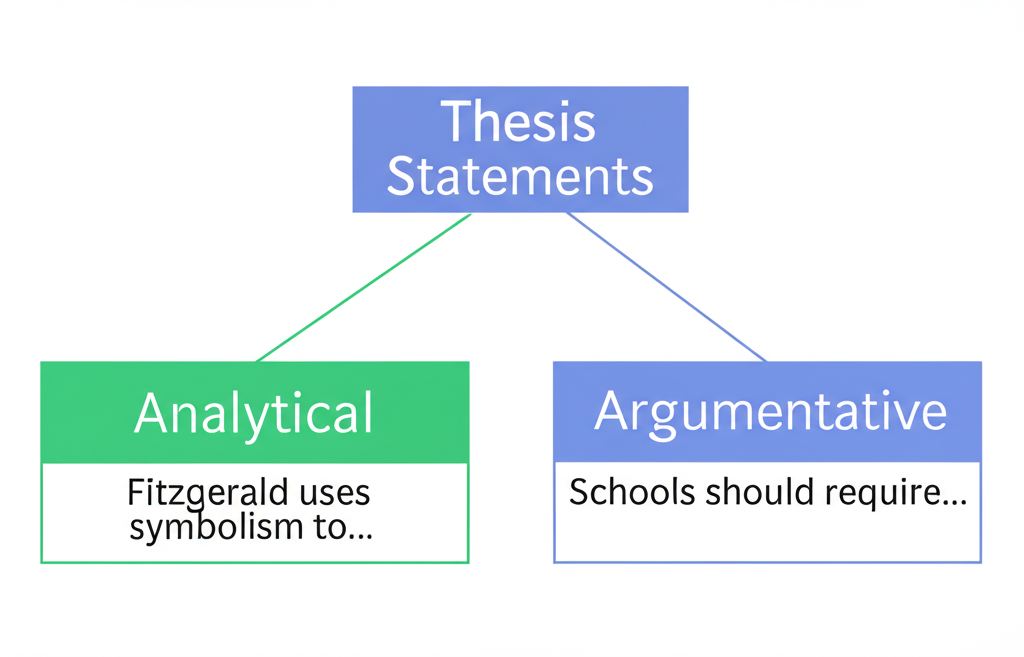
Step-by-Step: Crafting a Strong Thesis
1. Understand the Prompt
What exactly is the question asking? Identify keywords: analyze, compare, evaluate, discuss, argue.
2. Brainstorm & Form an Opinion
What's your answer to the prompt? What's your unique interpretation? Don't just summarize — argue something.
3. Identify Key Support Points
What are 2-3 main reasons or evidence pieces that support your opinion? These will become your topic sentences.
4. Draft a Tentative Thesis
Formula: [Specific Topic] + [Active Verb] + [Your Argument/Claim] + [Because/By showing X, Y, Z].
5. Refine and Test
Is it arguable? Specific? Focused? Provable with textual evidence? Usually placed at the end of the introduction?
Strong vs. Weak Thesis Statements
| Weak Thesis | Strong Thesis |
|---|---|
| "Romeo and Juliet is about love." | "Shakespeare uses light/dark imagery to show love is both beautiful and dangerous." |
| "Racism is bad." | "Through Tom Robinson's trial, Lee argues that moral courage is essential for challenging systemic injustice." |
| "Atticus Finch is a lawyer who tries to help people." | "Through Atticus Finch's unwavering moral integrity and empathetic defense of Tom Robinson, Harper Lee critiques racial injustice while asserting the power of individual conscience." |
| "There are many symbols in The Great Gatsby." | "Fitzgerald utilizes the green light, Valley of Ashes, and eyes of Dr. T.J. Eckleburg to symbolize the elusive American Dream, moral decay, and ignored judgment." |
A strong thesis is arguable (not a fact), specific (no vague language), focused (covers only what you'll discuss), and provable with textual evidence.
4Developing Body Paragraphs
Each body paragraph should develop one specific point that directly supports your thesis. The key to strong body paragraphs is the T.E.A.T. method: Topic sentence, Evidence, Analysis, and Transition.
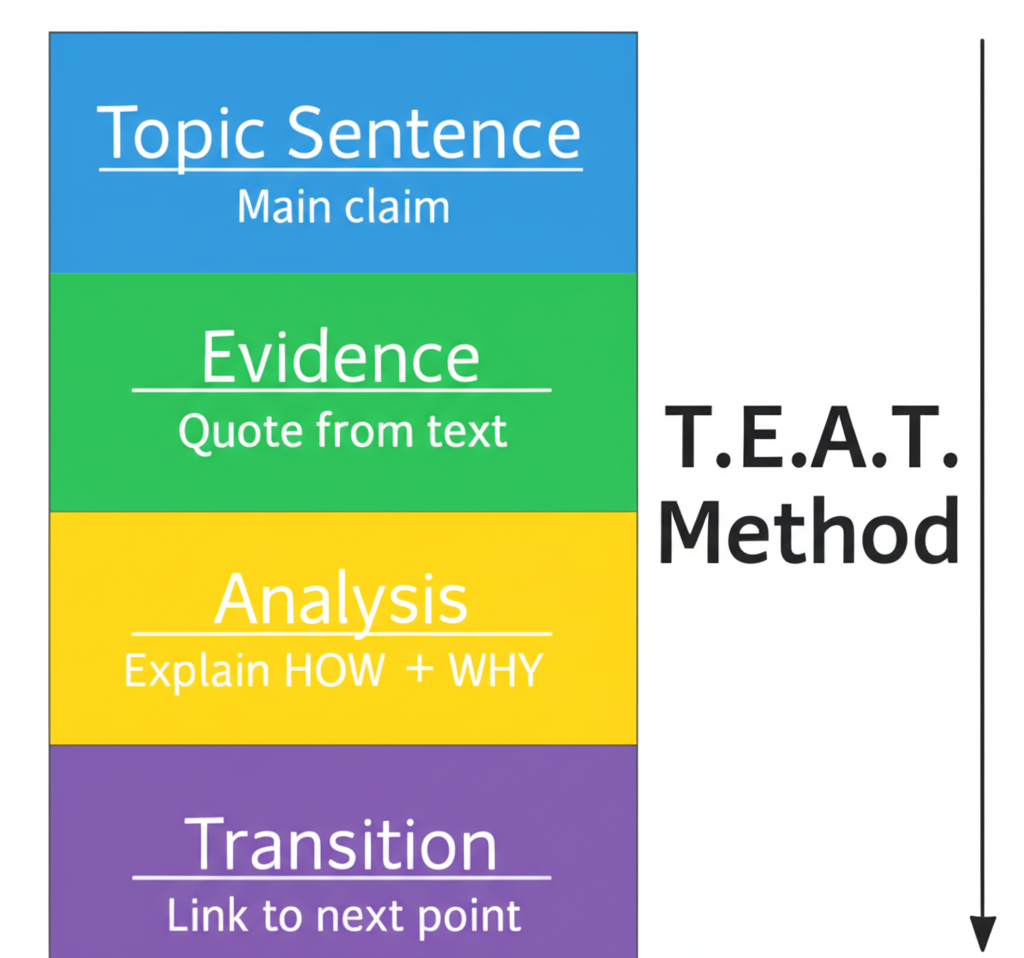
T — Topic Sentence
State the paragraph's main idea. It should directly support your thesis.
E — Evidence
Provide specific quotes, facts, or examples from the text to support your claim.
A — Analysis
Explain how and why the evidence supports your topic sentence and thesis.
T — Transition
Link smoothly to the next paragraph or idea using transition words or phrases.
Example Body Paragraph
Topic Sentence
Atticus consistently demonstrates his commitment to moral integrity by defending Tom Robinson, even when faced with widespread community disapproval.
Evidence
Atticus tells Scout: "You never really understand a person until you consider things from his point of view... until you climb into his skin and walk around in it."
Analysis
This quote reveals Atticus's profound belief in empathy, which guides his actions and underscores the novel's larger message about understanding others. His willingness to defend Tom Robinson despite community backlash demonstrates that moral integrity requires both courage and empathy.
Transition
Beyond his moral integrity, Atticus also embodies empathy by genuinely attempting to understand the perspectives of others, including those who oppose him.
Common Transition Words
Adding Ideas
Furthermore, Moreover, In addition, Similarly, Likewise
Contrasting
However, In contrast, On the other hand, Nevertheless, Conversely
Showing Cause/Effect
Consequently, Therefore, As a result, Thus, Hence
Concluding
Ultimately, In conclusion, To summarize, In essence, Finally
5Analysis & Critical Thinking
Analysis is what separates a strong essay from a summary. While summary tells the reader what happens, analysis explains how the author achieves an effect and why it matters. Analysis answers the crucial "so what?" question.
Summary vs. Analysis
Summary (Weak)
"The green light at the end of Daisy's dock in The Great Gatsby symbolizes Gatsby's hopes and dreams. This shows that Gatsby is always looking towards the future."
Simply restates the symbol's meaning without deeper insight.
Analysis (Strong)
"The green light represents not just Gatsby's longing for Daisy, but the broader American obsession with an idealized future that can never be fully realized. Its distance across the bay mirrors the fundamental unattainability of the Dream itself."
Interprets significance and connects to broader themes.
Counterarguments & Rebuttals
Addressing counterarguments demonstrates sophisticated thinking and strengthens your essay. Show that you've considered opposing views, then explain why your argument is still stronger.
Counterargument
"Some critics argue that Hamlet's delay is a fatal flaw, demonstrating a lack of resolve or an inability to act decisively, which leads to the tragic downfall of many characters."
Rebuttal
"However, this perspective overlooks the moral complexities Hamlet faces. His hesitation stems not from cowardice, but from a deeply philosophical need to confirm Claudius's guilt and avoid committing rash vengeance that would mirror the very corruption he despises."
A strong rebuttal doesn't dismiss a counterargument — it acknowledges it and then explains its limitations or reinterprets it to reinforce your original thesis.
6Essay Structure
The five-paragraph essay is the foundation of academic writing. While more advanced essays may use more paragraphs, this structure provides a reliable framework for organizing your arguments.
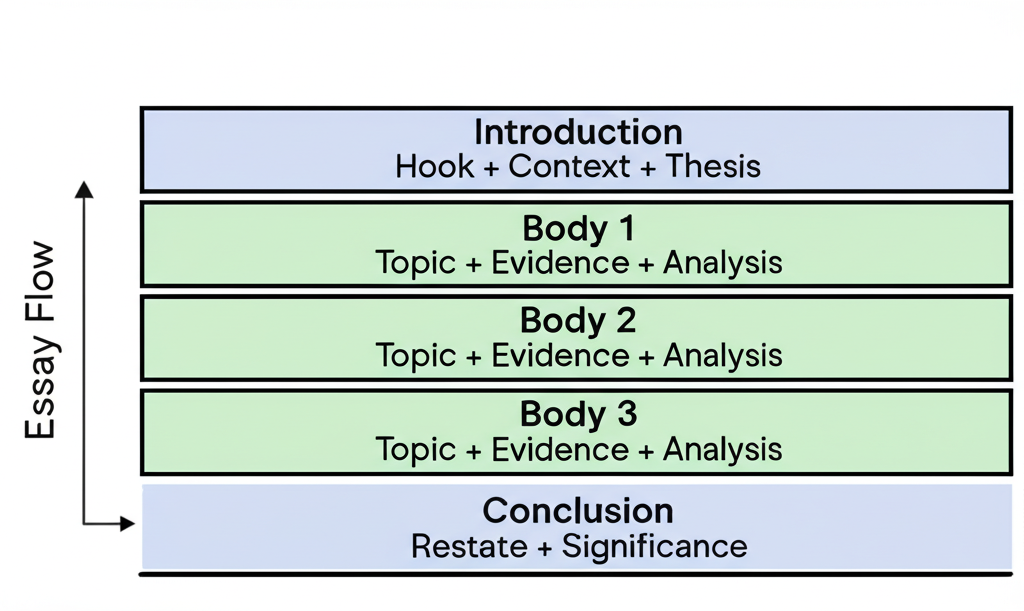
Introduction
Open with a hook (quote, question, or surprising fact), provide context (background on the topic/text), and end with your thesis statement.
Body Paragraphs (3+)
Each paragraph develops one point using the T.E.A.T. method. Together, they build the case for your thesis with evidence and analysis.
Conclusion
Restate your thesis in new words, summarize key points, and offer a final thought — a broader implication or "so what" for the reader.
Your conclusion should never introduce new evidence or new arguments. It should synthesize what you've already proven and leave the reader with a lasting impression.
7Worked Examples
Example 1: Identifying Core Essay Components
Read the following paragraph and identify its thesis statement, topic sentence, and a piece of evidence.
Step 1: "Harper Lee's To Kill a Mockingbird powerfully illustrates that true courage is not the absence of fear..." = Thesis Statement
Step 2: "This is exemplified through Atticus Finch's unwavering defense of Tom Robinson." = Topic Sentence
Step 3: "Atticus tells Scout, 'I wanted you to see what real courage is...'" = Evidence
Key Insight: Identifying the thesis, topic sentence, and evidence reveals the fundamental structure and support system of any persuasive argument.
Example 2: Crafting a Thesis Statement for The Great Gatsby
Write a strong, arguable thesis about the theme of the American Dream in The Great Gatsby.
Step 1 — Brainstorm: Gatsby pursues the Dream but fails. The Dream is corrupted by materialism. Gatsby's dream is tied to the past.
Step 2 — Select argument: The American Dream is not only unattainable but morally corrupting, particularly through materialism and an obsessive desire to recapture the past.
Step 3 — Refined thesis: "F. Scott Fitzgerald's The Great Gatsby critiques the American Dream, revealing it as a hollow pursuit corrupted by materialism and an obsessive desire to reclaim an idealized past, ultimately leading to disillusionment and tragedy."
Key Insight: An effective thesis makes a specific, arguable claim, providing clear direction for the entire essay.
Example 3: Developing a Body Paragraph for 1984
Given a thesis about totalitarianism and surveillance in 1984, develop a body paragraph with evidence and analysis.
Thesis: George Orwell's 1984 warns against totalitarianism by demonstrating how constant surveillance eradicates individual freedom and independent thought.
Topic Sentence: The omnipresent telescreens serve as the primary tools for suppressing dissent and enforcing conformity.
Evidence: "The telescreen received and transmitted simultaneously. Any sound that Winston made, above the level of a very low whisper, would be picked up by it."
Analysis: This passage illustrates the invasive nature of telescreens, denying citizens privacy even in their own homes. The simultaneous receiving and transmitting creates an environment where every individual is under constant scrutiny, forcing self-censorship and extinguishing any flicker of rebellious thought.
Connection to thesis: This pervasive technological control directly underpins the Party's totalitarian power, fulfilling the thesis's claim that surveillance eradicates both freedom and independent thought.
Key Insight: Strong analysis explains how evidence supports the topic sentence and why that support matters for the overall thesis.
Example 4: Counterargument & Rebuttal in Hamlet
Original argument: Hamlet's indecision reflects a profound moral struggle and intellectual caution in a corrupt world, not weakness.
Counterargument: "Some critics argue that Hamlet's delay is a fatal flaw, demonstrating a lack of resolve that leads to the tragic downfall of many characters, including himself."
Rebuttal: "However, this overlooks the moral complexities Hamlet faces; his hesitation stems from a deeply philosophical need to confirm Claudius's guilt and avoid committing rash vengeance that would mirror the very corruption he despises. His 'delay' is a testament to his moral integrity."
Key Insight: A strong rebuttal thoughtfully explains a counterargument's limitations rather than simply dismissing it.
Example 5: Full Analysis of Macbeth's Soliloquy
Analyze how "Tomorrow, and tomorrow, and tomorrow" contributes to the theme of meaninglessness in Macbeth.
Thesis: Macbeth's "Tomorrow" soliloquy powerfully articulates the theme that unchecked ambition ultimately renders life a meaningless, absurd existence.
Topic Sentence: Macbeth's despair is conveyed through time imagery and theatrical metaphors, painting human existence as a brief, insignificant performance.
Evidence: "Life's but a walking shadow, a poor player / That struts and frets his hour upon the stage / And then is heard no more. It is a tale / Told by an idiot, full of sound and fury, / Signifying nothing."
Analysis: The metaphor "walking shadow" strips humanity of substance, while "poor player" reduces existence to a fleeting performance. The phrase "signifying nothing" captures the ultimate emptiness of Macbeth's bloody reign.
Counterargument: "Some might argue that the speech's poetic beauty contradicts its message of 'signifying nothing.'"
Rebuttal: "However, Macbeth's words are a dramatic expression of his personal collapse, not a universal truth from Shakespeare. The irony is that while his life has become meaningless, his articulation of that meaninglessness serves to underscore the tragic consequences of his choices."
Key Insight: Comprehensive literary analysis involves dissecting textual details, connecting them to broader themes, and engaging with counter-interpretations for a nuanced argument.
8Memory Aids
"T.E.A.T. — Topic, Evidence, Analysis, Transition"
The structure of every body paragraph. Follow this order and you'll never lose points for paragraph structure.
"So what?" — The question every analysis must answer.
After presenting evidence, always ask yourself "so what?" If your analysis doesn't answer this, dig deeper.
"A thesis is your essay's GPS — it tells the reader where you're going and keeps you on track."
Without a thesis, your essay wanders aimlessly. With one, every paragraph has a clear destination.
"Ethos, Pathos, Logos — Credibility, Emotion, Logic"
The three pillars of persuasion. Strong arguments use all three to convince the reader.
"Don't just tell — show and explain."
Present evidence (show), then analyze it (explain). Never leave a quote hanging without analysis.
9Common Mistakes
Writing a fact instead of an arguable thesis
"Shakespeare wrote Romeo and Juliet" is a fact, not a thesis. Your thesis must present a debatable claim that requires evidence to support. Ask yourself: could someone reasonably disagree with this statement?
Summarizing instead of analyzing
Don't just retell what happens in the text. Instead, explain how and why the author's choices create meaning. Always answer the "so what?" question after presenting evidence.
Leaving quotes hanging without analysis
Never drop a quote into your essay without explaining its significance. Every piece of evidence needs your interpretation connecting it to your topic sentence and thesis.
Using vague or broad thesis statements
Avoid statements like "There are many themes in this book." Be specific about which themes, how they're developed, and what argument you're making about them.
Introducing new evidence in the conclusion
Your conclusion should synthesize what you've already proven, not introduce new arguments. Restate your thesis in new words and offer a broader implication.
Weak transitions between paragraphs
Each paragraph should flow logically into the next. Use transition words (Furthermore, However, Consequently) and make sure each topic sentence connects to the previous paragraph's conclusion.
10Quick Revision Summary
- ✓A thesis statement is your essay's central argument — arguable, specific, focused, and provable.
- ✓Use the T.E.A.T. method for body paragraphs: Topic sentence, Evidence, Analysis, Transition.
- ✓Analysis explains how and why evidence supports your argument — it answers "so what?"
- ✓Never leave a quote hanging — always follow evidence with your interpretation.
- ✓Address counterarguments to show sophisticated thinking and strengthen your position.
- ✓The five-paragraph essay: Introduction (hook + context + thesis), 3 body paragraphs, Conclusion.
- ✓Use transition words to create smooth flow between ideas and paragraphs.
- ✓The three pillars of persuasion: Ethos (credibility), Pathos (emotion), Logos (logic).
- ✓Know your figurative language: simile, metaphor, personification, hyperbole.
- ✓Your conclusion should synthesize, not introduce new evidence or arguments.
Frequently Asked Questions
- Does every essay need a thesis statement?
- Most academic essays require a thesis statement. It provides the central argument or claim that your entire essay supports. Even narrative or descriptive essays benefit from a clear controlling idea, though it may be implied rather than explicitly stated.
- How long should a thesis statement be?
- A thesis statement is typically one to two sentences long. It should be concise yet specific enough to convey your main argument and hint at the key points you will discuss. Avoid overly broad or vague statements.
- What is the difference between a topic sentence and a thesis statement?
- A thesis statement presents the central argument of your entire essay, usually placed at the end of the introduction. A topic sentence states the main idea of a single body paragraph and directly supports the thesis. Think of the thesis as the "big claim" and topic sentences as the supporting claims.
- How do I know if my thesis is strong enough?
- A strong thesis is arguable (not just a fact), specific (avoids vague language), focused (covers only what your essay will discuss), and provable with textual evidence. If someone could reasonably disagree with your statement, it is likely arguable enough to be a strong thesis.
- What is the T.E.A.T. method for body paragraphs?
- T.E.A.T. stands for Topic sentence, Evidence, Analysis, and Transition. Start each body paragraph with a topic sentence that supports your thesis, provide evidence (quotes, facts, examples), analyze how the evidence supports your point, and end with a transition to the next paragraph.
Practice Quiz
Test your understanding — select the correct answer for each question.
1.What is the central argument or main point of an essay, usually stated in one or two sentences at the end of the introduction?
2.Consider the example: 'Atticus consistently demonstrates his commitment to moral integrity by defending Tom Robinson, even when faced with widespread community disapproval.' Which essay component does this best represent?
3.The article states that 'Analysis' answers the 'so what?' question. What is the primary purpose of analysis in an essay?
4.A student writes the following thesis statement for an essay on To Kill a Mockingbird: 'This essay will discuss the themes present in the novel.' Which revision would make it a stronger thesis?
5.Which of the following terms describes words, phrases, or sentences that connect ideas and paragraphs, creating a smooth flow for the reader?
6.A student's essay argues that mandatory school uniforms improve student discipline. They then write: 'However, some parents and students believe that uniforms stifle individuality and are an unnecessary financial burden.' What essay component have they just introduced?
7.Given a quote from Atticus about empathy, which of the following best represents analysis of this evidence?
8.A student writes: 'The green light at the end of Daisy's dock in The Great Gatsby symbolizes Gatsby's hopes and dreams for the future. This shows that Gatsby is always looking towards the future.' What is a common weakness in the second sentence?
9.According to the introduction, beyond getting good grades, what is a fundamental skill that essay writing sharpens?
10.A paragraph discusses the benefits of regular exercise. The next paragraph will discuss the challenges people face in maintaining a consistent exercise routine. Which transition would be most effective between these paragraphs?
Final Study Advice
- 1.Always start with a clear, arguable thesis before writing anything else — it's your essay's roadmap.
- 2.Use the T.E.A.T. method for every body paragraph: Topic sentence, Evidence, Analysis, Transition.
- 3.After writing your analysis, always ask "so what?" — if you can't answer it, go deeper.
- 4.Read your essay aloud to catch awkward transitions and unclear sentences.
- 5.Practice with timed essay prompts — exams reward students who can organize quickly.