Mastering Critical Analysis
Critical analysis is the process of examining a text in detail to understand its deeper meaning, purpose, and how its parts work together to create an overall effect. It is the foundational skill that separates surface-level reading from true literary understanding.
This guide covers active reading strategies, key literary definitions, literary devices and rhetorical strategies, the analytical paragraph structure (P.E.E.L.), thesis statements, worked examples from classic literature, memory aids, common mistakes, and a practice quiz to sharpen your skills.
1Introduction
Why does critical analysis matter? At its core, critical analysis is about moving beyond "what happened" in a story to "how and why it happened" and, most importantly, "what it means." It is about uncovering the layers beneath the surface.
- Better Grades: It is the key ingredient for top scores on essays and exams in English and beyond.
- College Readiness: Colleges expect you to think deeply, not just summarize. This skill is foundational for higher education.
- Stronger Communication: When you can analyze, you can explain your ideas clearly and persuasively.
- Sharper Critical Thinking: This is not just for English class -- it helps you evaluate information, make informed decisions, and understand the world around you.
You are scrolling through social media, and you see a catchy advertisement for a new product. Instead of just thinking, "Oh, that looks cool," you pause. You start to wonder: What emotions is this ad trying to evoke? What images are they using to make me feel a certain way? Is the language persuasive? Who is their target audience? That moment of questioning, dissecting, and understanding the how and why behind the ad's message? That is critical analysis in action.
Critical analysis is about examining a text to understand its deeper meaning, author's purpose, and how its parts work together to create an overall effect. It requires you to interpret, evaluate, and argue -- not just summarize.
2Key Definitions
Core Analysis Terms
Text
Any piece of writing, art, or communication you are examining -- a novel, poem, short story, play, essay, speech, film, advertisement, or song.
Analysis
The process of breaking down a complex topic or text into smaller parts to understand its structure, components, and how they relate to each other.
Theme
The central idea or underlying message an author explores. E.g., the danger of unchecked ambition (Macbeth), the loss of innocence (Lord of the Flies), the American Dream (The Great Gatsby).
Thesis Statement
A concise, arguable sentence that presents the main argument or claim of an essay. It typically appears at the end of the introduction and guides the entire essay.
Textual Evidence
Specific details, quotes, examples, or paraphrases from the text used to support an argument or claim. The foundation of every analytical essay.
Critique / Critical Analysis
More than just finding fault -- this involves evaluating, interpreting, and explaining a text by examining its components, meaning, and effectiveness.
Story Elements
Symbolism
The use of objects, people, places, or ideas to represent something else. E.g., the green light in The Great Gatsby symbolizes Gatsby's hopes and unattainable dreams.
Motif
A recurring element, image, or structure throughout a text that helps develop a theme. E.g., the repeated imagery of eyes in The Great Gatsby suggests judgment and observation.
Characterization
The literary process by which an author develops a character's personality, appearance, thoughts, and motivations. Can be direct (stated) or indirect (shown through actions, speech, thoughts).
Setting
The time and place in which a story occurs, including physical location, historical period, and social context. E.g., the isolated island in Lord of the Flies emphasizes detachment from civilization.
Conflict
The struggle between opposing forces: internal (character vs. self) or external (character vs. character, nature, society, fate). The engine that drives plot forward.
Point of View (POV)
The perspective from which a story is told: first-person, third-person limited, or third-person omniscient. Shapes what the reader knows and how they perceive events.
Figurative Language & Rhetoric
Imagery
Language that appeals to the five senses (sight, sound, smell, taste, touch), creating vivid mental pictures. E.g., "The cold, wet ground clung to his boots, and the howl of the wind echoed in his ears."
Metaphor
A direct comparison between two unlike things without "like" or "as." E.g., "All the world's a stage, and all the men and women merely players" (Shakespeare).
Simile
A comparison between two unlike things using "like" or "as." E.g., "My love is like a red, red rose" (Robert Burns).
Personification
Giving human qualities to inanimate objects or animals. E.g., "The wind whispered secrets through the trees."
Irony
A contrast between expectation and reality. Verbal (saying the opposite), Situational (unexpected outcome), Dramatic (audience knows what characters do not).
Allusion
A brief, indirect reference to a well-known person, place, event, or work. E.g., calling a strong character a "Hercules" alludes to Greek mythology.
Tone
The author's attitude toward their subject, characters, or audience -- conveyed through word choice and style. E.g., serious, humorous, sarcastic, or melancholic.
Mood / Atmosphere
The overall feeling a text evokes in the reader. E.g., a dark, stormy setting in a Gothic novel creates a mood of dread or suspense.
Rhetorical Appeals
Ethos
Appeal to credibility or authority. E.g., "As a doctor, I recommend..." The speaker establishes themselves as trustworthy and knowledgeable.
Pathos
Appeal to emotion. E.g., "Think of the suffering children..." The writer evokes feelings in the audience to persuade them.
Logos
Appeal to logic or reason. E.g., "The data clearly shows..." The writer uses facts, statistics, and logical arguments to convince.
3Foundations & Key Principles
Before you can analyze deeply, you need to understand the basics. This section focuses on identifying the core components of a text and the author's overall purpose through active reading -- reading with a purpose, engaging with the text, and asking questions.
Step-by-Step: Unpacking the Text
- 1.Read Actively and Annotate: Highlight key phrases and striking imagery. Underline confusing passages. Write margin notes: What does this remind me of? Why did the character do that? What literary device is this? Look up unfamiliar words.
- 2.Identify Core Elements (The "Who, What, Where, When"): Characters and their key traits, plot and main conflicts, setting and its influence, and point of view.
- 3.Determine Author's Purpose (The "Why"): Is the purpose to inform, persuade, entertain, or critique? Often, it is a combination.
- 4.Identify Main Idea / Theme (The "So What?"): Themes are expressed as complete thoughts, not single words (e.g., "love is complicated," not just "love").
Applied Example: Lord of the Flies
Active Reading: You might highlight passages describing the boys' fear of the "beast," Jack's increasing savagery, Ralph's attempts at order, or Piggy's reliance on intellect. You would note the significance of the conch and Piggy's glasses.
Core Elements: Ralph (leader, order), Piggy (intellect, vulnerability), Jack (savagery, power), Simon (spiritual insight). Boys stranded on an island, attempt to establish society, descent into savagery. Third-person omniscient POV.
Author's Purpose: Golding, a former schoolteacher who fought in WWII, wrote this novel to critique the idea of inherent human goodness and to explore the darker aspects of human nature when societal rules are removed.
Theme: A major theme is the inherent savagery of humanity and the fragility of civilization. The novel argues that without external rules and moral guidance, humans are prone to violence and chaos.
Always ask yourself these questions: What is the author trying to teach us about life, society, or human nature? What big ideas or universal truths are at play? How do the basic elements (characters, plot, setting) contribute to the main idea?
4How Authors Build Meaning: Techniques & Application
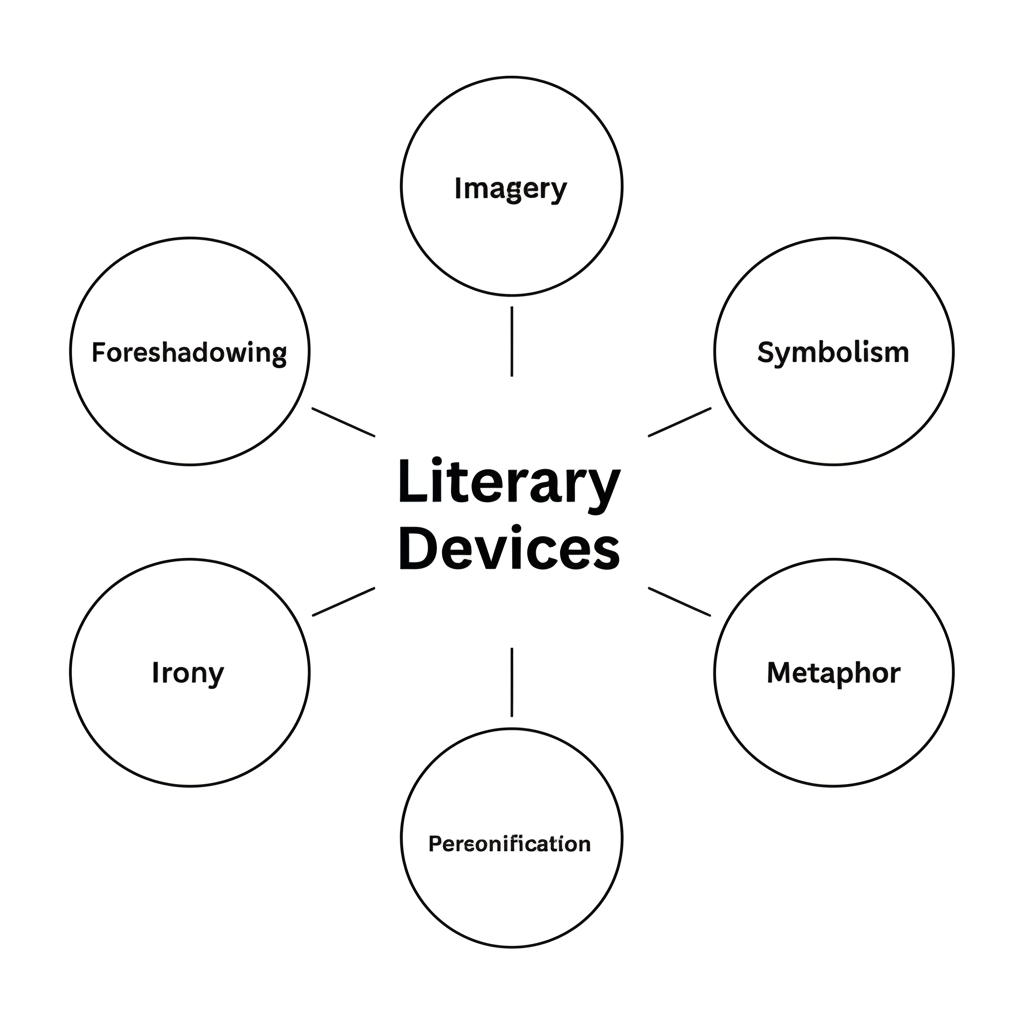
Authors do not just tell stories; they craft them using a variety of literary and rhetorical techniques. Understanding these tools allows you to analyze how the author achieves their purpose and conveys their themes.
Literary Devices in Action
Symbolism in To Kill a Mockingbird
The mockingbird symbolizes innocence and harmlessness. Atticus's instruction that "it's a sin to kill a mockingbird" foreshadows the injustice faced by Tom Robinson, an innocent man destroyed by prejudice.
Imagery in The Great Gatsby
Fitzgerald uses rich imagery to describe Gatsby's parties: "his station wagon sped like a brisk yellow bug to meet all trains." This conveys the lavish excess and superficiality of the Roaring Twenties.
Metaphor in Romeo and Juliet
Romeo describes Juliet as "a rich jewel in an Ethiope's ear." This direct comparison highlights her dazzling beauty and how she stands out against the darkness.
Personification in 1984
The omnipresent "Big Brother is Watching You" posters seem to take on a life of their own, as if the inanimate posters themselves are actively monitoring citizens, creating a pervasive atmosphere of fear and surveillance.
Situational Irony in Lord of the Flies
The boys light a signal fire to attract rescue, but the uncontrolled fire ultimately leads to destruction. The very thing meant to save them becomes a source of devastation -- a classic example of situational irony.
Rhetorical Strategies: MLK's "I Have a Dream"
Ethos
MLK establishes credibility by referencing historical documents like the Declaration of Independence and by speaking as a leader of the Civil Rights Movement.
Pathos
He appeals to emotion by vividly describing the injustices faced by African Americans and by expressing his dream for a future of equality and brotherhood.
Logos
He uses logical reasoning when he states that America has defaulted on its promise of liberty and justice for all, presenting civil rights as a matter of simple justice.
Effective vs. Ineffective Analysis
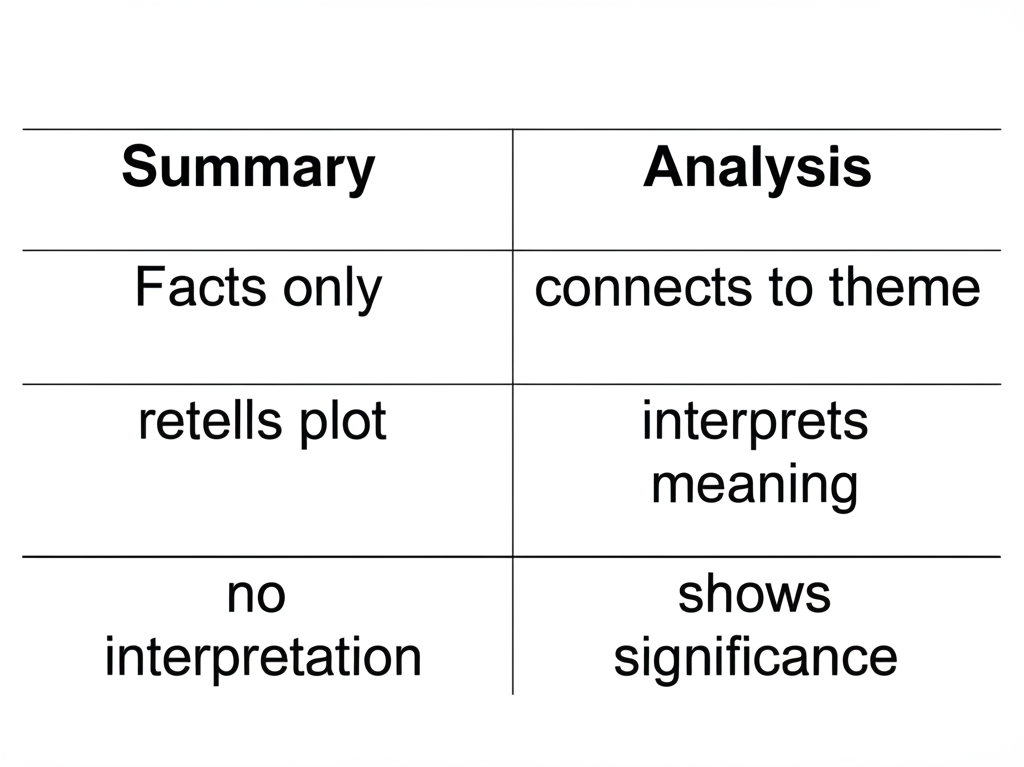
Ineffective: "The green light is green." (Just observation, not analysis.)
Ineffective: "Fitzgerald uses symbolism when he talks about the green light." (Identifies a device but does not explain how or why it is significant.)
Effective: "The green light at the end of Daisy's dock symbolizes Gatsby's unattainable dream of a past love and social acceptance, forever just out of reach. Fitzgerald uses this recurring image to highlight the illusory nature of the American Dream itself, suggesting that true happiness cannot be found by trying to reclaim the past."
Understanding literary techniques is crucial for writing analytical essays. Each time you identify a literary device or rhetorical strategy, you are finding a piece of evidence to support your argument. Your analysis then explains how that evidence works and why it is important to the overall meaning or theme of the text.
5Crafting Your Argument: Analysis & Critical Thinking
Critical thinking in analysis means going beyond simply spotting a literary device. It is about interpreting why the author used it, what effect it has on the reader, and how it contributes to the text's larger themes and meaning. You are not just reporting; you are arguing your interpretation.
It is not enough to say, "The author uses a metaphor." You must explain: WHY did the author choose this specific metaphor? WHAT IMPACT does it have on the reader? HOW does it support your overall argument (thesis statement)?
The Analytical Paragraph Structure (P.E.E.L.)
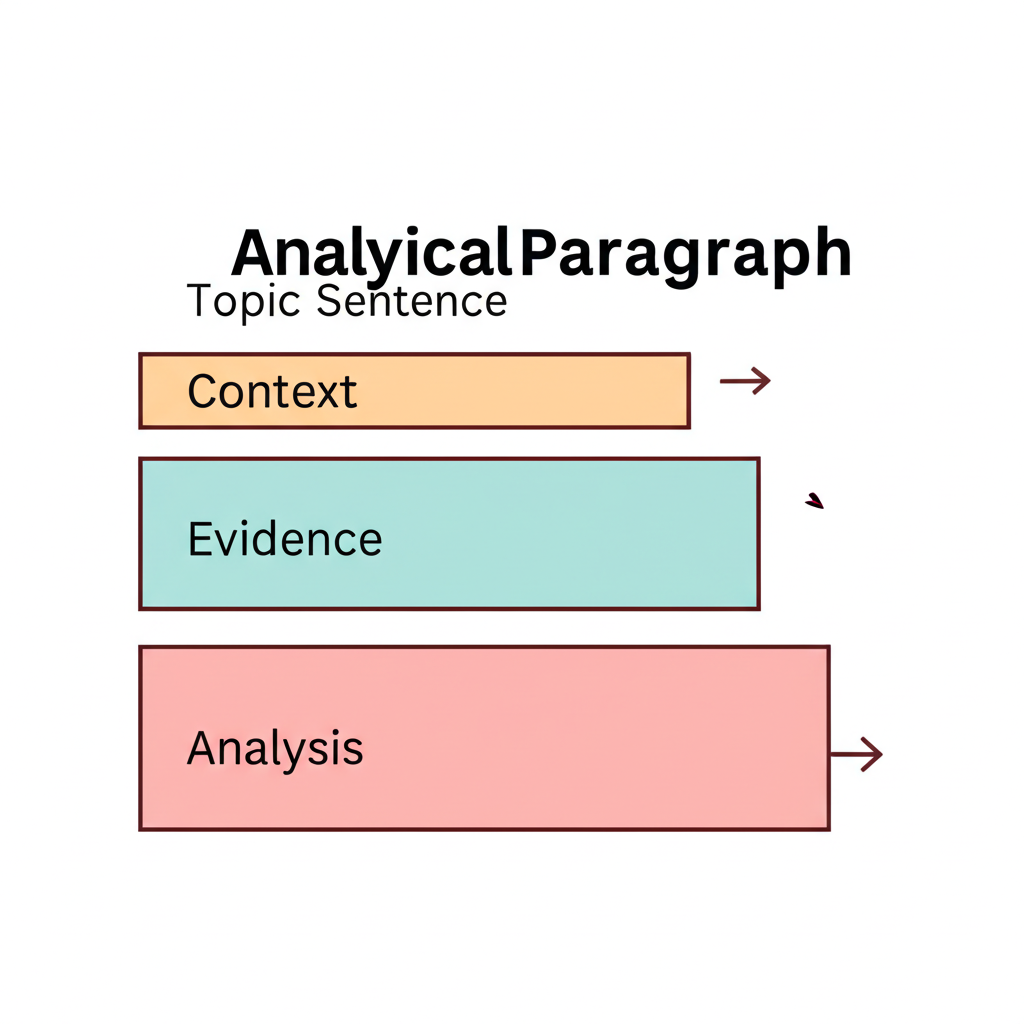
- 1.Topic Sentence (Point): A clear, arguable statement that introduces the main idea of your paragraph and connects back to your overall thesis.
- 2.Context / Introduction to Evidence: Briefly set the scene or introduce the quote so it does not appear out of nowhere.
- 3.Textual Evidence: Provide a specific quote, example, or paraphrase from the text. Integrate it smoothly into your own sentence.
- 4.Explanation / Elaboration (Analysis): The most crucial part. Explain how the evidence supports your topic sentence, identify literary devices, discuss the impact on the reader, and connect to the larger theme. Your analysis should be longer than the quote itself.
- 5.Concluding Sentence (Link): Summarize the paragraph's main point and transition to the next paragraph, reinforcing the connection to your thesis.
Sample Analytical Paragraph: The Great Gatsby
Thesis: In The Great Gatsby, F. Scott Fitzgerald utilizes the symbolism of the green light to illustrate the elusive and ultimately corrupting nature of the American Dream, revealing how a fixation on the past hinders genuine progress.
Gatsby's relentless pursuit of Daisy is epitomized by his unwavering focus on the green light across the bay, a potent symbol representing his idealized past and unattainable future. From his mansion, Gatsby frequently gazes at "a single green light, minute and far away, that might have been at the end of a dock." This initial description establishes the light as both a beacon of hope and a distant, almost fragile object.
Fitzgerald then elaborates on its profound significance, writing, "Gatsby believed in the green light, the orgastic future that year by year recedes before us. It eluded us then, but that's no matter -- tomorrow we will run faster, stretch out our arms farther...." Here, the symbolism of the green light expands beyond Daisy to encompass the entire American Dream -- a dream that, like the light, is perpetually just out of reach. The phrase "orgastic future that year by year recedes before us" powerfully conveys the idea that the pursuit itself is inherently fleeting and perhaps even an illusion.
Thus, the green light becomes a poignant emblem of an idealized past that traps Gatsby in an endless cycle of longing, preventing him from engaging with the present.
6Putting It All Together
Critical analysis is not just a stand-alone skill; it is a superpower that enhances many other areas of your academic and personal life.
Connections to Other ELA Skills
Reading Comprehension
Critical analysis builds on basic understanding, pushing you to comprehend deeper layers of meaning.
Persuasive Writing
Crafting an analytical essay is essentially writing a persuasive argument supported by evidence from the text.
Vocabulary
As you analyze, you encounter and learn precise literary and rhetorical terms that sharpen your writing.
Oral Communication
Being able to articulate your analysis clearly is vital for class discussions, presentations, and debates.
Real-World Applications
- >Analyzing Advertisements: Understand the psychological tactics companies use to sell products.
- >Evaluating News Reports: Identify bias, propaganda, or logical fallacies in media.
- >Understanding Political Speeches: Dissect a politician's rhetoric to see what they are really saying or trying to achieve.
- >Interpreting Social Media: Critically assess messages, memes, and arguments online.
- >Making Informed Decisions: Whether choosing a college, a career, or evaluating a claim, critical analysis helps you weigh pros and cons and look beyond surface claims.
Exam Strategies for Critical Analysis
- 1.Understand the Prompt: Read it multiple times. Identify keywords like "analyze," "discuss," "compare," "contrast," "evaluate."
- 2.Pre-Write / Outline: Spend 5-10 minutes brainstorming ideas, identifying key evidence, and outlining your thesis and main body paragraphs.
- 3.Develop a Strong Thesis Statement: This is the backbone of your essay. Make it arguable, specific, and directly address the prompt.
- 4.Prioritize Strong Evidence: Choose the most compelling textual evidence that directly supports your points.
- 5.Focus on "How" and "Why": For every piece of evidence, ask: How does this support my claim? Why did the author include it? What effect does it create?
- 6.Manage Your Time: Allocate specific amounts of time for planning, writing, and proofreading. Do not spend too long on the introduction.
- 7.Proofread Carefully: Check for grammar, spelling, punctuation, and clarity. A well-written essay strengthens your argument.
Self-Assessment Checklist
- ✓Clear Thesis? Is my main argument specific and arguable?
- ✓Relevant Evidence? Do I use specific quotes/examples that directly support my points?
- ✓Deep Explanation? Do I explain how my evidence supports my argument, rather than just summarizing?
- ✓Literary / Rhetorical Terms? Have I identified and explained the impact of specific devices?
- ✓Avoid Summary? Is my essay primarily analysis, not just a retelling of the plot?
- ✓Logical Flow? Do my paragraphs connect smoothly and build towards my overall argument?
- ✓"So What?" Test: Have I explained the broader significance or thematic connection of my analysis?
7Worked Examples
Example 1: Identifying Theme from a Short Passage
Read the following passage from Shakespeare's Romeo and Juliet (Act 2, Scene 2) and identify a central theme it explores.
Step 1 -- Read and Annotate: Highlight "wherefore art thou Romeo?" (Why are you Romeo/a Montague?), "Deny thy father and refuse thy name," "What's in a name?"
Step 2 -- Identify Core Conflict: Juliet is lamenting Romeo's family name (Montague), which is the source of their families' feud.
Step 3 -- Look for Big Questions: Juliet asks "What's in a name?" and argues that a name does not change the essence of a thing ("a rose / By any other word would smell as sweet").
Final Analysis: This passage explores the theme of the arbitrary nature of societal divisions and the conflict between individual identity and inherited social roles. Juliet questions the power of a name, suggesting that external labels like "Montague" or "Capulet" are superficial and should not dictate love or worth.
Key Insight: Themes are expressed as complete thoughts about life, not single words. "Love" is a subject; "societal labels should not dictate love" is a theme.
Example 2: Analyzing Symbolism in To Kill a Mockingbird
Analyze the symbolism of the mockingbird based on the following quote and broader understanding of the novel.
Step 1 -- Understand the Literal: Mockingbirds are harmless creatures that provide joy through their song.
Step 2 -- Identify Key Traits: "Don't do one thing but make music," "sing their hearts out," "sin to kill." These emphasize innocence, benevolence, and vulnerability.
Step 3 -- Connect to Characters: Tom Robinson is innocent, helps Mayella out of kindness, and is ultimately destroyed by prejudice. Boo Radley is reclusive and misunderstood, but he leaves gifts for the children and ultimately saves their lives.
Final Analysis: The mockingbird symbolizes innocent, benevolent individuals who contribute positively to the world but are vulnerable to the cruelty and injustice of society. To "kill a mockingbird" is to destroy innocence and inflict harm on those who do no wrong.
Key Insight: Effective symbol analysis connects the literal meaning to characters or themes, then explains the broader significance.
Example 3: Analyzing Rhetorical Appeals (Pathos)
Analyze the use of pathos in the following excerpt from a speech advocating for environmental protection.
Step 1 -- Scan for Emotional Language: "children, playing," "air is thick with smog," "majestic polar bears," "homes melting," "struggling to survive," "innocence," "destroyed for profit."
Step 2 -- Identify Specific Emotions: Fear and concern for children's health. Sympathy and pity for endangered animals. Outrage at destruction "for profit." Hope and responsibility for future generations.
Final Analysis: The speaker effectively employs pathos to stir the audience's emotions and compel action. By invoking images of children in smoggy parks, the speaker taps into parental fears. The vivid description of polar bears "struggling to survive" elicits profound sympathy. These emotional appeals create a strong moral imperative, making it difficult for the audience to ignore the call to protect the environment.
Key Insight: When analyzing pathos, identify the specific emotions evoked and explain how they connect to the speaker's argument.
Example 4: Crafting a Thesis and Body Paragraph
Write a thesis statement and a body paragraph analyzing how the valley of ashes in The Great Gatsby symbolizes moral decay and the forgotten consequences of the American Dream.
Thesis: In The Great Gatsby, F. Scott Fitzgerald masterfully uses the symbolism of the desolate valley of ashes to represent the moral decay and forgotten consequences of the unchecked pursuit of the American Dream, exposing the stark contrast between the wealthy elite and the struggling working class.
Topic Sentence: The valley of ashes stands as a powerful symbol of the moral and social devastation wrought by the relentless pursuit of wealth in 1920s America.
Evidence: Fitzgerald describes the valley as "a fantastic farm where ashes grow like wheat into ridges and hills and grotesque gardens... where ashes take the forms of houses and chimneys and rising smoke."
Analysis: The simile "ashes grow like wheat" creates a disturbing inversion of natural growth, suggesting that the byproduct of industrial and material excess is not prosperity but decay. The imagery of ashes taking the "forms of houses and chimneys" personifies the desolation, implying that even the structures of daily life are consumed and corrupted. This "grotesque garden" stands in stark contrast to the lush lawns of East and West Egg, symbolizing the forgotten human cost of the American Dream's promise.
Key Insight: Advanced analysis uses the P.E.E.L. structure to build a compelling, multi-layered argument that connects specific textual evidence to broader themes.
8Memory Aids
"P.E.E.L. for Analytical Paragraphs"
Point (Topic Sentence) -- Evidence (Quote/Example) -- Explanation (Your Analysis) -- Link (Back to Thesis). Follow this structure for every body paragraph.
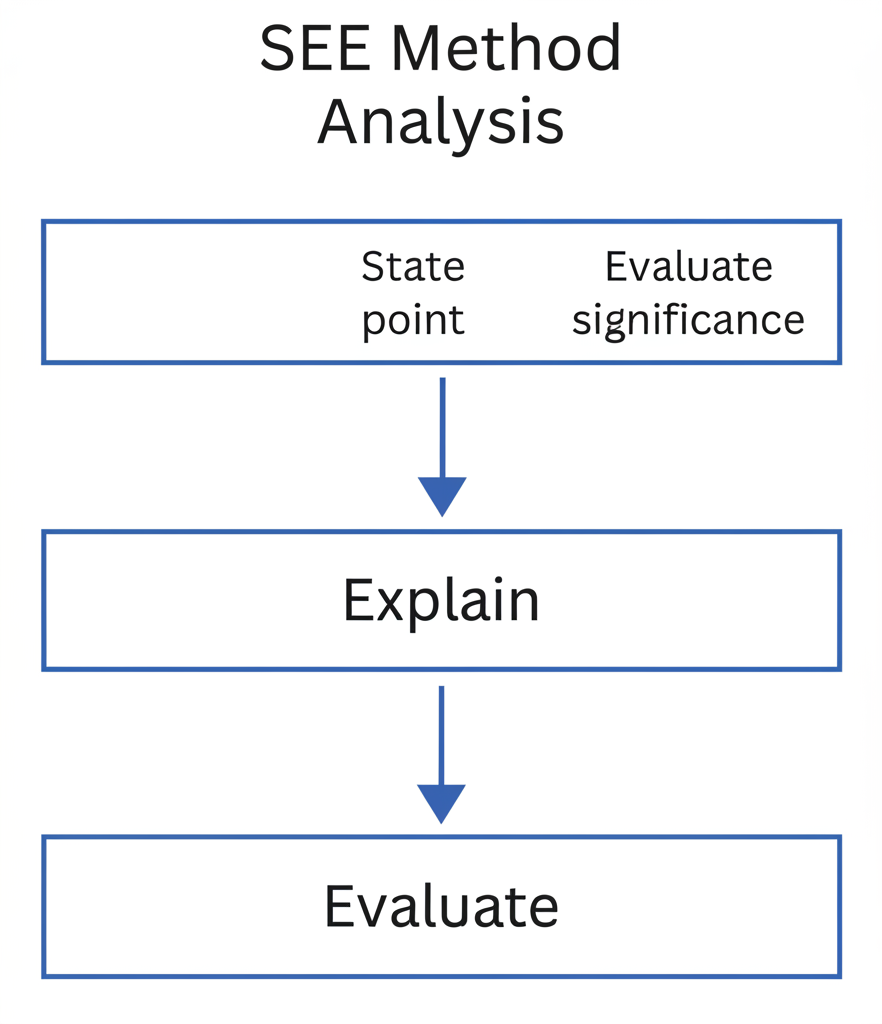
"S.E.E. for Quick Analysis"
Statement (your point about the text) -- Evidence (textual support) -- Explanation (how it supports your point and thesis). A streamlined version of P.E.E.L.
"So what?" -- The question every analysis must answer.
After you have identified a literary device and given evidence, always ask yourself: "So what? Why does this matter? What deeper meaning does it reveal?" If you cannot answer, your analysis is not deep enough.
"F.A.S.T. for Characterization"
Feelings (emotions, internal struggles) -- Actions (what they do) -- Speech (what they say and how they say it) -- Thoughts (what the narrator reveals about their inner mind). Use this to build a complete character analysis.
"E.P.L. for Rhetorical Appeals"
Ethos = Expert (Credibility) -- Pathos = Passion (Emotion) -- Logos = Logic (Reason). Remember the three pillars of persuasion.
9Common Mistakes
Summarizing instead of analyzing
Do not just retell what happens in the text. After presenting evidence, explain how it proves your point and why it is significant.
Wrong: "In Lord of the Flies, the boys get stranded on an island and try to make a society, but it fails and they turn savage." Right: "Golding illustrates the inherent savagery of humanity by depicting the boys' rapid descent from democratic order to brutal tribalism, particularly evident in Jack's manipulation of fear."
"Dropped" quotes -- inserting quotes without introduction or context
Always introduce your quotes with context and follow them with thorough analysis. Never leave a quote hanging.
Wrong: "The island was beautiful. 'The heat was like a hand on one's body.' This shows the setting." Right: "Golding immediately establishes the oppressive atmosphere, noting, 'The heat was like a hand on one's body.' This vivid simile personifies the heat, suggesting it is a physical force that begins to wear down the boys' civility."
Vague or general language
Avoid words like "good," "bad," "interesting," or "shows" without specific explanation.
Wrong: "The author uses good imagery to show the setting." Right: "Fitzgerald's use of opulent imagery, such as 'lavish parties' and 'mountains of flowers,' vividly portrays the superficial excess of the 1920s, highlighting the era's material obsession."
Not connecting evidence to the thesis
Your evidence needs to clearly support your main argument. Every quote should link back to your thesis.
Wrong: "Gatsby throws many parties. He says, 'Old sport.' This shows he is wealthy." Right: "Gatsby's extravagant parties ultimately underscore his profound isolation and the corrupting emptiness of his pursuit. His repeated, artificial use of 'old sport' reveals his desperate attempt to project belonging, reinforcing how obsession has hollowed out his identity."
Over-reliance on one type of evidence or analysis
Do not only look for one literary device. A strong analysis explores multiple elements: symbolism, characterization, setting, conflict, and rhetorical strategies.
Wrong: An essay analyzing 1984 that only talks about Big Brother as a symbol. Right: A strong analysis also explores themes like surveillance, psychological manipulation (doublethink), suppression of history, and the impact of setting.
Misinterpreting literary devices
Be careful not to assume a symbol means something it does not, or to misidentify irony. Always ground your interpretation in textual evidence.
Wrong: "The green light in The Great Gatsby symbolizes Gatsby's desire for money." Right: "The green light primarily symbolizes Gatsby's fervent hope and idealized dream of reuniting with Daisy, representing his unattainable past and the elusive nature of the American Dream itself."
Weak or obvious thesis statement
A thesis should be an arguable claim, not a statement of fact or a summary. Wrong: "Romeo and Juliet is a play about two lovers from feuding families who die." Right: "Through the tragic demise of its titular characters, Shakespeare's Romeo and Juliet critiques the destructive power of tribal hatred and the impulsive nature of youthful passion, arguing that unchecked societal conflict inevitably consumes individual happiness."
10Quick Revision Summary
- ✓Critical analysis is dissecting a text to understand its deeper meaning, author's purpose, and how elements work together.
- ✓Active reading is key: annotate, highlight, and question as you read.
- ✓Go beyond summary: explain how and why the text functions and what it means.
- ✓Master literary devices: symbolism, imagery, metaphor, simile, personification, irony, allusion.
- ✓Understand rhetorical strategies: recognize how authors use ethos, pathos, logos, and repetition to persuade.
- ✓Focus on impact: for every device, explain what effect it has on the reader or the text's meaning.
- ✓Craft a strong thesis: your main argument should be specific, arguable, and guide your entire essay.
- ✓Use P.E.E.L. structure: Point, Evidence, Explanation, Link for every body paragraph.
- ✓Integrate textual evidence smoothly: do not "drop" quotes; introduce them with context.
- ✓Analysis should be longer than the quote: elaborate and explain thoroughly.
- ✓Connect everything to your thesis: ensure all points and evidence support your main argument.
- ✓Apply to real world: use critical analysis skills for advertisements, news, speeches, and everyday decision-making.
Frequently Asked Questions
- What's the main difference between summary and critical analysis?
- Summary simply retells what happened in a text. Critical analysis, on the other hand, explains how something happened, why the author made certain choices, and what the deeper meaning or significance of those choices is. It interprets and argues, rather than just reporting.
- How long should my analysis be for a single quote or piece of evidence?
- As a general rule, your explanation and analysis should be at least two to three times longer than the quote itself. If your quote is one sentence, your analysis should be two to three sentences, explaining how the quote supports your point, what literary devices are used, and what impact it has on the reader or theme.
- What if I don't "see" any literary devices in a passage?
- Every piece of writing uses language in a specific way. If you don't immediately spot a metaphor or symbol, look for word choice (diction), sentence structure (syntax), imagery and sensory details, or character actions and dialogue. There's always something to analyze!
- How do I come up with a strong thesis statement?
- A strong thesis is an arguable claim about the text's meaning or the author's purpose. Identify the topic and specific aspect you're focusing on, state your main argument or interpretation, ensure it's arguable (could someone reasonably disagree?), and make it specific. For example, instead of "Gatsby is a sad character," try "Fitzgerald portrays Gatsby's relentless pursuit of an idealized past as a tragic flaw, ultimately revealing the hollowness of the American Dream."
- Can I analyze a text that I don't personally like?
- Absolutely! Your personal enjoyment of a text is separate from its analytical merit. Critical analysis isn't about whether you like something, but about understanding how it works and what message it conveys. In fact, sometimes disliking a text can even spark interesting critical insights if you can articulate why it's ineffective or problematic.
- How do I properly cite textual evidence in my essay?
- For most high school English essays, you'll use parenthetical citations. For prose (novels, short stories), include the author's last name and page number, e.g., (Lee 119). For plays (Shakespeare), include the act, scene, and line numbers, e.g., (Romeo and Juliet 2.2.2-3). For poems, include the line number(s), e.g., (Frost line 1). Always introduce your quote and explain it afterward.
Practice Quiz
Test your understanding — select the correct answer for each question.
1.What is the primary goal of critical analysis?
2.Which of the following statements is an example of analysis rather than mere summary?
3.In an analytical essay, what is the main purpose of a thesis statement?
4.Read the passage below: "Despite claims that standardized tests accurately measure student intelligence, these tests often fail to account for socioeconomic factors, cultural biases, and diverse learning styles. Therefore, relying solely on these scores for college admissions perpetuates inequality rather than meritocracy." What is the author's main argument in this passage?
5.Which of the following best describes the *theme* of a story, as opposed to its *subject*?
6.In critical analysis, what is the primary role of textual evidence?
7.Read the excerpt below: "The old house stood on the hill, a skeletal hand reaching towards the bruised twilight sky, its empty windows like vacant eyes staring into nothingness. A chill wind whispered through broken panes, carrying the scent of decay and forgotten memories." What literary device is most prominent in the description of the house, and what effect does it create?
8.Which statement demonstrates the strongest critical analysis of a text?
9.What is a "rhetorical device" in the context of critical analysis?
10.Read the passage below: "Critics of the new city park project claim it's too expensive, but they fail to acknowledge the immense benefits: increased property values, improved community health, and a vibrant new tourist attraction. Clearly, their narrow focus on cost ignores the bigger picture of urban revitalization." What is a potential bias or rhetorical strategy evident in the author's argument in the passage?
Final Study Advice
- 1.Read Actively and Often: The more you practice annotating and questioning texts, the more natural critical analysis will become. Pay attention to how professional writers craft their arguments.
- 2.Always Ask "So What?": After identifying any literary device or piece of evidence, push yourself to explain its significance. If you cannot answer "so what?", dig deeper.
- 3.Outline Before You Write: A solid outline ensures your argument is logical and coherent before you write a single full sentence. Spend 5-10 minutes planning.
- 4.Be Specific, Not Vague: Replace words like "good," "bad," and "interesting" with precise literary and analytical terms. Use concrete details from the text.
- 5.Practice Under Timed Conditions: Exams reward students who can organize and analyze quickly. Practice writing full analytical paragraphs under time pressure.