Reading Comprehension Strategies
Reading comprehension is the ability to understand, interpret, and analyze what you read, making connections and drawing conclusions beyond the surface meaning. Mastering this skill is crucial for achieving better grades across all subjects, preparing for college-level work, and developing critical thinking that extends far beyond the classroom.
This guide covers active reading techniques, literary devices, rhetorical appeals, textual analysis, worked examples from classic literature, and a practice quiz to test your understanding.
1Introduction
Reading comprehension is not just about getting through assigned texts — it's a fundamental skill that sharpens your critical thinking, prepares you for college-level work, and empowers you to understand complex ideas across every subject. Whether you're analyzing a novel, interpreting a historical document, or evaluating a scientific article, the principles of strong reading comprehension remain the same.
This guide will equip you with the foundational principles and practical techniques to transform you from a passive reader into an active, confident learner.
You're staring at a complex historical document or a challenging scientific article, and instead of feeling overwhelmed, you confidently break it down, identify the core arguments, and understand the author's purpose. That's the power of strong reading comprehension — it transforms you into a confident, capable learner.
Reading comprehension is an active process — it requires you to engage with the text before, during, and after reading through previewing, annotating, questioning, and connecting ideas.
2Key Definitions
Literary Terms
Theme
The central idea, message, or underlying meaning of a literary work. E.g., the corrupting influence of wealth in The Great Gatsby.
Symbol
An object, person, or action that represents something else, often an abstract idea. E.g., the green light in The Great Gatsby symbolizes Gatsby's unattainable dream.
Motif
A recurring element or image that appears throughout a work and helps develop the theme. E.g., the "eyes" motif in The Great Gatsby.
Allegory
A story that can be interpreted to reveal a hidden meaning, typically moral or political. E.g., Animal Farm is an allegory for the Russian Revolution.
Allusion
An indirect reference to a person, place, event, or literary work. E.g., calling someone a "Romeo" alludes to Shakespeare.
Foreshadowing
Hints or clues given by the author about future events. E.g., the opening brawl in Romeo and Juliet foreshadows the families' tragic conflict.
Protagonist
The main character in a story, often the central figure. E.g., Scout Finch in To Kill a Mockingbird.
Antagonist
The character or force that opposes the protagonist. E.g., Bob Ewell in To Kill a Mockingbird.
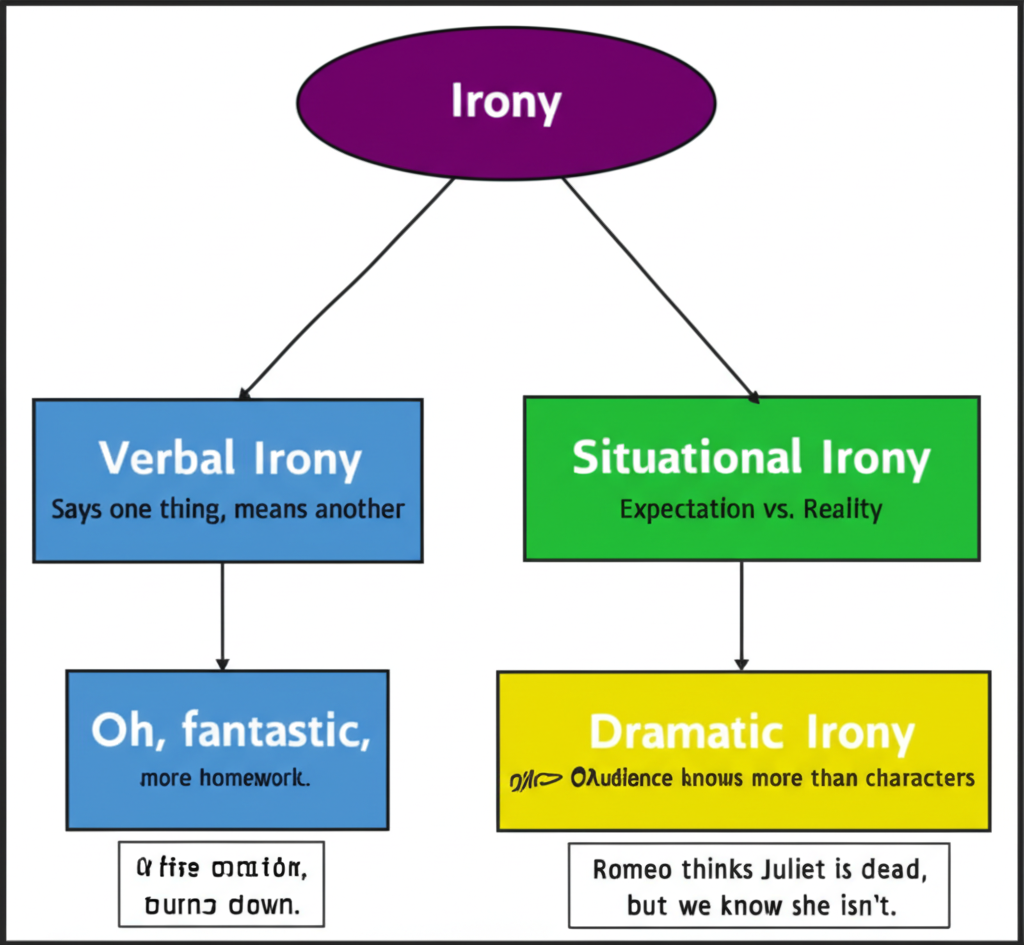
Irony
Verbal Irony
Saying one thing but meaning the opposite (sarcasm). E.g., "Oh, great, another pop quiz!"
Situational Irony
When the outcome is the opposite of what was expected. E.g., a fire station burning down.
Dramatic Irony
When the audience knows something the characters do not. E.g., the audience knows Juliet is alive when Romeo finds her.
Narrative Elements
Narrator
The person or character who tells the story. E.g., in 1984, a third-person limited narrator focuses on Winston Smith.
Imagery
Language that appeals to the five senses, creating vivid descriptions. E.g., "The afternoon sun slanted across the green lawn."
Point of View (POV)
The perspective from which a story is told: first person ("I"), second person ("you"), third person limited (one character's thoughts), or third person omniscient (all characters' thoughts).
Conflict
The struggle between opposing forces: internal (person vs. self) or external (person vs. person, nature, society, technology).
Rhetorical Devices
Ethos
Appeal to credibility or authority, convincing the audience of the writer's trustworthiness.
Pathos
Appeal to emotion, attempting to evoke feelings in the audience to persuade them.
Logos
Appeal to logic or reason, using facts, statistics, and rational arguments.
Rhetorical Question
A question asked for effect rather than to elicit an answer. E.g., "Are we to stand idly by while injustice prevails?"
Parallelism
Similar grammatical structures for rhythm and emphasis. E.g., "It was the best of times, it was the worst of times..."
Anaphora
Repetition of a word or phrase at the beginning of successive clauses. E.g., "We shall not fail. We shall go on..."
Figurative Language
Simile
A comparison using "like" or "as." E.g., "He fought like a lion."
Metaphor
A direct comparison without "like" or "as." E.g., "The classroom was a zoo."
Personification
Giving human qualities to non-human things. E.g., "The wind whispered secrets."
Hyperbole
Exaggeration for effect. E.g., "I'm so hungry I could eat a horse."
Essay Components
Thesis Statement
A concise sentence that presents the main argument or controlling idea of an essay.
Topic Sentence
The main idea of a paragraph, usually appearing at the beginning, that directly supports the thesis.
Evidence
Specific facts, details, examples, or quotations from the text used to support a claim.
Analysis
Your interpretation of how and why the evidence supports your claim. Answers the "so what?" question.
Transition
Words or phrases that connect ideas and paragraphs, creating smooth flow. E.g., "Furthermore," "However," "Consequently."
Counterargument & Rebuttal
A counterargument opposes your thesis; a rebuttal responds to it, explaining why it is flawed or less significant.
3The Active Reader's Toolkit
Reading comprehension isn't passive; it's an active process where you engage with the text. The foundation of this engagement is Active Reading, which means interacting with the text before, during, and after you read. It moves you from merely scanning words to truly understanding and remembering information.
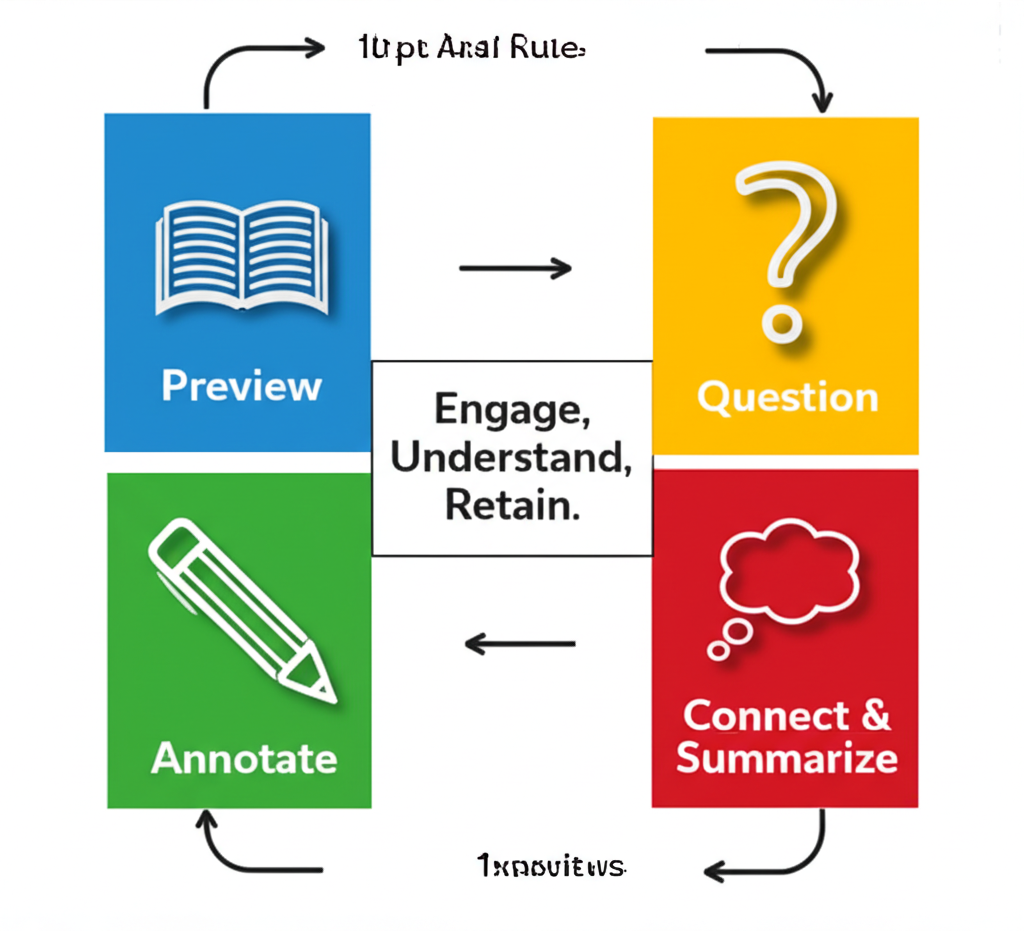
Step-by-Step: Active Reading
1. Preview the Text
Before you read: Look at the title, headings, subheadings, captions, images, and any introductory or concluding paragraphs. Ask: What is this text likely about? What do I already know? What is the author's purpose (to inform, persuade, entertain)?
2. Annotate as You Read
During reading: Highlight key terms, underline important sentences, circle unfamiliar words, and write notes in the margins — questions, summaries, connections, observations about literary devices, and reactions.
3. Question and Reflect
After reading: Revisit your annotations and questions. Ask: What is the main idea? What is the author's purpose? What evidence did they use? Can you explain the text in your own words?
Annotation in Practice
When reading Atticus's closing argument in To Kill a Mockingbird, effective annotation might include:
Pathos
"to subject him to the attention of the public and to public shame"
Marginal note: "Atticus uses emotion here to evoke empathy for Tom Robinson."
Logos
"The State has not produced one iota of medical evidence"
Marginal note: "This is a logical appeal — pointing out the lack of evidence."
- "Do I have to highlight everything?" No! Highlight sparingly — only the most important ideas, keywords, or evidence. Too much highlighting defeats the purpose.
- "What if I don't know what to write?" Start simple: circle unfamiliar words, star important ideas, or write a question mark if something confuses you.
- "Is it okay to write in my books?" If it's your own book, absolutely! Otherwise, use sticky notes or a separate notebook.
Active reading is essential for exam prep (identifying key details, understanding arguments), essay writing (finding evidence, developing analysis), and close reading (discovering subtle meanings). It's the single most impactful reading strategy you can develop.
4Techniques & Application: Unpacking Meaning
Beyond active reading, specific techniques help you dissect and understand complex texts. This section focuses on analyzing literary devices and rhetorical strategies — the tools authors use to create meaning.
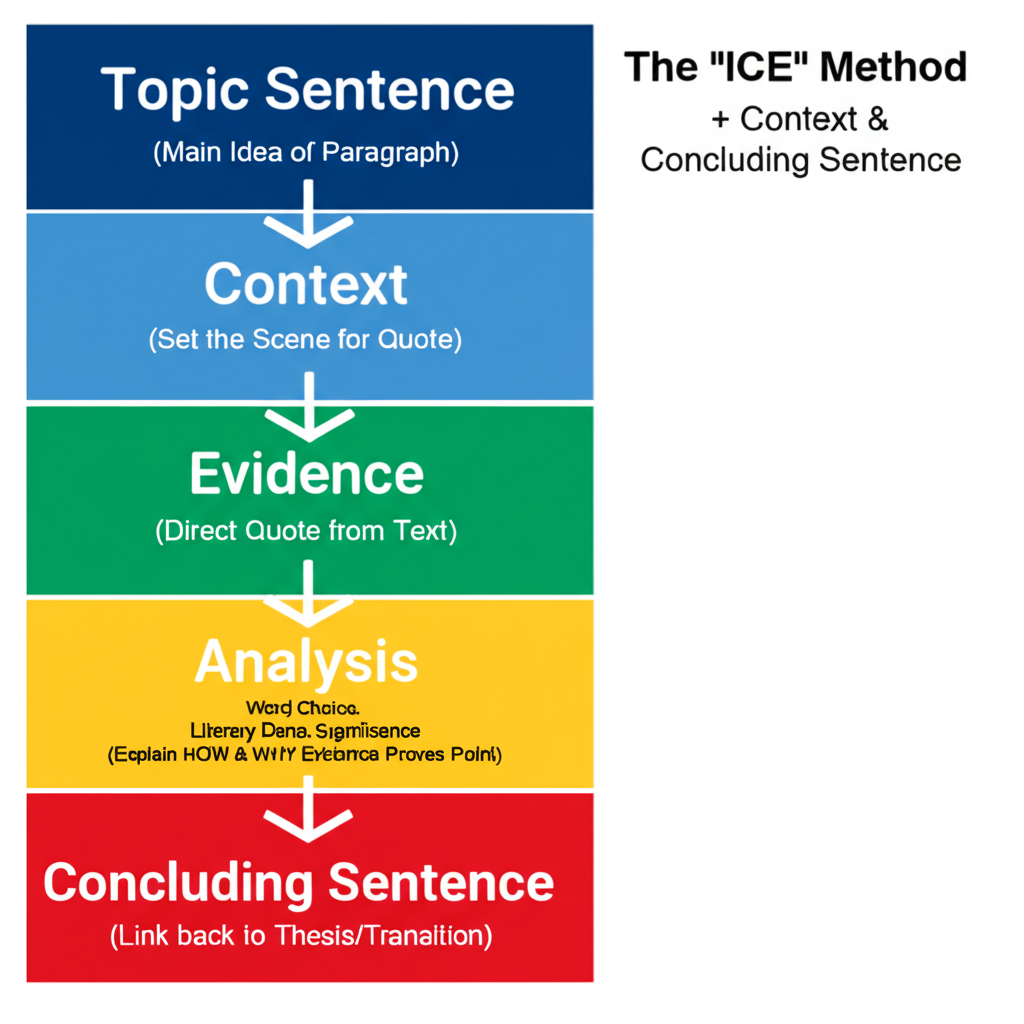
1. Analyzing Symbolism
Effective Analysis
In The Great Gatsby, the green light at the end of Daisy's dock is not just a light; it symbolizes Gatsby's unattainable dream of recapturing the past. Its physical distance across the bay mirrors the emotional and temporal distance separating Gatsby from his desires.
Ineffective Analysis
"The green light is a symbol. It means Gatsby wants Daisy."
Too simplistic — doesn't explain how or why it symbolizes this, or its broader significance.
2. Identifying Irony
Effective Analysis
In Romeo and Juliet, when Romeo exclaims, "O, I am fortune's fool!" after killing Tybalt, this is dramatic irony. The audience knows his impulsive action has sealed his fate, a fate he is unwittingly fulfilling.
Ineffective Analysis
"Romeo is ironic because he says he's a fool."
Doesn't explain what kind of irony or its deeper implications for the plot.
3. Character Analysis
Effective Analysis
Winston Smith in 1984 is a dynamic protagonist who initially rebels by writing in a diary and engaging in a forbidden relationship. His eventual torture and re-education illustrate the Party's absolute power to break even the strongest will.
Ineffective Analysis
"Winston is sad because he lives in a bad society."
Doesn't delve into motivations, development, or the nuances of his struggle.
4. Analyzing Rhetorical Appeals
Effective Analysis
In his "I Have a Dream" speech, MLK powerfully employs pathos when describing the "shameful condition" of racial injustice. By evoking empathy and moral outrage, he compels his audience to recognize the urgency of inequality.
Ineffective Analysis
"King uses pathos to make people sad."
Too general — doesn't specify how he evokes emotion or what kind of emotion.
Connection to Standardized Tests
AP Language
Requires rhetorical analysis — identifying how authors use appeals, figurative language, and organizational structures.
AP Literature
Focuses on literary analysis — character, theme, symbolism, and narrative structure in complex texts.
SAT/ACT Reading
Tests ability to identify main ideas, author's purpose, tone, and meaning of words in context.
5Analysis & Critical Thinking
True reading comprehension goes beyond understanding what happened to understanding how and why it matters. This is where critical thinking comes into play — it separates strong analysis from mere summary.
How to Think Critically
Question Everything
What's the author's bias? What are they not saying? What assumptions are they making?
Look for Patterns
Identify recurring images, words, ideas, or behaviors. These often point to motifs, symbols, or themes.
Consider Purpose & Audience
Why did the author write this? Who are they trying to reach? How does this influence their choices?
Evaluate Evidence
Is the evidence strong, relevant, and sufficient to support the claims?
Make Connections
How does this text relate to other texts, historical events, or contemporary issues?
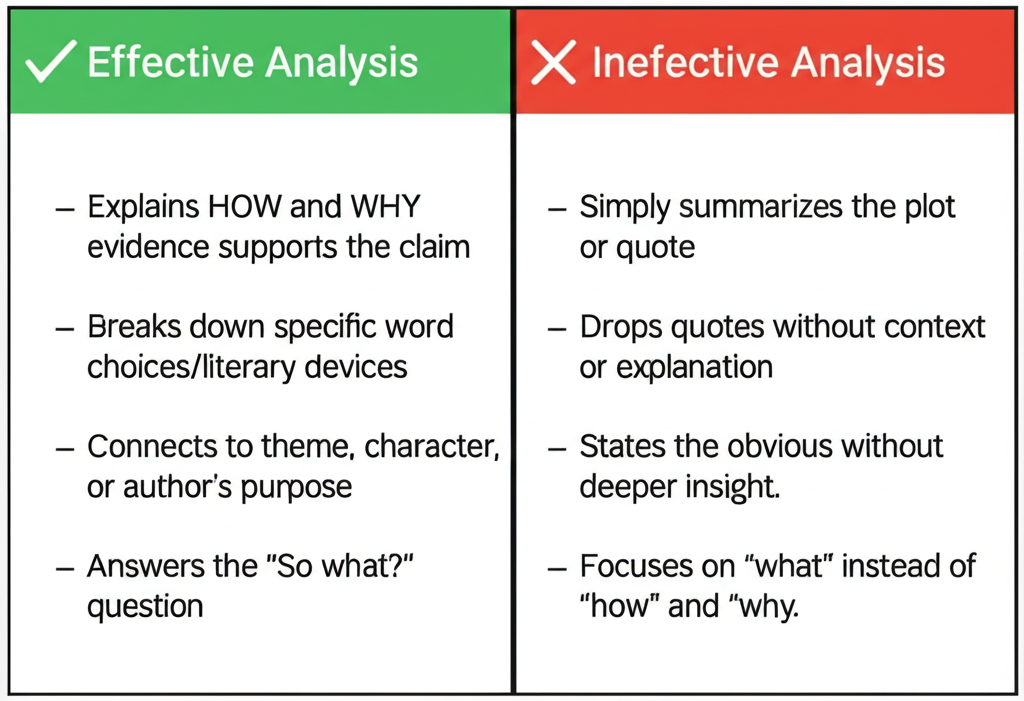
Surface-Level vs. Deeper Analysis
| Surface-Level (What) | Deeper Analysis (How/Why) |
|---|---|
| Ralph and Piggy argue a lot in Lord of the Flies. | Their conflict represents the tension between charismatic authority (Ralph) and intellectual reason (Piggy), foreshadowing the breakdown of democratic principles and the triumph of primal instincts. |
| Atticus defends Tom Robinson in To Kill a Mockingbird. | Atticus's decision establishes him as the moral compass of Maycomb, symbolizing the fight for justice against systemic bigotry and foreshadowing the moral awakening of Scout and Jem. |
| Big Brother is always watching in 1984. | The omnipresent surveillance creates pervasive fear and paranoia, symbolizing the total suppression of individual thought. It forces perpetual self-censorship, demonstrating psychological manipulation inherent in totalitarian regimes. |
Textual Evidence: Select, Introduce, Analyze
1. Select Relevant Evidence
Choose quotations that directly support your point and are rich enough for analysis. Don't pick long quotes if only a few words are crucial.
2. Introduce the Quotation
Don't "drop" quotes. Integrate them smoothly. Provide context: Who is speaking? What is happening?
3. Cite Properly
Include the author's last name and page number in parentheses (MLA format). E.g., (Fitzgerald 21).
4. Analyze the Quotation
Explain how the quote proves your point. What specific words are significant? What literary devices are present? What is the effect?
Quote Integration: Right vs. Wrong
Quote Bombing (Wrong)
"The green light is important. 'He stretched out his arms toward the dark water in a curious way, and, far as I could see, he was trembling.'"
Quote dropped without context or analysis.
Properly Introduced (Right)
Nick observes Gatsby on his dock, noting that "He stretched out his arms toward the dark water in a curious way, and, far as I could see, he was trembling" (Fitzgerald 21).
Smoothly integrated with context and citation.
The pervasive fear instilled by the Party in 1984 is powerfully conveyed through the omnipresent motif of surveillance, most notably embodied by the telescreens. From the novel's opening, Winston Smith's every movement is monitored, as "The telescreen received and transmitted simultaneously. Any sound that Winston made, above a very low whisper, would be picked up by it" (Orwell 3). This constant, two-way observation symbolizes the absolute eradication of privacy and individual autonomy in Oceania. The fact that the telescreen operates "simultaneously" emphasizes the inescapable nature of this control, forcing citizens into perpetual self-censorship. Consequently, the Party not only controls actions but also infiltrates the psychological space of its citizens, demonstrating how total technological oversight can dismantle the very concept of individual thought and rebellion.
6Putting It All Together
Reading comprehension strategies aren't isolated skills; they connect to everything you do in English class and beyond. Here's how these skills transfer across disciplines and into the real world.
Connections to Other ELA Skills
Writing
Strong comprehension allows you to analyze prompts, integrate evidence effectively, and develop sophisticated arguments.
Vocabulary
Encountering new words in context helps expand your lexicon and deepens understanding of nuanced language.
Grammar & Syntax
Understanding sentence structure helps you parse complex ideas and improve your own writing clarity.
Research
Critically evaluating sources requires advanced comprehension of arguments, evidence, and bias.
Real-World Applications
Contracts & Legal Documents
Reading carefully and identifying key terms can save you from costly mistakes in contracts and agreements.
News & Media Evaluation
Discern bias, identify logical fallacies, and understand the full context of a story before forming opinions.
Professional Success
In any career, you'll need to read reports, emails, and instructions accurately and efficiently.
Civic Engagement
Making informed decisions requires understanding policy proposals, political speeches, and complex social issues.
Strategies for Timed Writing and Exams
1. Read the Prompt Carefully
Underline keywords. What is the task? What are you being asked to analyze?
2. Skim and Annotate Strategically
In a timed setting, focus on main ideas, topic sentences, and obvious literary devices. Don't get bogged down in every detail.
3. Outline Quickly
Jot down your thesis and 2-3 main points with supporting evidence. This provides structure even under time pressure.
4. Prioritize Analysis
Don't just summarize. Spend the majority of your time explaining how and why your evidence supports your claims.
5. Manage Your Time
Allocate specific amounts of time for reading, outlining, drafting, and revising.
- Does my thesis clearly state my main argument?
- Does each paragraph have a clear topic sentence supporting my thesis?
- Have I introduced all quotations with context?
- Have I analyzed my evidence thoroughly, explaining how it supports my point?
- Are there smooth transitions between sentences and paragraphs?
- Does my conclusion restate my thesis in new words and offer a final insight?
7Worked Examples
Example 1: Identifying Verbal Irony
Read the following sentence and determine if it contains verbal irony: "After tripping and spilling his lunch all over himself, Mark exclaimed, 'Well, this day just keeps getting better and better!'"
Step 1: Mark says "this day just keeps getting better and better!" — the literal meaning is that his day is improving.
Step 2: The context shows Mark has tripped and spilled his lunch — clearly an unpleasant event. His day is not getting better.
Step 3: There is a clear contrast between what Mark says and what he actually means, given the unfortunate event.
Key Insight: Verbal irony occurs when there is a deliberate mismatch between what is said and what is truly meant, often for humorous or critical effect.
Example 2: Analyzing Symbolism in The Great Gatsby
Consider the green light at the end of Daisy's dock. What does this symbol represent, based on the novel's context?
Step 1: Identify the object: The green light is at the end of Daisy Buchanan's dock, across the bay from Gatsby's mansion.
Step 2: Observe Gatsby's interaction: Gatsby "stretched out his arms toward it in the darkness" — indicating yearning and longing for something he cannot reach.
Step 3: Connect to themes: Gatsby's primary goal is to reclaim his past with Daisy. The green light symbolizes his hopes, dreams, and his unattainable vision of the American Dream.
Key Insight: Symbols derive their meaning from their context within a story, often representing abstract ideas or complex emotions.
Example 3: Understanding Foreshadowing in To Kill a Mockingbird
Read the passage about Jem's destruction of Mrs. Dubose's camellias. What event might it be foreshadowing?
Step 1: Phrases like "I think I understand now" and "regretted bitterly later" indicate Scout is recounting past events with future knowledge.
Step 2: The event is Jem's destruction of Mrs. Dubose's camellias — a "senseless act."
Step 3: "Regretted bitterly later" directly hints at negative consequences, foreshadowing a difficult lesson for Jem.
Key Insight: Authors use foreshadowing to build suspense and prepare readers for future developments, often through narrators reflecting with future knowledge.
Example 4: Analyzing Motif and Theme in The Great Gatsby
The billboard with the eyes of Doctor T.J. Eckleburg is a recurring image. How does this motif contribute to a major theme?
Step 1: The motif is gigantic, disembodied eyes on a billboard overlooking the Valley of Ashes.
Step 2: The eyes "brood on over the solemn dumping ground" — they watch everything but represent an absent or indifferent moral authority.
Step 3: The motif reinforces the theme of moral decay and the absence of spiritual values in the pursuit of wealth, suggesting a society under silent, indifferent judgment.
Key Insight: Motifs are powerful tools that, through repetition and symbolic association, deepen a reader's understanding of the central themes of a literary work.
Example 5: Situational Irony in "The Gift of the Magi"
Della sells her hair to buy Jim a fob chain for his watch, while Jim sells his watch to buy Della combs for her hair. Explain the situational irony and its effect.
Step 1: Each character expects their sacrifice to result in a perfectly complementary gift for their beloved's most cherished item.
Step 2: Both gifts are rendered useless by the very sacrifices made to acquire them.
Step 3: The situational irony lies in the fact that their selfless acts of love made the gifts functionally obsolete.
Step 4: The irony deepens the story's message: true love and sacrificial giving are more valuable than material possessions. The spiritual gift of love was perfectly exchanged.
Key Insight: Situational irony often serves to highlight a deeper truth or moral, revealing a contrast between superficial expectations and profound realities.
Example 6: Deconstructing Allegory in Animal Farm
Animal Farm is an allegory for the Russian Revolution. Explain how the characters and events represent historical counterparts.
Step 1 — Characters: Old Major = Karl Marx/Lenin (ideological founder); Napoleon = Stalin (ruthless leader); Snowball = Trotsky (exiled idealist); Boxer = the exploited working class.
Step 2 — Events: The Animal Rebellion = 1917 Russian Revolution; Battle of the Cowshed = Russian Civil War; the windmill = Stalin's Five-Year Plans; purges = Stalin's Great Purge.
Step 3 — Meaning: By showing how the animals' ideals of equality are corrupted by the pigs, Orwell critiques totalitarianism and warns that revolutionary ideals can be betrayed by power. The pigs become indistinguishable from the humans they overthrew.
Key Insight: Allegories use a narrative to convey a deeper moral or political message, requiring readers to interpret characters and events as symbols for real-world counterparts.
8Memory Aids
"TWIST — for Tone Analysis"
Tone (What is the author's attitude?) — Word Choice (Diction) — Imagery (Sensory details) — Style (Sentence structure) — Theme (Central message). Use this to systematically analyze any passage.
"So what?" — The question every analysis must answer.
After presenting evidence, always ask yourself "so what?" If your analysis doesn't answer this, you're still at the summary level. Dig deeper into how and why the evidence matters.
"Active reading is like being a detective — you're not just reading the scene, you're searching for clues."
Every annotation is evidence collected. Every question is a lead followed. Every connection brings you closer to solving the author's puzzle.
"Ethos, Pathos, Logos — Credibility, Emotion, Logic"
The three pillars of persuasion. When analyzing any argument, identify which appeal the author relies on most and consider why that approach serves their purpose.
"Don't just tell — show and explain."
Present evidence (show), then analyze it (explain). Never leave a quote hanging without analysis. Your interpretation is what earns the marks.
9Common Mistakes
Summarizing instead of analyzing
Don't just retell what happens in the text. Explain how and why the author's choices create meaning. Always answer the "so what?" question after presenting evidence. Summary tells what; analysis explains how and why.
Dropping quotes without context or analysis
Never "quote bomb" — dropping a quotation into your essay without introducing it or explaining its significance. Every piece of evidence needs context (who said it, when, why) and your interpretation connecting it to your argument.
Identifying a literary device without explaining its effect
Saying "the author uses a metaphor" is not enough. You must explain what the metaphor compares, how it creates meaning, and why it matters to the text's theme or the author's purpose.
Over-highlighting or under-annotating
Highlighting entire paragraphs defeats the purpose of active reading. Be selective — focus on key arguments, evidence, and literary devices. Use marginal notes for questions, connections, and observations.
Confusing types of irony
Verbal irony (saying the opposite of what you mean) is different from situational irony (unexpected outcomes) and dramatic irony (audience knows more than characters). Always specify which type and explain the discrepancy.
Ignoring author's purpose and audience
Every text is written for a reason and an audience. Failing to consider why the author made specific choices (word choice, structure, tone) leads to shallow analysis that misses the deeper meaning.
10Quick Revision Summary
- ✓Active reading means engaging with text before, during, and after — preview, annotate, question, and connect.
- ✓Symbols represent abstract ideas; motifs are recurring elements that develop themes.
- ✓There are three types of irony: verbal (says opposite), situational (unexpected outcome), dramatic (audience knows more).
- ✓Analysis explains how and why — it answers "so what?" and goes beyond summary.
- ✓Never leave a quote hanging — always introduce it with context and follow it with your interpretation.
- ✓The three rhetorical appeals: Ethos (credibility), Pathos (emotion), Logos (logic).
- ✓Use TWIST for tone analysis: Tone, Word Choice, Imagery, Style, Theme.
- ✓Know your figurative language: simile, metaphor, personification, hyperbole.
- ✓Understand point of view: first person, second person, third person limited, and third person omniscient.
- ✓Critical thinking means questioning everything — the author's bias, assumptions, purpose, and audience.
Frequently Asked Questions
- What is active reading and why is it important?
- Active reading is a strategy where you engage with the text before, during, and after reading by previewing, annotating, questioning, and summarizing. It is important because it transforms you from a passive receiver of information into an engaged participant, dramatically improving comprehension, retention, and your ability to analyze texts for exams and essays.
- How do I annotate a text effectively without over-highlighting?
- Highlight sparingly — only the most important ideas, keywords, or evidence. Use marginal notes for questions, brief summaries, connections to other texts, and observations about literary devices. Circle unfamiliar words and put a star next to key arguments. The goal is targeted engagement, not coloring the entire page.
- What is the difference between a symbol and a motif?
- A symbol is an object, person, or action that represents something else, often an abstract idea (e.g., the green light in The Great Gatsby symbolizes unattainable dreams). A motif is a recurring element that appears throughout a work and helps develop a theme (e.g., the repeated image of eyes in The Great Gatsby suggests moral judgment). A motif recurs; a symbol may appear only once.
- How do I move from summary to analysis in my writing?
- Summary tells what happens; analysis explains how and why it matters. After presenting evidence, ask yourself "so what?" Explain the significance of specific word choices, literary devices, and how they connect to the author's broader theme or purpose. Focus on how the author achieves an effect rather than retelling events.
- What are the three types of irony and how do I identify them?
- Verbal irony is saying one thing but meaning the opposite (sarcasm). Situational irony occurs when the outcome is the opposite of what was expected. Dramatic irony is when the audience knows something the characters do not. To identify them, look for discrepancies between words and meaning, expectations and reality, or character knowledge and audience knowledge.
- What are ethos, pathos, and logos?
- These are the three rhetorical appeals used in persuasion. Ethos appeals to credibility or authority. Pathos appeals to emotion. Logos appeals to logic and reason using facts and data. Strong arguments typically use all three. Identifying which appeal an author uses helps you understand their persuasive strategy.
- How should I select and integrate quotations in an essay?
- Choose quotations that directly support your point and are rich enough for analysis. Never "drop" a quote without context — introduce it by explaining who is speaking and what is happening. After the quote, provide thorough analysis explaining how it proves your point. Always cite properly using MLA format (Author Page).
Practice Quiz
Test your understanding — select the correct answer for each question.
1.According to the article, which of the following is NOT a stated benefit of mastering reading comprehension?
2.Which literary term refers to the central idea, message, or underlying meaning of a literary work?
3.The article provides the example: 'A fire station burning down is an instance of __________.' Which type of irony correctly fills the blank?
4.A student analyzes The Great Gatsby and writes, 'The green light at the end of Daisy's dock is a motif because it appears throughout the story and represents Gatsby's unattainable dream.' What correction should be made?
5.Which of the following literary works is cited in the article as an example of an allegory?
6.The article mentions that 'The opening scene of Romeo and Juliet with the street brawl foreshadows the tragic conflict between the families.' What does this example best illustrate about foreshadowing?
7.A student identifies Bob Ewell as the main character and hero in To Kill a Mockingbird. What common mistake is the student making?
8.A student summarized reading comprehension as 'just being able to read the words on the page.' Which revision best reflects the article's broader definition?
9.If an author writes, 'He was a true Scrooge when it came to spending money,' this is an example of an:
10.A student describes a situation where a character says, 'What a beautiful day!' while walking through a terrible storm, and labels it as 'situational irony.' Which correction should be made?
Final Study Advice
- 1.Read widely — the more you read, the better you become at it. Explore different genres and authors.
- 2.Discuss your readings with peers or teachers — talking about texts solidifies understanding and exposes you to new perspectives.
- 3.Practice active reading consistently — make it a habit for all your reading, not just English class.
- 4.Don't be afraid to re-read — complex passages often require multiple readings to fully grasp.
- 5.Keep a literary terms glossary — refer back to definitions when you encounter unfamiliar devices in your reading.