Rhetorical Analysis
Rhetorical analysis is the art of examining how authors, speakers, or creators use language and other techniques to persuade, inform, entertain, or inspire an audience. It sharpens your critical thinking, prepares you for college-level work, and empowers you to see beyond the surface of messages in an age of constant information.
This guide covers the rhetorical situation (SOAPSTone), persuasive appeals (ethos, pathos, logos), rhetorical devices, analytical paragraph structure, worked examples from classic texts, and a practice quiz to test your understanding.
1Introduction
Rhetorical analysis is not just about what someone says, but how they say it, and why they chose those specific words and strategies. Mastering this skill will help you earn better grades in English and history classes, prepare you for college-level critical thinking, and sharpen your communication skills as both a speaker and writer.
At its core, rhetorical analysis involves deconstructing a text — which could be an essay, a speech, an advertisement, or even a political cartoon — to understand its purpose, audience, and the persuasive strategies employed. You'll learn to identify the tools writers use and explain why those tools are effective (or ineffective) in achieving their goals.
Imagine watching a political debate. One candidate uses emotionally charged stories about struggling families, while another presents detailed economic data. A third repeatedly uses a catchy slogan. Without rhetorical analysis, you might just react to the emotions or numbers. With it, you'd recognize the first candidate is using pathos, the second logos, and the third repetition, allowing you to critically evaluate their strategies, not just their surface claims.
Rhetorical analysis examines how communication works, not just what it says. It looks at the author's choices in language and strategy to achieve a purpose for a specific audience.
2Key Definitions
Core Rhetorical Terms
Rhetoric
The art of effective or persuasive speaking or writing, especially the use of figures of speech and other compositional techniques. E.g., a lawyer using powerful language to convince a jury.
Rhetorical Situation
The circumstances surrounding a text, including the Speaker, Occasion, Audience, Purpose, Subject, and Tone. Analyzed using the SOAPSTone framework.
Exigence
The immediate occasion or reason for the text's creation; the "spark" or problem that prompts the rhetor to speak or write. E.g., the exigence for To Kill a Mockingbird was addressing racial injustice.
Audience
The person or group of people the rhetor is trying to reach and influence. E.g., the audience for a principal's speech about school rules is the student body.
Purpose
The goal the rhetor hopes to achieve — to persuade, inform, entertain, inspire, or provoke. E.g., MLK's purpose in "I Have a Dream" was to inspire action towards civil rights.
Context
The circumstances and environment surrounding the text, including historical, social, and cultural factors. E.g., understanding the Cold War context is crucial for analyzing 1950s political speeches.
Persuasive Appeals
Ethos
Appeal to credibility or character. The rhetor convinces the audience they are trustworthy, knowledgeable, or authoritative. E.g., a doctor recommending a healthy diet.
Pathos
Appeal to emotion. The rhetor evokes feelings such as sympathy, anger, fear, or joy to persuade the audience. E.g., commercials showing sad animals to encourage donations.
Logos
Appeal to logic or reason. The rhetor uses facts, statistics, evidence, or logical arguments. E.g., presenting crime rates and economic data to argue for a new policy.
Rhetorical Devices
Rhetorical Question
A question posed for effect, not requiring an answer, often to make a point or provoke thought. E.g., "Can we truly stand by and let this happen?"
Parallelism
The repetition of a grammatical structure or pattern of words to create rhythm, balance, and emphasis. E.g., "It was the best of times, it was the worst of times..."
Anaphora
A specific type of repetition where a word or phrase is repeated at the beginning of successive clauses. E.g., "We shall fight in France. We shall fight on the seas..."
Antithesis
The juxtaposition of contrasting ideas in balanced phrases to create a strong contrast. E.g., "One small step for man, one giant leap for mankind."
Allusion
An indirect reference to a person, place, event, or literary work that the audience is expected to know. E.g., calling someone a "Romeo."
Imagery
Vivid descriptive language that appeals to the five senses, creating a mental picture for the reader.
Repetition
The repeated use of a word, phrase, or clause for emphasis or rhetorical effect. E.g., "Let freedom ring..." repeated by MLK.
Language & Style
Tone
The author's or speaker's attitude toward their subject and audience, conveyed through word choice and style. E.g., a sarcastic, formal, or somber tone.
Diction
The author's specific word choice, which significantly impacts the tone and meaning. E.g., using "childish" versus "youthful" changes the diction and tone.
Syntax
The arrangement of words and phrases to form sentences. Short, choppy sentences create urgency; long, complex sentences convey formality.
Metaphor
A direct comparison without "like" or "as," stating one thing is another. E.g., "Life is a highway."
Simile
A comparison using "like" or "as." E.g., "She sings like an angel."
3The Rhetorical Situation: Understanding the Context
The first core concept in rhetorical analysis is understanding the Rhetorical Situation. This framework helps you identify the essential components that shape any communicative act. A popular mnemonic for remembering these components is SOAPSTone.
Before you can analyze how a speaker persuades, you need to understand who they are, when and where they're speaking, to whom, why, and what they're talking about. This foundational understanding is crucial for exam prep, essay writing, and close reading.
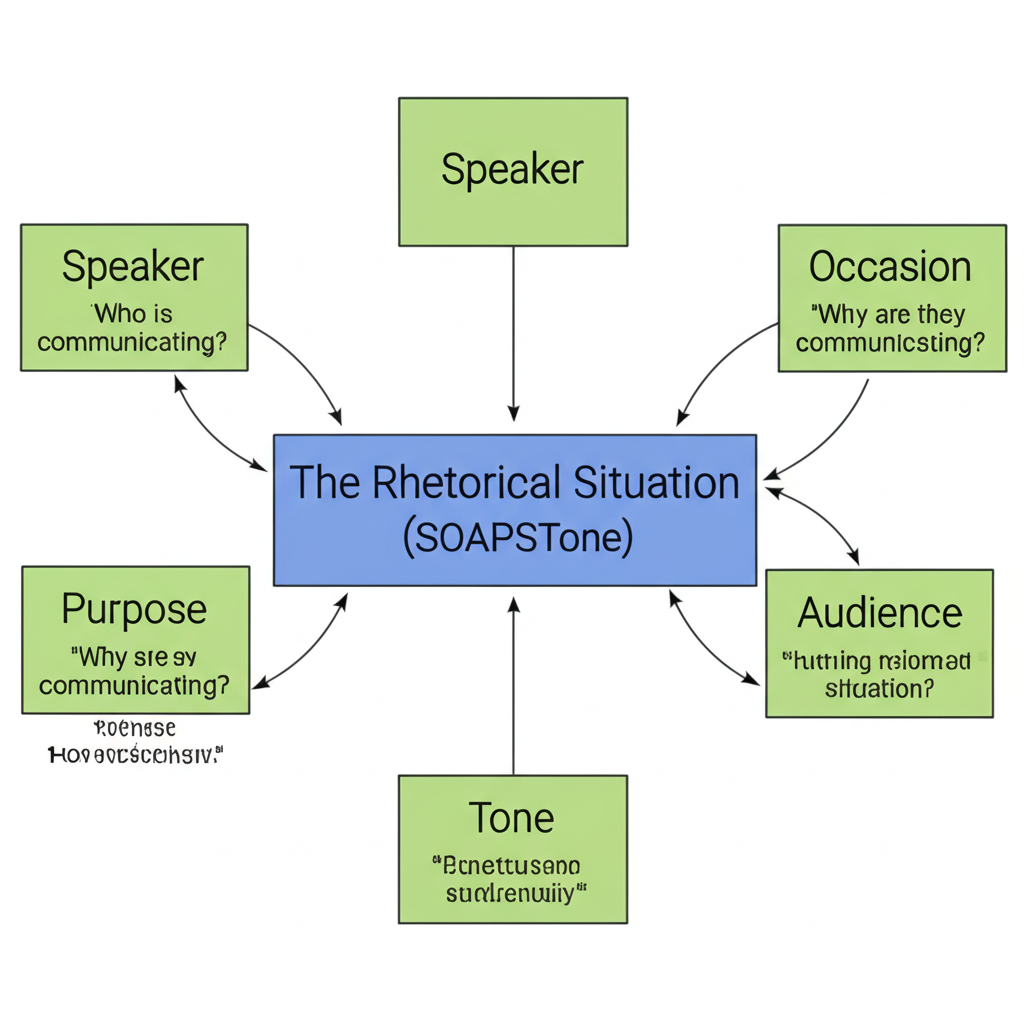
Step-by-Step: Applying SOAPSTone
S — Speaker
Who is the voice behind the text? What do you know about their background, identity, authority, and biases? E.g., Atticus Finch is a lawyer known for his integrity.
O — Occasion
What is the time, place, and context of the text? What events or circumstances prompted its creation? E.g., Marc Antony's oration is prompted by Caesar's assassination.
A — Audience
Who is the intended recipient? What are their characteristics, beliefs, values, or potential biases? E.g., Antony's audience is the Roman populace, initially hostile to him.
P — Purpose
Why did the speaker create this text? What do they hope to achieve — to inform, persuade, entertain, commemorate, inspire, or provoke? E.g., Antony's purpose is to turn the crowd against the assassins.
S — Subject
What is the main topic, content, or central idea of the text? E.g., the subject of Antony's speech is Caesar's death and the conspirators' actions.
T — Tone
What is the speaker's attitude toward the subject and audience? How is this conveyed through diction and syntax? E.g., Antony's tone shifts from mournful to ironic and accusatory.
Example: Marc Antony's Funeral Oration (Julius Caesar)
Speaker
Marc Antony, a close friend and loyal supporter of Julius Caesar — a skilled orator and politician.
Occasion
Caesar's public funeral, immediately after his assassination. The Roman crowd is agitated and initially swayed by Brutus's reasoning.
Audience
The Roman common people (the plebians), who are emotional, easily swayed, and initially believe Brutus's claim that Caesar was ambitious.
Purpose
To avenge Caesar's death by turning the Roman citizens against the conspirators, without directly accusing them at first, thereby inciting a riot.
Subject
The legacy of Julius Caesar, the conspirators' actions, and the concept of honor and justice.
Tone
Initially mournful and seemingly deferential to Brutus ("noble Brutus"). It becomes increasingly ironic, questioning, and subtly inflammatory, shifting to passionate and vengeful by the end.
The occasion is more than just "when it happened." It's the circumstances that prompted the text. A graduation speech's occasion isn't just a date — it's the culmination of years of study, marking a transition to adulthood.
4The Art of Persuasion: Ethos, Pathos, Logos
Once you understand the rhetorical situation, you can delve into the primary persuasive appeals: Ethos, Pathos, and Logos. These are the fundamental tools rhetors use to connect with and influence their audience.
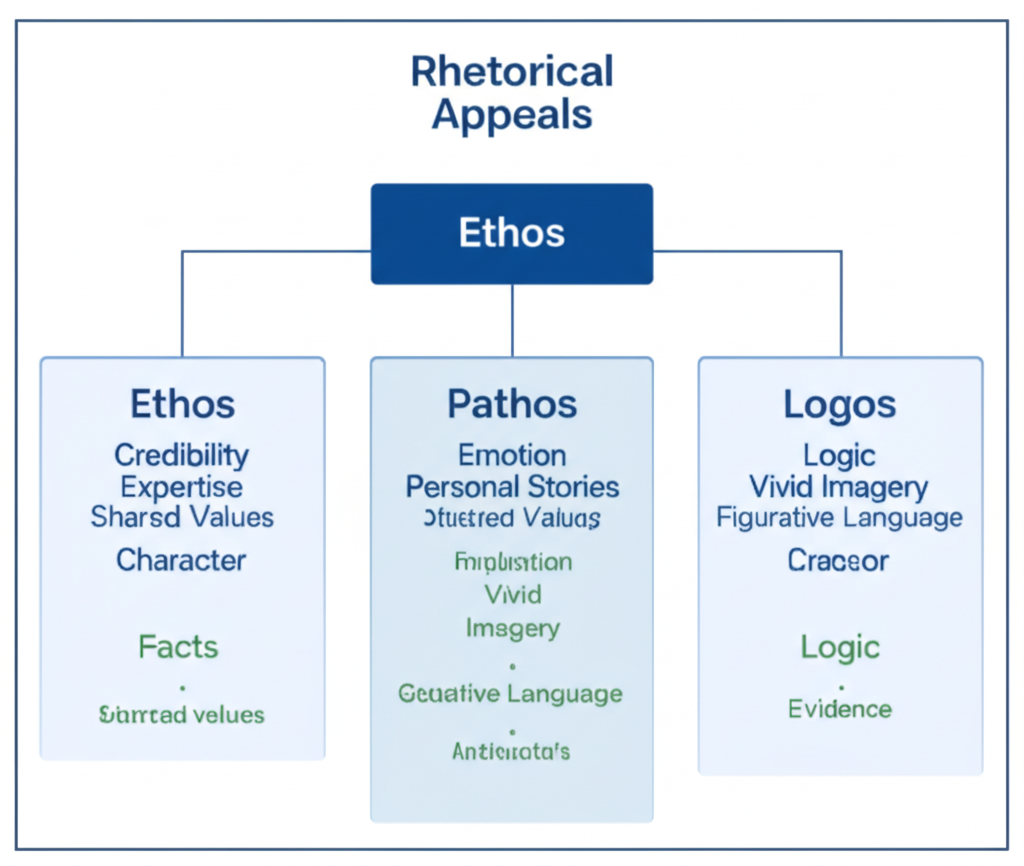
Ethos (Credibility)
The speaker establishes their authority, expertise, experience, or good character.
Effective: Atticus Finch's moral uprightness as a lawyer makes his audience trust his perspective on justice.
Ineffective: "My friend thinks it's a good idea" — the principal doesn't know the friend, and no authority is established.
Pathos (Emotion)
The speaker uses vivid language, personal anecdotes, or emotional imagery to evoke feelings.
Effective: In Of Mice and Men, George's retelling of the dream farm evokes hope and bittersweet longing.
Ineffective: "You should feel bad for poor people" — no specific stories or imagery to generate strong emotional response.
Logos (Logic)
The speaker presents facts, statistics, logical reasoning, or evidence to construct a rational argument.
Effective: Presenting crime rates and economic data to argue for a new policy appeals to the audience's intellect.
Ineffective: "Everyone else is doing it" — a logical fallacy, not sound reasoning.
Connection to Standardized Tests
Rhetorical analysis is a cornerstone of the AP English Language and Composition exam, where you analyze non-fiction texts to explain how authors achieve their purpose. The SAT and state exams often include reading passages requiring you to identify the author's purpose, tone, and persuasive techniques. Understanding Ethos, Pathos, and Logos is fundamental to answering these questions accurately.
Try rewriting a simple statement like "Students should study more" using each appeal. How would you present it using ethos, then pathos, then logos? This practice builds intuition for identifying appeals in any text.
5Rhetorical Devices & Their Impact
Beyond the three main appeals, rhetors employ a vast toolkit of rhetorical devices — specific techniques that manipulate language to create particular effects. Analyzing these devices helps you move from what is said to how it's said and why it's effective.
Surface-Level vs. Deeper Understanding
Surface-Level (Weak)
"The speaker uses repetition."
Simply names the device without explaining its impact.
Deeper Understanding (Strong)
"The speaker's anaphora of 'I have a dream' at the beginning of successive clauses creates a rhythmic, almost chant-like quality that builds emotional intensity and reinforces the central vision of equality, making the dream feel both urgent and attainable."
Explains effect, audience impact, and connection to purpose.
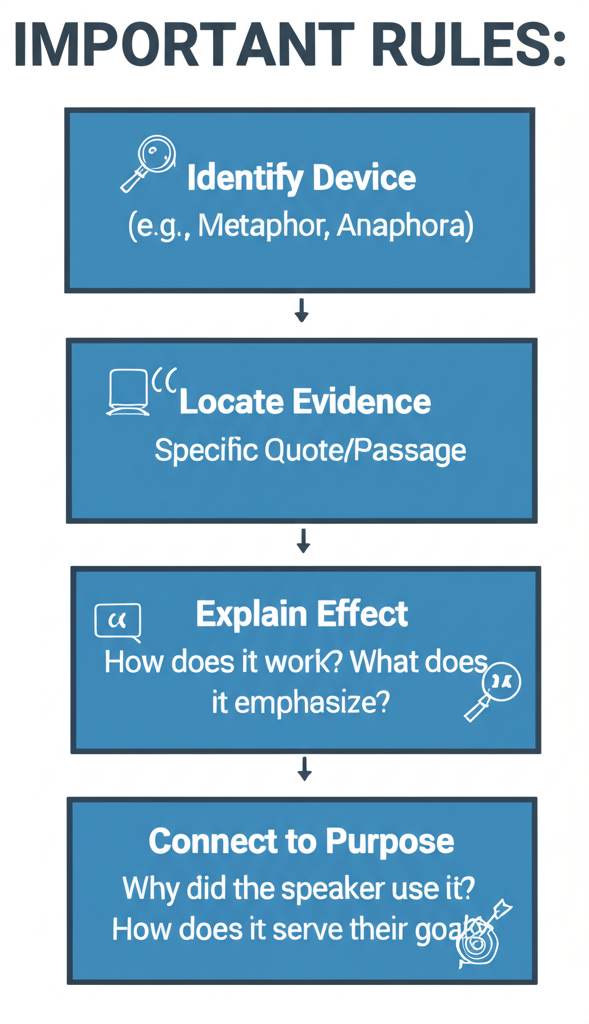
How to Write About Devices in an Essay
1. Identify the device
Spot a specific technique in the text (e.g., anaphora, metaphor, rhetorical question).
2. State the device and its purpose
Introduce it in your topic sentence or within your analytical paragraph.
3. Provide textual evidence
Quote the specific words/phrases where the device appears. Introduce quotes smoothly — don't "drop" them.
4. Analyze its effect
Explain how the device works, what it emphasizes, how it affects the audience, and why the speaker used it to achieve their purpose.
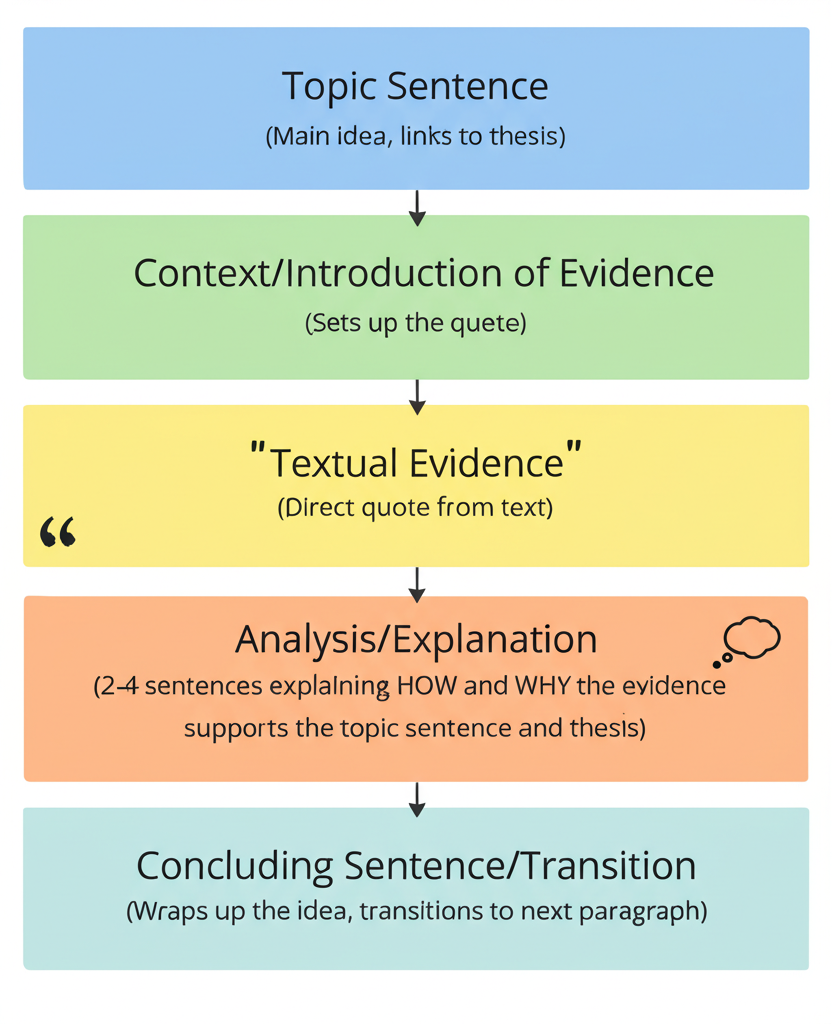
Sample Analytical Paragraph
Topic Sentence
In his iconic "I Have a Dream" speech, Martin Luther King Jr. masterfully employs anaphora to build emotional momentum and underscore the urgency of his vision for racial equality.
Evidence
He powerfully repeats the phrase "I have a dream" at the beginning of eight consecutive sentences, declaring, "I have a dream that one day this nation will rise up... I have a dream that one day on the red hills of Georgia... I have a dream that my four little children will one day live in a nation..."
Analysis
This rhythmic repetition creates a powerful, almost hymnal cadence that resonates deeply with the audience, making his dream feel both immediate and achievable. By reiterating this central idea, King not only reinforces his purpose to inspire hope and action but also transforms a personal aspiration into a collective, shared vision.
Connection to Purpose
The anaphora compels his listeners to envision and work towards a more just future, directly serving King's purpose of inspiring collective action towards racial equality.
Don't just name a device; explain its impact. Instead of saying "The speaker uses a metaphor," ask: What does this metaphor reveal? How does it make the audience feel? How does it contribute to the speaker's overall argument?
6Putting It All Together
Rhetorical analysis isn't an isolated skill; it connects to almost everything you do in English Language Arts and beyond.
Connections to Other ELA Skills
Literary Analysis
Understanding rhetorical devices helps you analyze authors' craft in novels and poems (e.g., how Fitzgerald uses imagery in The Great Gatsby).
Argumentative Writing
Learning how others persuade teaches you how to construct your own effective arguments using ethos, pathos, and logos.
Research Skills
Rhetorical analysis helps you discern bias, credibility, and the intent behind information when evaluating sources.
Reading Comprehension
It deepens your understanding of complex texts by helping you see beyond surface meaning to the author's craft and purpose.
Real-World Applications
Media Literacy
Analyze news articles, social media posts, and advertisements to understand their underlying messages and persuasive tactics.
Civic Engagement
Evaluate political speeches, campaigns, and public policy debates to make informed decisions as a citizen.
Professional Communication
Craft more persuasive emails, presentations, and reports in any career field.
Interpersonal Relationships
Understand different communication styles and motivations in everyday conversations.
Strategies for Timed Writing & Exams
1. Read Actively & Annotate
Underline key phrases, circle rhetorical devices, make notes about appeals (E, P, L), and identify SOAPSTone elements.
2. Formulate a Strong Thesis
Your thesis should identify the speaker/author, their purpose, and the main rhetorical strategies they use. E.g., "In his speech, [Speaker] utilizes [Strategy 1] and [Strategy 2] to [Purpose] for [Audience]."
3. Outline Quickly
Jot down a quick plan: Intro (thesis), Body Paragraph 1 (strategy + examples + analysis), Body Paragraph 2, etc., Conclusion.
4. Focus on "How" and "Why"
Don't just list devices. Explain how they work and why they are effective for achieving the author's purpose.
5. Manage Your Time
Allocate specific times for reading, outlining, writing, and revising. Save time at the end for proofreading.
Self-Assessment Checklist
- ✓Does my essay have a clear, arguable thesis statement that identifies the author's purpose and key rhetorical choices?
- ✓Does each body paragraph begin with a topic sentence that supports the thesis?
- ✓Do I use specific, well-chosen textual evidence (quotes) to support my claims?
- ✓Do I introduce all my quotes smoothly into my own sentences?
- ✓Do I analyze my evidence, explaining how it works and why it's effective?
- ✓Do I discuss Ethos, Pathos, and Logos where appropriate?
- ✓Do I identify and analyze specific rhetorical devices (e.g., metaphor, parallelism, anaphora)?
- ✓Do I discuss the author's diction and syntax and their effects?
7Worked Examples
Example 1: Identifying Audience and Purpose in a School Announcement
Analyze the following school announcement to identify its audience and purpose.
Step 1: Read the text carefully. The content is about a field trip permission slip deadline and submission requirements.
Step 2: The phrase "Attention students" directly addresses the primary recipients. The mention of "parent or guardian" suggests they are an indirect audience. = Audience: Primarily students; secondarily, parents/guardians.
Step 3: The announcement informs about a deadline and the need for signed forms, with a clear consequence for late submissions. = Purpose: To inform students about the deadline and persuade them to submit on time.
Key Insight: Identifying the audience and purpose clarifies who a text is for and what it aims to achieve, laying the groundwork for deeper analysis.
Example 2: Identifying Pathos in MLK's "I Have a Dream"
Analyze the following excerpt to identify and explain the use of pathos.
Step 1 — Highlight emotional language: "my four little children," "judged by the color of their skin," "content of their character."
Step 2 — Explain the emotional appeal: Referring to "my four little children" evokes empathy, protection, and concern for innocent youth. The contrast between "color of their skin" (injustice) and "content of their character" (true merit) appeals to a universal sense of fairness and hope.
Step 3 — Connect to purpose: By personalizing the struggle through his children, King makes the abstract concept of civil rights tangible and deeply emotional, motivating the audience to support the cause.
Key Insight: Pathos effectively uses emotional language and appeals to shared values to create empathy and motivate an audience towards a specific cause or belief.
Example 3: Understanding Context in The Great Gatsby
Analyze the concluding lines of The Great Gatsby by considering its historical and cultural context.
Step 1 — Identify themes: Gatsby's unwavering hope ("believed in the green light"), the elusive nature of the future ("recedes before us"), relentless pursuit, and the inescapable pull of the past.
Step 2 — Recall context: The 1920s (Jazz Age) was a period of unprecedented economic prosperity, social change, and moral relativism after WWI. The "American Dream" was often associated with material wealth but also underlying disillusionment.
Step 3 — Connect context to rhetoric: Gatsby's "orgastic future" represents the era's boundless optimism, but "borne back ceaselessly into the past" reflects the futility and moral emptiness Fitzgerald perceived beneath the glittering surface — a cautionary critique of the era's misplaced values.
Key Insight: Context provides essential background that deepens understanding of a text's rhetorical purpose and its commentary on specific historical or cultural moments.
Example 4: Analyzing Diction and Imagery in Antony's Speech (Julius Caesar)
Analyze the opening lines of Antony's funeral oration, focusing on diction and how it subtly influences the Roman citizens.
Step 1: "Friends" is a term of intimacy and respect, disarming a hostile crowd. "Romans, countrymen" establishes shared identity. "Lend me your ears" is a humble request, not a demand.
Step 2: "I come to bury Caesar, not to praise him" aligns with the crowd's current anti-Caesar sentiment, making Antony seem non-threatening and setting up an expectation of neutrality.
Step 3: "The evil that men do lives after them; The good is oft interred with their bones" is presented as a universal truth, but subtly plants doubt: if Caesar's "good" would be buried, the audience begins questioning the conspirators' narrative.
Step 4: Through careful diction, Antony disarms his hostile audience and begins the process of turning their sympathies towards Caesar, laying the groundwork for his full persuasive attack.
Key Insight: Skilled rhetors use precise diction and artful construction of general truths to subtly influence an audience's perception, often appearing conciliatory while laying groundwork for a powerful counter-argument.
Example 5: Deconstructing Irony and Satire in Orwell's 1984
Analyze the rhetorical effect of the Party's slogans: "WAR IS PEACE. FREEDOM IS SLAVERY. IGNORANCE IS STRENGTH."
Step 1 — Identify the contradiction: War vs. Peace; Freedom vs. Slavery; Ignorance vs. Strength. Each slogan presents two antithetical concepts as equivalent — direct logical paradoxes.
Step 2 — Function as propaganda: The Party uses these slogans to enforce "doublethink" — the ability to hold two contradictory beliefs simultaneously. "WAR IS PEACE" justifies perpetual conflict. "FREEDOM IS SLAVERY" discourages individual thought. "IGNORANCE IS STRENGTH" promotes unquestioning obedience.
Step 3 — Orwell's satirical purpose: Orwell employs verbal irony and paradox to highlight the absurd and terrifying logic of totalitarianism. By presenting these contradictions as foundational truths, he satirizes how authoritarian regimes distort language and reality to maintain power, warning readers about the dangers of unchecked state control.
Key Insight: Paradoxical slogans serve as potent rhetorical devices — both as tools of propaganda to control thought within the fictional world and as satirical critiques exposing the dangers of manipulated language in real-world authoritarianism.
8Memory Aids
"SOAPSTone — Speaker, Occasion, Audience, Purpose, Subject, Tone"
Remember the core elements of the rhetorical situation. Apply this framework to any text before you begin your analysis.
"EPA — Ethos, Pathos, Logos"
Ethos = Expertise / Ethical appeal (credibility). Pathos = Passion / People's feelings (emotion). Logos = Logic / Learning (reason).
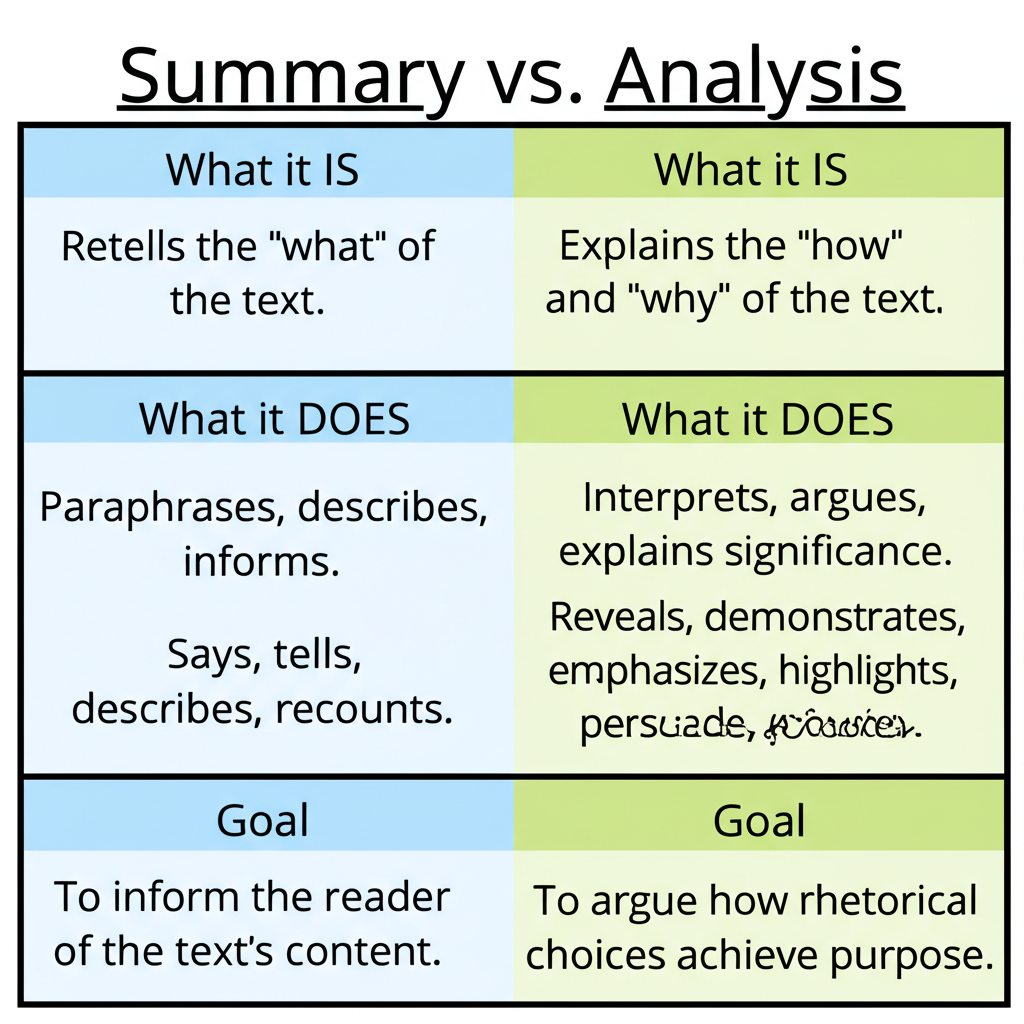
"Analyze, Don't Summarize!"
Chant this to yourself before writing any analytical essay. It's the most common mistake students make. Focus on how the author makes their point, not just what the point is.
"Quotes are like puppies: Don't just drop them off; introduce them, care for them, and explain why they matter."
A visual association for remembering to always introduce and analyze evidence. Never leave a quote hanging without analysis.
"Simile vs. Metaphor"
A Simile is Similar to a metaphor but uses "S-words" (like or as). A Metaphor "Marries" two unlike things directly.
9Common Mistakes
Summarizing instead of analyzing
Don't just retell what the text says. Focus on how the author makes their point and why their choices are effective. Wrong: "The article talks about how plastic pollution is bad for the ocean." Right: "The author employs alarming statistics and vivid imagery of polluted beaches to evoke urgency, persuading readers to support stricter environmental regulations."
Writing thesis statements that are too vague or are just facts
Your thesis needs to be arguable, specific, and identify rhetorical choices. Wrong: "This speech is about freedom." Right: "In his 'I Have a Dream' speech, Martin Luther King Jr. strategically uses powerful anaphora and emotionally resonant allusions to build a compelling argument for racial equality."
Confusing theme with subject/topic
The subject is the topic; the theme is the underlying message about that topic. Wrong: "The theme of Romeo and Juliet is love." Right: "The subject is love and conflict, while a central theme is how unchecked hatred can tragically destroy even the purest love."
Dropping quotations without introduction or analysis ("quote bombing")
Integrate quotes smoothly and follow them with explanation. Wrong: Just inserting a quote without context. Right: "Dickens opens A Tale of Two Cities with the famous antithetical statement, 'It was the best of times, it was the worst of times,' immediately establishing a tone of paradox and historical turmoil."
Not explaining why a rhetorical choice is effective for the specific audience
Always link the device to the audience's likely reaction. Wrong: "The speaker used a rhetorical question." Right: "By posing 'Are we to stand idly by while injustice prevails?', the speaker directly challenges the audience's moral complacency, compelling them to consider their own responsibility."
Run-on sentences and comma splices
Separate independent clauses with a period, semicolon, or comma + coordinating conjunction (FANBOYS). Wrong: "The speaker used pathos, it made the audience cry." Right: "The speaker used pathos; it made the audience cry." OR "The speaker used pathos, and it made the audience cry."
Confusing commonly misused words
Watch out for its/it's (possessive vs. contraction), their/there/they're, your/you're, and affect/effect (verb vs. noun). These errors undermine your credibility as a writer.
10Quick Revision Summary
- ✓Rhetorical analysis is about understanding how communication works, not just what it says.
- ✓The Rhetorical Situation (SOAPSTone) provides a crucial framework: Speaker, Occasion, Audience, Purpose, Subject, Tone.
- ✓The three main persuasive appeals: Ethos (credibility), Pathos (emotion), Logos (logic).
- ✓Rhetorical devices (parallelism, anaphora, metaphor, allusion) are specific techniques that enhance communication.
- ✓When analyzing, identify the device, provide evidence, and explain its effect on the audience and its contribution to the author's purpose.
- ✓Your thesis statement should present an arguable claim about the rhetorical choices and purpose.
- ✓Each body paragraph should start with a topic sentence and focus on analyzing a specific rhetorical strategy.
- ✓Analyze, don't summarize! Explain how and why the author's choices are effective.
- ✓Always introduce and analyze your textual evidence — don't just "quote bomb."
- ✓Pay attention to diction (word choice) and syntax (sentence structure) as rhetorical tools.
- ✓Rhetorical analysis builds critical thinking, writing, and media literacy skills for life.
- ✓Practice identifying rhetorical elements in everyday communication — news, ads, social media, and speeches.
Frequently Asked Questions
- How do I choose which rhetorical devices to focus on in an essay?
- Focus on the devices that are most prominent, impactful, and directly contribute to the author's purpose. Don't try to list every single device; instead, select 2-4 key strategies that you can analyze deeply, explaining how they work and why they are effective.
- What is the difference between a rhetorical device and a literary device?
- Many terms overlap. A literary device is a technique used in literature to create an artistic effect (e.g., symbolism, foreshadowing). A rhetorical device is specifically used to persuade, inform, or motivate an audience in any form of communication (e.g., ethos, pathos, logos, anaphora). All rhetorical devices can be literary devices, but not all literary devices are primarily rhetorical.
- How can I make my analysis deeper than just identifying devices?
- Move beyond "The author uses X." Ask yourself: What specific effect does X have on the audience? How does X make the audience feel or think? Why is X particularly effective given the context? How does X ultimately help the author achieve their overall purpose? Connect every observation back to the "how" and "why."
- How do I handle a text that uses manipulative rhetoric?
- Your job is still to analyze how it attempts to persuade, even if you disagree with its message. You can point out when a speaker uses logical fallacies or manipulative pathos, explaining why these techniques might be effective on a certain audience, but also how they might undermine the speaker's credibility for a more discerning audience.
- How important is it to identify the specific names of devices like anaphora vs. repetition?
- While knowing specific terms like anaphora or antithesis is good, it is far more important to explain the effect of the technique. If you cannot recall the specific name, describe the technique (e.g., "the repetition of words at the beginning of successive clauses") and then analyze its impact. However, using precise terminology demonstrates a stronger command of the subject.
- What if I cannot find clear examples of Ethos, Pathos, or Logos in a text?
- Sometimes one appeal might be much stronger than others, or they might be subtly interwoven. Consider the overall impression: Does the speaker sound trustworthy (ethos)? Do they appeal to common sense or present data (logos)? Do they try to evoke feelings (pathos)? Even a lack of a certain appeal can be an analytical point, such as noting the author deliberately avoids emotional appeals and relies solely on logos.
Practice Quiz
Test your understanding — select the correct answer for each question.
1.Which of the following best describes the primary focus of rhetorical analysis?
2.A local newspaper publishes an editorial arguing for stricter recycling laws after a report reveals the city's overflowing landfill. What rhetorical term best describes the specific reason that prompted this editorial?
3.In the article's example of a political debate, one candidate 'presents detailed economic data.' This strategy primarily appeals to which rhetorical concept?
4.A commercial features a famous chef endorsing a new brand of cooking oil, highlighting their expertise. This appeal primarily relies on which rhetorical strategy?
5.A student writes, 'The speaker's argument that climate change is real is very convincing and true.' What common mistake is the student making?
6.Which revision best improves the weak statement: 'The author uses big words to make her essay sound smart.'?
7.The article states that mastering rhetorical analysis 'sharpens your communication skills.' This benefit is primarily due to:
8.According to the article, what is 'the art of effective or persuasive speaking or writing'?
9.What would be the most precise exigence for Lincoln's Gettysburg Address?
10.Which of the following is not explicitly mentioned as a potential purpose a rhetor might achieve?
Final Study Advice
- 1.Always annotate actively when reading — underline key phrases, circle devices, and note appeals (E, P, L) in the margins.
- 2.Apply SOAPSTone before you start writing to ensure you understand the full context of the text.
- 3.Use strong verbs in your analysis: instead of "The author uses repetition," try "The author emphasizes," "underscores," or "reinforces."
- 4.After presenting evidence, always ask "so what?" — if your analysis doesn't answer this, dig deeper.
- 5.Practice with timed essay prompts — exams reward students who can organize quickly and focus on analysis over summary.