Essay Organization
Essay organization is the art of structuring your ideas so that your argument flows logically from beginning to end. A well-organized essay guides the reader through your thinking clearly and persuasively — even before the quality of your evidence matters.
This guide covers the five-paragraph essay structure, how to write effective introductions and conclusions, strategies for ordering body paragraphs, outlining techniques, worked examples, and a practice quiz.
1Introduction
Think of essay organization as the blueprint of a building. Just as an architect plans where every room goes before construction begins, a writer plans how every idea connects before putting pen to paper. Without a clear structure, even the best arguments get lost.
Good organization matters because it makes your argument easy to follow, demonstrates logical thinking to your teacher, and helps you write faster — especially under exam conditions. Once you internalize these structures, you can outline and draft an essay in a fraction of the time.
You're reading two essays on the same topic. One jumps randomly between ideas, and you have to re-read every paragraph twice. The other guides you smoothly from point to point, building toward a powerful conclusion. The second essay isn't necessarily smarter — it's just better organized.
Every well-organized essay has three parts: an Introduction (hook + context + thesis), Body Paragraphs (each developing one point), and a Conclusion (synthesis + broader implication).
2Key Definitions
Essay Structure Terms
Hook
An attention-grabbing opening sentence or sentences designed to draw the reader into the essay. Can be a question, quote, statistic, or anecdote.
Context (Background)
Information that narrows the topic and provides the reader with necessary background to understand your thesis.
Thesis Statement
The central argument of your essay, usually one to two sentences at the end of the introduction. Every body paragraph should support this claim.
Topic Sentence
The first sentence of a body paragraph that introduces that paragraph's main idea and connects it to the thesis.
Transition
Words, phrases, or sentences that connect ideas between and within paragraphs. E.g., "Furthermore," "In contrast," "As a result."
Outline
A structured plan that maps out the thesis, topic sentences, key evidence, and conclusion before drafting the full essay.
Synthesis
Combining your main points to show how they work together to support your thesis — the goal of a strong conclusion.
Organizational Patterns
Chronological Order
Arranging ideas in the order they occurred in time. Best for historical essays, process explanations, or narratives.
Order of Importance
Arranging arguments from weakest to strongest (emphatic order). Builds momentum and leaves the reader with your most compelling point.
Compare & Contrast
Organizing by similarities and differences between two subjects. Can be structured point-by-point or subject-by-subject.
Cause & Effect
Organizing around why something happened (causes) and what resulted (effects). Ideal for analytical and explanatory essays.
3The Five-Paragraph Essay
The five-paragraph essay is the foundational structure of academic writing. While advanced essays may use more paragraphs, this framework teaches the essential principle: introduce your argument, support it with evidence, and conclude by synthesizing your points.
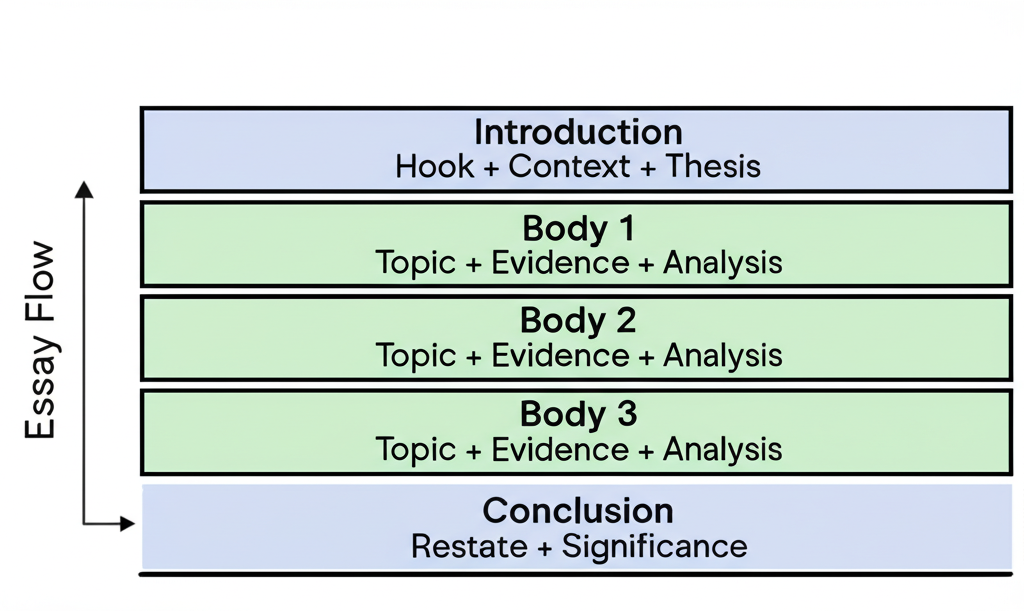
Paragraph 1: Introduction
Opens with a hook, provides context, and ends with your thesis statement. Think of it as a funnel — start broad, then narrow to your specific argument.
Paragraphs 2-4: Body Paragraphs
Each paragraph develops one main point that supports your thesis. Start with a topic sentence, provide evidence, analyze it, and transition to the next point.
Paragraph 5: Conclusion
Restate your thesis in new words, synthesize your key points (don't just list them), and offer a final thought — a broader implication or call to action.
The five-paragraph format is a training framework, not a lifelong rule. Once you master it, you'll naturally expand to longer, more complex structures — but the core principle of introduction, support, and conclusion never changes.
4Writing Introductions
Your introduction is the reader's first impression. It should accomplish three things: grab attention, provide context, and present your thesis. Think of it as an inverted triangle — broad at the top, narrowing to your specific argument.
The Three Parts of an Introduction
1. Hook — Grab Attention
Start with something that makes the reader want to keep reading. Your hook should be relevant to your topic and set the tone for the essay.
2. Context — Provide Background
Give the reader the information they need to understand your argument. For literary essays, mention the author, title, and relevant plot details. For argumentative essays, introduce the debate.
3. Thesis — State Your Argument
End the introduction with your thesis statement — a clear, arguable claim that your body paragraphs will prove.
Types of Hooks
Rhetorical Question
"What does it truly mean to be free in a society that surveils your every thought?"
Surprising Statistic
"According to a recent study, students who outline before writing score an average of 15% higher on essays."
Vivid Anecdote
"When Scout Finch watches her father defend a man the entire town has already condemned, she learns that courage isn't the absence of fear."
Bold Statement
"The American Dream was never meant to be achieved — it was designed to keep people chasing."
Example: Complete Introduction
Hook
"You never really understand a person until you consider things from his point of view... until you climb into his skin and walk around in it."
Context
In Harper Lee's To Kill a Mockingbird, Atticus Finch teaches his children — and the reader — that empathy is the foundation of justice. Set in the racially divided American South of the 1930s, the novel follows Scout Finch as she witnesses her father's moral courage during Tom Robinson's trial.
Thesis
Through the character of Atticus Finch, Harper Lee argues that moral integrity and empathy are essential for challenging systemic injustice, even when that challenge comes at personal cost.
5Organizing Body Paragraphs
The order of your body paragraphs matters just as much as the content within them. Each paragraph should logically follow the previous one and build toward your strongest point.
Choosing Your Organizational Pattern
| Pattern | Best For | Example |
|---|---|---|
| Chronological | History, processes, narratives | Causes of WWI in order of occurrence |
| Order of Importance | Persuasive and argumentative essays | Three reasons school uniforms help, weakest to strongest |
| Compare & Contrast | Analytical essays comparing two subjects | Comparing themes in 1984 and Brave New World |
| Cause & Effect | Explanatory and analytical essays | How industrialization led to environmental damage |
Transition Strategies Between Paragraphs
Strong transitions are the glue that holds your essay together. Each paragraph should connect logically to the one before it and the one after it.
Adding Ideas
Furthermore, Moreover, In addition, Similarly, Likewise, Building on this
Contrasting
However, In contrast, On the other hand, Nevertheless, Conversely, Despite this
Showing Cause/Effect
Consequently, Therefore, As a result, Thus, This leads to, Because of this
Building Importance
More importantly, Most significantly, Above all, The strongest evidence, Crucially
For persuasive essays, use emphatic order — present your weakest argument first and build to your strongest. This creates a crescendo effect, leaving the reader with your most compelling point fresh in their mind.
6Writing Conclusions
Your conclusion is your last chance to leave an impression. A weak conclusion can undermine an otherwise strong essay. Think of the conclusion as the mirror image of the introduction — the introduction narrows from broad to specific (thesis), while the conclusion expands from specific (thesis restatement) back to broad (implications).
The Three Parts of a Conclusion
1. Restate the Thesis (in new words)
Don't copy your thesis word for word. Rephrase it to reflect the argument you've now proven — your conclusion thesis should feel earned, not repetitive.
2. Synthesize Key Points
Briefly show how your body paragraphs work together to prove your thesis. Don't just list them — explain how they connect and build upon each other.
3. Final Thought (the "So What?")
End with a broader implication, a thought-provoking question, or a call to action. This is your opportunity to explain why your argument matters beyond the essay itself.
Weak vs. Strong Conclusions
Weak Conclusion
"In conclusion, this essay discussed how Atticus Finch is a good person. He defends Tom Robinson, teaches his kids, and is respected in the community. That is why he is a good character."
Merely repeats points without synthesis or broader implication.
Strong Conclusion
"Through Atticus's unwavering moral courage, Lee demonstrates that justice requires individuals willing to stand against the tide of popular opinion. In a world still grappling with systemic inequality, Atticus's example reminds us that progress begins with the quiet determination of individuals who refuse to look away."
Restates thesis in new words, synthesizes, and connects to a broader implication.
Your conclusion should never introduce new evidence or new arguments. It should synthesize what you've already proven and leave the reader with a lasting impression.
7Beyond Five Paragraphs
As your writing matures, you'll encounter essays that need more than five paragraphs. The core principles remain the same — what changes is the complexity and depth of your argument.
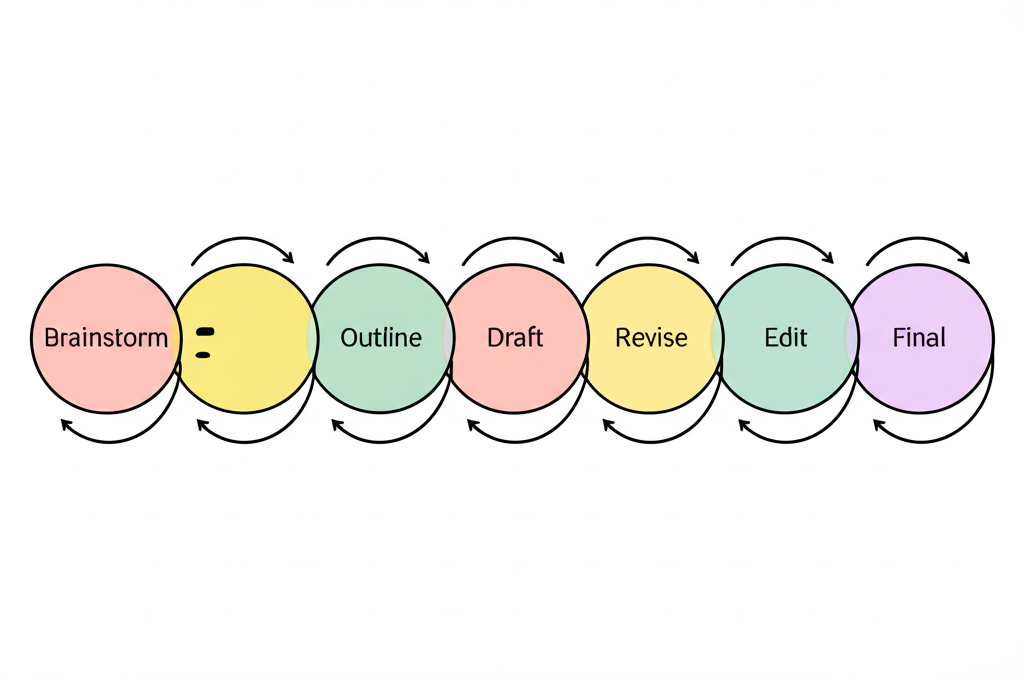
Common Extended Structures
Adding a Counterargument Paragraph
Insert a paragraph before the conclusion that addresses an opposing viewpoint and provides a rebuttal. This demonstrates sophisticated thinking and strengthens your position.
Multiple Evidence Paragraphs Per Point
For complex arguments, a single body paragraph may not provide enough evidence. Use two or more paragraphs to thoroughly develop each main point.
Linking Paragraphs
In longer essays, add brief linking paragraphs that transition between major sections and remind the reader how each section connects to your thesis.
When expanding beyond five paragraphs, outline first. Map out your thesis, each main point, and how they connect before you start drafting. A clear outline prevents the most common problem in longer essays: losing focus.
8Worked Examples
Example 1: Creating a Five-Paragraph Essay Outline
Create an outline for an essay arguing that Atticus Finch in To Kill a Mockingbird represents moral courage.
Step 1 — Thesis: "Through Atticus Finch, Harper Lee argues that moral integrity and empathy are essential for challenging systemic injustice."
Step 2 — Body 1 (Topic Sentence): "Atticus demonstrates moral integrity by defending Tom Robinson despite community disapproval." Evidence: his courtroom defense, the mob scene.
Step 3 — Body 2 (Topic Sentence): "Atticus models empathy by teaching his children to understand others' perspectives." Evidence: the "climb into his skin" quote, his treatment of Boo Radley.
Step 4 — Body 3 (Topic Sentence): "Atticus's actions inspire lasting change in those around him, proving that individual courage can challenge injustice." Evidence: Scout's growth, the community's subtle shifts.
Step 5 — Conclusion note: Restate thesis, connect to broader idea about individual responsibility in fighting injustice.
Key Insight: An outline ensures every paragraph has a clear purpose and directly supports your thesis before you start writing.
Example 2: Identifying Essay Parts in a Sample Introduction
Read the following introduction and identify the hook, context, and thesis.
Hook: "Every society tells itself a story about what it values most." — A bold, general statement that draws the reader in.
Context: "In F. Scott Fitzgerald's The Great Gatsby, that story is the American Dream..." — Introduces the text and topic.
Thesis: "Fitzgerald reveals that the American Dream is ultimately a destructive illusion..." — A specific, arguable claim.
Key Insight: A well-structured introduction follows a funnel pattern — broad hook, narrowing context, specific thesis.
Example 3: Choosing an Organizational Pattern
A student needs to write an essay on "How social media has changed teen communication." Which organizational pattern should they choose?
Option A — Chronological: Organize by time period (before social media, early social media, present day). Good for showing evolution.
Option B — Cause & Effect: Organize by the causes (technology access, platform design) and effects (shorter attention spans, new slang, cyberbullying). Good for analytical depth.
Best choice: Cause & Effect — because the essay asks "how" social media changed communication, which is fundamentally a cause-and-effect question. Each body paragraph can explore a different effect and trace it back to its cause.
Key Insight: Let the essay prompt guide your organizational pattern. "How" and "why" questions often suit cause-and-effect; "compare" questions suit compare-and-contrast.
Example 4: Fixing a Weak Conclusion
Weak conclusion: "In conclusion, 1984 is about surveillance and totalitarianism. The telescreens watch everyone. Big Brother controls everything. This is why the book is important."
Problem 1: Merely lists points instead of synthesizing them.
Problem 2: "This is why the book is important" says nothing meaningful — no broader implication.
Revised conclusion: "Orwell's 1984 demonstrates that totalitarian control depends not just on surveillance technology, but on the systematic destruction of individual thought and language. Written in 1949, the novel's warnings remain strikingly relevant in an age of data collection and algorithmic influence — reminding us that the price of freedom is eternal vigilance over both technology and truth."
Key Insight: A strong conclusion synthesizes your points into a cohesive takeaway and connects to a broader real-world implication.
Example 5: Full Essay Outline with Counterargument
Create a complete outline for a six-paragraph essay arguing that The Great Gatsby critiques the American Dream.
Introduction: Hook (the promise of America), context (Gatsby, 1920s), thesis ("Fitzgerald reveals the American Dream as a hollow pursuit corrupted by materialism and an obsessive desire to reclaim the past").
Body 1 (Weakest → build up): The green light symbolizes Gatsby's unattainable longing — the Dream is always out of reach.
Body 2: The Valley of Ashes represents the moral and human cost of pursuing wealth — the Dream destroys those at the bottom.
Body 3 (Strongest): Gatsby's death reveals the Dream's ultimate emptiness — his wealth, parties, and reinvention all fail to deliver happiness or genuine human connection.
Counterargument paragraph: "Some argue Gatsby's story is about personal failure, not the Dream itself." Rebuttal: The novel systematically shows that every character who chases the Dream is corrupted or destroyed by it.
Conclusion: Restate thesis, synthesize how all three symbols work together, connect to the broader idea that the American Dream continues to seduce and disappoint today.
Key Insight: Extended essays use the same core structure — what changes is adding a counterargument paragraph and organizing body paragraphs in emphatic order for maximum impact.
9Memory Aids
"An essay is a sandwich — the introduction and conclusion are the bread, the body paragraphs are the filling."
Without bread, the filling falls apart. Without filling, the bread is just empty carbs. You need all three parts working together.
"H.C.T. — Hook, Context, Thesis"
The three parts of every introduction, in order. Grab attention, provide background, state your argument.
"Start broad, end broad — go specific in the middle."
The introduction funnels from broad to specific (thesis). The conclusion expands from specific (thesis restatement) back to broad (implications). The body paragraphs are the specific evidence in between.
"Save your best argument for last — like a lawyer's closing statement."
In persuasive essays, use emphatic order (weakest to strongest). The last body paragraph should contain your most compelling point.
"Outline first, write second, revise third."
Never start writing without a plan. A 10-minute outline saves 30 minutes of confused drafting — especially during timed exams.
10Common Mistakes
Writing a conclusion that merely repeats the introduction
Your conclusion should restate your thesis in new language, not copy-paste it. It should also synthesize your points and offer a broader implication — not just summarize what you already said.
Introducing new evidence or arguments in the conclusion
The conclusion is for wrapping up, not introducing new material. If you have another important point, add a body paragraph — don't squeeze it into the conclusion.
Starting the essay without outlining
Jumping straight into writing often leads to disorganized arguments, redundant paragraphs, and missing key points. Even a quick 5-minute outline dramatically improves essay organization.
Body paragraphs that don't connect to the thesis
Every body paragraph must clearly relate back to your thesis. If a paragraph doesn't support your central argument, either revise it to show the connection or remove it.
Weak or missing transitions between paragraphs
Each paragraph should flow logically into the next. Abrupt jumps between ideas confuse the reader. Use transition words and make sure each topic sentence connects to the previous paragraph's conclusion.
Using "In conclusion" as the only conclusion strategy
While phrases like "In conclusion" are acceptable, relying on them as a crutch signals a formulaic essay. Instead, transition naturally by restating your thesis in a way that signals you're wrapping up.
11Quick Revision Summary
- ✓Every essay has three parts: Introduction (hook, context, thesis), Body (supporting paragraphs), and Conclusion (synthesis + implication).
- ✓The five-paragraph essay is a foundational framework — master it before expanding to longer structures.
- ✓Introductions follow the H.C.T. pattern: Hook, Context, Thesis — broad to specific.
- ✓Choose an organizational pattern that fits your topic: chronological, order of importance, compare/contrast, or cause/effect.
- ✓Use emphatic order for persuasive essays — save your strongest argument for last.
- ✓Strong transitions connect paragraphs logically — they're the glue of your essay.
- ✓Conclusions restate (don't repeat), synthesize (don't just list), and offer a "so what?"
- ✓Never introduce new evidence in the conclusion.
- ✓Always outline before writing — even a quick 5-minute outline dramatically improves organization.
- ✓The five-paragraph format is a framework, not a rule — real essays can be any length.
Frequently Asked Questions
- Do all essays have to be five paragraphs?
- No — the five-paragraph format is a foundational learning framework, not a rigid rule. Real-world and advanced academic essays can have any number of paragraphs depending on the complexity of the argument. The key principle — introduction, support, conclusion — remains the same regardless of length.
- What is the best way to start an essay introduction?
- Start with a hook — a compelling opening that grabs the reader's attention. Effective hooks include rhetorical questions, surprising statistics, vivid anecdotes, relevant quotations, or bold statements. After the hook, provide context to narrow the topic before presenting your thesis.
- How do I decide the order of my body paragraphs?
- Choose an organizational pattern that suits your topic: chronological order for historical or process-based topics, order of importance (weakest to strongest) for persuasive essays, compare-and-contrast for analytical essays, or cause-and-effect for explanatory writing. The most common strategy for argumentative essays is saving your strongest point for last.
- What should a conclusion do?
- A strong conclusion restates the thesis in new words, briefly synthesizes (not just repeats) the key points from the body paragraphs, and then offers a broader implication — a "so what?" that connects your argument to a larger idea, question, or call to action.
- How long should an essay outline be?
- An outline should be detailed enough to guide your writing but brief enough to stay flexible. For a five-paragraph essay, aim for your thesis statement, 2-3 bullet points of support per body paragraph (topic sentence + key evidence), and a note about your conclusion's final thought. This typically fits on one page.
Practice Quiz
Test your understanding — select the correct answer for each question.
1.What are the three main parts of a standard academic essay?
2.Where should the thesis statement typically be placed in an essay?
3.A student begins an essay with: "Have you ever wondered what life was like before electricity?" What type of hook is this?
4.What is the purpose of a topic sentence in a body paragraph?
5.Which organizational pattern arranges body paragraphs from least important to most important?
6.A student writes in their conclusion: "Additionally, another important point I forgot to mention is that the author also uses color symbolism." What mistake have they made?
7.What is the correct order of elements within an introduction paragraph?
8.Which of the following is the BEST conclusion strategy?
9.Do all essays have to be exactly five paragraphs?
10.A student organizes an essay about the causes of World War I with each body paragraph covering a different cause in the order they occurred. What organizational pattern are they using?
Final Study Advice
- 1.Before every essay, spend 5-10 minutes outlining — thesis, topic sentences, and key evidence for each body paragraph.
- 2.Let your essay prompt guide your organizational pattern. "Compare" = compare/contrast. "Trace the development" = chronological. "Argue" = order of importance.
- 3.Read your essay aloud after drafting — if you stumble or lose track, your transitions need work.
- 4.Practice writing introductions and conclusions separately — they're the hardest parts and benefit most from focused practice.
- 5.For timed essays, follow the 10-30-10 rule: 10 minutes to outline, 30 minutes to write, 10 minutes to revise.