Narrative Writing
Narrative writing is the art of telling a story. It's about crafting an experience for your reader, whether through a fictional tale, a personal anecdote, or a historical account, using specific literary elements and techniques.
This guide covers plot structure and Freytag's Pyramid, character development, point of view, conflict types, symbolism, imagery, the "show don't tell" technique, worked examples from classic literature, and a practice quiz to test your understanding.
1Introduction
Understanding narrative writing isn't just for aspiring novelists. It's a foundational skill that will significantly impact your academic success and beyond: better grades on ELA essays, literary analysis, and creative writing assignments; college readiness through critical analysis and effective communication; communication skills to articulate ideas and connect with others through compelling storytelling; and critical thinking to deconstruct complex texts and discern authorial intent.
This guide will equip you with the tools to both analyze existing narratives and create your own. We'll explore the essential building blocks of any story, delve into the techniques authors use to engage readers, and show you how to critically evaluate and write about narrative texts for your essays and exams.
Imagine you're in an English class, struggling to understand why a character made a particular choice, or how a novel's ending connects to its beginning. Now, picture yourself confidently dissecting a complex plot, identifying subtle themes, and crafting a powerful essay that earns top marks — all because you've mastered the principles of narrative writing.
Every compelling narrative is built on interconnected elements: plot (what happens), character (who it happens to), setting (where and when), conflict (the struggle), and theme (the deeper meaning). Mastering these building blocks is the key to both analyzing and creating powerful stories.
2Key Definitions
Story Elements
Narrative
A spoken or written account of connected events; a story. E.g., the entire novel The Great Gatsby is a narrative told by Nick Carraway.
Plot
The sequence of events in a story, typically involving a conflict and a resolution. E.g., in Romeo and Juliet, the plot includes the lovers meeting, their secret marriage, and their tragic deaths.
Character
A person, animal, or imaginary creature who takes part in the action of a story. E.g., Atticus Finch in To Kill a Mockingbird is a principled and moral character.
Setting
The time and place in which a story takes place, including social context and atmosphere. E.g., the setting of 1984 is a dystopian London in a totalitarian state called Oceania.
Theme
The central, underlying message or idea that an author explores; a universal truth or insight. E.g., a major theme in Lord of the Flies is the inherent savagery of humanity when civilization breaks down.
Conflict
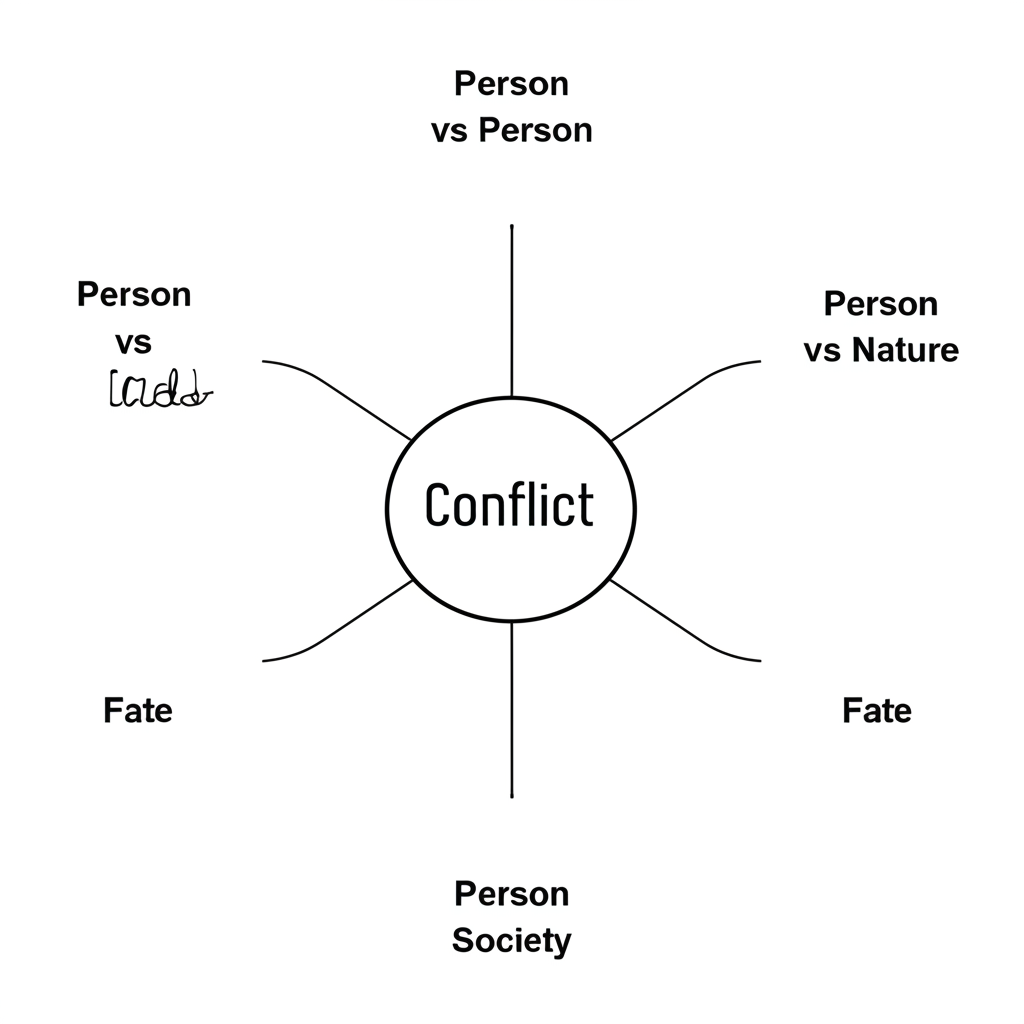
The struggle between opposing forces that drives the plot. Can be internal (character vs. self) or external (character vs. character, nature, society, fate). E.g., Winston's struggle against the Party in 1984.
Plot Structure Terms
Exposition
The beginning of the story, where characters, setting, and basic conflict are introduced. E.g., the opening chapters of Lord of the Flies introduce Ralph, Piggy, Jack, and the deserted island.
Rising Action
The series of events that build suspense and lead to the climax. E.g., in To Kill a Mockingbird, the events leading up to Tom Robinson's trial.
Climax
The turning point of the story, where the main conflict reaches its peak and the outcome becomes clear. E.g., in Romeo and Juliet, the deaths of Mercutio and Tybalt.
Resolution (Denouement)
The conclusion of the story, where the main conflict is resolved and loose ends are tied up. E.g., the resolution of Of Mice and Men sees George making a difficult choice.
Narrative Perspectives
First Person
The narrator is a character in the story, using "I" and "me." Offers intimacy but limited perspective. E.g., Nick Carraway in The Great Gatsby.
Third Person Limited
The narrator is outside the story but focuses on one character's thoughts and feelings using "he/she/they." E.g., Winston Smith in 1984.
Third Person Omniscient
The narrator is outside the story and knows everything about all characters and events, including their thoughts and feelings.
Literary Techniques
Foreshadowing
Hints or clues about future events in a story. E.g., repeated warnings about the dangers of the island in Lord of the Flies foreshadow the boys' descent into savagery.
Flashback
An interruption in the chronological sequence to present an event that occurred earlier. E.g., George's flashbacks in Of Mice and Men reveal his history with Lennie.
Symbolism
The use of objects, people, or ideas to represent something else, often a deeper concept. E.g., the green light in The Great Gatsby symbolizes Gatsby's hopes and dreams.
Imagery
Descriptive language that appeals to the five senses, creating vivid mental pictures. E.g., "The hot, still air hung heavy with the scent of honeysuckle and the distant buzz of cicadas."
Tone
The author's attitude toward the subject matter, conveyed through word choice and style. E.g., the tone of 1984 is largely bleak, pessimistic, and cautionary.
Mood (Atmosphere)
The feeling or emotional response that the reader experiences. E.g., the mood of a gothic novel like Frankenstein is often dark, mysterious, and suspenseful.
3The Narrative Arc: Foundations & Key Principles
At the heart of every compelling story is its structure, often visualized as a narrative arc or Freytag's Pyramid. Understanding this structure helps you analyze how a story unfolds and how individual events contribute to the overall meaning.
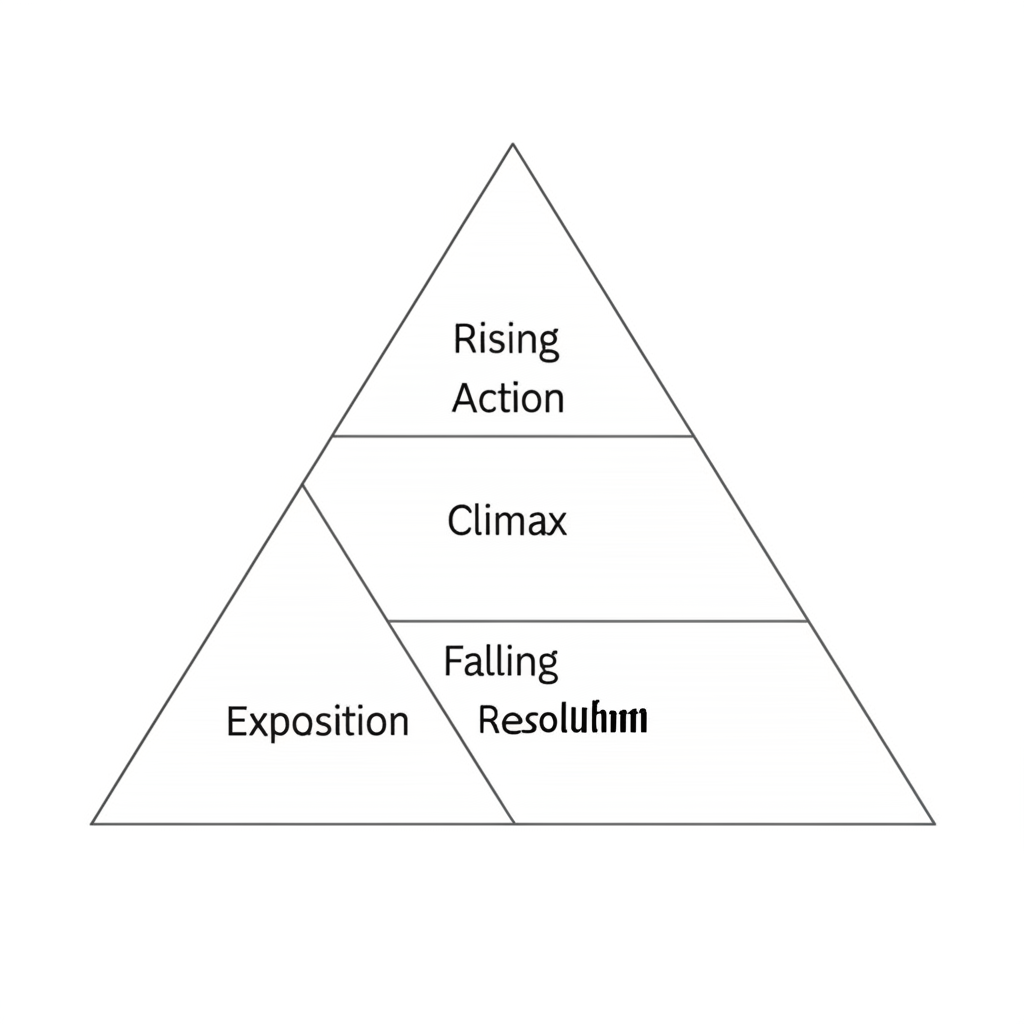
The Traditional Narrative Arc
1. Exposition
Introduces the characters, setting, and basic situation. It sets the stage for the story.
2. Inciting Incident
The event that introduces the central conflict and sets the main plot in motion. It's the spark that ignites the story.
3. Rising Action
A series of events that build suspense, develop the conflict, and lead towards the climax. Characters face challenges, make decisions, and encounter obstacles.
4. Climax
The point of highest tension or drama, where the main conflict comes to a head. It's the turning point from which there's no going back.
5. Falling Action
The events that occur after the climax, as the tension decreases and the story moves towards its conclusion.
6. Resolution (Denouement)
The conclusion of the story where the main conflict is resolved and any remaining loose ends are tied up. The new normal is established.
Step-by-Step: Tracing the Narrative Arc
Step 1: Identify the Exposition
Who are the main characters? Where and when does the story begin? What's the initial situation?
Step 2: Locate the Inciting Incident
What single event or decision disrupts the initial peace and introduces the central problem?
Step 3: Map the Rising Action
List 3-5 key events that escalate the conflict, introduce complications, and build tension towards the peak.
Step 4: Pinpoint the Climax
Where does the main conflict reach its absolute peak? What is the decisive moment that changes everything?
Step 5: Trace the Falling Action
What significant events happen immediately after the climax that lead to the story's end?
Step 6: Determine the Resolution
How is the main conflict ultimately resolved? What is the final outcome for the characters?
Text Example: Romeo and Juliet
Exposition
We meet the Capulet and Montague families in Verona, established as bitter rivals. Romeo is lovesick for Rosaline, and Juliet is an obedient daughter.
Inciting Incident
Romeo, a Montague, crashes a Capulet feast and meets Juliet. They fall instantly in love, unaware of each other's family identity.
Rising Action
Romeo and Juliet declare their love at the balcony. Friar Laurence secretly marries them. Tybalt kills Mercutio. Romeo kills Tybalt and is banished. Lord Capulet forces Juliet to marry Paris. Friar Laurence gives Juliet a sleeping potion.
Climax
Juliet takes the potion. Romeo, believing she is truly dead, buys poison and dies by her side. Juliet awakens, finds Romeo dead, and stabs herself.
Falling Action
The watchmen discover the bodies. Friar Laurence explains the truth to the Prince and the grieving families.
Resolution
The Capulets and Montagues, devastated by the loss of their children, agree to end their feud and erect golden statues in their memory.
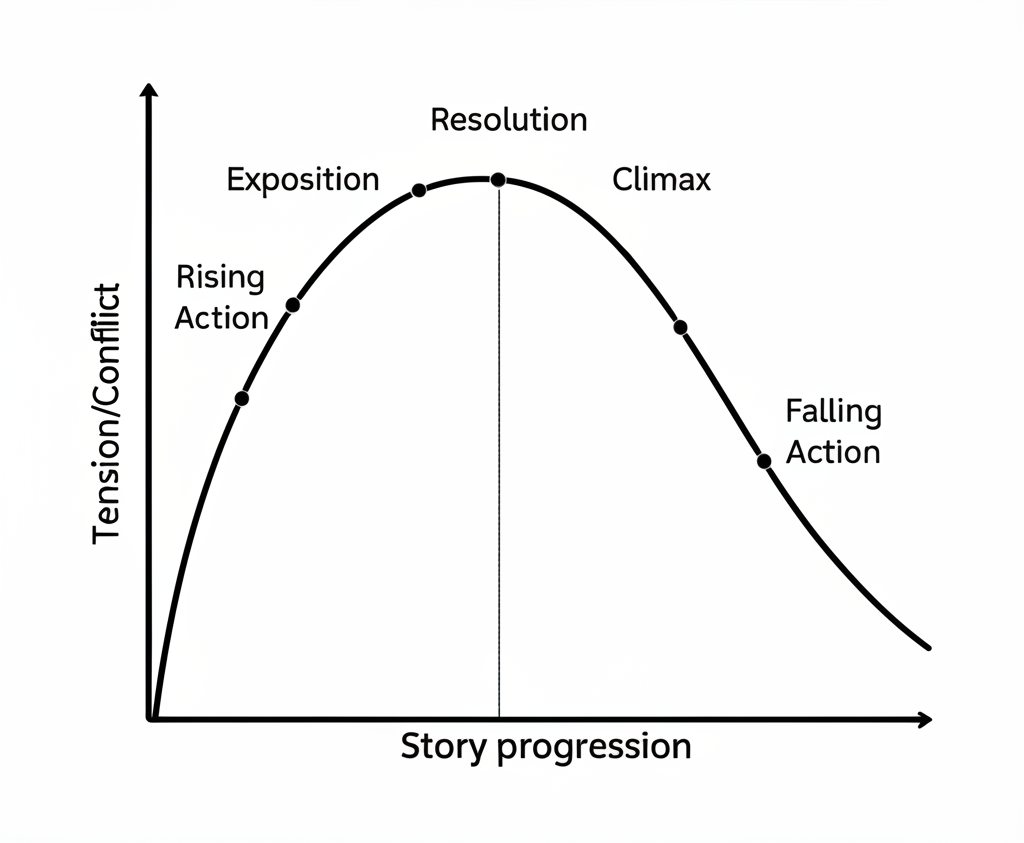
- How would the story change if the inciting incident happened later or differently?
- Identify a key event in the rising action of Lord of the Flies that significantly escalates the conflict between Ralph and Jack.
- What makes the specific moment you identified as the climax truly the turning point, and not another dramatic event?
4Techniques & Application: Crafting Elements
Beyond the basic structure, authors use specific techniques to bring their narratives to life. Mastering these allows you to appreciate the artistry of storytelling and apply them to your own writing.
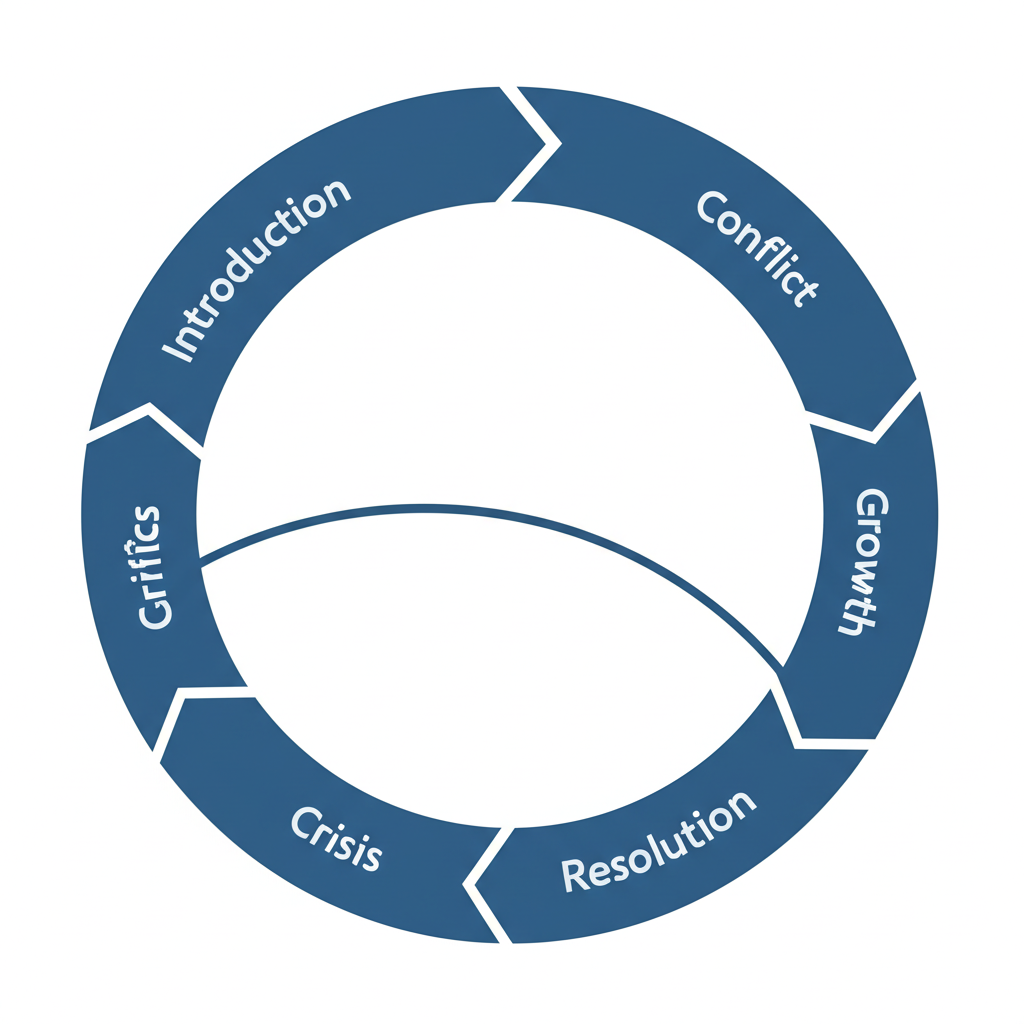
A. Character Development
Characters are the heart of any story. Authors use two main methods to reveal character:
Direct Characterization
The narrator explicitly tells the reader about a character's traits. E.g., "Atticus Finch was a lawyer, a man of quiet integrity, and perhaps the bravest person Scout ever knew."
Indirect Characterization
The narrator shows the reader what a character is like through their speech, thoughts, effect on others, actions, and looks. E.g., Fitzgerald shows Gatsby is mysterious through his lavish parties and swirling rumors.
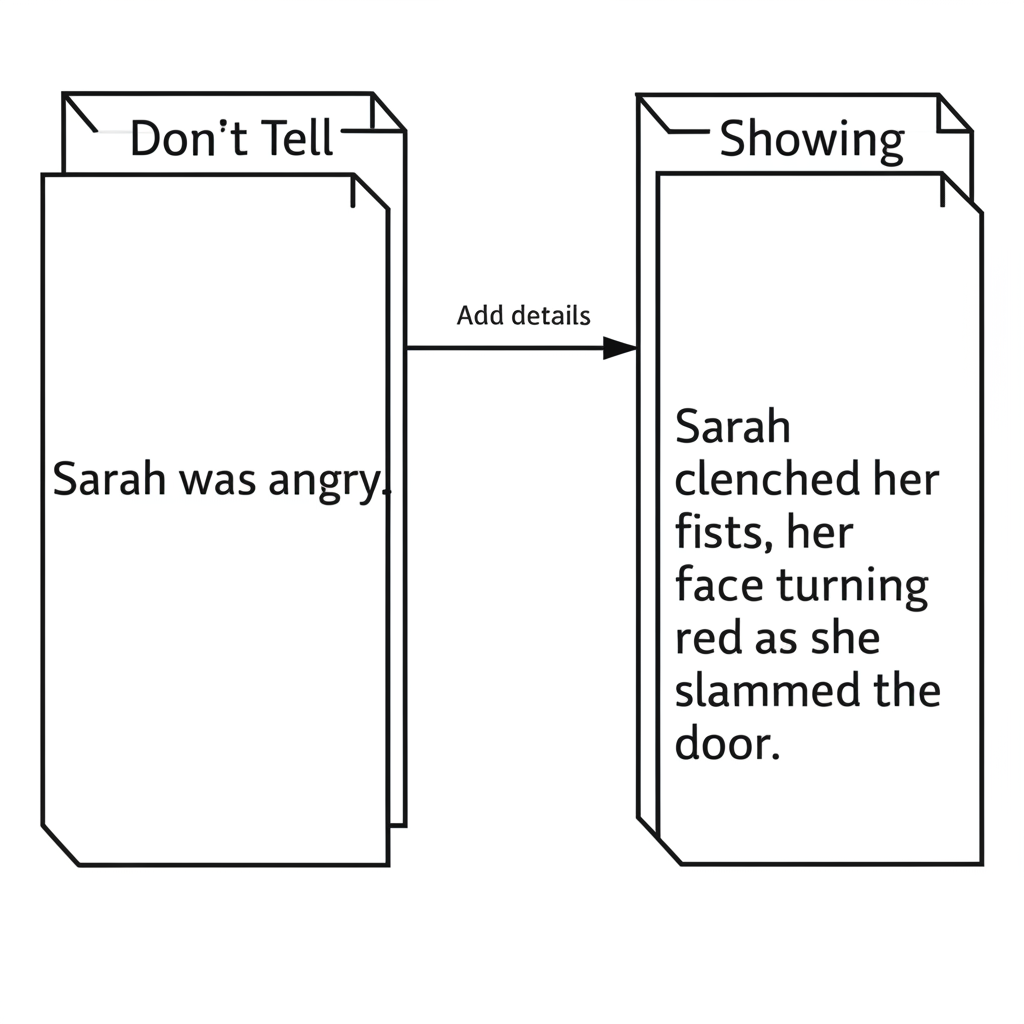
Ineffective (Telling)
"The character was very evil."
Generic, lacks detail, tells rather than shows.
Effective (Showing)
"His smile was a thin, cruel line, and his eyes, usually cold and calculating, now glittered with malicious glee as he watched the boy trip."
Uses looks and actions to reveal character.
B. Setting
The setting is more than just a backdrop; it often influences mood, character, and theme.
Atmosphere/Mood
Maycomb, Alabama in To Kill a Mockingbird creates a sleepy, traditional, yet racially tense atmosphere.
Symbolism
The desolate farm in Of Mice and Men symbolizes the broken American Dream for many migrant workers.
Conflict
The isolation of the island in Lord of the Flies removes societal constraints, allowing savagery to emerge.
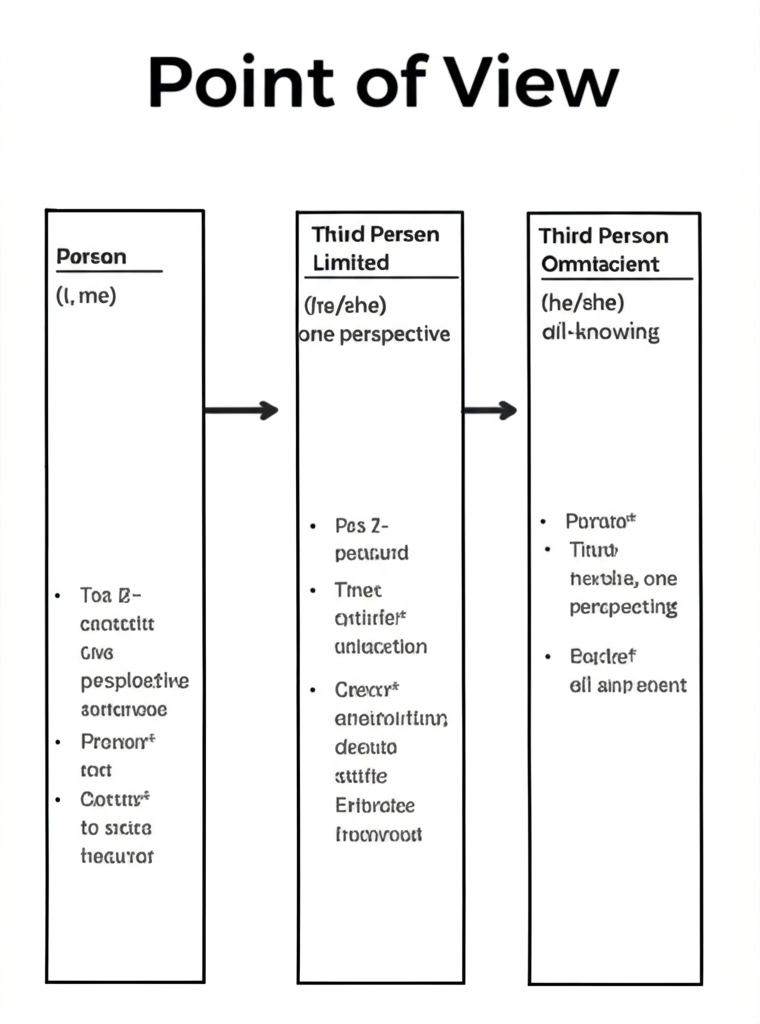
C. Point of View (POV)
The narrator's perspective profoundly shapes the reader's experience.
| Point of View | Characteristics | Impact on Reader |
|---|---|---|
| First Person | Uses "I," "me." Narrator is a character. Subjective, personal. | Reader feels close to character, understands inner thoughts, but sees a biased view. |
| Third Person Limited | Uses "he," "she," "they." Narrator outside, focuses on one character. | Reader knows one character deeply, maintains some objectivity, but limited to that character's knowledge. |
| Third Person Omniscient | Uses "he," "she," "they." Narrator knows all characters' thoughts, past, and future. | Reader gets a broad, god-like view; author can comment on events, less intimacy with one character. |
D. Dialogue
Well-crafted dialogue serves multiple purposes in a narrative:
Reveals Character
Shows personality, education, and background through how characters speak.
Advances Plot
Moves the story forward and delivers important information to the reader.
Creates Conflict
Shows disagreements, misunderstandings, or power dynamics between characters.
Establishes Tone/Mood
Contributes to the overall feeling of a scene through word choice and rhythm.
In Of Mice and Men, Lennie's simple, repetitive dialogue ("Tell me about the rabbits, George") immediately establishes his child-like nature and dependence on George, while also foreshadowing the tragedy to come.
Essay Questions: You'll often be asked to analyze how an author uses characterization, setting, or POV to develop a theme. Multiple Choice: You might need to identify the POV of a passage or the purpose of a specific piece of dialogue.
5Analysis & Critical Thinking
Moving beyond simply identifying narrative elements, critical thinking involves analyzing why an author made certain choices and what deeper meanings emerge. This is crucial for strong essays.
A. Unpacking Theme
The theme is the story's big idea, its universal message about life, society, or human nature. It's rarely stated directly.
1. Look for Recurring Ideas/Motifs
What concepts keep reappearing (e.g., innocence, corruption, justice, freedom)?
2. Examine Character Changes
How do characters grow or fail to grow? What lessons do they learn (or not learn)?
3. Consider the Conflict and Resolution
What deeper message does the outcome of the main conflict convey?
4. Analyze Symbolism
What do key symbols represent, and how do they contribute to a larger idea?
5. Think Universally
What message does the story convey that applies beyond the specific characters and setting? (E.g., "Power corrupts" is a theme, not "Jack became a dictator.")
B. Interpreting Symbolism
The Green Light
In The Great Gatsby, the green light at the end of Daisy's dock symbolizes Gatsby's unattainable dream, his hope for a past he can never truly recapture, and the idealized future he envisions with Daisy.
The Conch Shell
In Lord of the Flies, the conch initially symbolizes order, democracy, and civilized discourse. As it loses power and is shattered, it symbolizes the complete breakdown of civility and descent into savagery.
C. Author's Purpose
Understanding the author's purpose helps you grasp the full impact of a narrative:
Entertain
Pure escapism and enjoyment for the reader.
Inform
Provide facts, insights, or new perspectives.
Persuade
Influence beliefs, actions, or attitudes.
Critique
Comment on society, politics, or human nature. E.g., Orwell's 1984 warns about totalitarianism.
D. Essay Writing & Textual Evidence
Strong analytical essays require a clear thesis statement, well-supported topic sentences, and robust textual evidence integrated seamlessly.
F. Scott Fitzgerald masterfully employs symbolism through the recurring image of the green light to underscore the unattainable nature of Gatsby's American Dream. Positioned at the end of Daisy Buchanan's dock, the light initially represents Gatsby's boundless hope and singular focus on reuniting with his lost love. Nick Carraway observes Gatsby "stretch[ing] out his arms toward the dark water in a curious way," a gesture imbued with a profound longing for a future he believes Daisy embodies (Fitzgerald 21). However, as the narrative progresses, the light transforms from a beacon of possibility into a stark reminder of the past's irrevocability. Ultimately, the green light, like Gatsby's dream itself, remains a distant, shimmering illusion, always just out of reach, highlighting the novel's central critique of the superficiality of the Jazz Age.
6Putting It All Together
Understanding narrative writing isn't just an isolated English class skill; it connects to many other areas of your life and learning.
Connections to Other ELA Skills
Reading Comprehension
Strong narrative analysis directly improves your ability to understand complex texts in any subject.
Argumentative Writing
When you write an argumentative essay, you're often building a narrative of ideas. Analyzing literary texts gives you practice in constructing logical arguments.
Research Skills
Understanding how narratives are constructed helps you evaluate the reliability and bias of sources, especially historical accounts.
Public Speaking
The principles of good storytelling (engaging audience, clear structure, compelling details) are vital for effective presentations.
Real-World Applications
Effective Communication
Whether in a job interview or a presentation, the ability to tell a clear, engaging story is invaluable.
Critical Media Literacy
Every advertisement, news report, and documentary is a narrative. Understanding construction helps you identify underlying agendas or biases.
Empathy and Understanding
Narratives allow us to step into others' shoes, understand different perspectives, and develop empathy.
Creative Expression
Whether you write stories, poems, or design video games, a strong grasp of narrative principles is fundamental.
Exam Strategies for Narrative Analysis
1. Read Actively
Underline key details, make notes on character traits, plot points, and potential themes as you read.
2. Deconstruct the Prompt
Identify the literary elements the prompt asks you to analyze (e.g., "How does conflict develop theme?").
3. Brainstorm & Outline
Before writing, quickly map out your thesis, main points (topic sentences), and supporting textual evidence.
4. Analyze, Don't Summarize
Your essay should explain how elements work, not just retell the story. Always ask "So what?" after presenting evidence.
5. Use Literary Terminology
Integrate terms like "foreshadowing," "irony," "characterization," and "symbolism" naturally into your analysis.
6. Connect to Theme
Always link your analysis of specific techniques back to the story's broader meaning or the author's message.
Self-Assessment Checklist
- ✓Can I confidently identify the five main parts of a narrative arc in any story I read?
- ✓Am I able to distinguish between direct and indirect characterization?
- ✓Can I explain how setting contributes to mood or theme in a text?
- ✓When I read a story, do I actively look for symbols and try to interpret their meaning?
- ✓Can I formulate a strong thesis statement for an analytical essay about a narrative?
- ✓Do I consistently support my claims with specific textual evidence and explain its significance?
7Worked Examples
Example 1: Identifying Plot Elements
Read the opening of Lord of the Flies and identify the Inciting Incident and an early event in the Rising Action.
Step 1: Identify the initial situation. Ralph (fair boy) and Piggy are introduced on a deserted island after a plane crash.
Step 2: Inciting Incident: Ralph and Piggy find the conch shell and decide to blow it to gather other survivors, introducing the need for order.
Step 3: Rising Action: The boys hold their first assembly, and Ralph is elected chief over Jack. This establishes the initial power struggle that drives the novel.
Key Insight: The inciting incident is the crucial spark, and the rising action quickly builds on it by establishing initial conflicts or goals.
Example 2: Analyzing Character Motivation
Analyze Lennie Small's primary motivation and how it drives his actions in Of Mice and Men, using textual evidence.
Step 1: Identify Lennie's core desire. He frequently asks George to "tell about the rabbits" and expresses a desire for soft things. His primary motivation is to live on the dream farm where he can tend rabbits.
Step 2: His actions (petting mice, a puppy, Curley's wife's hair) are driven by his innocent desire for softness, which he associates with the dream farm rabbits.
Step 3: Ironically, his attempts to fulfill this dream inadvertently lead to violence and death, ultimately making the dream impossible and sealing his tragic fate. His simple-mindedness and great strength create an inescapable cycle of unintended harm.
Key Insight: Character motivation often reveals deeper themes about human nature or societal conditions.
Example 3: Interpreting Symbolism
Explain the significance of the conch shell as a symbol in Lord of the Flies and how its fate reflects the novel's themes.
Step 1: Initially, the conch symbolizes order, democracy, reason, and civilized authority among the boys on the island.
Step 2: As the boys descend into savagery, the conch's power wanes, reflecting the erosion of their adherence to rules and rational thought.
Step 3: The shattering of the conch into "a thousand white fragments" simultaneously with Piggy's death signifies the complete triumph of primal instinct and savagery over civilization, reason, and order. It underscores the theme that without societal structures, humanity succumbs to its darker impulses.
Key Insight: Symbols often undergo transformations that mirror or highlight major thematic shifts in a narrative.
Example 4: Crafting a Thesis Statement for Narrative Analysis
Write a strong analytical thesis statement about how George Orwell uses setting and point of view in 1984 to convey a central theme about totalitarianism.
Step 1: Identify the core argument: Totalitarianism crushes individuality and truth.
Step 2: How does setting contribute? The oppressive, constantly surveilled setting of Oceania reinforces the omnipresent control of the Party.
Step 3: How does POV contribute? The third-person limited point of view through Winston immerses the reader in the psychological torment faced by citizens.
Thesis: "In George Orwell's 1984, the meticulously crafted, omnipresently surveilled setting of Oceania, combined with the psychologically immersive third-person limited point of view through Winston Smith, effectively conveys the devastating theme that totalitarian regimes systematically eradicate individual thought and manipulate objective reality."
Key Insight: A thesis statement is a roadmap for your essay, connecting literary techniques to thematic arguments.
8Memory Aids
"P.C.S.T.C. — The Core Five"
Plot, Character, Setting, Theme, Conflict — "Please Carefully Study These Concepts!" These are the absolute basics you must know.
"Freytag's Pyramid as a Mountain Hike"
Exposition: Starting at the peaceful base. Inciting Incident: A rockslide that starts your ascent. Rising Action: The challenging climb with obstacles and switchbacks. Climax: Reaching the peak — the most difficult but exhilarating view. Falling Action: The descent down. Resolution: Reaching the new base, journey complete.
"ICE for Integrating Quotes"
Introduce: Provide context for your quote. Cite: Include the quote itself with proper citation. Explain: Analyze how the quote supports your point and its significance. Never let a quote speak for itself.
"S.W.I.F.T. — Analyzing Author's Style"
Syntax (sentence structure), Word choice (diction), Imagery (sensory details), Figurative language (metaphors, similes), Tone (author's attitude). This helps you remember what to look for when analyzing how an author writes.
"So what?" — The question every analysis must answer.
After presenting evidence, always ask yourself "so what?" and "why is this important?" If your analysis doesn't answer these, dig deeper. Connect it to broader themes, character development, or author's purpose.
9Common Mistakes
Confusing plot summary with analysis
Don't just retell what happens in the text. After presenting evidence, explain how it proves your point and why it's significant.
Wrong: "In Romeo and Juliet, Romeo kills Tybalt because Tybalt killed Mercutio, and then he gets banished." Right: "Romeo's impulsive act of killing Tybalt serves as the pivotal turning point, transforming a personal feud into an irreversible tragedy that seals his banishment and foreshadows the lovers' ultimate demise."
Weak or missing thesis statement
A strong thesis is specific, debatable, and states your argument. "This essay will discuss..." is never a strong thesis.
Wrong: "This essay will discuss the characters in The Great Gatsby." Right: "Through the contrasting portrayals of Jay Gatsby and Tom Buchanan, Fitzgerald critiques the moral decay inherent in the pursuit of the American Dream, revealing how wealth corrupts both aspiration and relationships."
Lack of specific textual evidence
Vague claims without specific quotes or details from the text are unconvincing. Use precise textual evidence.
Wrong: "Gatsby really loves Daisy." Right: "Gatsby's profound devotion to Daisy is evident in his nightly vigil, 'stretching out his arms toward the dark water' in longing for the green light at the end of her dock (Fitzgerald 21)."
"Telling" instead of "showing" in your own writing
Use imagery and sensory details to evoke emotions rather than stating them directly.
Wrong: "The old house was scary." Right: "The old house loomed against the bruised sky, its broken windows like vacant eyes staring into the perpetual twilight, and a faint, mildewed scent clung to the air, whispering of decay."
Misinterpreting point of view or its effect
Don't assume a first-person narrator is always reliable. Consider their biases and limitations.
Wrong: "Nick Carraway tells The Great Gatsby, so we know everything that happens accurately." Right: "While Nick's first-person narration offers intimate access, his role as a participant and initial admiration for Gatsby introduce a subjective lens, prompting the reader to question the reliability of his observations."
Ignoring author's purpose or intent
Connect plot outcomes to the author's broader message or purpose, not just emotional reactions.
Wrong: "The ending of 1984 is sad." Right: "The utterly bleak ending, with Winston's complete psychological subjugation, serves Orwell's didactic purpose of issuing a stark warning about the ultimate triumph of totalitarianism when individual thought is crushed."
Generic or unexplained literary terminology
Don't just identify a technique — explain what symbol, how it works, and why it matters. Wrong: "The author uses symbolism." Right: "The recurring motif of the 'beast' in Lord of the Flies functions as a potent symbol of the boys' primal fears and the inherent savagery latent within human nature itself."
10Quick Revision Summary
- ✓Narrative writing is the art of storytelling, crucial for academic success and real-world communication.
- ✓The narrative arc (Freytag's Pyramid) outlines the common structure: Exposition, Inciting Incident, Rising Action, Climax, Falling Action, Resolution.
- ✓Characterization (direct and indirect) reveals personality through telling or showing.
- ✓Setting establishes time, place, and often influences mood, character, and theme.
- ✓Point of View (first person, third-person limited, third-person omniscient) determines the narrative perspective and reader experience.
- ✓Conflict drives the plot — internal (vs. self) and external (vs. character, nature, society, fate).
- ✓Theme is the story's central, universal message or insight about life or human nature.
- ✓Symbolism uses objects or ideas to represent deeper meanings.
- ✓Imagery uses sensory details to create vivid descriptions. Tone is the author's attitude; Mood is the reader's feeling.
- ✓Foreshadowing provides hints about future events; Flashback interrupts chronology to show past events.
- ✓"Show, Don't Tell" is a powerful technique for vivid, immersive writing.
- ✓For essays, analyze, don't summarize, and always use specific textual evidence with the ICE method.
- ✓Understanding narrative enhances critical thinking, media literacy, and empathy.
Frequently Asked Questions
- What's the main difference between plot and theme?
- Plot is what happens in the story — the sequence of events, conflicts, and resolutions. Theme is what the story means — the underlying message, universal truth, or insight about life that the plot helps to reveal. For example, in Romeo and Juliet, the plot involves their forbidden love and tragic deaths, while a theme is the destructive power of hatred or the inevitability of fate.
- How do I find the theme of a story if it's not explicitly stated?
- Look for recurring ideas, symbols, and motifs. Consider how characters change and what lessons they learn (or fail to learn). Analyze the main conflict and its resolution: what larger message does the outcome convey? Ask yourself, "What universal truth about life or human nature does this story illustrate?" The theme should be a complete sentence, not just a single word (e.g., "Love" is a topic; "Love can conquer all, but also lead to destruction" is a theme).
- Is one narrative element more important than the others?
- Not inherently. All narrative elements (plot, character, setting, theme, POV, conflict, etc.) work together synergistically to create a complete and impactful story. The effectiveness of a narrative often depends on how well these elements are integrated and how they contribute to the overall meaning. However, for analytical purposes, a specific element might be more central to a particular essay prompt or the author's primary message.
- How can I improve my own narrative writing?
- Read widely and pay attention to how authors you admire use different techniques. Practice "Show, Don't Tell" — instead of stating emotions or facts, describe actions, dialogue, and sensory details. Develop strong characters with motivations, flaws, and unique voices. Outline your plot for direction. Focus on conflict to keep readers engaged. Get feedback and be open to constructive criticism.
- What's the best way to use textual evidence in an essay?
- Use the ICE method: Introduce (provide context for the quote — who is speaking, when, why), Cite (insert the quote precisely with proper citation), and Explain (analyze how the quote supports your argument, why it's significant, and what it reveals about character, theme, or the author's purpose). Don't let the quote speak for itself — the explanation is the most crucial part.
- What if a story doesn't follow the traditional narrative arc?
- While many stories loosely follow Freytag's Pyramid, not all do. Some narratives use non-linear structures (flashbacks, multiple perspectives), fragmented plots, or open endings. When analyzing such a story, discuss how the author deviates from the traditional structure and why. What effect does this non-traditional structure have on the reader's understanding, the pacing, or the overall message? This shows a deeper level of critical analysis.
Practice Quiz
Test your understanding — select the correct answer for each question.
1.Which of the following best defines the 'Climax' of a narrative?
2.In *The Great Gatsby*, Nick Carraway's narration is an example of which Point of View?
3.What literary device is used when an author provides hints or clues about future events in a story?
4.The central, underlying message or idea that an author explores in a narrative is known as the:
5.Which type of conflict is exemplified by Winston Smith's struggle against the oppressive government in *1984*?
6.When an author describes a character's traits directly, such as 'He was a kind and generous man,' this is an example of:
7.In *Lord of the Flies*, the conch shell initially represents order and democracy. As the boys descend into savagery and the conch is destroyed, this change in its meaning is an example of:
8.Which of these is an example of 'showing' rather than 'telling'?
9.The sequence of events in a story, from beginning to end, is called the:
10.What is the primary purpose of the 'Exposition' in a narrative?
Final Study Advice
- 1.Read Widely: The more you read well-written narratives, the better your own writing and analysis will become. Pay attention to how professional writers structure their stories, develop characters, and use literary techniques.
- 2.Practice "Show, Don't Tell": Instead of stating emotions or facts directly, describe actions, dialogue, and sensory details. This makes your writing more vivid and engaging.
- 3.Outline First: A solid outline ensures your narrative has a clear structure. Even a simple arc can give your story direction and coherence.
- 4.Develop Strong Characters: Give your characters motivations, flaws, and unique voices. Characters that feel real are more compelling to read and write about.
- 5.Analyze, Don't Summarize: In essays, always explain how and why narrative elements work, not just what happens. Connect your analysis to theme and author's purpose.