Revision & Editing
Revision and editing are the essential final stages of the writing process that transform rough drafts into polished, impactful essays. Revision focuses on big-picture improvements to content, organization, and argument, while editing refines your writing at the sentence level for grammar, punctuation, and word choice.
This guide covers the complete revision and editing process -- self-editing strategies, revision checklists, peer review techniques, sentence-level editing, worked examples from classic literature, and a practice quiz to test your understanding.
1Introduction: Polish Your Power
You've poured your ideas onto the page, wrestled with your thesis, and finally typed "The End." Congratulations! But before you hit submit, there's a crucial next step that separates good writing from great writing: revision and editing. These aren't just about fixing typos; they're about refining your thoughts, strengthening your arguments, and ensuring your voice shines through clearly and powerfully.
This guide will equip you with the tools and strategies to transform your rough drafts into polished, impactful essays.
Imagine you're a chef. You've gathered all your ingredients, followed the recipe, and cooked a delicious meal. But before serving it to a judge, you taste it. Does it need more salt? A dash of spice? Is the presentation appealing? That is revision. Once you're happy with the overall flavor and presentation, you wipe the plate clean, ensuring no smudges or stray crumbs. That is editing and proofreading.
Good writing is rewritten writing. Even professional writers revise extensively. The revision and editing process is where your essay truly takes shape -- it's where you move from a rough draft to a polished piece that communicates your ideas with clarity, coherence, and impact.
2Key Definitions
Understanding the language of revision and editing is the first step to mastering the process.
The Three Stages
Revision
From the Latin "re-videre," meaning "to see again." The big-picture stage focusing on content, organization, argument, and clarity of ideas. It's about rethinking your essay's core.
Editing
Refining your writing at the sentence and word level. Includes checking for grammar, punctuation, spelling, word choice, and sentence structure.
Proofreading
The final, meticulous check for surface-level errors (typos, misspellings, missing punctuation) just before submitting your work.
Writing Quality Terms
Coherence
The quality of being logical and consistent, where all parts of your writing flow together smoothly and make sense as a whole.
Flow
How easily a reader can move from one idea, sentence, or paragraph to the next without stumbling or getting confused.
Transition
Words, phrases, or sentences that connect ideas and guide the reader from one point to another (e.g., "however," "consequently," "in addition").
Clarity
The quality of being easy to understand; clear writing leaves no room for misinterpretation.
Concision
Writing that is brief and to the point, avoiding unnecessary words or phrases. Saying more with less.
Voice
The unique personality, style, and perspective that an author brings to their writing.
Tone
The attitude of the writer toward the subject or audience (e.g., formal, informal, serious, humorous, objective).
Paragraph Unity
The principle that each paragraph should focus on a single main idea, introduced by a topic sentence and supported by relevant details.
Technical Terms
Grammar
The set of rules governing the structure of sentences and words in a language.
Punctuation
The use of symbols (commas, periods, semicolons, etc.) to structure and organize written language, making its meaning clear.
Mechanics
The technical aspects of writing, including spelling, capitalization, indentation, and formatting.
Sentence Structure
The way words are arranged to form sentences, including their length, complexity, and variety.
Peer Review
The process of having classmates or colleagues read and provide feedback on your writing.
Thesis Statement
The central argument or main point of your essay, which you will defend and support throughout your writing.
3Core Concepts: Two Stages, One Goal
Think of revision and editing as two distinct but equally important phases, like building a house (revision) and then decorating and cleaning it (editing).
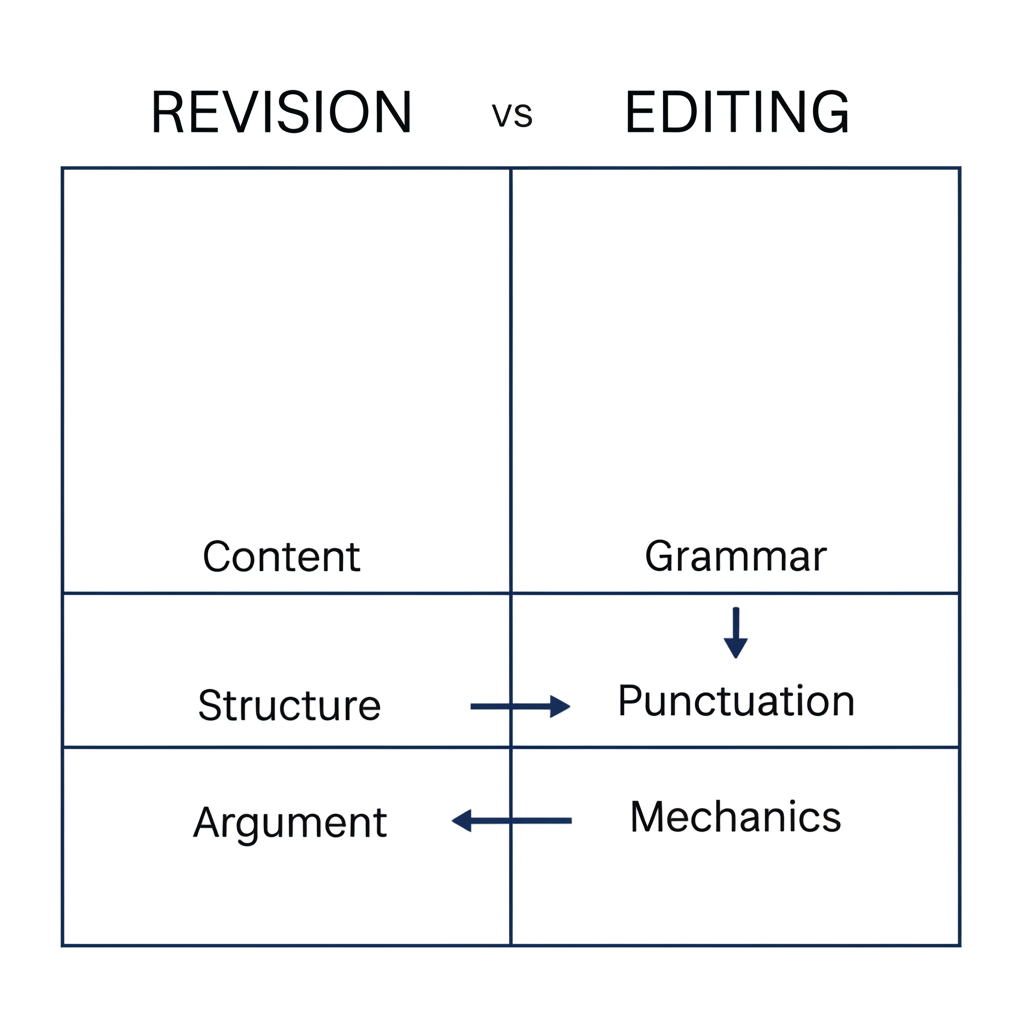
The Revision Process: Shaping the Big Picture
Revision is about making sure your essay works. It's where you ask the big questions about content, argument, and organization.
Content & Argument
- Thesis Clarity: Is my thesis statement clear, arguable, and consistently supported throughout the essay?
- Evidence & Support: Do I have enough strong, relevant evidence to back up each claim? Is it explained thoroughly?
- Completeness: Have I addressed all parts of the prompt? Is there anything missing?
- Audience & Purpose: Is my writing appropriate for my audience? Does it achieve my purpose?
Organization & Structure
- Logical Flow: Does my essay progress logically from one idea to the next?
- Paragraph Unity: Does each paragraph have a clear topic sentence? Do all sentences relate to the main idea?
- Transitions: Do I use effective transitions to connect paragraphs and ideas?
- Introduction & Conclusion: Does my introduction hook the reader? Does my conclusion provide a lasting thought?
The Editing Process: Polishing at the Sentence Level
Once the big picture is solid, editing focuses on making your writing precise, correct, and professional.
Sentence Structure & Style
- Clarity & Concision: Are my sentences clear and easy to understand? Can I say the same thing with fewer words?
- Sentence Variety: Do I use a mix of sentence lengths and structures to keep the reader engaged?
- Word Choice: Are my words precise and impactful? Am I using strong verbs and specific nouns?
Grammar & Punctuation
- Subject-Verb Agreement: Do all my subjects and verbs agree in number?
- Verb Tense Consistency: Am I consistent with verb tenses throughout?
- Comma Usage: Are commas used correctly in lists, with introductory phrases, and separating clauses?
- Apostrophes & Semicolons: Are they used correctly for possession, contractions, and connecting related ideas?
Mechanics & Formatting
- Spelling: Have I checked for all spelling errors, including homophones ("their" vs. "there")?
- Capitalization: Is capitalization correct throughout?
- Formatting: Does my essay follow any specific formatting guidelines (MLA, APA, Chicago)?
Self-Editing Strategies: Be Your Own Best Critic
1. Take a Break
Step away from your writing for a few hours, or even a day. Fresh eyes catch more errors.
2. Read Aloud
Reading your essay out loud forces you to slow down and hear how your sentences flow. Awkward phrasing, missing words, and grammatical errors often become obvious.
3. Print It Out
Reading on paper can reveal errors you missed on a screen. Mark it up with a pen!
4. Edit in Stages
Don't try to fix everything at once. Focus on one type of error (e.g., grammar, then organization) in each pass.
5. Use a Checklist
Create or use a provided checklist to systematically review your work.
6. Highlight Potential Problems
If you're unsure about a sentence or word, highlight it and come back to it later or ask for help.
7. Focus on One Type of Error at a Time
For example, do one pass just for run-on sentences, another for comma splices, another for subject-verb agreement.
Revision before editing, always. There's no point polishing a sentence that might get cut during revision. Fix the big-picture issues first, then refine at the sentence level.
4Techniques: Tools for Transformation
Here are specific techniques to apply during your revision and editing phases.
1. Adding Details & "Showing, Not Telling"
Replace general observations with specific sensory details, actions, and vivid descriptions.
Before
"The character was sad."
After
"A heavy sigh escaped her lips, her shoulders slumped, and a single tear traced a path down her cheek, landing softly on the faded photograph."
Ask "How?" or "Why?" or "What did it look, sound, smell, taste, feel like?"
2. Cutting Fluff & Achieving Concision
Look for phrases that can be condensed, eliminate repetitive words, and favor active voice.
Before (19 words)
"Due to the fact that he was experiencing a lack of sufficient funds, he was unable to make a purchase of the desired item."
After (9 words)
"Because he lacked funds, he couldn't buy the item."
Identify "empty" phrases like "in order to," "the fact that," "at this point in time." Convert passive voice to active voice.
3. Strengthening Verbs
Replace weak verbs (forms of "to be," "get," "make") with strong, specific action verbs.
Before
"He walked quickly down the street." / "The argument was very important."
After
"He raced down the street." / "The argument proved crucial."
Circle all "to be" verbs (is, am, are, was, were) and see if you can replace them with stronger action verbs.
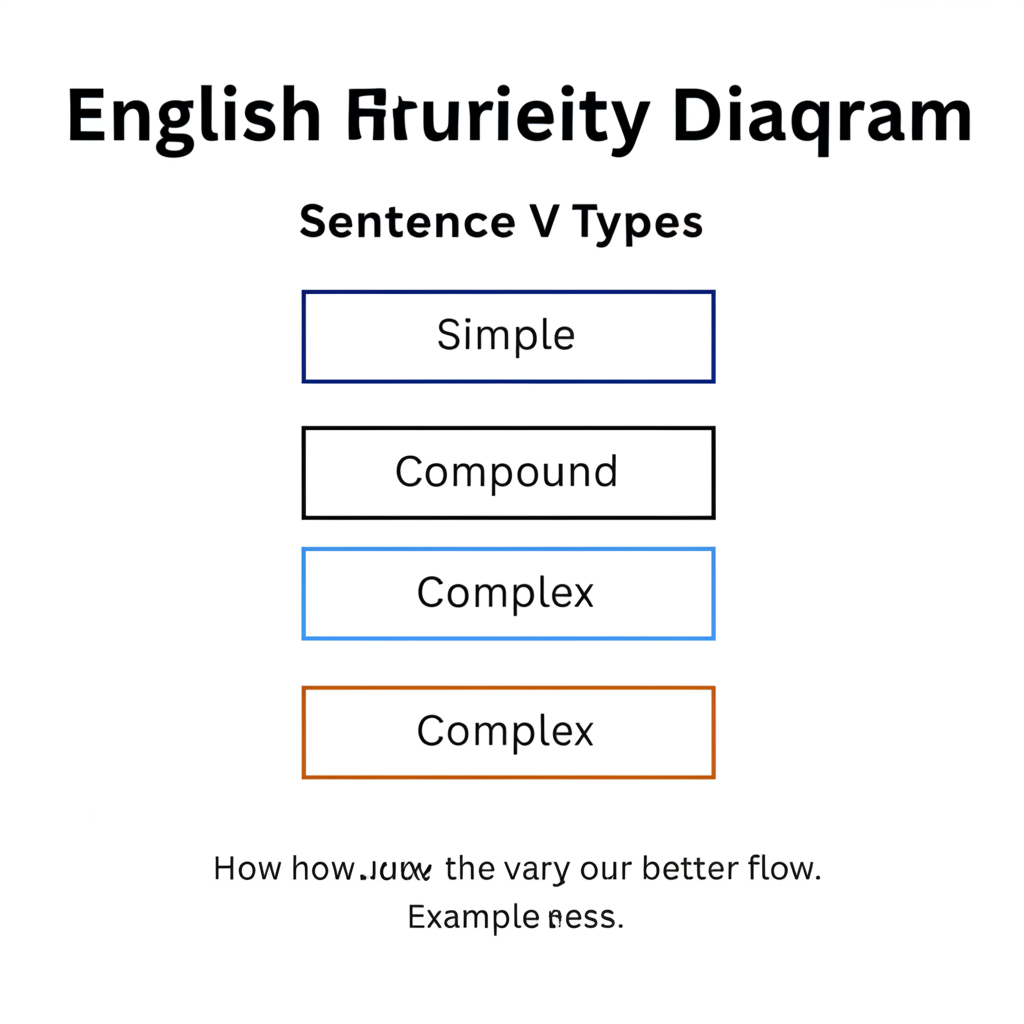
4. Varying Sentence Structure
Mix short, direct sentences with longer, more complex ones. Start sentences with different parts of speech.
Before (Choppy)
"The dog barked. It chased the squirrel. The squirrel ran up the tree. The dog looked sad."
After (Varied)
"With a sudden burst of energy, the dog barked, chasing the squirrel up the oak tree. The squirrel, nimble and quick, disappeared into the branches, leaving the dog to gaze sadly at the empty trunk."
Try combining short sentences with conjunctions or subordinating clauses (because, while, although).
5. Using Effective Transitions
Employ transition words and phrases that signal relationships between ideas.
Addition
"Furthermore," "In addition," "Moreover"
Contrast
"However," "On the other hand," "Conversely"
Cause/Effect
"Therefore," "Consequently," "As a result"
Sequence
"First," "Next," "Finally"
Underline the first sentence of each paragraph. Do they clearly connect to the previous paragraph or the overall thesis?
6. Strategic Paragraph Breaks
Ensure each paragraph develops one main idea. Break paragraphs when you shift to a new main point, introduce a new example, or change perspective. Combine short paragraphs if they develop the same idea.
Read through your essay asking: "What is the main point of this paragraph?" If you find multiple main points, it's time to split.
5Analysis: Getting Critical Distance
One of the hardest parts of revision is objectively evaluating your own work. You know what you meant to say, but does it come across clearly to a reader?
Evaluate Your Own Work Critically
Adopt a Reader's Mindset
Pretend you're reading this essay for the first time. Are there any parts that confuse you? Do you have questions that aren't answered?
Check for Logic Gaps
Are there any leaps in logic? Do your conclusions follow directly from your evidence?
Question Every Sentence
Does this sentence need to be here? Does it contribute to my overall point? Is there a clearer, more concise way to say it?
Identify Your Own Habits
Do you tend to overuse certain words? Do you always start sentences with "The"? Recognizing your patterns helps you target specific areas.
Getting Distance From Your Writing
Time Away
Time is your best friend. Even an hour can make a difference. Step away and come back with fresh eyes.
Change the Medium
Print it out. Read it on a different device. Change the font. These small changes can trick your brain into seeing the text anew.
Read Backwards (for Proofreading)
Reading sentences in reverse order helps you catch typos and grammar errors by breaking the flow of meaning, preventing your brain from "autocorrecting" errors.
Use Tools (Wisely)
Grammar checkers and spell checkers are helpful but not infallible. They won't catch every error, especially those related to context, voice, or tone. Use them as a first pass, not a final solution.
Your brain knows what you meant to write, which makes it harder to see what you actually wrote. Every strategy for getting distance -- time away, changing the medium, reading aloud -- is designed to bypass this mental autocorrect and help you see your text as a reader would.
6Putting It All Together: Collaboration & Checklists
Using Feedback Effectively
Feedback, whether from a teacher, peer reviewer, or writing center tutor, is a gift. It offers an external perspective you can't get on your own.
1. Listen Actively
When receiving feedback, listen without getting defensive. The goal isn't to judge you, but to improve your writing.
2. Ask Clarifying Questions
If you don't understand a comment, ask for an explanation or an example.
3. Prioritize Feedback
Not all feedback is equally important. Address major issues (thesis, organization) before minor ones (punctuation).
4. Don't Feel Obligated to Use Every Suggestion
It's your essay. Consider the feedback, but ultimately decide what changes best serve your vision and the assignment.
The Peer Review Process
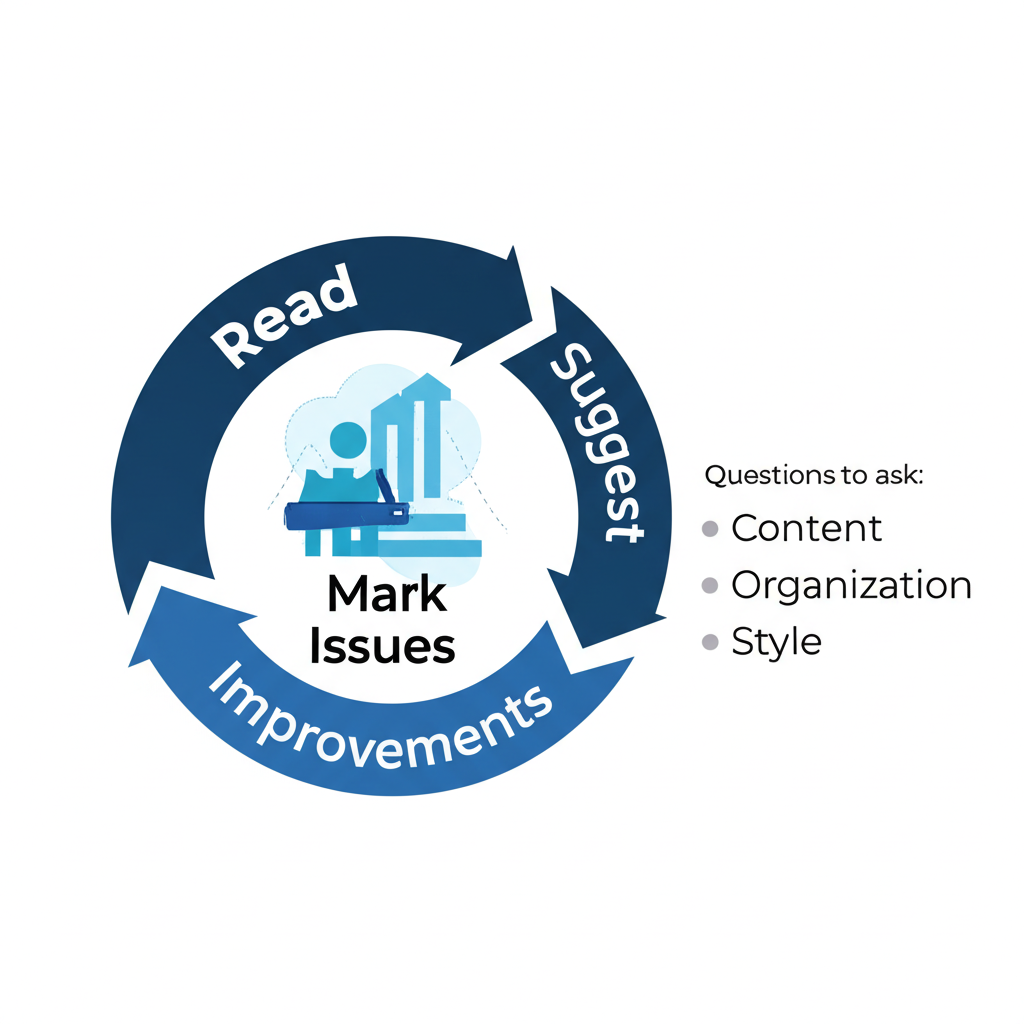
Giving Constructive Feedback
- Be Specific: Instead of "It's confusing," say "Paragraph 3 is confusing because the topic sentence introduces an idea that isn't developed."
- Be Kind: Focus on the writing, not the writer. Start with something positive.
- Be Helpful: Offer suggestions for improvement, not just criticisms.
- Focus on the Assignment: Does the essay meet the requirements of the prompt?
Receiving Feedback Gracefully
- Listen without interrupting.
- Take notes on key suggestions.
- Thank your reviewer for their time.
- Don't argue or explain why you wrote something a certain way. Just absorb the feedback.
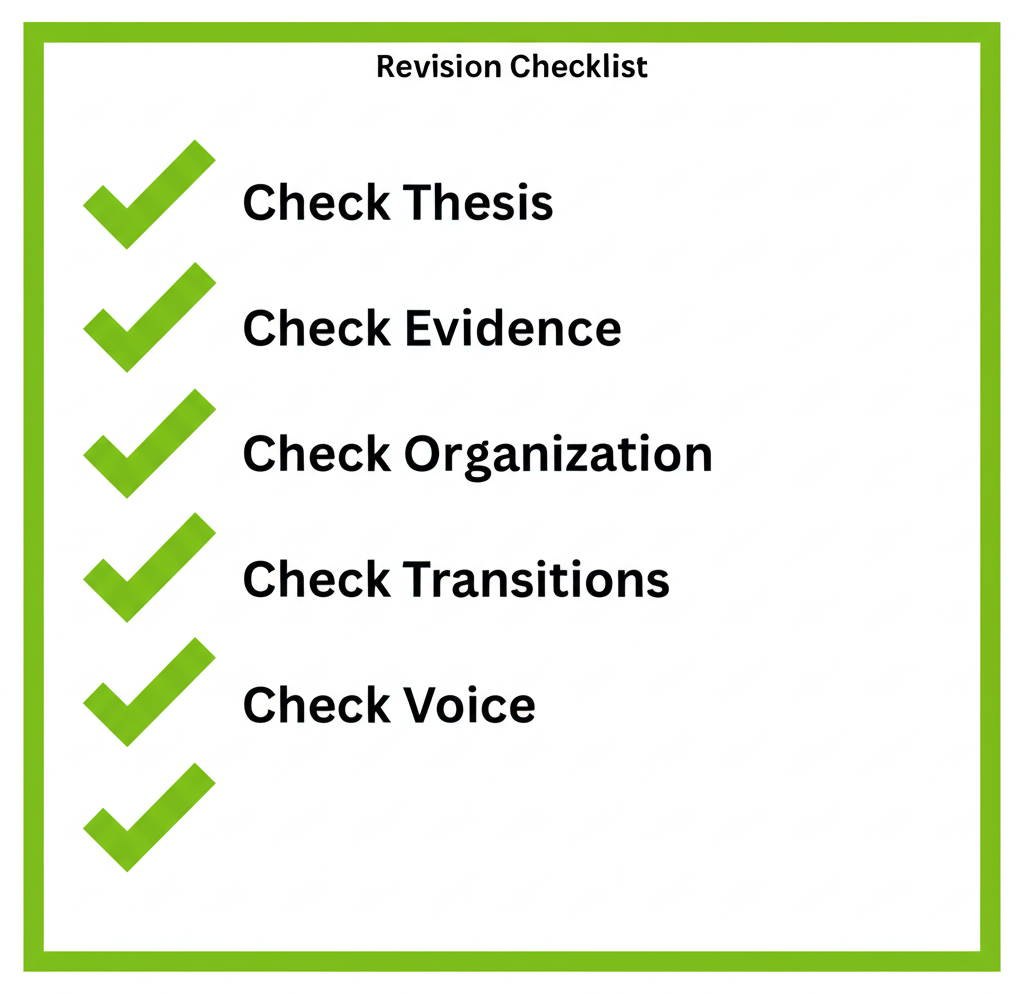
Revision Checklist
Revision (Big Picture)
- ✓Does my thesis statement clearly state my main argument and respond to the prompt?
- ✓Is my thesis supported by strong evidence in every body paragraph?
- ✓Is my essay logically organized? Are paragraphs in the best order?
- ✓Does each paragraph have a clear topic sentence and focus on one main idea (paragraph unity)?
- ✓Do I use effective transitions to connect ideas and paragraphs?
- ✓Is my introduction engaging and does my conclusion provide a strong sense of closure?
- ✓Is my voice consistent and appropriate for the assignment?
Editing (Sentence Level)
- ✓Are my sentences clear and concise? Can I cut any unnecessary words?
- ✓Have I used strong, specific verbs instead of weak ones?
- ✓Do I have a variety of sentence structures?
- ✓Is my grammar correct (subject-verb agreement, verb tense, pronoun agreement)?
- ✓Is my punctuation correct (commas, apostrophes, semicolons)?
- ✓Is my spelling correct throughout? (Use spell check, but also proofread manually!)
- ✓Does my essay follow all formatting guidelines?
7Worked Examples
Let's see revision and editing in action with common scenarios.
Example 1: Strengthening a Thesis & Adding Specificity
Before
"Shakespeare's Romeo and Juliet is a play about love and hate."
After
"While often celebrated as a tragic romance, Shakespeare's Romeo and Juliet ultimately critiques the destructive power of unchecked familial hatred, demonstrating how societal conflict can tragically doom individual passion."
Explanation: The "before" is too broad and obvious. The "after" offers a specific, arguable interpretation (a "critique" of "familial hatred") that goes beyond surface-level observation and sets up a clear argument for the essay.
Example 2: Cutting Fluff & Improving Concision
Before
"In the opinion of this writer, it is felt that the novel To Kill a Mockingbird by Harper Lee is a very important piece of literature that has a lot of significant meaning for young people in today's modern world."
After
"Harper Lee's To Kill a Mockingbird remains a significant novel, offering vital lessons for young readers on justice and empathy."
Explanation: Removed wordy phrases like "in the opinion of this writer," "it is felt that," "very important piece of literature that has a lot of significant meaning," and "today's modern world." The revised sentence is direct and impactful.
Example 3: Strengthening Verbs & Showing, Not Telling
Before
"The student went quickly to the door and then he opened it."
After
"The student rushed to the door and yanked it open."
Explanation: "Went quickly" is replaced by the stronger verb "rushed." "Opened it" becomes "yanked it open," adding a sense of urgency and effort.
Example 4: Improving Sentence Structure & Flow
Before
"The research was difficult. It involved many hours. The data was complex. We finally understood it."
After
"Although the research was difficult and involved many hours, we finally understood the complex data."
Explanation: Combined four choppy sentences into one more sophisticated and flowing sentence using a subordinating conjunction ("Although") and coordinating conjunction ("and") to show the relationship between ideas.
Example 5: Enhancing Transitions
Before
"Atticus Finch demonstrates courage. He defends Tom Robinson. Scout learns important lessons."
After
"Atticus Finch demonstrates courage when he defends Tom Robinson, despite overwhelming odds. Consequently, Scout learns important lessons about justice and integrity from her father's example."
Explanation: Added a phrase to elaborate on Atticus's courage and used the transition word "Consequently" to clearly show the cause-and-effect relationship between Atticus's actions and Scout's learning.
8Key Concepts Summary Table
| Aspect | Revision (Big Picture) | Editing (Sentence Level) | Proofreading (Final Check) |
|---|---|---|---|
| Focus | Content, Argument, Organization, Thesis, Clarity of Ideas | Grammar, Punctuation, Word Choice, Sentence Structure | Typos, Misspellings, Formatting, Missing Words |
| Goal | Ensure essay works and communicates core message | Ensure essay is precise, correct, and professional | Catch all remaining surface-level errors |
| Questions | Is my argument clear? Is it well-supported? Is it logical? | Are sentences clear? Are verbs strong? Is grammar correct? | Any stray commas? Any misspelled words? Is it formatted? |
| Tools | Outlines, peer review, reading aloud, thesis check | Grammar checkers, style guides, reading aloud, checklists | Reading backwards, printed copy, fresh eyes |
| Timing | After first draft, before editing | After revision, before proofreading | Last step before submission |
9Memory Aids
"R.E.P.: Revise, Edit, Proofread"
Revise (Rethink big picture), Edit (Examine sentences), Proofread (Perfect errors). Always follow this order.
"ARMS for Revision: Add, Remove, Move, Substitute"
This helps remember the types of changes you make during revision. Add details or evidence, Remove unnecessary parts, Move paragraphs for better flow, Substitute weak words or ideas with stronger ones.
"CUPS for Editing: Capitalization, Usage, Punctuation, Spelling"
A good reminder for sentence-level checks. Capitalization correct? Usage (grammar) correct? Punctuation in place? Spelling accurate?
"The Reader's Hat"
Imagine you're a tired, slightly grumpy reader. What would confuse them? What would bore them? Put on this "hat" to get critical distance from your own writing.
"Show, Don't Tell -- like a movie!"
Instead of telling the audience a character is scared, show them: trembling hands, wide eyes, quick breaths. Apply this principle whenever you find yourself making vague, general statements.
10Common Mistakes
Skipping the Revision Stage Entirely
Many students jump straight from drafting to proofreading, missing the crucial step of evaluating their content and organization. Revision is where the most impactful improvements happen -- don't skip it!
Relying Solely on Spell/Grammar Checkers
While helpful, these tools miss contextual errors, misused words (e.g., "their" vs. "there"), and stylistic issues. Use them as a starting point, not a replacement for careful human review.
Editing While Drafting
Trying to perfect every sentence as you write slows you down and can stifle creativity. Draft first, then revise, then edit. Keep these stages separate for maximum effectiveness.
Not Taking a Break
Submitting an essay immediately after finishing it guarantees you'll miss errors. Fresh eyes are essential -- even an hour away makes a significant difference.
Getting Defensive About Feedback
Viewing feedback as a personal attack rather than an opportunity to improve prevents growth. Remember: feedback targets the writing, not the writer.
Proofreading Only Once
A single proofread is rarely enough. Multiple passes, focusing on different error types each time, are much more effective at catching all mistakes.
Ignoring Formatting Guidelines
Overlooking specific requirements for citations, page numbers, or font can lead to lost points. Always double-check formatting requirements before submitting.
Over-revising / Over-editing
Sometimes students get caught in a loop, endlessly tweaking without making significant improvements, or making changes that actually weaken the original intent. Know when to stop!
11Quick Revision Summary
- ✓Revision is the big-picture stage, focusing on content, argument, and organization.
- ✓Editing refines writing at the sentence level, addressing grammar, punctuation, and word choice.
- ✓Proofreading is the final check for surface errors like typos, misspellings, and formatting.
- ✓Strong essays require clear coherence, smooth flow, and effective transitions.
- ✓Aim for clarity and concision in your writing -- say more with less.
- ✓Develop your unique voice and maintain an appropriate tone throughout.
- ✓Mastering grammar, punctuation, and mechanics is crucial for credibility.
- ✓Ensure paragraph unity by focusing each paragraph on one main idea.
- ✓Self-editing strategies include reading aloud, taking breaks, and printing your work.
- ✓Techniques like adding details, cutting fluff, strengthening verbs, and varying sentence structure elevate your writing.
- ✓Critically evaluate your own work by adopting a reader's mindset and getting distance.
- ✓Use feedback constructively and participate actively in peer review.
- ✓A revision checklist helps ensure all aspects are covered systematically.
- ✓Remember the R.E.P. process: Rethink, Examine, Perfect.
- ✓Your thesis statement is the backbone of your essay -- ensure it's strong and consistent throughout.
- ✓Don't be afraid to cut words, sentences, or even entire paragraphs if they don't serve your argument.
Frequently Asked Questions
- What is the absolute first thing I should do after writing my first draft?
- Take a break! Step away from your essay for at least an hour, preferably longer. This mental distance will allow you to approach your work with fresh eyes, making it easier to spot errors and areas for improvement.
- How many times should I revise and edit my essay?
- There's no magic number, but at least two distinct passes are recommended: one for revision (big picture) and one for editing/proofreading (sentence level). For important assignments, three or more passes, perhaps with peer feedback in between, can be very beneficial.
- My teacher always tells me my writing is "too vague." How can I fix that?
- Focus on "showing, not telling." For every general statement, ask yourself: "How can I illustrate this? What specific details, examples, or sensory descriptions can I add?" Use strong nouns and verbs instead of relying on adjectives and adverbs.
- I struggle with grammar, even after using spell check. What should I do?
- Spell check won't catch everything. Read your essay aloud slowly, sentence by sentence. This often helps you hear awkward phrasing or grammatical errors. Also, identify your common grammar mistakes (e.g., comma splices, subject-verb agreement) and do targeted passes just for those issues. Don't hesitate to consult grammar resources or ask your teacher for help.
- Is it okay to ask a parent or friend to read my essay?
- Absolutely! Getting an outside perspective is invaluable. Just make sure they understand the assignment and know to give constructive feedback, not just praise. Also, remember that you are ultimately responsible for the final product, so consider their feedback but make your own revisions.
- How do I balance being critical of my own work without getting discouraged?
- Separate the writer from the editor. When you're drafting, be creative and let ideas flow. When you're revising, put on your critical "editor's hat" and focus on improving the text, not judging your abilities. Remind yourself that even professional writers revise extensively. The goal is improvement, not perfection on the first try.
Practice Quiz
Test your understanding — select the correct answer for each question.
1.Which stage primarily focuses on the overall argument, organization, and clarity of ideas?
2.What is the main purpose of 'concision' in writing?
3.Reading your essay aloud is a recommended strategy for:
4.Replacing 'She walked slowly' with 'She ambled' is an example of:
5.Which of the following is NOT a good strategy for getting distance from your writing?
6.What does 'paragraph unity' refer to?
7.When receiving peer feedback, what is the most effective approach?
8.Which of these is a common mistake when revising and editing?
9.Words like 'however,' 'consequently,' and 'in addition' are examples of:
10.What is the final stage of the writing refinement process, focusing on surface-level errors?
Final Study Advice
- 1.Practice Makes Perfect: The more you revise and edit, the better you'll become. Each essay is an opportunity to sharpen these skills.
- 2.Read Widely: Reading well-written prose helps you internalize good sentence structure, varied vocabulary, and effective organization.
- 3.Build a Personal Checklist: As you learn your own common mistakes, create a personalized checklist to use with every essay.
- 4.Seek Feedback from Multiple Sources: Teachers, peers, family members -- different readers catch different things.
- 5.Remember: Every word and sentence should contribute to your overall purpose. If it doesn't serve your argument, cut it.