Argumentative Writing
Argumentative writing is the art of convincing an audience to agree with your viewpoint through logical reasoning, credible evidence, and compelling analysis. It's a fundamental skill for college readiness, effective communication, and developing strong critical thinking.
This guide covers the Claim-Evidence-Reasoning framework, rhetorical appeals (ethos, pathos, logos), counterarguments and rebuttals, analytical techniques, worked examples from classic literature, and a practice quiz.
1Introduction
Every day you argue — convincing your parents you deserve a later curfew, debating with friends about the best movie, or explaining to a teacher why you need an extension. Argumentative writing takes those same skills and channels them into structured, evidence-based reasoning that can persuade any reader.
Mastering argumentative writing isn't just about better grades. It builds critical thinking, prepares you for AP exams and college essays, and equips you to communicate persuasively in any career — from law to science to business.
You're trying to convince your parents why you deserve a later curfew. You could just say "please" over and over (pathos), show them your perfect grades and clean room (ethos), or present statistics about teen sleep schedules and responsibility research (logos). The best argument? All three, woven together.
Every strong argument follows the C-E-R framework: make a Claim, support it with Evidence, and explain your Reasoning. Then strengthen it further by addressing counterarguments with a rebuttal.
2Key Definitions
Argument Components
Claim / Thesis Statement
The central argument of your essay, stated in one clear sentence. Must be debatable — not just a fact.
Evidence
Facts, statistics, examples, expert opinions, or textual quotes used to support a claim.
Reasoning / Analysis
The explanation of how and why the evidence supports your claim. Connects the dots for the reader.
Counterargument
An opposing viewpoint or objection to your main argument that you acknowledge in your essay.
Rebuttal
Your response to a counterargument, demonstrating why your original argument is still valid or stronger.
Tone
The writer's attitude toward the subject and audience, conveyed through word choice and style.
Audience
The intended readers for whom the writing is created. Tailor your appeals to your audience.
Rhetorical Appeals
Ethos
Appeal to credibility or character. Establishes the writer as trustworthy and knowledgeable.
Pathos
Appeal to emotion. Evokes feelings in the audience to persuade them.
Logos
Appeal to logic or reason. Uses facts, statistics, and rational arguments.
Rhetorical Devices
Rhetorical Question
A question asked for effect, not to get an answer. E.g., "Can we truly stand by while injustice prevails?"
Parallelism
Similar grammatical structures expressing related ideas. E.g., "It was the best of times, it was the worst of times..."
Anaphora
Repeating a word at the beginning of successive clauses. E.g., "We shall fight on the beaches, we shall fight..."
Antithesis
Juxtaposing contrasting ideas in balanced phrases. E.g., "Man proposes, God disposes."
3The C-E-R Framework
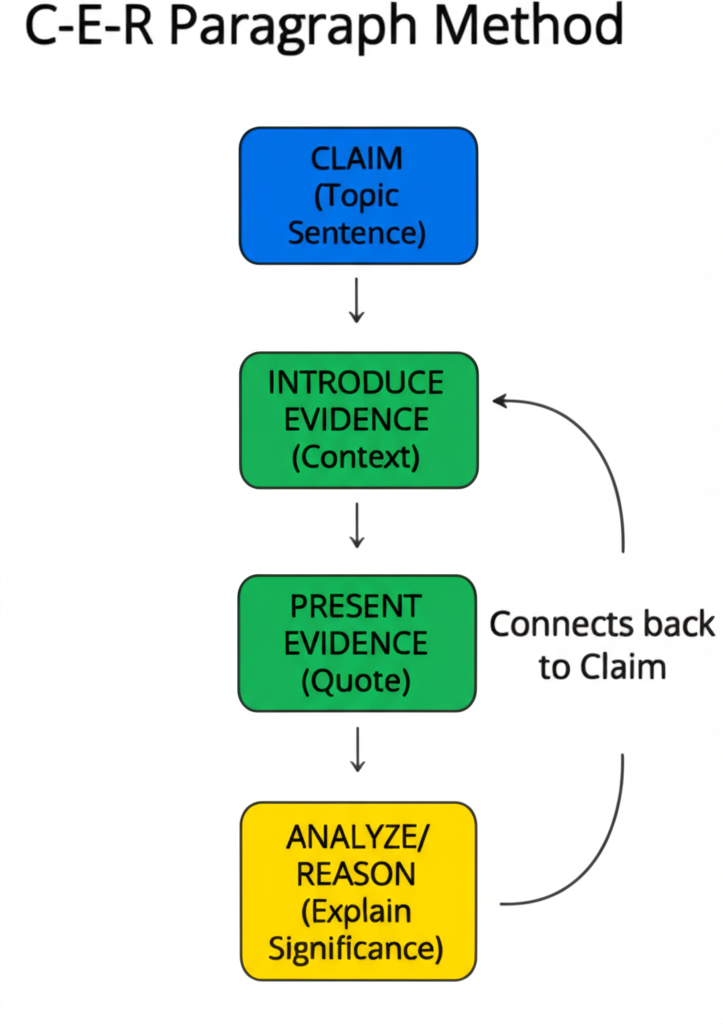
The Claim-Evidence-Reasoning (C-E-R) framework is your blueprint for building every body paragraph. It ensures your argument isn't just stated, but proven and explained.
C — Claim
State the specific point you're proving. For a paragraph, this is your topic sentence. For an essay, it's your thesis. It must be debatable, not just a fact.
E — Evidence
Provide specific quotes, facts, or data that directly support your claim. Choose the strongest evidence available — quality over quantity.
R — Reasoning
Explain how and why your evidence proves your claim. This is where you add your analysis — the "so what?" that makes your argument convincing.
Example: C-E-R in Action
Claim
In Lord of the Flies, Jack's descent into savagery is largely fueled by his desire for power and control, which he achieves by manipulating the boys' primal fears.
Evidence
When Jack declares, "I gave you food... I gave you meat!" (Ch. 8), he is asserting his dominance after a successful hunt.
Reasoning
This declaration highlights Jack's cunning use of basic needs to secure loyalty. By providing meat, Jack satisfies an immediate, primal desire, contrasting with Ralph's focus on long-term goals like shelter and rescue. His emphasis on "I gave you" underscores his individual power and the boys' dependence on him, solidifying his control through a primitive form of patronage.
After presenting evidence, always ask yourself "So what?" and "Why does this matter?" If your reasoning doesn't answer these questions, dig deeper. Connect to broader themes, character development, or the author's purpose.
4Rhetorical Appeals: Ethos, Pathos, Logos
Effective argumentative writing doesn't just present facts — it strategically engages the audience through rhetorical appeals. The strongest arguments use all three appeals working together.
The Three Pillars of Persuasion
ETHOS
Credibility
PATHOS
Emotion
LOGOS
Logic
Effective vs. Ineffective Use
| Appeal | Effective Use | Ineffective Use |
|---|---|---|
| Ethos | "As a biologist with 20 years of research, I can confirm these findings are consistent with current science." | "Trust me, I know what I'm talking about because I've read a few articles online." |
| Pathos | "Imagine a child, no older than yourself, forced to work instead of attending school, their future stolen." | "You should feel bad for these people because they're sad." |
| Logos | "Communities with well-funded after-school programs experience a 30% reduction in juvenile crime rates." | "Everyone knows after-school programs are good for kids, so we should fund them." |
Rhetorical Appeals in Literature
Mark Antony's Speech in Julius Caesar
Ethos
"I come to bury Caesar, not to praise him" — Antony positions himself as neutral and humble, gaining the crowd's initial trust. "Here, under leave of Brutus" — he shows he has permission to speak.
Pathos
"He was my friend, faithful and just to me" — appeals to sympathy. The repeated ironic "Brutus is an honourable man" gradually turns the crowd's grief into rage against the conspirators.
Logos
Antony reads Caesar's will and shows his wounds — concrete evidence that Caesar was generous and his murder unjust, appealing to the crowd's reason.
Identifying and analyzing rhetorical appeals is a core skill for the AP English Language Rhetorical Analysis essay. Practice recognizing how authors use ethos, pathos, and logos to achieve their purpose — this skill transfers directly to the exam.
5Counterarguments & Rebuttals
Addressing counterarguments is what separates a good essay from a great one. It demonstrates that you've considered multiple perspectives and that your argument is strong enough to withstand objections.
The Three-Step Process
1. Acknowledge the opposing view
Use phrases like "Some might argue that..." or "Critics contend that..." to show you've considered other perspectives.
2. Present the counterargument fairly
State the opposing view accurately and respectfully. Don't create a "straw man" — a weakened version that's easy to knock down.
3. Deliver your rebuttal
Explain why your argument is still stronger. Use "However," "Nevertheless," or "While this may be true," to pivot back to your position with evidence and reasoning.
Example: Counterargument & Rebuttal
Original claim: Hamlet's apparent indecision reflects a profound moral struggle, not weakness.
Counterargument
"Some critics argue that Hamlet's delay is a fatal flaw, demonstrating a lack of resolve that leads to the tragic downfall of many characters, including himself."
Rebuttal
"However, this perspective overlooks the moral complexities Hamlet faces. His hesitation stems not from cowardice, but from a deeply philosophical need to confirm Claudius's guilt and avoid committing rash vengeance that would mirror the very corruption he despises. His 'delay' is a testament to his moral integrity."
A strong rebuttal doesn't dismiss a counterargument — it acknowledges it and then explains its limitations or reinterprets it to reinforce your original thesis.
6Analysis & Critical Thinking
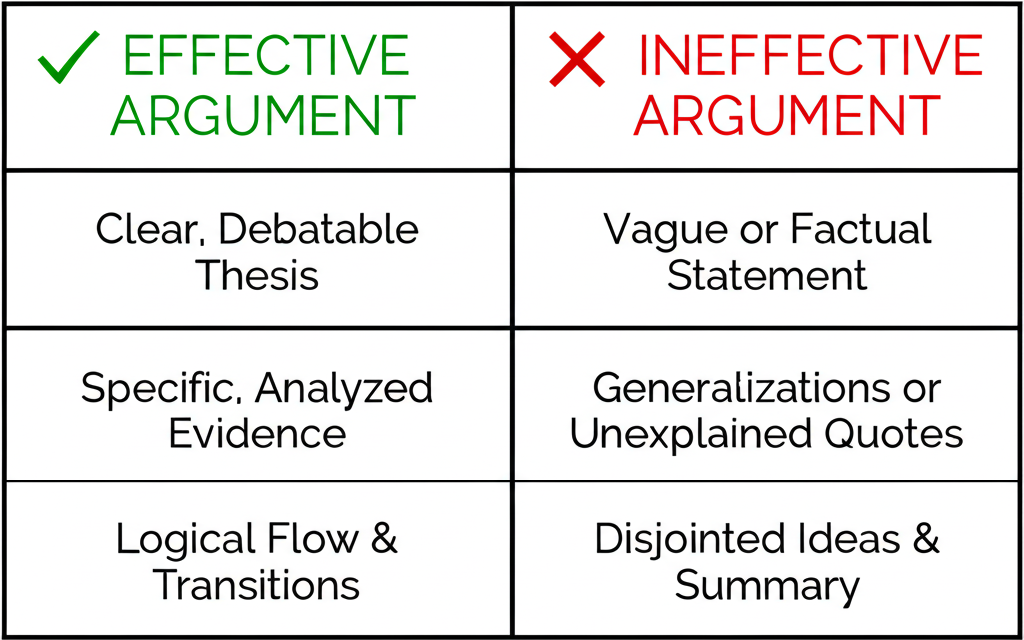
Analysis is what separates a strong argument from a summary. Summary tells the reader what happened; analysis explains how the author achieves an effect and why it matters.
Surface-Level vs. Deep Analysis
Surface-Level (Weak)
"The author uses a statistic to support their argument."
Only identifies the technique — doesn't explain why it works.
Deep Analysis (Strong)
"The author uses the statistic '75% of voters support...' to establish logos, implying broad public consensus and pressuring the audience to conform to the majority opinion, even without directly addressing the policy's merits."
Explains how the technique works and why it persuades.
How to Integrate Textual Evidence
1. Select — Choose the strongest, most relevant evidence
Don't use long quotes if only a few words are crucial. Pick evidence that directly supports your specific claim.
2. Introduce — Never drop a quote without context
3. Analyze — Explain what the evidence means and why it matters
Use phrases like "This demonstrates...", "This reveals...", "This is significant because..." to push past summary into genuine analysis.
7Structuring Your Argument
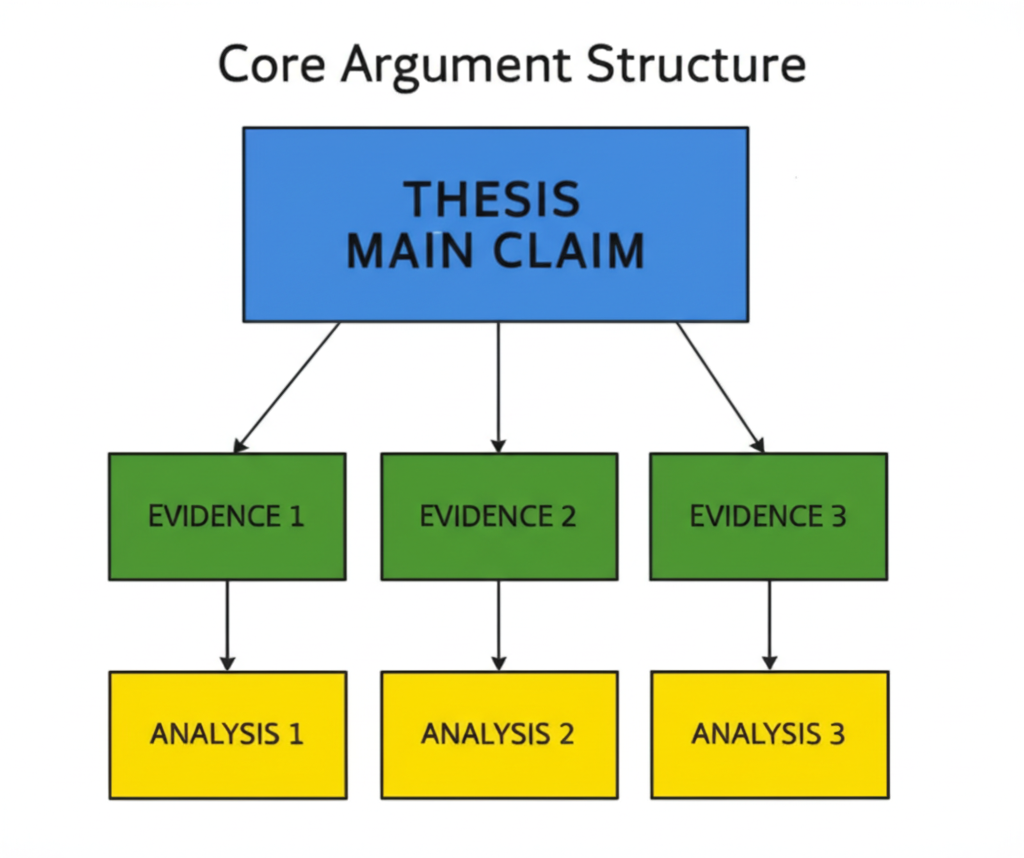
A well-structured argumentative essay organizes your claims in a logical progression that builds toward your strongest point.
Argumentative Essay Structure
Introduction
Hook the reader, provide context, and present your thesis statement — your central claim that the entire essay will prove.
Body Paragraphs (C-E-R)
Each paragraph presents one claim (topic sentence) supported by evidence and explained through reasoning. Order from weakest to strongest argument.
Counterargument & Rebuttal Paragraph
Acknowledge an opposing viewpoint and then demonstrate why your argument is still stronger. Place this before the conclusion for maximum impact.
Conclusion
Restate your thesis in new words, synthesize your key points, and offer a broader implication — why your argument matters beyond the essay.
Timed Writing Strategy
1. Deconstruct the Prompt (2 min)
Identify keywords: analyze, argue, compare? What texts or concepts are required?
2. Outline (5-8 min)
Thesis, topic sentences, key evidence for each paragraph. A quick outline saves drafting time.
3. Draft with C-E-R (25-30 min)
Follow C-E-R for each paragraph. Don't aim for perfection — aim for completeness.
4. Revise (5 min)
Check thesis clarity, evidence integration, transitions, and that your conclusion doesn't introduce new points.
8Worked Examples
Example 1: Identifying Claim and Evidence
Read the following and identify the claim and evidence.
Step 1 — Identify the claim: "Atticus Finch's unwavering moral integrity serves as the ethical compass..." — This is the main argument.
Step 2 — Identify the evidence: "...he defends Tom Robinson despite intense social pressure." — This is the specific fact supporting the claim.
Key Insight: Every strong argument begins with a clear claim supported by specific evidence.
Example 2: Crafting an Argumentative Thesis
Write a thesis statement about fate vs. free will in Romeo and Juliet.
Step 1 — Brainstorm: "Romeo and Juliet die" (too factual). "Fate causes their deaths" (too simplistic). Need a nuanced, arguable position.
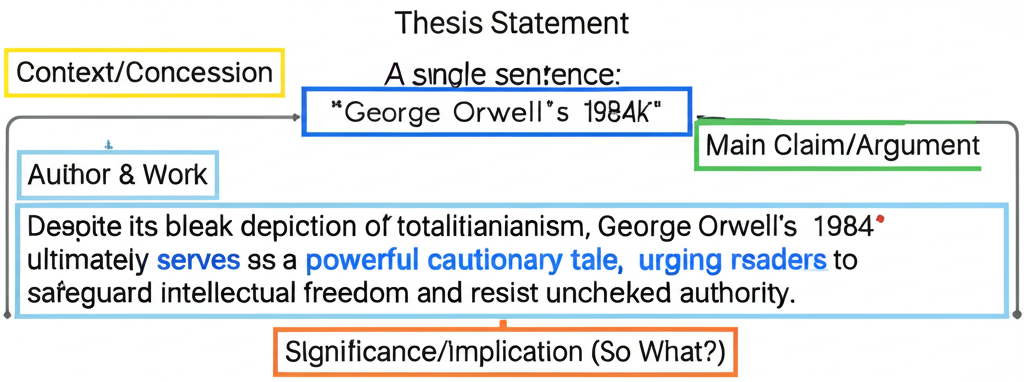
Step 2 — Refined thesis: "While external forces and societal pressures appear to doom Romeo and Juliet, their tragic demise is primarily a consequence of impulsive decisions, demonstrating the destructive power of individual choices rather than inevitable fate."
Key Insight: A strong thesis is specific, arguable, and guides the entire essay's argument.
Example 3: Analyzing Reasoning & Formulating a Counterargument
Student claim: "Winston's rebellion in 1984 proves the human spirit can never be entirely extinguished."
Reasoning analysis: The essay equates Winston's persistent thoughtcrime and internal desire for truth with the resilience of the human spirit, arguing that even failed rebellion demonstrates an unyielding core.
Counterargument: "However, Winston's ultimate submission in Room 101 — where he genuinely comes to love Big Brother — actually demonstrates the Party's horrifying effectiveness in completely crushing the human spirit, reducing him to an obedient shell devoid of individuality."
Key Insight: Strong reasoning explains "why" and "how," while a good counterargument challenges the validity of that reasoning.
Example 4: Identifying Ethos & Pathos in Julius Caesar
Analyze how Mark Antony uses ethos and pathos in his funeral speech.
Ethos: "I come to bury Caesar, not to praise him" — positions himself as humble and non-confrontational. "Under leave of Brutus" — shows he has permission, not acting against authority. "He was my friend" — establishes trustworthy, personal connection.
Pathos: "Friends, Romans, countrymen" — direct address creates connection. The repeated, increasingly ironic "Brutus is an honourable man" transforms the crowd's grief into rage, turning them against the conspirators through mounting emotional tension.
Key Insight: Effective speakers use ethos to build trust and pathos to connect emotionally — Antony uses both to completely reverse the crowd's opinion.
Example 5: Full Argumentative Paragraph on The Great Gatsby
Thesis: Gatsby's relentless pursuit of Daisy is fundamentally self-destructive, rooted in an idealized past that blinds him to reality.
Claim: Gatsby's entire identity becomes linked to a romanticized vision of Daisy, making his pursuit inherently self-destructive.
Evidence: Fitzgerald writes, "He had committed himself to the following of a grail" (149).
Reasoning: The metaphor of the "grail" elevates Daisy from a person to a sacred, mythical quest, implying Gatsby's devotion is to an idealized symbol, not the real Daisy. This obsession forces him to build his entire life around a fantasy, engaging in illicit activities and isolating himself from genuine human connection.
Counterargument + Rebuttal: While some might interpret Gatsby's dedication as a testament to enduring love, this perspective overlooks the profound psychological damage and moral compromises his single-minded obsession inflicts upon him.
Key Insight: A strong argumentative paragraph integrates all components — claim, evidence, reasoning, and counterargument — into a seamless, compelling case.
9Memory Aids
"C-E-R: Claim it, Evidence it, Reason it"
The foundation of every body paragraph. Say what you're arguing, prove it, then explain why it matters.
"An argument is a court case — your thesis is the charge, evidence is the exhibits, and reasoning is the lawyer's explanation."
Just as a lawyer doesn't just show evidence but explains what it proves, your reasoning must explain how your evidence supports your claim.
"Ethos, Pathos, Logos — Head, Heart, Hard Facts"
Ethos speaks to the head (trust), pathos to the heart (emotion), logos to hard facts (logic). The best arguments engage all three.
"So what?" — The question every piece of reasoning must answer.
If you can't answer "so what?" after your reasoning, you're still summarizing. Dig deeper until you can explain why your evidence actually matters.
"A counterargument is like a sparring partner — it makes you stronger, not weaker."
Engaging with opposing views doesn't weaken your essay — it proves you've thought deeply about the issue and that your argument can withstand scrutiny.
10Common Mistakes
Ignoring counterarguments, making the essay one-sided
Failing to address opposing views makes your argument appear uninformed or simplistic. Always include at least one counterargument with a rebuttal to demonstrate critical thinking.
Summarizing instead of analyzing
Don't just retell what happens in the text. After presenting evidence, always explain how and why it supports your claim. Ask yourself "so what?" — if you can't answer it, dig deeper.
Dropping quotes without context or analysis
Never insert a quote without introducing it (who said it, when, why) and analyzing it afterward. An unexplained quote is like presenting evidence in court without a lawyer — it proves nothing on its own.
Writing a vague or factual thesis
"Romeo and Juliet is about love" is a fact, not a thesis. Your thesis must be arguable — someone should be able to reasonably disagree. Be specific about what you're claiming and why.
Relying on only one rhetorical appeal
An argument built entirely on emotion (pathos) without facts feels manipulative. One built entirely on logic (logos) without credibility feels cold. The strongest arguments blend all three appeals.
Creating a "straw man" counterargument
Don't present a weakened, easily defeated version of the opposing view. Address the strongest counterargument to your position — this makes your rebuttal more impressive and your argument more credible.
11Quick Revision Summary
- ✓Every body paragraph follows the C-E-R framework: Claim, Evidence, Reasoning.
- ✓Your thesis must be arguable, specific, and provable — not just a fact or summary.
- ✓The three rhetorical appeals: Ethos (credibility), Pathos (emotion), Logos (logic).
- ✓Always address a counterargument and provide a rebuttal to strengthen your position.
- ✓Analysis explains how and why evidence supports your claim — summary only tells what.
- ✓Never drop a quote without context (who, when, where) and analysis (so what?).
- ✓A strong rebuttal acknowledges the counterargument, then explains its limitations.
- ✓Use emphatic order — weakest to strongest argument — for maximum persuasive impact.
- ✓For timed essays: 2 min read prompt, 5-8 min outline, 25-30 min draft, 5 min revise.
- ✓Argumentative writing emphasizes logic and evidence; persuasive writing may also lean on emotional appeals.
Frequently Asked Questions
- What is the difference between argumentative and persuasive writing?
- Argumentative writing relies primarily on logic, evidence, and reasoning (logos) to convince the reader through rational proof. Persuasive writing may also use emotional appeals (pathos) and credibility (ethos) more freely. In practice, strong argumentative essays use all three appeals, but the emphasis is on evidence-based reasoning.
- How many pieces of evidence do I need per body paragraph?
- Typically, 1-2 strong pieces of evidence per body paragraph is sufficient. Quality matters more than quantity — one well-analyzed quote is stronger than three unexplained ones. Make sure each piece of evidence is followed by thorough reasoning that explains how it supports your claim.
- Do I always need a counterargument in my essay?
- For most argumentative essays, yes. Addressing a counterargument demonstrates sophisticated thinking, shows you've considered multiple perspectives, and actually strengthens your position when paired with an effective rebuttal. Many rubrics and AP exams explicitly reward this.
- What is the C-E-R framework?
- C-E-R stands for Claim, Evidence, Reasoning. It's the foundational structure for every body paragraph: state your Claim (topic sentence), provide Evidence (quotes, facts, data), then explain your Reasoning (how and why the evidence proves your claim). Think of it as "say it, prove it, explain it."
- How do I make my reasoning deeper instead of just summarizing?
- After presenting evidence, ask yourself "So what?" and "Why does this matter?" Connect the evidence to broader themes, character motivations, or the author's purpose. Use phrases like "This demonstrates...", "This reveals...", "This is significant because..." to push past surface-level summary into genuine analysis.
Practice Quiz
Test your understanding — select the correct answer for each question.
1.What is the primary purpose of a rebuttal in argumentative writing?
2.A scientist presents data from a double-blind study showing the effectiveness of a new medication. Which rhetorical appeal is primarily being used?
3.Consider this statement: 'Atticus Finch's unwavering moral integrity serves as the ethical compass of To Kill a Mockingbird, guiding both his children and the reader towards a deeper understanding of justice.' This sentence best exemplifies which key term?
4.Which of the following best represents reasoning/analysis for a claim about Atticus Finch, rather than just evidence?
5.A student writes an essay arguing for longer school days. They include a paragraph acknowledging that 'some parents might worry about additional childcare costs.' What is the next crucial step to strengthen the argument?
6.Which of the following would be the strongest claim/thesis statement for a persuasive essay about recycling?
7.Phrases like 'Can we truly ignore the suffering?' or 'Is this the future we want for our children?' are examples of which rhetorical device?
8.If you argued for a later curfew by showing your parents your excellent grades and responsible behavior, you would primarily be using which rhetorical appeal?
9.What does the C-E-R framework stand for in argumentative writing?
10.What is the difference between argumentative and persuasive writing?
Final Study Advice
- 1.Practice identifying ethos, pathos, and logos in everything you read — ads, articles, speeches, even movie trailers.
- 2.Before every body paragraph, ask: "What's my claim? What's my evidence? What's my reasoning?"
- 3.Always outline before writing — even a 5-minute outline prevents disorganized arguments.
- 4.Practice writing counterarguments for your own essays — if you can't think of one, your thesis might not be arguable enough.
- 5.Read your reasoning aloud. If it sounds like summary, rewrite it to explain why the evidence matters.